Sign Up My Profile
Prayers

Orthodox prayers for someone with cancer

Prayers for someone with cancer, from the diagnosis through every treatment.

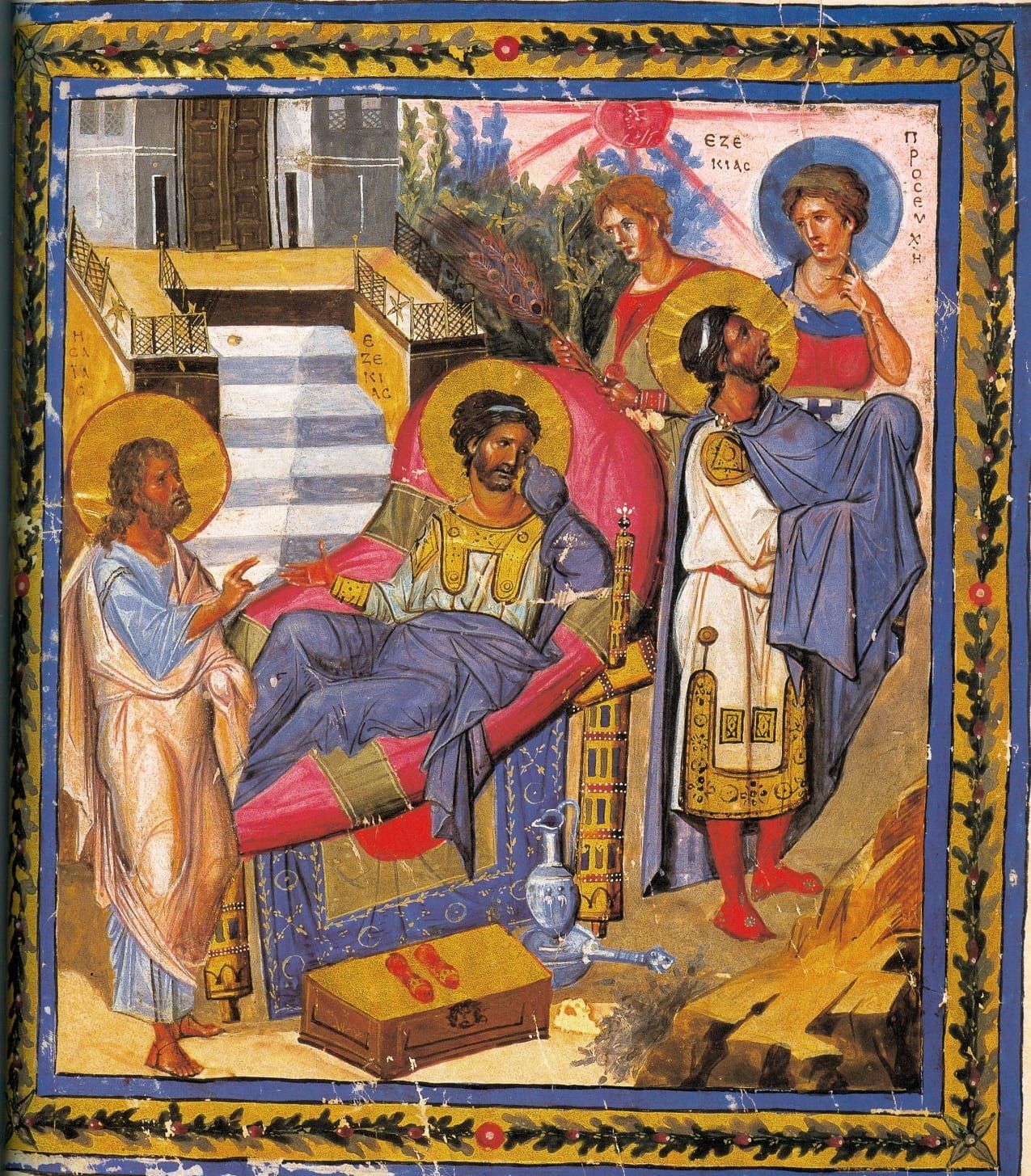
Picture: The Paris Psalter, The Illness and Prayer of Hezekiah, Constantinople, mid-900s AD

4 prayers and 1 to the saints

After a hard diagnosis

Prayer of Hezekiah

When he was told he would dieRemember, LORD, I beg You,how I have walked before You faithfullyand with my whole heart,and have done what is good in Your sight.

His song after he recoveredI said, “In the prime of my lifeI must go through the gates of the grave.I am robbed of the rest of my years.”I said, “I will not see the LORD,the LORD in the land of the living.I will look on no one againamong those who live in the world.”

Like a swift or a crane I cried out;I moaned like a dove.My eyes grew weak from looking upward.Lord, I am oppressed; come to my aid!

Indeed, it was for my own goodthat I had such bitterness.In Your love You kept my soulfrom the pit of destruction,for You have cast all my sins behind Your back.

The grave cannot thank You;death cannot praise You.Those who go down to the pitcannot hope for Your faithfulness.The living, the living, they thank You,as I do today.A father tells his children of Your faithfulness.

The LORD will save me,and we will play my songs on stringed instrumentsall the days of our lifein the house of the LORD.

Traditional wording, 1611

Remember now, O LORD, I beseech Thee,how I have walked before Thee in truth and with a perfect heart,and have done that which is good in Thy sight.

I said in the cutting off of my days,I shall go to the gates of the grave:I am deprived of the residue of my years.I said, I shall not see the LORD, even the LORD,in the land of the living:I shall behold man no more with the inhabitants of the world.

Like a crane or a swallow, so did I chatter:I did mourn as a dove:mine eyes fail with looking upward:O LORD, I am oppressed; undertake for me.

Behold, for peace I had great bitterness:but Thou hast in love to my soul delivered it from the pit of corruption:for Thou hast cast all my sins behind Thy back.

For the grave cannot praise Thee, death can not celebrate Thee:they that go down into the pit cannot hope for Thy truth.The living, the living, he shall praise Thee, as I do this day:the father to the children shall make known Thy truth.

The LORD was ready to save me:therefore we will sing my songs to the stringed instrumentsall the days of our life in the house of the LORD.

King Hezekiah was told his illness would kill him. He turned his face to the wall and prayed with tears, and God gave him 15 more years. The song he wrote after he recovered remembers the fear and ends in thanks.

Plain English by Wiser Walk, from the Hebrew (Isaiah 38:3, then verses 10, 11, 14 and 17 to 20 of the song), with the King James Version beside it. How the wording is made. Traditional wording: The King James translators, The King James Version, 1611.

Where it comes from, and the original

For someone you love, by name

Raise up Your servant

O God, You added fifteen yearsto the life of Your servant Hezekiah.

So too may Your power raise up Your servant (name)from the bed of sickness to health.

Through Jesus Christ our Lord.

O God, You added fifteen yearsto the life of Your servant Hezekiah.

So too may Your power raise up me, Your servant,from the bed of sickness to health.

Through Jesus Christ our Lord.

Traditional wording, 1864

O God, Who didst add fifteen years to the life of Thy servant Hezekiah;let Thy power raise up Thy servant N. from the bed of sickness unto health;through Jesus Christ our Lord.

An old Roman prayer for visiting the sick, from the book Pope Hadrian I sent to Charlemagne in the late 700s. It recalls Hezekiah’s healing and asks God to raise up the one you love from the bed of sickness to health.

Plain English by Wiser Walk, from the Latin of the Gregorian Sacramentary (Wilson’s 1915 edition), with William Bright’s 1864 translation beside it. How the wording is made. Traditional wording: William Bright, Ancient Collects, 1864.

Where it comes from, and the Latin

A short hymn, with their name

Troparion for the sick

O Christ, You alone are quick to help.Come quickly from on highand visit Your suffering servant (name).Free them from sickness and bitter pain.Raise them up to sing to Youand glorify You without ceasing,through the prayers of the Mother of God,O only Lover of mankind.

O Christ, You alone are quick to help.Come quickly from on highand visit me, Your suffering servant.Free me from sickness and bitter pain.Raise me up to sing to Youand glorify You without ceasing,through the prayers of the Mother of God,O only Lover of mankind.

Traditional wording, 1894

Thou that alone art quick to help, O Christ,make manifest from on high a speedy visitation to Thine ailing servant:deliver him from sicknesses and bitter pains,and raise him up, that, without ceasing, he may praise and glorify Thee,through the God-bearing one’s entreaties,O Thou sole Lover of mankind.

The Church’s short hymn for anyone who is ill. It asks Christ, Who alone is quick to help, to free them from sickness and bitter pain and raise them up.

Plain English by Wiser Walk, from the Greek. How the wording is made. Traditional wording: G. V. Shann, Book of Needs of the Holy Orthodox Church, 1894.

Where it comes from, and the Greek

Before each treatment

Prayer before medical treatment

Plain English only: no traditional English wording is given for this prayer

Lord our God, You created the doctorand the many kinds of treatment, as Scripture says,and You gave them to heal disease and to ease illness.

Look with mercy on me, a sinner.Forgive my wrongs and my sins.Heal my soul,and give my body health through this treatment,so that, when I have received Your merciful help,I may serve You with all thankfulness.

For You are the Source of healing,and to You we give glory, to the Father and to the Son and to the Holy Spirit,now and always, and for ever and ever. Amen.

The Russian Orthodox Church approved this prayer in 2019. It names God as the Maker of the doctor and of medicine, and it suits every round of chemotherapy or radiation.

Plain English by Wiser Walk, from the Church Slavonic; no English translation was found. How the wording is made.

Where it comes from, and the Church Slavonic

To a saint

Troparion of St Nektarios

Let us, the faithful, honour Nektariosas a godly servant of Christ:the son of Selymbria and the guardian of Aegina,who appeared in the last times,a true friend of virtue.For he pours out healings of every kindon those who cry out with reverence:

Glory to Christ, Who glorified you!Glory to Him Who made you wondrous!Glory to Him Who works healings for all through you!

Traditional wording

O ye faithful, let us honor Nectarius, the offspring of Silyvria,the guardian of Aegina, the true friend of the virtues, as a godly servant of Christ;for he poureth forth all manner of healings upon those who piously cry aloud:

Glory to Christ Who hath glorified thee!Glory to Him Who hath crowned thee!Glory to Him Who worketh healings for all through thee!

St Nektarios spent his last two months in a hospital for the poor in Athens. Orthodox Christians often ask his prayers for the sick, above all in cancer.

Plain English by Wiser Walk, from the Greek, with a traditional English Menaion beside it. How the wording is made. Traditional wording: an unnamed translator, English Menaion for 9 November, All Saints Eastern Orthodox Church.

This English has “crowned” where the Greek has “made you wondrous”, and it has no line for “who appeared in the last times”.

Where it comes from, and the Greek
Patron saints of cancer patients The saints people ask for help with this, their stories and their prayers.

Scripture for this

Even to your old age, I will be the same, and I will bear you up when you turn gray. I have made you, and I will carry you; I will sustain you and deliver you.

Isaiah 46:4 God tells His people that He made them and that He will carry them and sustain them.

9The LORD is a refuge for the oppressed, a stronghold in times of trouble. 10Those who know Your name trust in You, for You, O LORD, have not forsaken those who seek You.

Psalm 9:9-10 In the weeks of tests and treatment, the LORD is still a stronghold, and He does not forsake those who seek Him.

I consider that our present sufferings are not comparable to the glory that will be revealed in us.

Romans 8:18 Paul set the sufferings of this present time beside the glory to come, and he found them not worth comparing.

3Blessed be the God and Father of our Lord Jesus Christ, the Father of compassion and the God of all comfort, 4Who comforts us in all our troubles, so that we can comfort those in any trouble with the comfort we ourselves have received from God.

2 Corinthians 1:3-4 The God of all comfort comforts us in every trouble so that we can comfort others, as family and friends try to do.

Bible text: Berean Standard Bible, public domain.

Close to this

All prayers

Quiz What prayer do you need right now? A few honest taps about where you are, and a prayer of the Church for exactly that. 8 questions, about 3 minutes. Start

Suggest a correction

Berean Standard Bible