Sign Up My Profile
Prayers

Orthodox prayers for chronic illness and pain

These prayers are for illness or pain that lasts for months or years, and for the days when patience wears thin.

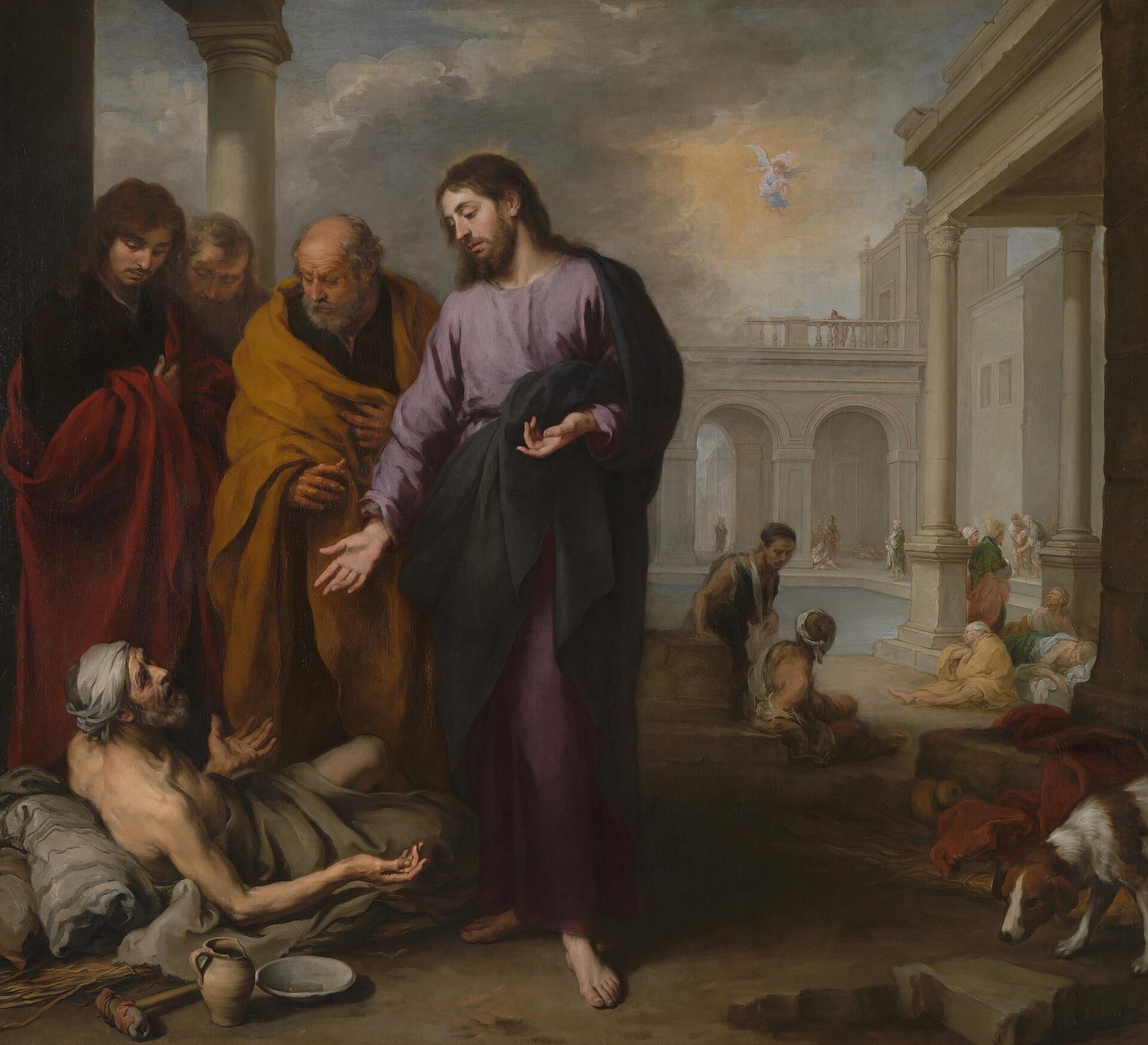
Picture: Bartolomé Esteban Murillo, Christ Healing the Paralytic at the Pool of Bethesda, 1667–70

5 prayers

Strength to bear it

Not beyond my strength

Plain English only: no traditional English wording is given for this prayer

Lord, look on my affliction and have mercy on me!O God, help me, a sinner!

Master, do not let any trial, sorrow or illnesscome on me beyond my strength,but give me a way out and strength,so that I can endure with thanksgiving.

The Russian monk St Nil Sorsky gave these two prayers for days when it seems things can only get worse. The second asks God not to let any illness come on you beyond your strength.

Plain English by Wiser Walk, from the Church Slavonic of St Nil’s Rule (the 1912 edition), with G. M. Prokhorov’s modern Russian translation beside it. How the wording is made.

Where it comes from, and the Church Slavonic

When the pain is constant

Have mercy on me, for I am weak (Psalm 6)

Have mercy on me, Lord, for I am weak.Heal me, Lord, for my bones are shaken,and my soul is deeply shaken.But You, Lord, how long?

Come back, Lord, and rescue my soul.Save me for the sake of Your mercy.

Traditional wording, 1906

Have mercy upon me, O Lord, for I am weak;Lord, heal me, for my bones are vexed.My soul also is sore troubled:but, Lord, how long wilt Thou punish me?

Turn Thee, O Lord, and deliver my soul;O save me, for Thy mercy’s sake.

In these lines of Psalm 6, David asks God for mercy because he is weak and for healing because his bones are shaken.

Plain English by Wiser Walk, from the Greek of the Septuagint, as the book of hours prints it at Great Compline, with Hapgood’s 1906 wording beside it. How the wording is made. Traditional wording: Isabel F. Hapgood, Service Book of the Holy Orthodox-Catholic Apostolic Church, 1906.

Hapgood’s “how long wilt Thou punish me?” adds “punish me”. The Greek asks only, “But You, Lord, how long?”

Where it comes from, and the Greek

When it goes on and on

How long, O Lord (Psalm 13)

How long, O Lord? Will You forget me for ever?How long will You hide Your face from me?

How long must I struggle with my thoughtsand carry sorrow in my heart all day?How long will my enemy triumph over me?

Look on me and answer me, O Lord my God.Give light to my eyes,or I will sleep the sleep of death,and my enemy will say he has beaten me,and my foes will rejoice when I stumble.

But I have trusted in Your mercy;my heart will rejoice in Your salvation.I will sing to the Lord,for He has been good to me.

Traditional wording, 1611

How long wilt Thou forget me, O LORD? for ever? how long wilt Thou hide Thy face from me?

How long shall I take counsel in my soul, having sorrow in my heart daily? how long shall mine enemy be exalted over me?

Consider and hear me, O LORD my God: lighten mine eyes, lest I sleep the sleep of death;Lest mine enemy say, I have prevailed against him; and those that trouble me rejoice when I am moved.

But I have trusted in Thy mercy; my heart shall rejoice in Thy salvation.I will sing unto the LORD, because He hath dealt bountifully with me.

Psalm 13 asks God “How long?” four times and speaks of sorrow in the heart all day. Still it ends by trusting in God’s mercy.

Plain English by Wiser Walk, from the Hebrew, with the King James Version beside it. How the wording is made. Traditional wording: The King James translators, The King James Version, 1611.

Where it comes from, and the original

Healing, if it is good for me

St John of Gaza’s prayer for healing

Plain English only: no traditional English wording is given for this prayer

Master, I am in Your hands.Have mercy on me as You will,and if it is good for me,heal me soon.

A disciple asked St John of Gaza whether healing would come at once if he asked the saints to pray for him. John answered that it is not good to press God for healing without knowing what is good for us, and he gave him these four lines.

Plain English by Wiser Walk, from a Russian translation of John’s Greek; the Greek was not found online in a form we could use. How the wording is made.

Where it comes from, and the Russian

A saint who knew long illness

Prayer of St Gabriel of the Seven Lakes

Plain English only: no traditional English wording is given for this prayer

Lord Jesus, I cry to You!You are my sweetness, my life, my health,a joy beyond the joy of this world,everything my life is made of.You are a light beyond every light.

I see that illness has left my body unable to move.I feel the weakness in all my limbsand the pain in my bones.But, O my Light, how sweet to meare the rays of Your light that fall on my wounds!Warmed by them, I forget everything.At Your feet I wash my sins away with my tears,and I am lifted up and filled with light.

This one thing I ask of You, my Jesus:do not turn Your face away from me.Let me weep for my sins with joyat Your feet for ever,for when I see You, Lord,repentance and tears are sweeter to methan all the joys of the world.

O Light, my joy, my sweetness, Jesus!Do not drive me away from Your feet, my Jesus,but, as I ask You, be with me always,so that, living by You,I may glorify You with the Father and the Spirit for ever.Through the prayers of the Mother of God and all Your saints,hear me, Lord. Amen.

Russian prayer books credit this prayer to St Gabriel of the Seven Lakes, a monk who spent five years unable to leave his bed. It speaks of a body that cannot move and of Christ’s light falling on its wounds.

Plain English by Wiser Walk, from the Church Slavonic, with Azbyka’s modern Russian translation beside it. How the wording is made.

Where it comes from, and the Church Slavonic

Scripture for this

O Lord, my every desire is before You; my groaning is not hidden from You.

Psalm 38:9 In a psalm full of bodily pain, David tells God that his every desire lies before Him and his groaning is not hidden.

7or because of these surpassingly great revelations. So to keep me from becoming conceited, I was given a thorn in my flesh, a messenger of Satan, to torment me. 8Three times I pleaded with the Lord to take it away from me. 9But He said to me, “My grace is sufficient for you, for My power is perfected in weakness.” Therefore I will boast all the more gladly in my weaknesses, so that the power of Christ may rest on me.

2 Corinthians 12:7-9 Paul pleaded with the Lord three times to take away his thorn in the flesh. The answer was “My grace is sufficient for you.”

16Therefore we do not lose heart. Though our outer self is wasting away, yet our inner self is being renewed day by day. 17For our light and momentary affliction is producing for us an eternal weight of glory that is far beyond comparison.

2 Corinthians 4:16-17 Paul does not lose heart, because while the outer self is wasting away, the inner self is being renewed day by day.

My flesh and my heart may fail, but God is the strength of my heart and my portion forever.

Psalm 73:26 The writer of this psalm knows his flesh and his heart may fail, yet God remains the strength of his heart for ever.

25And a woman was there who had suffered from bleeding for twelve years. 26She had borne much agony under the care of many physicians and had spent all she had, but to no avail. Instead, her condition had only grown worse. 27When the woman heard about Jesus, she came up through the crowd behind Him and touched His cloak. 28For she kept saying, “If only I touch His garments, I will be healed.” 29Immediately her bleeding stopped, and she sensed in her body that she was healed of her affliction.

Mark 5:25-29 A woman ill for 12 years grew only worse under many doctors. She touched Jesus’s cloak in the crowd and was healed.

Bible text: Berean Standard Bible, public domain.

Close to this

All prayers

Quiz What prayer do you need right now? A few honest taps about where you are, and a prayer of the Church for exactly that. 8 questions, about 3 minutes. Start

Suggest a correction

Berean Standard Bible