
When it is said
The old Roman book gives it as a prayer to say when visiting a sick person.
Anyone can pray it at a bedside or at home with the sick person’s name, or pray it for themselves.
Where it comes from
No author known
From Rome to Charlemagne
Charlemagne asked Pope Hadrian I for the Roman service book that bore St Gregory’s name. A letter of the pope, written between AD 784 and 791, shows that he sent it from Rome. Among the book’s prayers for the sick is this one, which recalls King Hezekiah.
H. A. Wilson, The Gregorian Sacramentary under Charles the Great (1915), introduction and page 138
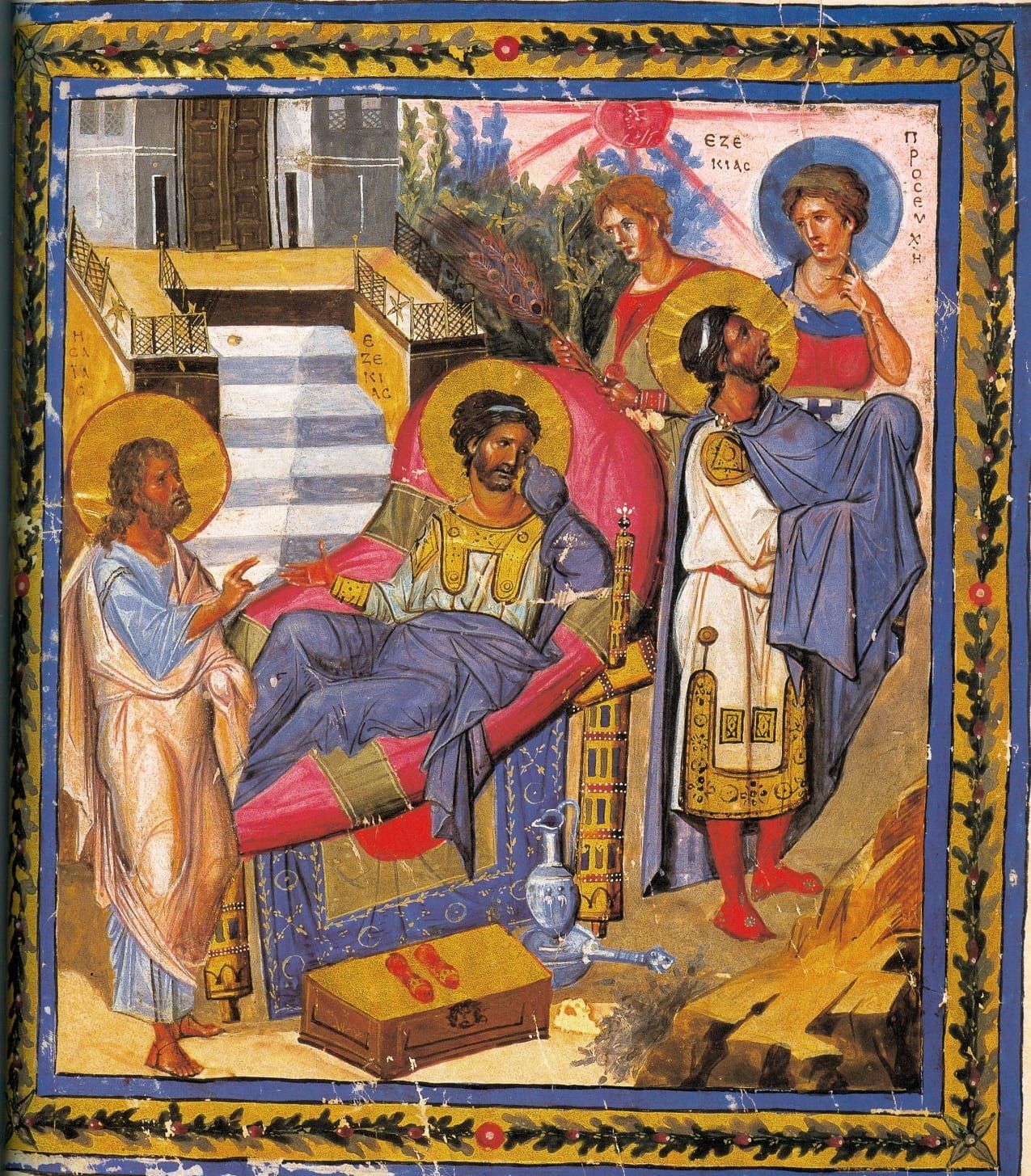
Hezekiah’s 15 years
The prophet Isaiah told King Hezekiah that his illness would kill him. Hezekiah turned his face to the wall and prayed with tears. God sent Isaiah back to say that He had heard the prayer and would add 15 years to the king’s life (Isaiah 38:1-5). Hezekiah recovered and wrote a song of thanks (Isaiah 38:9).
Isaiah 38:1-5; Isaiah 38:9
The Scripture in it
“Go and tell Hezekiah that this is what the LORD, the God of your father David, says: ‘I have heard your prayer; I have seen your tears. Behold, I will add fifteen years to your life.”
Bible text: Berean Standard Bible, public domain.
In Latin
Deus, qui famulo tuo Ezechiae ter quinos annos ad uitam donasti,
ita et famulum tuum N. a lecto aegritudinis tua potentia erigat ad salutem.
Per.