Sign Up My Profile
Prayers

St Augustine’s prayer before reading Scripture

A prayer from St Augustine’s Confessions, written about AD 400, asking that the Scriptures be his delight, and that he neither be deceived in them nor mislead others.

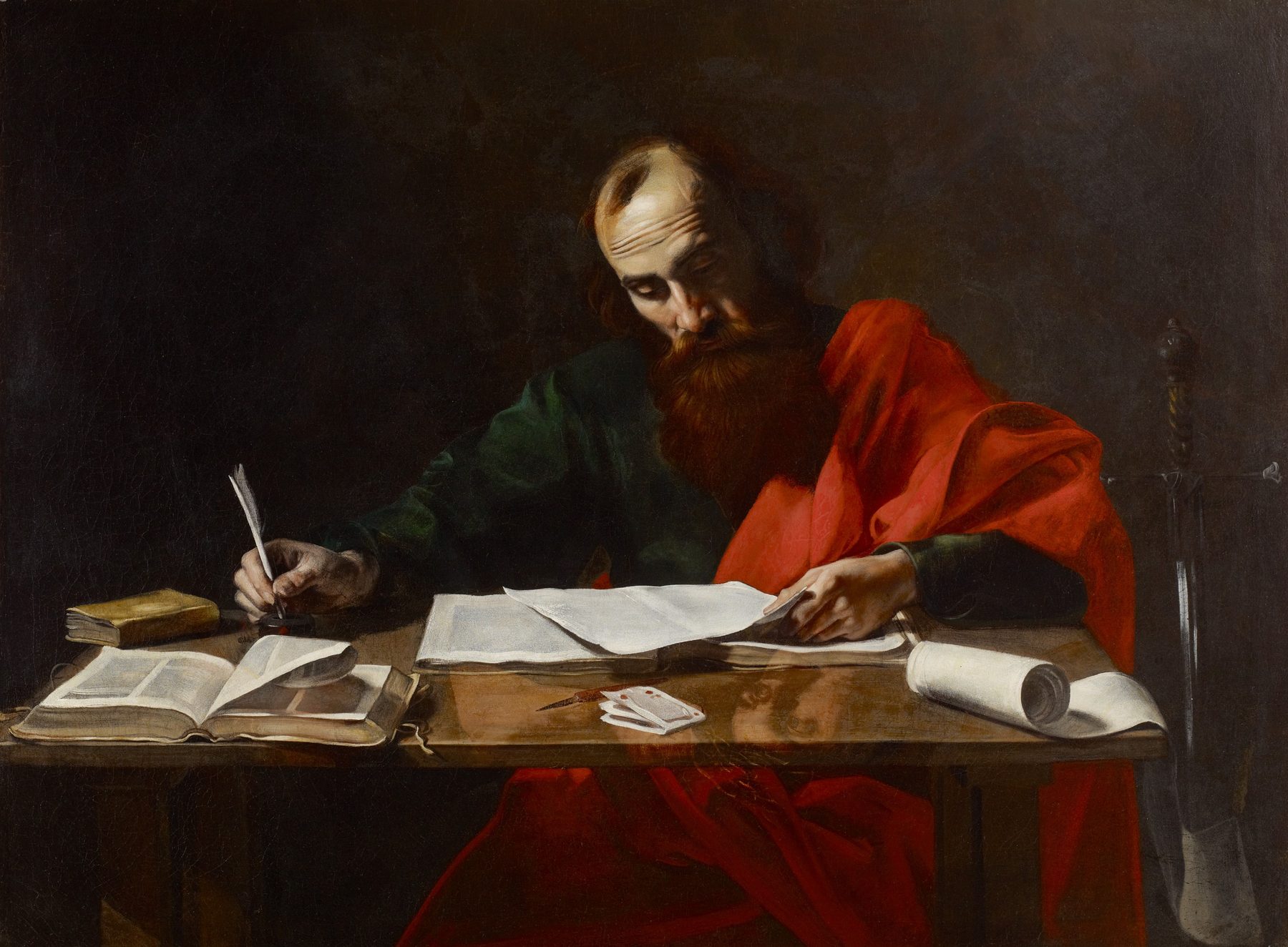
Picture: attributed to Valentin de Boulogne, Saint Paul Writing His Epistles, about 1618–20

The words of the prayer

Plain English

Let Your Scriptures be my pure delight.Let me not be deceived in them,nor deceive anyone by them.

Lord, listen and have mercy,O Lord my God,light of the blind and strength of the weak,and light of those who see and strength of the strong as well.Listen to my soul,and hear it crying out of the depths.For if Your ears are not there in the depths too,where will we go?Where will we cry out?

The day is Yours, and the night is Yours.At a nod from You the moments fly by.From those moments grant us time to meditateon the hidden things of Your law,and do not close it against us when we knock.

It was not for nothing that You wantedthe dark secrets of so many pages written down,and those forests of pages have their own deer,which shelter in them and are refreshed there,which walk and graze,lie down and chew the cud.O Lord, make me perfect,and open those forests to me.

See, Your voice is my joy.Your voice is worth more than a flood of pleasures.Give me what I love,for I do love,and that love is Your gift.Do not abandon Your own gifts,and do not scorn Your thirsty grass.

Let me confess to You whatever I find in Your books,and hear the voice of praise,and drink You in,and ponder the wonders of Your law,from the beginning, when You made heaven and earth,to the kingdom of Your holy city,which lasts for ever with You.

Traditional wording, 1886

Let Thy Scriptures be my chaste delights.Neither let me be deceived in them, nor deceive out of them.

Lord, hear and pity, O Lord my God,light of the blind, and strength of the weak;even also light of those that see, and strength of the strong,hearken unto my soul, and hear it crying "out of the depths."For unless Thine ears be present in the depths also,whither shall we go? whither shall we cry?

"The day is Thine, and the night also is Thine."At Thy nod the moments flee by.Grant thereof space for our meditations amongst the hidden things of Thy law,nor close it against us who knock.

For not in vain hast Thou willed that the obscure secret of so many pages should be written.Nor is it that those forests have not their harts,betaking themselves therein, and ranging, and walking, and feeding, lying down, and ruminating.Perfect me, O Lord, and reveal them unto me.

Behold, Thy voice is my joy, Thy voice surpasseth the abundance of pleasures.Give that which I love, for I do love; and this hast Thou given.Abandon not Thine own gifts, nor despise Thy grass that thirsteth.

Let me confess unto Thee whatsoever I shall have found in Thy books,and let me hear the voice of praise, and let me imbibe Thee,and reflect on the wonderful things of Thy law;even from the beginning, wherein Thou madest the heaven and the earth,unto the everlasting kingdom of Thy holy city that is with Thee.

Plain English by Wiser Walk, from the Latin, with J. G. Pilkington’s translation of 1886 beside it. How the wording is made. Traditional wording: J. G. Pilkington, The Confessions of St. Augustin, 1886.

Pilkington has “those forests”. The plain wording says “those forests of pages”, the dark pages Augustine has just named.

When it is said

It is not a prayer of the Church’s services but a passage of Augustine’s Confessions.

It can be said before any reading of the Bible, alone or with others.

Where it comes from

Author known

Where it comes from

St Augustine of Hippo wrote his Confessions about AD 400. Near the start of Book 11 he prays at length that God would lead him to the truth through the Holy Scriptures. Then he begins to explain the Bible’s first words, on how God made heaven and earth. These lines come from the middle of that prayer, which goes on to say that it is Christ he looks for in God’s books.

Encyclopaedia Britannica, “Saint Augustine”; Confessions, Book 11, translated by J. G. Pilkington (1886)

A bishop short of time

Just before the prayer, Augustine says he has long been eager to meditate on God’s law. He does not want the free hours left over from caring for his body and mind, and from serving others, to drain away into anything else. Like other bishops of his day, he lost much of his time settling people’s worldly disputes. Elsewhere he wrote that he would rather have worked with his hands, as monks did, than bear all that turmoil.

Confessions, Book 11, translated by J. G. Pilkington (1886), with the editor’s notes

What the words mean

The forests and the deer

Augustine’s Latin psalter had a line about “the voice of the Lord perfecting the deer”. When he explained it, he made the dark forest stand for the hard places of Scripture, and the deer chewing the cud for a Christian who ponders them. In this prayer he asks God to make him perfect too and open those forests to him.

The editor’s note on this passage, Nicene and Post-Nicene Fathers (1886)

“Not deceived in them”

Augustine was careful to tell the plain teaching of Scripture apart from its hard places. He held that everything about faith and how to live is plainly set down in it. On the dark passages he was slow to make up his mind, so that he would not be deceived in them or mislead others with them.

The editor’s note on this passage, Nicene and Post-Nicene Fathers (1886)

The Scripture in it

Out of the depths I cry to You, O LORD!

Psalm 130:1 Quoted “Out of the depths”: the psalmist’s cry, which Augustine makes his own.

The day is Yours, and also the night; You established the moon and the sun.

Psalm 74:16 Quoted “The day is Yours, and the night is Yours.”

Ask, and it will be given to you; seek, and you will find; knock, and the door will be opened to you.

Matthew 7:7 Echoed “Do not close it against us when we knock.” Jesus promised that the door would be opened to those who knock.

Open my eyes that I may see wondrous things from Your law.

Psalm 119:18 Echoed “The wonders of Your law”, which the psalmist asks God to open his eyes to see.

In the beginning God created the heavens and the earth.

Genesis 1:1 Echoed “The beginning, when You made heaven and earth”, the verse Augustine goes on to explain.

Bible text: Berean Standard Bible, public domain.

In Latin

sint castae deliciae meae scripturae Tuae, nec fallar in eis nec fallam ex eis.

Domine, attende et miserere, Domine Deus meus, lux caecorum et virtus infirmorum statimque lux videntium et virtus fortium, attende animam meam et audi clamantem de profundo.

nam nisi adsint et in profundo aures Tuae, quo ibimus? quo clamabimus?

Tuus est dies et Tua est nox; ad nutum Tuum momenta transvolant.

largire inde spatium meditationibus nostris in abdita legis Tuae, neque adversus pulsantes claudas eam.

neque enim frustra scribi voluisti tot paginarum opaca secreta, aut non habent illae silvae cervos suos, recipientes se in eas et resumentes, ambulantes et pascentes, recumbentes et ruminantes.

o Domine, perfice me et revela mihi eas.

ecce vox Tua gaudium meum, vox Tua super affluentiam voluptatum.

da quod amo: amo enim, et hoc Tu dedisti.

ne dona Tua deseras nec herbam Tuam spernas sitientem.

confitear Tibi quidquid invenero in libris Tuis et audiam vocem laudis, et Te bibam et considerem mirabilia de lege Tua ab usque principio in quo fecisti caelum et terram usque ad regnum Tecum perpetuum sanctae civitatis Tuae.

From Confessions, Book 11, as printed by The Latin Library, with capitals for God.

Close to this

All prayers

Suggest a correction

Berean Standard Bible