Sign Up My Profile
Prayers

St Augustine’s prayer for his mother

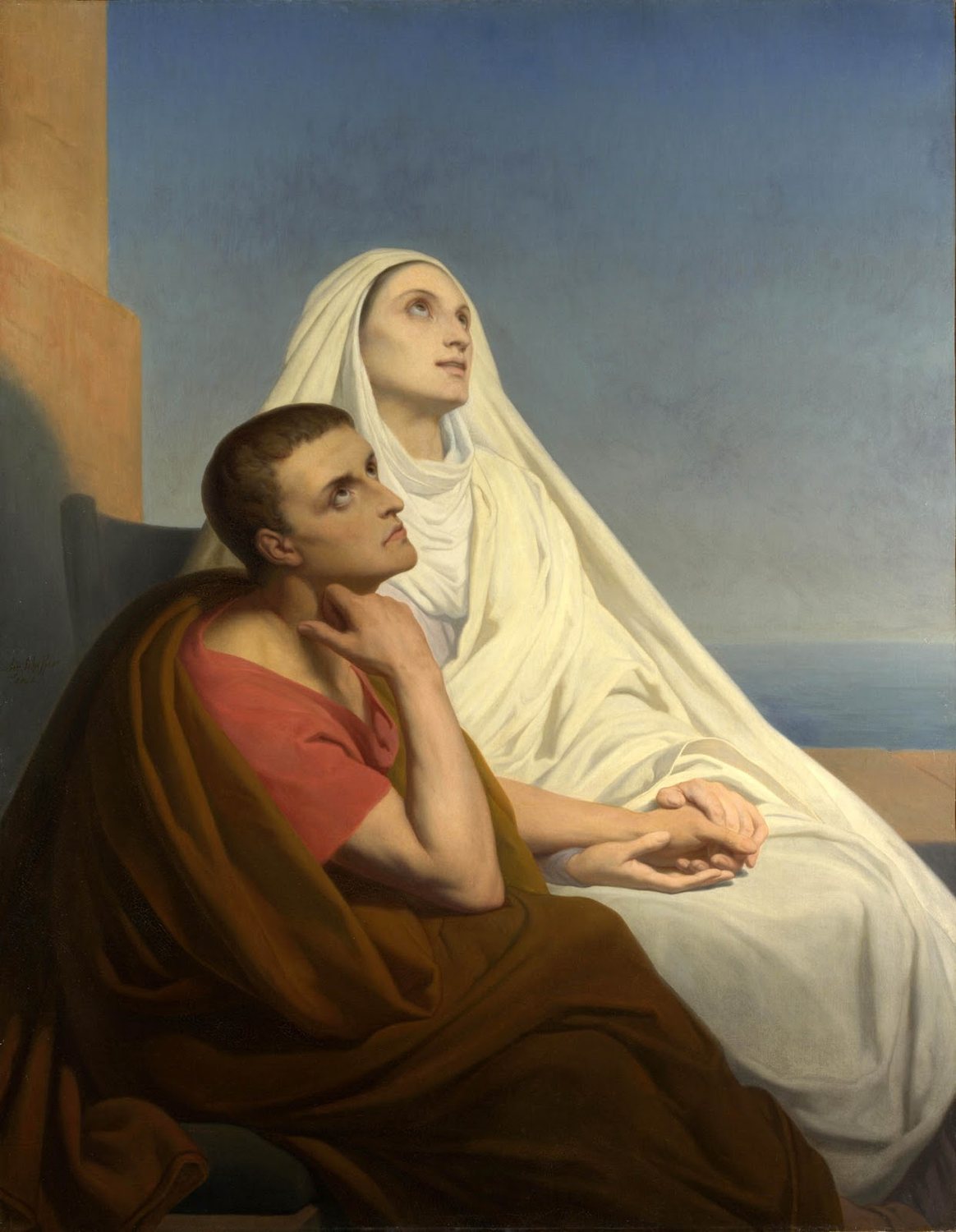
St Augustine’s prayer for his mother Monica, from his Confessions of about AD 400. He asks God to forgive her sins and let her rest in peace with her husband.

Picture: Ary Scheffer, Saint Augustine and Saint Monica, 1854

The words of the prayer

Plain English

And so, my Praise and my Life, God of my heart,I set aside for a while my mother’s good deeds,for which I thank You with joy,and now I pray to You for her sins.Hear me through the Medicine for our wounds,Who hung on the tree,and Who sits at Your right hand and pleads with You for us.

I know that she showed mercy,and from her heart forgave her debtors their debts.You too, forgive her debts,if she ran up any in all the yearssince the water of salvation.Forgive her, Lord, forgive her, I beg You.Do not bring her into judgment.

Let mercy triumph over judgment,for Your words are true,and You have promised mercy to the merciful.It was You Who made them merciful,You Who have mercy on whom You have mercyand compassion on whom You have compassion.

And I believe You have already done what I ask.Yet accept, Lord, the freewill offerings of my mouth.

Let no one tear her away from Your protection.Let neither the lion nor the dragon come between her and You,by force or by trickery.For she will not answer that she owes nothing,so that the cunning accuser cannot convict her and seize her.She will answer that her debts were forgivenby Him to Whom no one will ever pay backwhat He paid for us, though He owed nothing.

So may she rest in peace with her husband.She married no one before him and no one after him.She served him, bearing fruit for You with patience,so that she might win him for You as well.

Traditional wording, 1886

I then, O my Praise and my Life, Thou God of my heart,putting aside for a little her good deeds,for which I joyfully give thanks to Thee,do now beseech Thee for the sins of my mother.Hearken unto me, through that Medicine of our wounds Who hung upon the tree,and Who, sitting at Thy right hand, “maketh intercession for us.”

I know that she acted mercifully,and from the heart forgave her debtors their debts;do Thou also forgive her debts,whatever she contracted during so many years since the water of salvation.Forgive her, O Lord, forgive her, I beseech Thee;“enter not into judgment” with her.

Let Thy mercy be exalted above Thy justice,because Thy words are true,and Thou hast promised mercy unto “the merciful;”which Thou gavest them to be Who wilt “have mercy” on whom Thou wilt “have mercy,”and wilt “have compassion” on whom Thou hast had compassion.

And I believe Thou hast already done that which I ask Thee;but “accept the free-will offerings of my mouth, O Lord.”

… Let none separate her from Thy protection.Let not the “lion” and the “dragon” introduce himself by force or fraud.For she will not reply that she owes nothing,lest she be convicted and got the better of by the wily deceiver;but she will answer that her “sins are forgiven”by Him to Whom no one is able to repay that pricewhich He, owing nothing, laid down for us.

May she therefore rest in peace with her husband,before or after whom she married none;whom she obeyed, with patience bringing forth fruit unto Thee,that she might gain him also for Thee.

Plain English by Wiser Walk, from the Latin, with Pilkington’s 1886 translation beside it, leaving out a passage on her burial and the altar. How the wording is made. Traditional wording: J. G. Pilkington, The Confessions of St. Augustin, 1886.

Where Pilkington says “Let Thy mercy be exalted above Thy justice”, the Latin has the words of James 2:13, “mercy triumphs over judgment”.

When it is said

It is not part of any Orthodox service.

A son or daughter might pray it in Augustine’s words for a mother who has died, on the anniversary of her death or at any other time.

Where it comes from

Author known

Written for his mother Monica

St Augustine wrote this prayer in his Confessions, about AD 400, years after his mother Monica died. He first thanks God for her good deeds and then sets them aside to pray for her sins. He knew she had forgiven others from her heart, so he pleads God’s own promise of mercy to the merciful.

Augustine, Confessions, Book 9, tr. J. G. Pilkington (1886); Encyclopaedia Britannica, St. Augustine

What Monica asked as she was dying

Monica fell ill with a fever at Ostia in AD 387, while the family was on its way home. She told Augustine and his brother to bury her body anywhere and not to worry about it. Then she said, “This only I ask, that you will remember me at the Lord’s altar, wherever you be.” She died on the ninth day of her illness, in her 56th year.

Augustine, Confessions, Book 9, tr. J. G. Pilkington (1886); Philip Schaff, Nicene and Post-Nicene Fathers, vol. 1 (1886)

His father, Patricius

Monica won her husband Patricius to the faith toward the end of his life. She had long worried about her grave and had made one ready beside his body. Augustine’s prayer asks that she rest in peace with her husband. In the Confessions the prayer then asks his readers to remember them both at God’s altar, the parents through whom God brought him into this life.

Augustine, Confessions, Book 9, tr. J. G. Pilkington (1886)

What the words mean

“Her debts”

Augustine takes the word from the Lord’s Prayer, “Forgive us our debts, as we also have forgiven our debtors.” By “the water of salvation” he means her baptism. His translator J. G. Pilkington notes that Augustine applies this line of the Lord’s Prayer, again and again, to sins committed after baptism.

Augustine, Confessions, Book 9, tr. J. G. Pilkington (1886), note 799

The lion and the dragon

Psalm 91:13 promises the one who trusts in God that he will trample “the young lion and the dragon”, as the King James Version words it. Augustine uses the two beasts for one enemy, the devil, whom he also calls the cunning accuser. He trusts that Monica will make no claim to innocence before him. She will answer that Christ paid her debts, though He owed nothing.

The Book of Psalms, King James Version

The Scripture in it

Who is there to condemn us? For Christ Jesus, Who died, and more than that was raised to life, is at the right hand of God—and He is interceding for us.

Romans 8:34 Echoed Christ at God’s right hand, interceding for us. Pilkington’s note points to this verse.

And forgive us our debts, as we also have forgiven our debtors.

Matthew 6:12 Echoed “Forgive us our debts, as we also have forgiven our debtors”: the Lord’s Prayer, behind “her debts”.

Do not bring Your servant into judgment, for no one alive is righteous before You.

Psalm 143:2 Quoted David asks God not to bring His servant into judgment.

For judgment without mercy will be shown to anyone who has not been merciful. Mercy triumphs over judgment.

James 2:13 Quoted James teaches that mercy triumphs over judgment.

Blessed are the merciful, for they will be shown mercy.

Matthew 5:7 Echoed Jesus promises mercy to the merciful.

For He says to Moses: “I will have mercy on whom I have mercy, and I will have compassion on whom I have compassion.”

Romans 9:15 Quoted God tells Moses that He will have mercy on whom He has mercy.

Accept the freewill offerings of my mouth, O LORD, and teach me Your judgments.

Psalm 119:108 Quoted “Accept the freewill offerings of my mouth, O LORD.”

You will tread on the lion and cobra; you will trample the young lion and serpent.

Psalm 91:13 Echoed The lion and the serpent trampled underfoot. Pilkington’s note points to this verse.

Bible text: Berean Standard Bible, public domain.

In Latin

Ego itaque, Laus mea et Vita mea, Deus cordis mei, sepositis paulisper bonis eius actibus, pro quibus Tibi gaudens gratias ago, nunc pro peccatis matris meae deprecor Te.

Exaudi me per Medicinam vulnerum nostrorum, Quae pependit in ligno et sedens ad dexteram Tuam Te interpellat pro nobis.

Scio misericorditer operatam et ex corde dimisisse debita debitoribus suis.

Dimitte illi et Tu debita sua, si qua etiam contraxit per tot annos post aquam salutis.

Dimitte, Domine, dimitte, obsecro, ne intres cum ea in iudicium.

Superexultet misericordia iudicio, quoniam eloquia Tua vera sunt et promisisti misericordiam misericordibus.

Quod ut essent Tu dedisti eis, Qui misereberis cui misertus eris, et misericordiam praestabis cui misericors fueris.

Et credo, iam feceris quod Te rogo, sed voluntaria oris mei approba, Domine.

… Nemo a protectione Tua dirumpat eam; non se interponat nec vi nec insidiis leo et draco.

Neque enim respondebit illa nihil se debere, ne convincatur et obtineatur ab accusatore callido, sed respondebit dimissa debita sua ab Eo Cui nemo reddet, quod pro nobis non debens reddidit.

Sit ergo in pace cum viro, ante quem nulli et post quem nulli nupta est, cui servivit fructum Tibi afferens cum tolerantia, ut eum quoque lucraretur Tibi.

From Confessions, Book 9, as printed by The Latin Library, with capitals for God.

Close to this

All prayers

Suggest a correction

Berean Standard Bible