Sign Up My Profile
Prayers

Psalm 141: “Set a guard over my mouth”

A psalm of David that the early Church sang every evening and the Orthodox still sing at Vespers. It asks God to guard your mouth and keep your heart from evil.

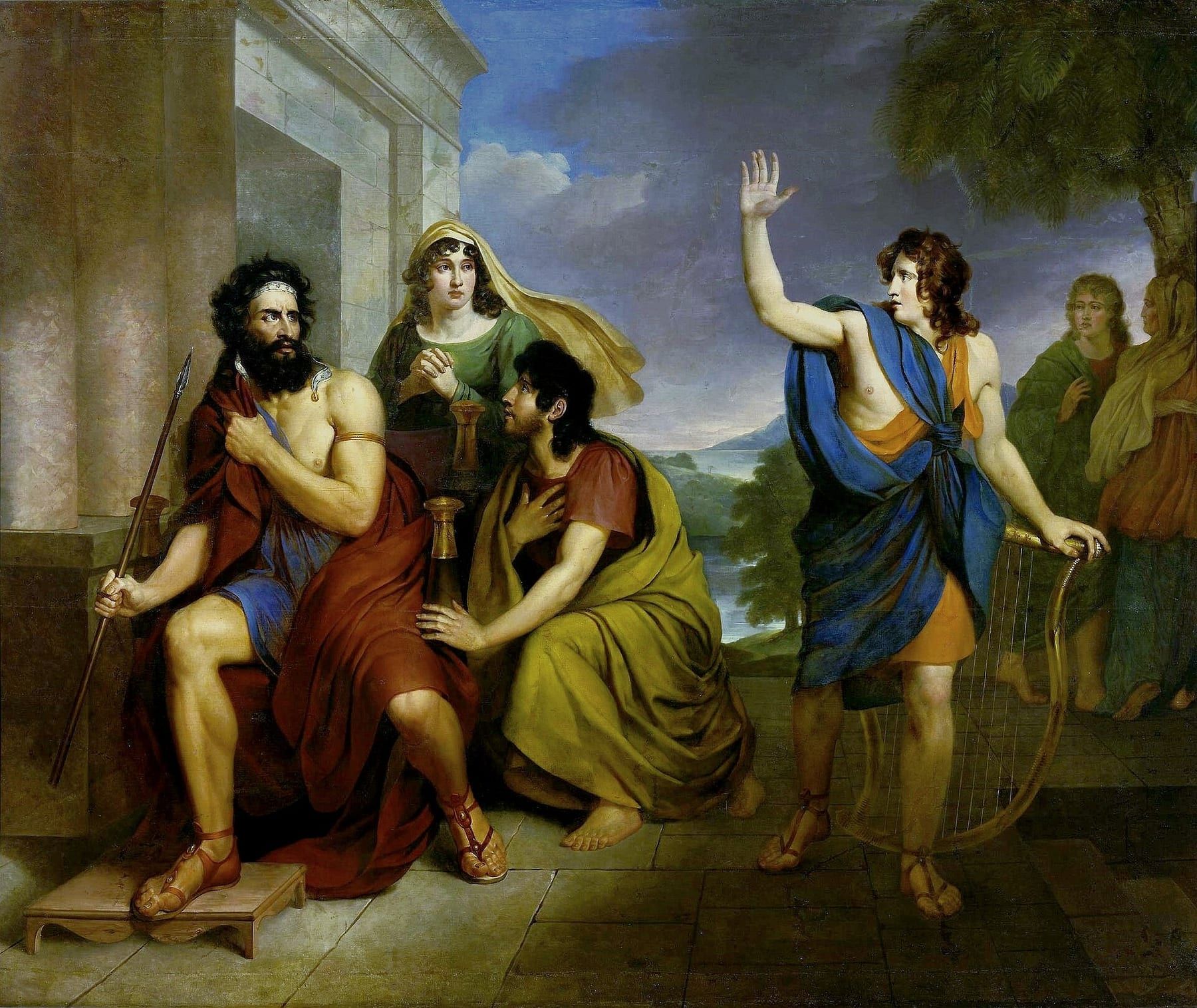
Picture: Antoni Brodowski, Saul’s Anger at David, 1812–19

The words of the prayer

Plain English

LORD, I call to You; come quickly to me.Hear my voice when I call to You.Let my prayer be set before You like incense,the lifting up of my hands like the evening offering.

Set a guard, LORD, over my mouth;keep watch at the door of my lips.Do not let my heart turn to anything evil,to join in wicked deeds with men who do wrong.Do not let me eat their fine food.

Let a righteous man strike me; it is a kindness.Let him correct me; it is oil on my head.Let my head not refuse it.

But my eyes are on You, O GOD the Lord;in You I take refuge.Do not leave my soul defenceless.Keep me from the trap they have set for me,and from the snares of those who do evil.

Traditional wording, 1611

LORD, I cry unto Thee: make haste unto me; give ear unto my voice, when I cry unto Thee.Let my prayer be set forth before Thee as incense; and the lifting up of my hands as the evening sacrifice.

Set a watch, O LORD, before my mouth; keep the door of my lips.Incline not my heart to any evil thing, to practise wicked works with men that work iniquity: and let me not eat of their dainties.

Let the righteous smite me; it shall be a kindness: and let him reprove me; it shall be an excellent oil, which shall not break my head.

But mine eyes are unto Thee, O GOD the Lord: in Thee is my trust; leave not my soul destitute.Keep me from the snares which they have laid for me, and the gins of the workers of iniquity.

Plain English by Wiser Walk, from the Hebrew (verses 1 to 5 and 8 to 9, without the end of verse 5), with the King James Version beside it. How the wording is made. Traditional wording: The King James translators, The King James Version, 1611.

Where the King James reads “which shall not break my head”, the Hebrew can also be read “let my head not refuse it”, as the plain wording has it.

When it is said

Pray it when you feel angry words rising, or before a conversation you dread.

It can be prayed whole, or its third verse alone, “Set a guard, LORD, over my mouth”, as a short prayer before you speak.

Where it comes from

Author by tradition

The Church’s evening psalm

An old book of church rules, the Apostolic Constitutions, tells Christians to gather every morning and evening to sing psalms and pray. They were to say Psalm 63 in the morning and this psalm in the evening. Its second verse, where prayer rises like incense and lifted hands are the evening offering, is what made it the psalm for that hour.

Apostolic Constitutions, in Ante-Nicene Fathers, volume 7; G. V. Shann, Euchology (1891), notes on Vespers

Where the Orthodox sing it

At Vespers the Orthodox still sing it under the name “Lord, I have cried”. At the Liturgy of the Presanctified Gifts, after the readings from Genesis and Proverbs, the choir sings “Let my prayer be set forth”, and the guard over the mouth is one of the verses sung with it.

G. V. Shann, Euchology (1891), the All-Night Vigil; Isabel F. Hapgood, Service Book (1906), the Liturgy of the Presanctified Gifts

What the words mean

What the Church sings in verses 4 and 5

The Orthodox sing this psalm from the Greek Old Testament, which reads differently from the Hebrew in places. In verse 4 the Greek asks that the heart not turn to evil words “to make excuses for sins”. In verse 5 it asks that the oil of a sinner never anoint the head, where the Hebrew speaks of a righteous man’s correction as oil.

G. V. Shann, Euchology (1891), the All-Night Vigil

The Scripture in it

I call upon You, O LORD; come quickly to me. Hear my voice when I call to You. May my prayer be set before You like incense; my uplifted hands, like the evening offering. Set a guard, O LORD, over my mouth; keep watch at the door of my lips. Do not let my heart be drawn to any evil thing or take part in works of wickedness with men who do iniquity; let me not feast on their delicacies. Let the righteous man strike me; let his rebuke be an act of loving devotion. It is oil for my head; let me not refuse it. For my prayer is ever against the deeds of the wicked.

Psalm 141:1-5 Quoted David cries to God, asks for a guard over his mouth and welcomes a righteous man’s correction.

But my eyes are fixed on You, O GOD the Lord. In You I seek refuge; do not leave my soul defenseless. Keep me from the snares they have laid for me, and from the lures of evildoers.

Psalm 141:8-9 Quoted He keeps his eyes on the Lord and asks to be kept from the traps set for him.

Bible text: Berean Standard Bible, public domain.

Close to this

All prayers

Suggest a correction

Berean Standard Bible