
When it is said
At the all-night vigil, a long evening service, it may be sung three times as Vespers ends. Then the priest blesses five loaves of bread, set out with wine and oil.
On weekdays in Great Lent, the fast before Easter, it opens the short hymns that close Vespers. A bow to the ground follows it.
In the Russian prayer book it comes near the end of the morning prayers. St Seraphim of Sarov, a Russian monk, taught everyone a short rule for waking: the Lord’s Prayer three times, this hymn three times, then the Creed once.
Where it comes from
No author known
Words from Luke’s Gospel
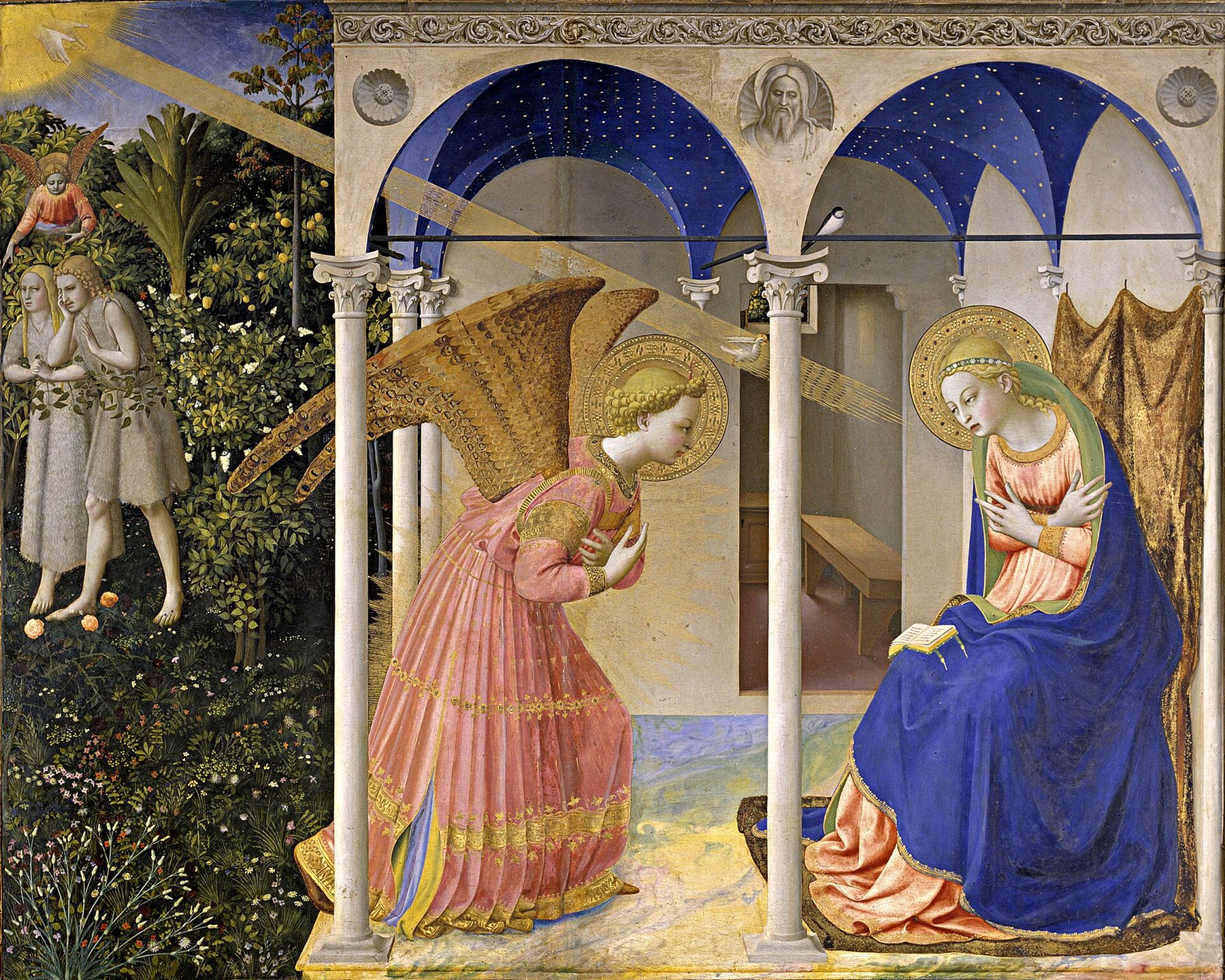
Most of the hymn comes from the Gospel of Luke. “Rejoice, full of grace, the Lord is with you” is the angel Gabriel’s greeting to Mary. “Blessed are you among women, and blessed is the fruit of your womb” is what her relative Elizabeth said when Mary came to see her. The hymn adds Mary’s name and title, and says why she is blessed: she bore the Saviour.
Older in the Liturgy than “It is truly right”
At the Liturgy, the service of Holy Communion, there is a moment in the great prayer over the bread and wine when Mary is named. Old copies have the priest greet her there quietly, most often with the angel’s words or with this hymn. In time the choir took it up and sang it aloud. By the 1500s another hymn to Mary stood in its place, as “It is truly right” still does today.
What the words mean
Rejoice or hail?
The Greek word, chaire, means “rejoice”. It was also an everyday greeting: the Russian prayer book’s notes call it the usual greeting in the East. Older English books, like the Western prayer, say “Hail”. Orthodox books in English today, such as those of the Orthodox Church in America, say “Rejoice”, which keeps the joy in the angel’s word.
The Russian prayer book with notes, Azbyka.ru (in Russian); Orthodox Church in America, Lenten Vespers
How it differs from the Hail Mary
Both begin with the words of Gabriel and Elizabeth. The Western Hail Mary then adds the name of Jesus and a request: “Holy Mary, Mother of God, pray for us sinners now and at the hour of our death.” The Roman Breviary, the Western Church’s book of daily prayer, made that full form official in 1568. The Orthodox hymn asks nothing. It ends by praising her Son, the Saviour of our souls.
Is this worship of Mary?
No. The Orthodox honour Mary, but worship belongs to God alone. When they ask her or the saints for help, they ask for prayers. The Orthodox Confession, adopted by a synod in 1643 and signed by the Eastern patriarchs, says: “We pray unto the Saints for their Intercession with God ... but we do by no Means call upon them as Gods”.
The Orthodox Confession (1643), Lodvill’s translation, Overbeck’s edition of 1898; Philip Schaff, The Creeds of Christendom, volume 2
The Scripture in it
The angel appeared to her and said, “Greetings, you who are highly favored! The Lord is with you.”
In a loud voice she exclaimed, “Blessed are you among women, and blessed is the fruit of your womb!”
Bible text: Berean Standard Bible, public domain.
In Greek
Θεοτόκε Παρθένε, Χαῖρε κεχαριτωμένη Μαρία,
ὁ Κύριος μετὰ σοῦ, εὐλογημένη σὺ ἐν γυναιξί,
καὶ εὐλογημένος ὁ καρπὸς τῆς κοιλίας σου,
ὅτι Σωτῆρα ἔτεκες τῶν ψυχῶν ἡμῶν.