
When it is said
The Orthodox sing this hymn on St Christopher’s feast day on 9 May. Churches on the old calendar keep the day on 22 May.
Anyone may pray it at any time to ask his prayers.
Where it comes from
No author known
Who was St Christopher?
Many different stories are told of Christopher, a martyr of the 200s. In the Life the Russian Church reads, the emperor Decius sent 200 soldiers to arrest him, and he went with them without a fight. The soldiers saw wonders on the road, came to believe in Christ and were baptised with him.
The women sent to tempt him
Decius then tried cunning in place of force. He sent two women named Callinica and Aquilina to persuade Christopher to deny Christ and offer sacrifice to the idols. Instead the women came to believe in Christ through him. They told the emperor they were Christians and died as martyrs. Christopher himself was beheaded in Lycia, in Asia Minor, about the year 250.
Azbyka, “Мученик Христофор Ликийский”; Synaxarion for 9 May, Digital Chant Stand
The story of the river
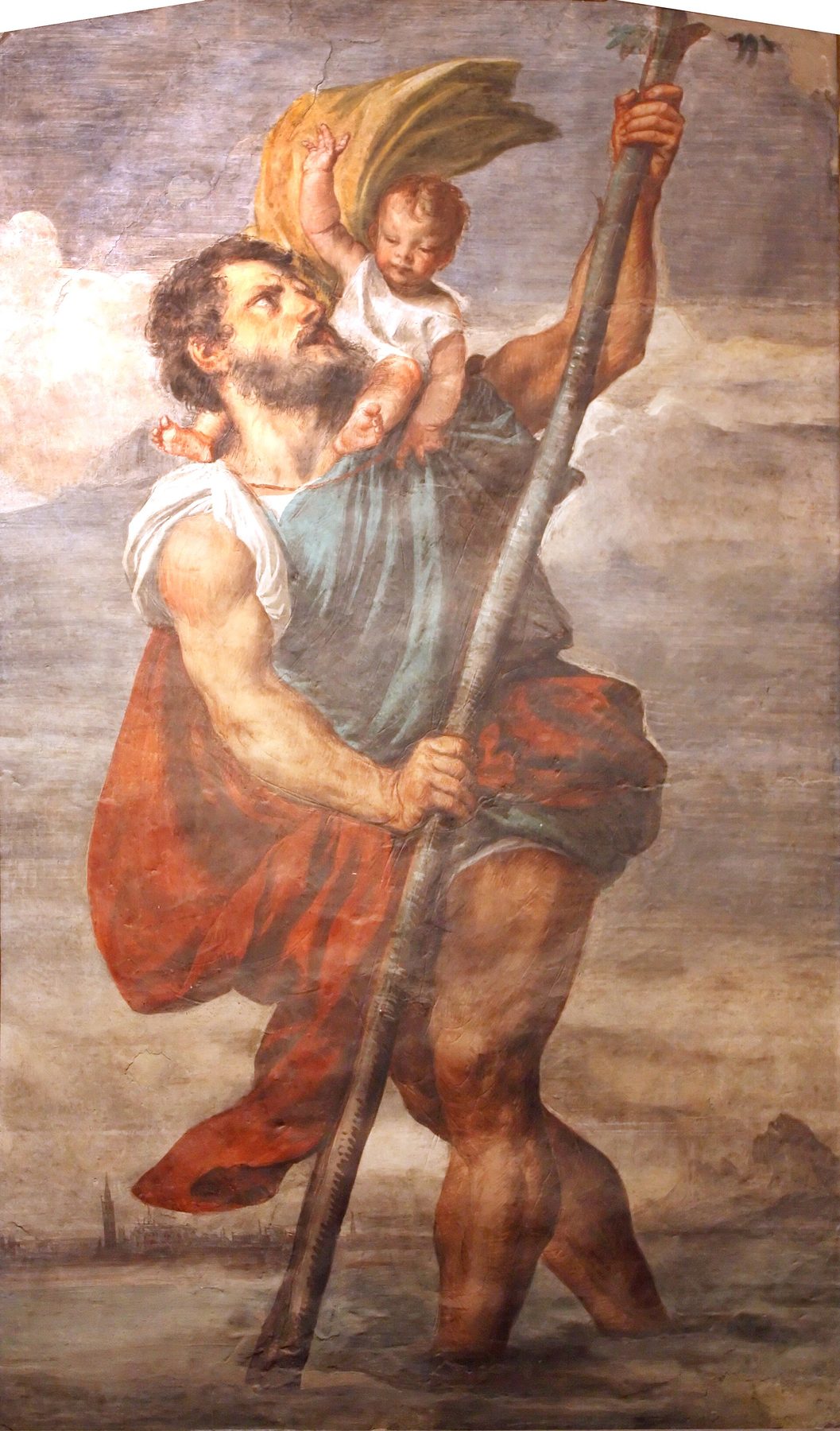
Many people know Christopher from a story in which he carries a child across a flooded river on his shoulders. The child turns out to be Christ, and He gives Christopher his name, which means “Christ-bearer”. A Russian guide to the holy places of Greece says the Greeks love this story, though it is not part of his official Life.
Azbyka, “Мученик Христофор Ликийский”, from the guide “Евлогите! Благословите!”
The Scripture in it
And they were calling out to one another: “Holy, holy, holy is the LORD of Hosts; all the earth is full of His glory.”
Bible text: Berean Standard Bible, public domain.
In Greek
Στολαῖς ταῖς ἐξ αἵματος, ὡραϊζόμενος, Κυρίῳ παρίστασαι,
τῷ Βασιλεῖ οὐρανῶν, Χριστοφόρε ἀοίδιμε·
ὅθεν σὺν ἀσωμάτων καὶ Μαρτύρων χορείαις, ᾄδεις τῇ τρισαγίῳ,
καὶ φρικτῇ μελῳδίᾳ· διὸ ταῖς ἱκεσίαις ταῖς σαῖς,
σῷζε τοὺς δούλους σου.
From the Menaion for 9 May, on the Digital Chant Stand of the Greek Orthodox Archdiocese of America.