
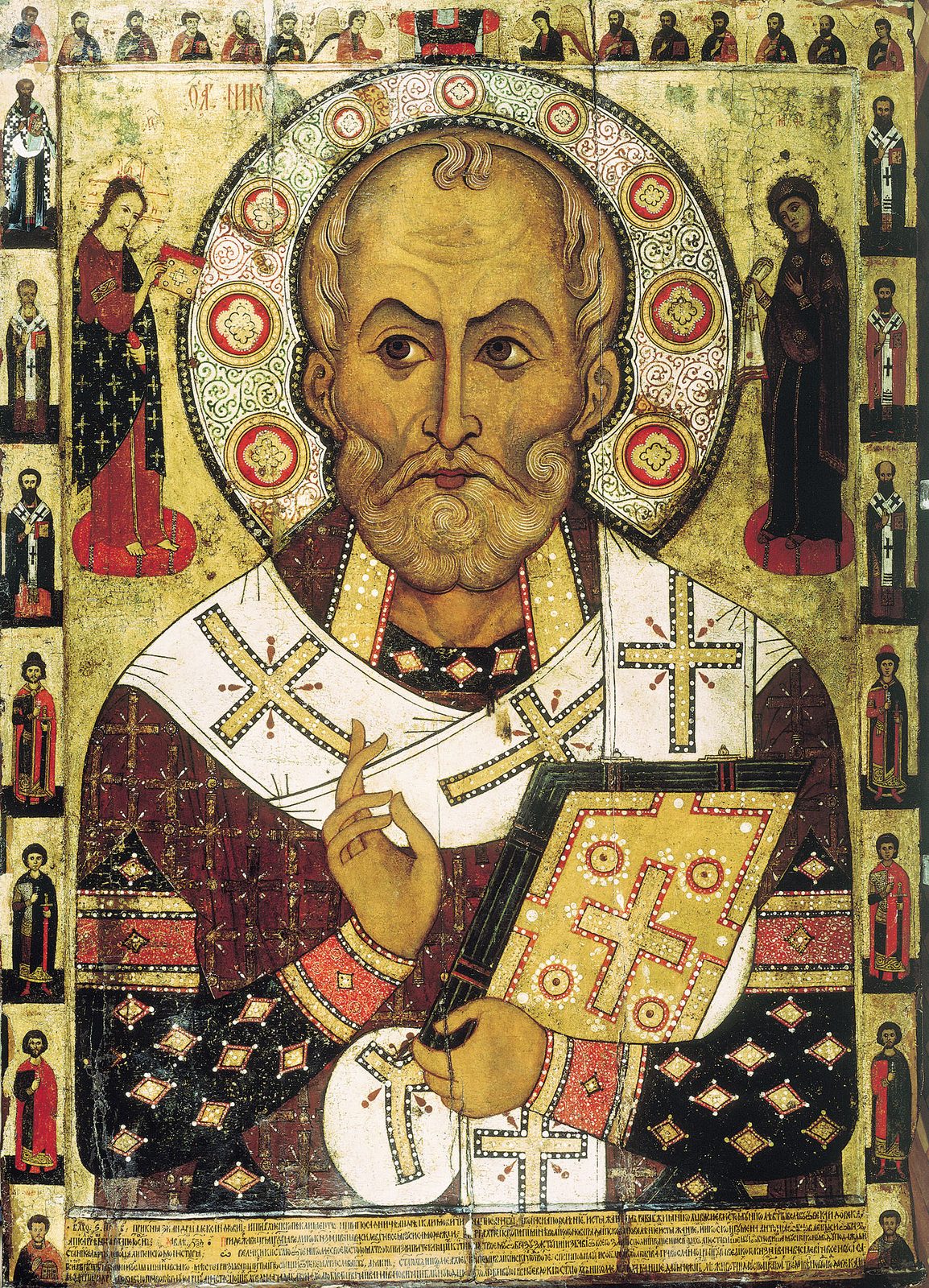
Why people ask St Nicholas
Finding a job
The Russian service for people looking for work names him with St Spyridon. He gave in secret, and by night he threw gold into a poor man’s house, a dowry for each of three daughters.
The service for those seeking work, 2023, Azbyka; Jacobus de Voragine, The Golden Legend, St Nicholas
When it is said
It is the troparion, the short hymn of the day, for St Nicholas’s feast on 6 December. It is sung in the fourth tone, one of the eight melodies of the Church’s chant.
In Russian use it is also sung every Thursday, the day the week gives to the apostles and to St Nicholas.
The same words, with another name, are the Church’s hymn for any holy bishop.
Where it comes from
No author known
One hymn for every holy bishop
The Russian Church’s book of hours gives this hymn twice. First it is the hymn for any holy bishop, with a blank for his name. Then it is given by name for St Nicholas the Wonderworker, on 6 December. He was archbishop of Myra, on the south coast of Asia Minor, and took part in the First Ecumenical Council in AD 325.
The Church Slavonic book of hours (Chasoslov), on Azbyka.ru; Orthodox Church in America, St Nicholas the Wonderworker
Gold through a window
The best-known story of St Nicholas is about money. A once-rich man of Patara had grown so poor that he planned to sell his three daughters’ bodies to buy food. Nicholas came secretly by night and threw a sack of gold through his window. Later he gave gold for the other daughters too. He always tried to hide his giving.
Asked for help in hard times
The Orthodox Church in America writes that the Orthodox pray to St Nicholas for deliverance from floods, poverty or any misfortune. Russian peasants honoured him as a merciful intercessor for all the people in their work.
Orthodox Church in America, St Nicholas the Wonderworker; Orthodox Church in America, Translation of the Relics of St Nicholas
What the words mean
“By poverty, riches”
As a young priest, Nicholas gave all his inheritance to the poor, the Orthodox Church in America’s life of him says. The hymn sees what he gained by it: by humility, the heights; by poverty, riches. The words echo Paul on Christ, Who became poor so that through His poverty we might become rich.
The Scripture in it
For you know the grace of our Lord Jesus Christ, that though He was rich, yet for your sake He became poor, so that you through His poverty might become rich.
Bible text: Berean Standard Bible, public domain.
In Church Slavonic
Правило веры и образ кротости, воздержания учителя
яви тя стаду твоему Яже вещей Истина,
сего ради стяжал еси смирением высокая, нищетою богатая,
отче священноначальниче Николае, моли Христа Бога спастися душам нашим.
From the Church Slavonic book of hours (Chasoslov), on Azbyka.ru, a Russian Orthodox website.