Sign Up My Profile
Prayers

Orthodox prayers for the poor and hungry

These prayers for everyone in need come from the Church’s Liturgy, with a psalm and a prayer for the moment you give.

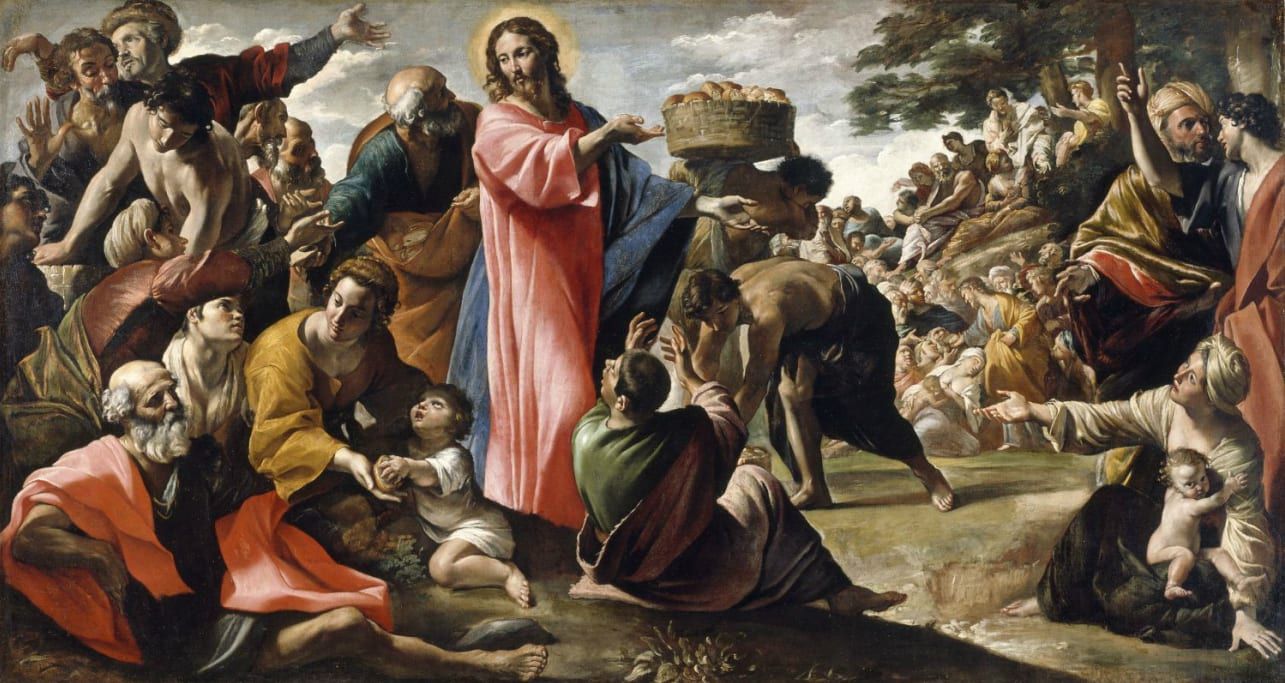
Picture: Giovanni Lanfranco, The Miracle of the Bread and Fish, 1620–23

4 prayers and 3 to the saints

For everyone in need

Prayer for all in need

Set the captives free;rescue those in distress;feed the hungry;comfort the fainthearted;turn back those who have gone astray;give light to those in darkness;raise up the fallen;steady those who waver;heal the sick.Lead them all into the way of salvation,and join them too to Your holy flock.And deliver us from our sins,and be our guard and our helper in all things.

Traditional wording, 1886

Deliver the captive; rescue the distressed; feed the hungry;comfort the faint-hearted, convert the erring;enlighten the darkened; raise the fallen;confirm the wavering; heal the sick;and guide them all, good Lord, into the way of salvation,and into Thy sacred fold.Deliver us from our iniquities;protect and defend us at all times.

In the Liturgy of St Mark the priest says it to close the long prayers for others. Its short lines ask God to set the captives free, feed the hungry and raise up the fallen.

Plain English by Wiser Walk, from the Greek of the Liturgy of St Mark, with George Ross Merry’s translation beside it. How the wording is made. Traditional wording: George Ross Merry, Ante-Nicene Fathers, vol. 7, 1886.

Merry adds “good Lord” and ends “protect and defend us at all times”, where the Greek asks God to be “our guard and helper in all things”.

Where it comes from, and the Greek

For those we forget to name

Helper of the helpless

Remember, O God, those on trial,those in the mines, in exile and in bitter slavery,and all who are in any affliction, need or distress,and all who need Your great compassion.

Remember those who love us and those who hate us,and those who have asked us, unworthy as we are,to pray for them.

Remember all Your people, O Lord our God,and pour out Your rich mercy on them all,granting all their requests that lead to salvation.

And those we have not remembered,through not knowing, or forgetting,or the great number of names,remember them Yourself, O God.You know the age and the name of each one.You have known each one from their mother’s womb.

For You, O Lord, are the Helper of the helpless,the Hope of the hopeless,the Saviour of the storm-tossed,the Harbour of those at sea,the Physician of the sick.

Be all things to all people,You Who know each oneand what they ask for,where they live and what they need.

Deliver, O Lord, this city and land,and every city and land,from famine, plague, earthquake, flood and fire,from the sword, foreign invasionand civil war.

Traditional wording, 1906

Have in remembrance those who are under trial, and in the mines,and in exile, and in bitter slavery,and in all affliction, distress and tribulation.

Have in remembrance, O God, all those who invoke Thy great loving-kindness;those also who love us, and those who hate us,and those who have enjoined us, unworthy though we are, that we should pray for them;and all Thy people, O Lord our God:And upon them all pour out Thy rich mercy,granting unto all such of their petitions as are unto salvation.

And those whom we, through ignorance, or forgetfulness, or the multitude of names, have not remembered,do Thou Thyself call to mind, O God,Who knowest the age and the name of each,and knowest every man even from his mother’s womb.

For Thou, O Lord, art the Helper of the helpless,the Hope of the hopeless, the Saviour of the storm-tossed,the Haven of the voyager, the Healer of the sick.

Be Thyself all things unto all men,O Thou Who knowest every man, his petition, his abode, and his need.

Deliver, O Lord, this city, and every city and landfrom famine, plague, earthquake, flood, fire, sword,the invasion of enemies, and from civil war.

The priest prays it at the Liturgy of St Basil, named for the bishop who served food to famine victims with his own hands. It calls God the One Who knows where each one lives and what they need.

Plain English by Wiser Walk, from the Greek, with Hapgood’s 1906 translation beside it. How the wording is made. Traditional wording: Isabel F. Hapgood, Service Book of the Holy Orthodox-Catholic Apostolic Church, 1906.

Hapgood’s book, made from the Russian, asks for “this city”; the Greek asks for “this city and land”.

Where it comes from, and the Greek

For those who help the poor

Who considers the poor (Psalm 41)

Blessed is the one who considers the poor;the LORD will rescue him in the day of trouble.

The LORD will guard him and keep him alive;he will be blessed in the land.You will not give him up to the will of his enemies.

The LORD will sustain him on his bed of illness;in his sickness You restore him from his bed.

As for me, I said, “LORD, have mercy on me;heal my soul, for I have sinned against You.”

Blessed be the LORD, the God of Israel,from everlasting to everlasting.Amen and amen.

Traditional wording, 1611

Blessed is he that considereth the poor:the LORD will deliver him in time of trouble.

The LORD will preserve him, and keep him alive;and he shall be blessed upon the earth:and Thou wilt not deliver him unto the will of his enemies.

The LORD will strengthen him upon the bed of languishing:Thou wilt make all his bed in his sickness.

I said, LORD, be merciful unto me:heal my soul; for I have sinned against Thee.

Blessed be the LORD God of Israelfrom everlasting, and to everlasting.Amen, and Amen.

St Athanasius of Alexandria gave this psalm to anyone who sees many poor people and wants them shown mercy. It blesses the one who considers the poor, then asks God for mercy.

Plain English by Wiser Walk, from the Hebrew (verses 1 to 4 and 13), with the King James Version beside it. How the wording is made. Traditional wording: The King James translators, The King James Version, 1611.

Where the plain wording says God restores him from his bed, the King James Version reads “make all his bed”. Its own margin gives the Hebrew word as “turn”.

Where it comes from, and the original

Before you give

Prayer for giving alms

Lord, teach me to give to the poorwillingly, kindly and with joy,and to believe that when I give,I do not lose but gaininfinitely more than I give.

Lord, may every gift I givedo good and not harm.

Lord, receive the gift Yourselfin the person of Your poor.

Traditional wording, 1897

Lord! teach me to bestow charity willingly, kindly, joyfully,and to believe that by bestowing it I do not lose,but gain infinitely more than that which I give.

Lord, grant that every charity I bestow may be profitable,and may not do harm!

Lord, accept Thyself charity in the person of Thy poor.

It comes from the diary of St John of Kronstadt, a Russian priest who often gave the poor his last coins. It asks God for a glad heart in giving, and to receive the gift Himself.

Plain English by Wiser Walk, from the Russian of his diary, as a Russian prayer book prints it, with E. E. Goulaeff’s English of 1897 beside it. How the wording is made. Traditional wording: E. E. Goulaeff, My Life in Christ, 1897.

Goulaeff’s “charity” translates the Russian word for alms, a gift to someone poor.

Where it comes from, and the Russian

To a saint · To St Nicholas, who gave in secret

Troparion of St Nicholas

The truth of things showed you to your flockas a rule of faith, an image of meeknessand a teacher of self-control.So by humility you gained the heights,and by poverty, riches.Father Nicholas, holy bishop,pray to Christ our Godthat our souls may be saved.

Traditional wording, 1891

The Truth hath made thee a standard of faith,a pattern of meekness, and a teacher of temperance to thy flock.

Thus didst thou, O holy priestly Father Nicolas,by humiliation acquire greatness, by thy poverty, riches.

Pray Christ our God to save our souls.

St Nicholas came by night and threw a sack of gold through the window of a man who had grown too poor to buy food. His hymn says that by poverty he gained riches.

Plain English by Wiser Walk, from the Church Slavonic, with Shann’s 1891 translation beside it. How the wording is made. Traditional wording: G. V. Shann, Euchology: A Manual of Prayers of the Holy Orthodox Church, 1891.

Shann’s “humiliation” is humility, as the Slavonic says.

Where it comes from, and the Church Slavonic

To a saint · To St John the Merciful, who fed a city’s poor

Troparion of St John the Merciful

By your patience you won your reward, holy father.You persevered in prayer without ceasing;you loved the poor and provided for them.

So pray to Christ our God, blessed John the Merciful,that our souls may be saved.

Traditional wording

In thy patience thou hast won thy reward, O righteous Father.Thou didst persevere unceasingly in prayer;thou didst love the poor, and didst provide for them in all things.

Wherefore, intercede with Christ our God, O blessed John the Almsgiver,that our souls be saved.

As patriarch of Alexandria, St John had the church provide for more than 7,000 of the city’s poor each day. His hymn praises him for loving them.

Plain English by Wiser Walk, from the Greek, with the English of the Patriarchate of Antioch beside it. How the wording is made. Traditional wording: Greek Orthodox Patriarchate of Antioch, Apolytikion of St John the Merciful, on its website.

The Greek says he loved the poor and provided for them. “In all things” is not in it.

Where it comes from, and the Greek

To a saint · To St Spyridon, who lent freely

Troparion of St Spyridon

You were shown to be the champion of the First Counciland a wonderworker, Spyridon, our God-bearing father.And so you called to a dead woman in her grave,and you changed a snake into gold.And as you sang your holy prayers,you had angels serving with you, most holy one.

Glory to Him Who glorified you!Glory to Him Who crowned you!Glory to Him Who works healing for all through you!

Traditional wording

At the First Council you appeared as a champion of Truth and a Wonderworker, O our God-bearing Father Spyridon.For you spoke to one dead in her grave, and transformed a serpent into gold;while chanting your holy prayersyou had Angels serving with you, most holy one.

Glory to Him Who glorified you.Glory to Him Who crowned you.Glory to Him Who, through you, grants healing to all.

St Spyridon of Cyprus gave part of every harvest to the poor and let anyone in need borrow from his storehouse. The hymns of his feast say he changed a snake into gold for a man in need.

Plain English by Wiser Walk, from the Greek, with the Orthodox Church in America’s translation beside it. How the wording is made. Traditional wording: Orthodox Church in America, Troparion and Kontakion of St Spyridon, on its website.

The Greek calls him the champion of the First Council. The OCA’s English adds “of Truth”.

Where it comes from, and the Greek

Scripture for this

35For I was hungry and you gave Me something to eat, I was thirsty and you gave Me something to drink, I was a stranger and you took Me in, 36I was naked and you clothed Me, I was sick and you looked after Me, I was in prison and you visited Me.’ 37Then the righteous will answer Him, ‘Lord, when did we see You hungry and feed You, or thirsty and give You something to drink? 38When did we see You a stranger and take You in, or naked and clothe You? 39When did we see You sick or in prison and visit You?’ 40And the King will reply, ‘Truly I tell you, whatever you did for one of the least of these brothers of Mine, you did for Me.’

Matthew 25:35-40 Jesus says that whatever we do for the hungry, the stranger, the sick and the prisoner, we do for Him.

20Looking up at His disciples, Jesus said: “Blessed are you who are poor, for yours is the kingdom of God. 21Blessed are you who hunger now, for you will be filled. Blessed are you who weep now, for you will laugh.”

Luke 6:20-21 Jesus called the poor and the hungry blessed, because the kingdom of God is theirs and they will be filled.

6Isn’t this the fast that I have chosen: to break the chains of wickedness, to untie the cords of the yoke, to set the oppressed free and tear off every yoke? 7Isn’t it to share your bread with the hungry, to bring the poor and homeless into your home, to clothe the naked when you see him, and not to turn away from your own flesh and blood?

Isaiah 58:6-7 The fast God chooses includes sharing your bread with the hungry and bringing the homeless poor into your home.

He executes justice for the oppressed and gives food to the hungry. The LORD sets the prisoners free …

Psalm 146:7 The LORD gives justice to the oppressed and food to the hungry, and He sets the prisoners free.

Kindness to the poor is a loan to the LORD, and He will repay the lender.

Proverbs 19:17 Kindness to the poor is a loan to the LORD, and He will repay it.

If anyone with earthly possessions sees his brother in need, but withholds his compassion from him, how can the love of God abide in him?

1 John 3:17 The apostle John asks how God’s love can live in anyone who sees a brother in need and holds back his compassion.

Bible text: Berean Standard Bible, public domain.

Close to this

All prayers

Quiz What prayer do you need right now? A few honest taps about where you are, and a prayer of the Church for exactly that. 8 questions, about 3 minutes. Start

Suggest a correction

Berean Standard Bible