Sign Up My Profile
Prayers

Orthodox prayers before and after meals

Orthodox Christians say grace before a meal and give thanks after it, in the words of their prayer books and in older graces from the early Church.

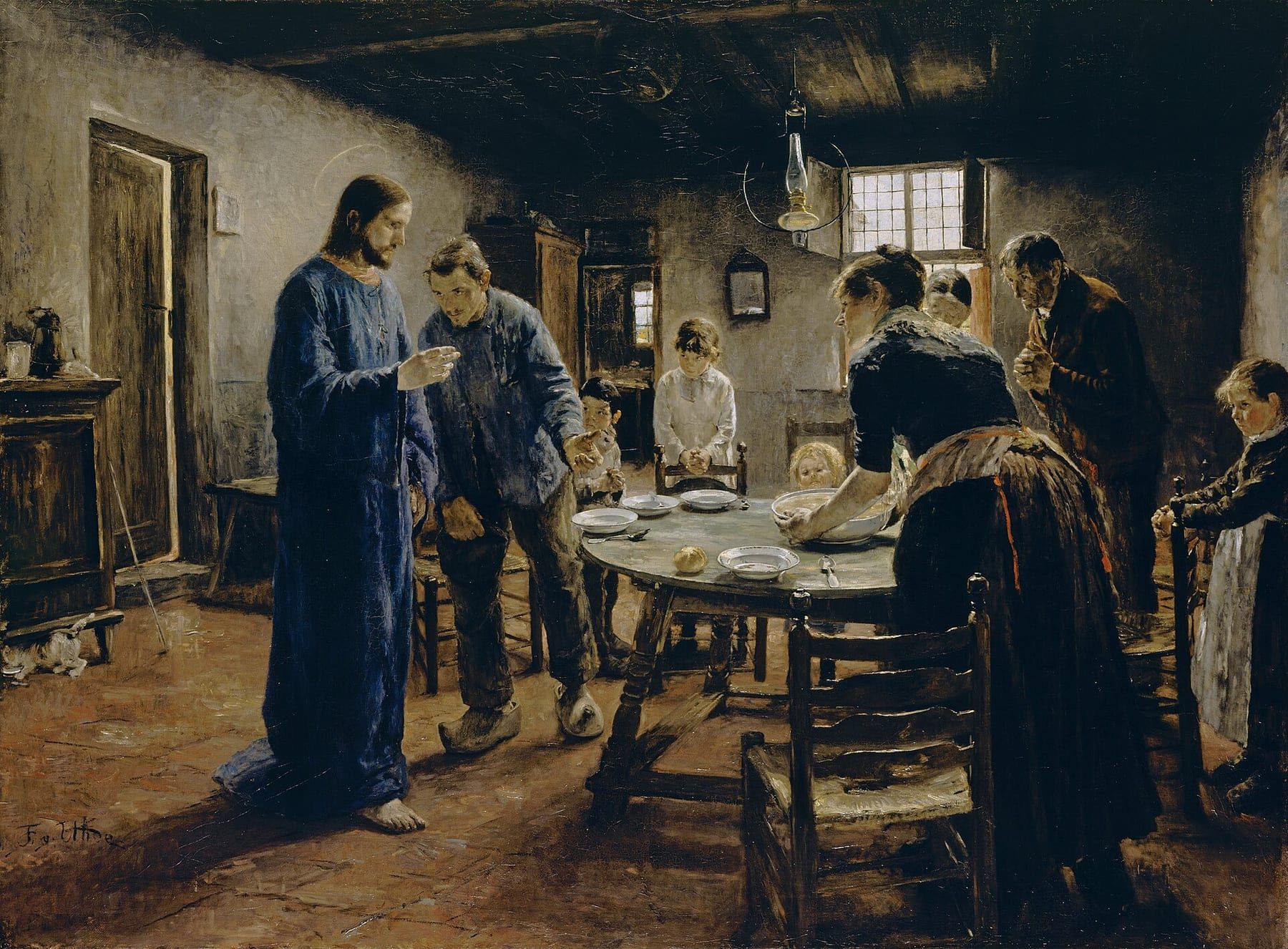
Picture: Fritz von Uhde, Come, Lord Jesus, Be Our Guest (Grace before the Meal), 1885

4 prayers

Before you eat

Prayer before meals

Our Father in heaven,hallowed be Your name.Your kingdom come,Your will be doneon earth as it is in heaven.

Give us today our daily bread.And forgive us our debts,as we also forgive our debtors.And lead us not into temptation,but deliver us from the evil one.Amen.

Or, in place of the Lord’s Prayer, these words from Psalm 145:The eyes of all look to You in hope, O Lord,and You give them their food in due season.You open Your generous handand fill every living thing with Your goodwill.

Glory to the Father, and to the Son, and to the Holy Spirit,now and always, and for ever and ever. Amen.

Lord, have mercy.Three times

O Christ God,bless the food and drink of Your servants,for You are holy at all times,now and always, and for ever and ever. Amen.Make the sign of the cross over the food

Traditional wording, 1982

Our Father, Who art in heaven, hallowed be Thy Name.Thy Kingdom come. Thy will be done, on earth as it is in heaven.Give us this day our daily bread;and forgive us our trespasses, as we forgive those who trespass against us;and lead us not into temptation, but deliver us from evil.

Glory to the Father, and to the Son, and to the Holy Spirit,now and ever and unto ages of ages. Amen.

Lord, have mercy! (3 times)

O Christ God, bless the food and drink of Thy servants,for Thou art holy, always, now and ever and unto ages of ages. Amen.

The Lord’s Prayer, then a blessing on the food and drink. Orthodox families say it standing, and bless the food with the sign of the cross.

Plain English by Wiser Walk, from the Greek, with St Tikhon’s 1982 translation beside it; the psalm verses from the Church Slavonic of the Russian prayer book. How the wording is made. Traditional wording: St Tikhon’s Seminary Press, Orthodox Daily Prayers, 1982.

St Tikhon’s book has no psalm verses: Russian prayer books give them as a second choice. Its Lord’s Prayer says “trespasses” and “from evil”, where the Greek says “debts” and “from the evil one”.

Where it comes from, and the Greek

The grace many families already know

Bless, O Lord, Your gifts

Bless, O Lord, Your gifts,which we are about to receive from Your bounty.

May Your gifts, O Lord, refresh us,and may Your grace comfort us.

Through Jesus Christ our Lord.

Traditional wording, 1864

Bless, O Lord, Thy gifts, which we are about to receive from Thy bounty.

May Thy gifts, Lord, be our refreshment, and Thy grace our consolation;through our Lord.

The familiar “Bless us, O Lord, and these Thy gifts” grew from this old Latin grace. The Antiochian Orthodox Archdiocese gives the newer form among its own graces before meals.

Plain English by Wiser Walk, from the Latin, as H. A. Wilson printed the Old Gelasian book in 1894, with William Bright’s 1864 English beside it. How the wording is made. Traditional wording: William Bright, Ancient Collects, 1864.

Where it comes from, and the Latin

After the meal

Prayer after meals

We thank You, O Christ our God,that You have filled us with Your earthly good things.Do not deprive us of Your heavenly kingdom as well.But as You came among Your disciples, O Saviour,giving them peace,come to us also and save us.

Glory to the Father, and to the Son, and to the Holy Spirit,now and always, and for ever and ever. Amen.

Lord, have mercy.Three times

Blessed is God,Who has mercy on us and feeds us from His rich gifts,by His grace and love for mankind,at all times, now and always, and for ever and ever. Amen.

Traditional wording, 1982

We thank Thee, Christ our God, for Thou hast satisfied us with Thine earthly gifts.Deprive us not of Thy Heavenly Kingdom,but as Thou camest among Thy disciples, O Savior, giving them peace,so come to us and save us!

Glory to the Father, and to the Son, and to the Holy Spirit,now and ever and unto ages of ages. Amen.

Lord, have mercy! (3 times)

Blessed is God, Who has had mercy on us and fed us from His rich gifts,through His Grace and love for mankind,always, now and ever and unto ages of ages. Amen.

Thanks to Christ for the food just eaten, and a plea not to be kept from His heavenly kingdom. Monks end their daily meal with it.

Plain English by Wiser Walk, from the Church Slavonic, with St Tikhon’s 1982 translation beside it. How the wording is made. Traditional wording: St Tikhon’s Seminary Press, Orthodox Daily Prayers, 1982.

Where it comes from, and the Church Slavonic

A grace from the 300s

Ancient grace after meals

Blessed is God,Who has mercy on us and feeds us from our youth,Who gives food to every living creature.Fill our hearts with joy and gladness,so that, always having all that we need,we may abound in every good work,in Christ Jesus our Lord.Glory, might, honour and worship are due to You,with Him and the Holy Spirit, for ever. Amen.

Glory to You, O Lord!Glory to You, O Holy One!Glory to You, O King!For You have given us food to gladden us.Fill us also with the Holy Spirit,so that we may be found pleasing to Youand not be put to shamewhen You repay each one according to their deeds.

Traditional wording, 1888

Blessed God, Who feedest me from my youth up, Who givest food to all flesh;fill our hearts with joy and gladness,that always having all sufficiency we may abound unto every good work in Christ Jesus our Lord;with Whom be unto Thee glory, honor and might, with the Holy Spirit, forever. Amen.

Glory to Thee, O Lord, glory to Thee, O Holy One, glory to Thee, O King,that Thou hast given us meat to make us glad.Fill us with the Holy Ghost, that we may be found well-pleasing before Thee,not being ashamed, when Thou renderest to every man according to his works.

The desert monks’ hymn after supper. St John Chrysostom recited it in a sermon and urged every family to say it at home.

Plain English by Wiser Walk, from the Church Slavonic of the book of hours, with the 1888 translation of St John Chrysostom’s sermon beside it. How the wording is made. Traditional wording: George Prevost and M. B. Riddle, St John Chrysostom, Homilies on Matthew (Nicene and Post-Nicene Fathers), 1888.

This is the grace as Chrysostom quoted it in the 4th century: “Blessed God, Who feedest me”. The book of hours today says “Blessed is God, Who has mercy on us and feeds us”.

Where it comes from, and the Church Slavonic

Scripture for this

When you eat and are satisfied, you are to bless the LORD your God for the good land that He has given you.

Deuteronomy 8:10 The Law of Moses: when you have eaten and are satisfied, bless the Lord for the good land He has given you.

And He directed the crowds to sit down on the grass. Taking the five loaves and the two fish and looking up to heaven, He spoke a blessing. Then He broke the loaves and gave them to the disciples, and the disciples gave them to the people.

Matthew 14:19 Before He fed the five thousand, Jesus looked up to heaven and spoke a blessing over the loaves.

30While He was reclining at the table with them, He took bread, spoke a blessing and broke it, and gave it to them. 31Then their eyes were opened and they recognized Jesus—and He disappeared from their sight.

Luke 24:30-31 At Emmaus the risen Jesus took bread, blessed it and broke it, and the two disciples knew Him.

4For every creation of God is good, and nothing that is received with thanksgiving should be rejected, 5because it is sanctified by the word of God and prayer.

1 Timothy 4:4-5 Paul: nothing God made is to be rejected if it is received with thanks. God’s word and prayer make it holy.

And whatever you do, in word or deed, do it all in the name of the Lord Jesus, giving thanks to God the Father through Him.

Colossians 3:17 St John Chrysostom saw the monks’ grace keeping this command: whatever you do, give thanks to God the Father through Jesus.

With one accord they continued to meet daily in the temple courts and to break bread from house to house, sharing their meals with gladness and sincerity of heart …

Acts 2:46 The first Christians in Jerusalem broke bread in their homes and ate together with glad and sincere hearts.

The poor will eat and be satisfied; those who seek the LORD will praise Him. May your hearts live forever!

Psalm 22:26 The Antiochian Orthodox Archdiocese gives this verse as a grace to say before meals, in place of the blessing on the food and drink.

Bible text: Berean Standard Bible, public domain.

A psalm for this

Every day I will bless You, and I will praise Your name forever and ever.

Psalm 145:2

Orthodox monks walk from church to their meal saying this psalm. A monastic rule of 1034 already has them sing it on the way.

Psalm 145 Read the whole psalm, with St Athanasius’s advice on when to pray it.

Close to this

All prayers

Quiz What prayer do you need right now? A few honest taps about where you are, and a prayer of the Church for exactly that. 8 questions, about 3 minutes. Start

Suggest a correction

Berean Standard Bible