
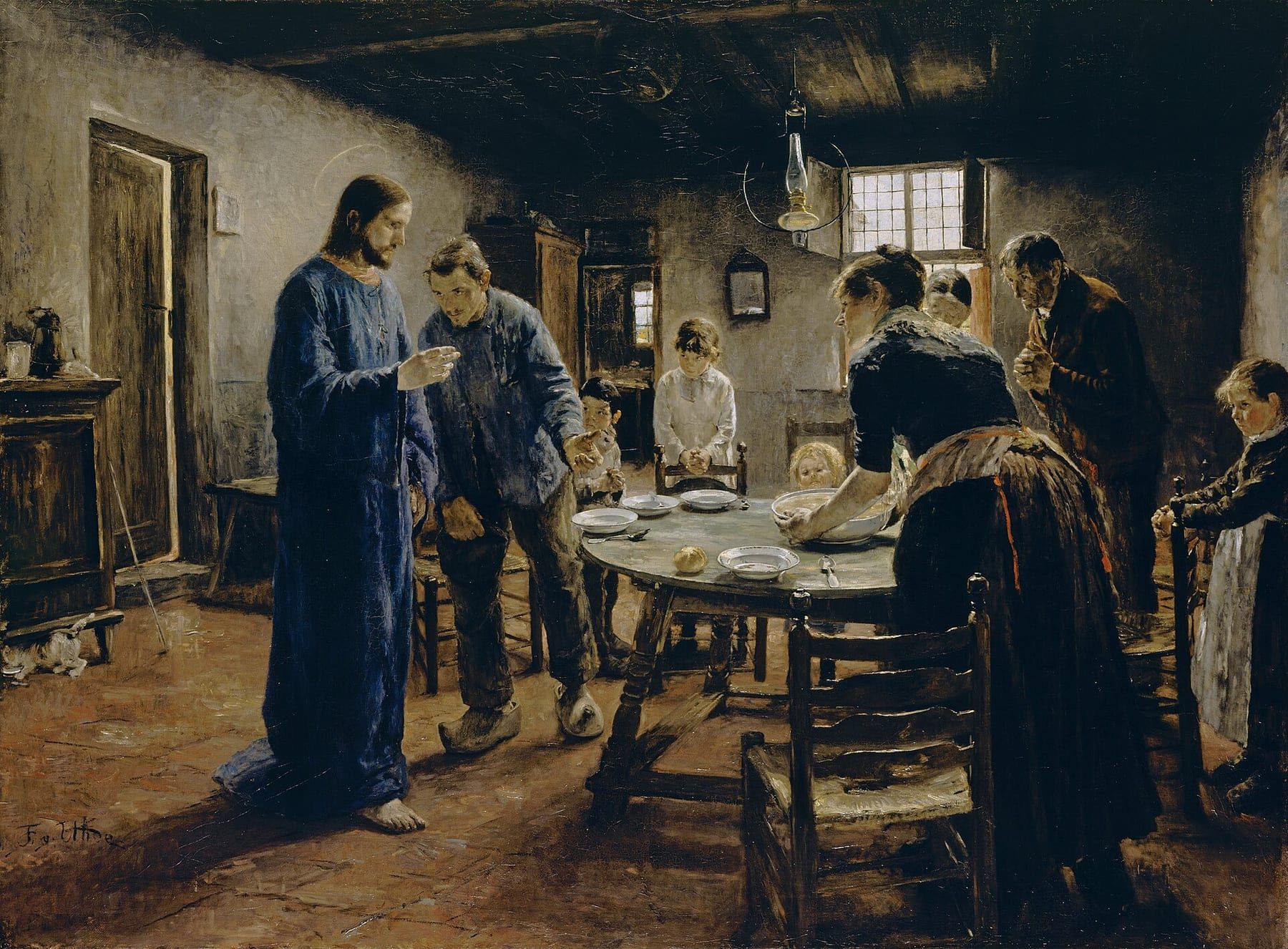
When it is said
Say it at the table before you eat, alone or with others.
The Roman book it comes from follows it with prayers for after the meal, such as “Filled with the gifts of Your plenty”.
Where it comes from
No author known
From a Roman book of about AD 750
Both halves of this grace come from the Old Gelasian book, a collection of Roman service prayers probably put together near Paris about AD 750. The book gives six short prayers for before food. The church historian William Bright took two of them and made them into this one grace in his Ancient Collects of 1864.
H. A. Wilson, The Gelasian Sacramentary (Oxford, 1894), page 293; The Cult of Saints in Late Antiquity database, University of Oxford, record E07005; William Bright, Ancient Collects, third edition (1864), page 175
Behind “Bless us, O Lord”
Many Catholics say “Bless us, O Lord, and these Thy gifts, which we are about to receive from Thy bounty” as their grace before meals. Its Latin is almost word for word this prayer’s first line, with “us and these” added. Herbert Thurston’s 1912 article on grace in the Catholic Encyclopedia traces it to the Gelasian book.
Herbert Thurston, “Thanksgiving before and after Meals”, The Catholic Encyclopedia (1912); Wikipedia, Grace (meals)
An Orthodox grace too
The Antiochian Orthodox Christian Archdiocese gives “Bless us, O Lord, and these Thy gifts” as one of three graces to say before meals. There it ends “for Thou art blessed and glorified; now and ever, and unto ages of ages.”
Antiochian Orthodox Christian Archdiocese, Occasional Prayers (archived 2023)
In Latin
Benedic, Domine, dona tua,
quae de tua largitate sumus sumpturi. Per.
Tua nos, Domine, dona reficiant,
et tua gratia consoletur.
Per Dominum nostrum.
From the Old Gelasian Sacramentary, Book III, section 86, ed. H. A. Wilson (Oxford, 1894), page 293.