
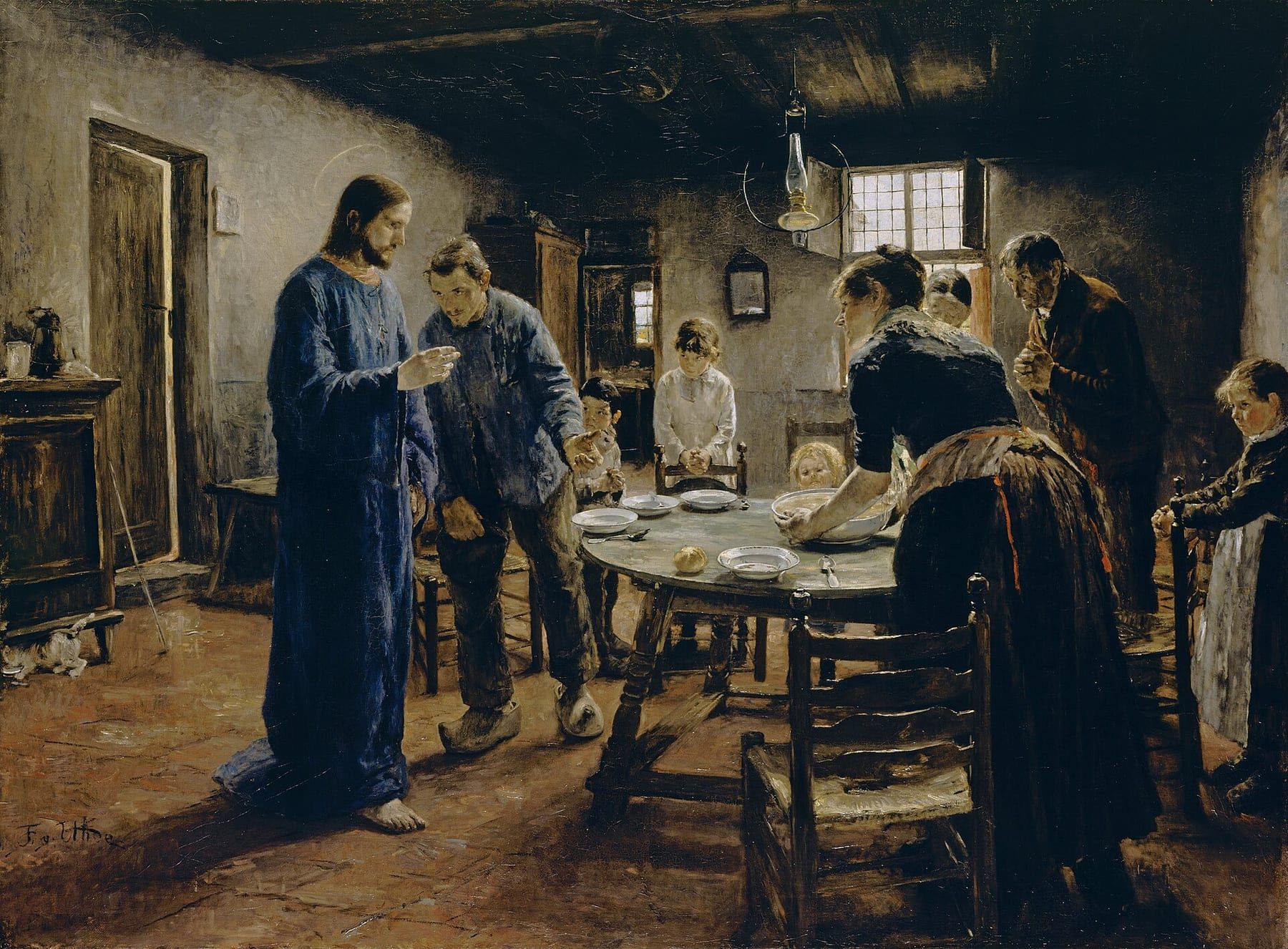
When it is said
Before every meal, at home and in monasteries. Orthodox Christians usually stand to say it, aloud or even sung. It may also be said silently, as at a table in a café.
After the prayer they cross themselves, and the food is blessed with the sign of the cross.
Greek prayer books give this order. Russian ones allow the verses of Psalm 145 in place of the Lord’s Prayer.
On the twelve great feasts of the year and at Easter, Russian prayer books replace it with the feast’s troparion, its short hymn.
Where it comes from
No author known
From the monastery dining hall
The prayer comes from the meal of an Orthodox monastery. After the Liturgy (the Communion service), the monks walk two by two from the church to the dining hall, saying Psalm 145. Then they say the Lord’s Prayer, and the priest blesses the table with these words. A monastic rule of 1034 already has them walk in singing the psalm.
The Church Slavonic book of hours (Chasoslov), the rite of the Panagia; Fr Mikhail Zheltov, “Panagia”, Orthodox Encyclopedia (in Russian)
The same words at home
Greek prayer books give families the monks’ order: the Lord’s Prayer, “Glory”, “Lord, have mercy” three times, and the blessing. So does St Tikhon’s, an American Orthodox prayer book in English. In a monastery the priest says the blessing. Russian prayer books give lay people a blessing of their own. It asks Christ to bless the food and drink through the prayers of His Mother and all the saints.
AgionLogoi.org, Prayer before and after the meal (in Greek); Azbyka.ru prayer book, Prayers before and after eating (in Russian)
What the words mean
“And fellowship”
The Orthodox Church in America’s prayer page asks Christ to bless “the food, drink, and fellowship” of His servants. The Greek and the Slavonic ask a blessing on the food and drink only, and this page keeps to them.
The Scripture in it
So then, this is how you should pray: ‘Our Father in heaven, hallowed be Your name. Your kingdom come, Your will be done, on earth as it is in heaven. Give us this day our daily bread. And forgive us our debts, as we also have forgiven our debtors. And lead us not into temptation, but deliver us from the evil one.’
The eyes of all look to You, and You give them their food in season. You open Your hand and satisfy the desire of every living thing.
Bible text: Berean Standard Bible, public domain.
In Greek
Πάτερ ἡμῶν ὁ ἐν τοῖς οὐρανοῖς, ἁγιασθήτω τὸ ὄνομά Σου.
Ἐλθέτω ἡ βασιλεία Σου. Γενηθήτω τὸ θέλημά Σου, ὡς ἐν οὐρανῷ, καὶ ἐπὶ τῆς γῆς.
Τὸν ἄρτον ἡμῶν τὸν ἐπιούσιον δὸς ἡμῖν σήμερον.
Καὶ ἄφες ἡμῖν τὰ ὀφειλήματα ἡμῶν, ὡς καὶ ἡμεῖς ἀφίεμεν τοῖς ὀφειλέταις ἡμῶν.
Καὶ μὴ εἰσενέγκῃς ἡμᾶς εἰς πειρασμόν, ἀλλὰ ῥῦσαι ἡμᾶς ἀπὸ τοῦ πονηροῦ. Ἀμήν.
Δόξα Πατρὶ καὶ Υἱῷ καὶ Ἁγίῳ Πνεύματι.
Καὶ νῦν καὶ ἀεὶ καὶ εἰς τοὺς αἰῶνας τῶν αἰώνων. Ἀμήν.
Κύριε, ἐλέησον (γ´).
Χριστὲ ὁ Θεός, εὐλόγησον τὴν βρῶσιν καὶ τὴν πόσιν τῶν δούλων Σου,
ὅτι Ἅγιος εἶ, πάντοτε· νῦν καὶ ἀεὶ καὶ εἰς τοὺς αἰῶνας τῶν αἰώνων. Ἀμήν.
From the Greek prayers before a meal, as printed by AgionLogoi.org, a Greek Orthodox website.