
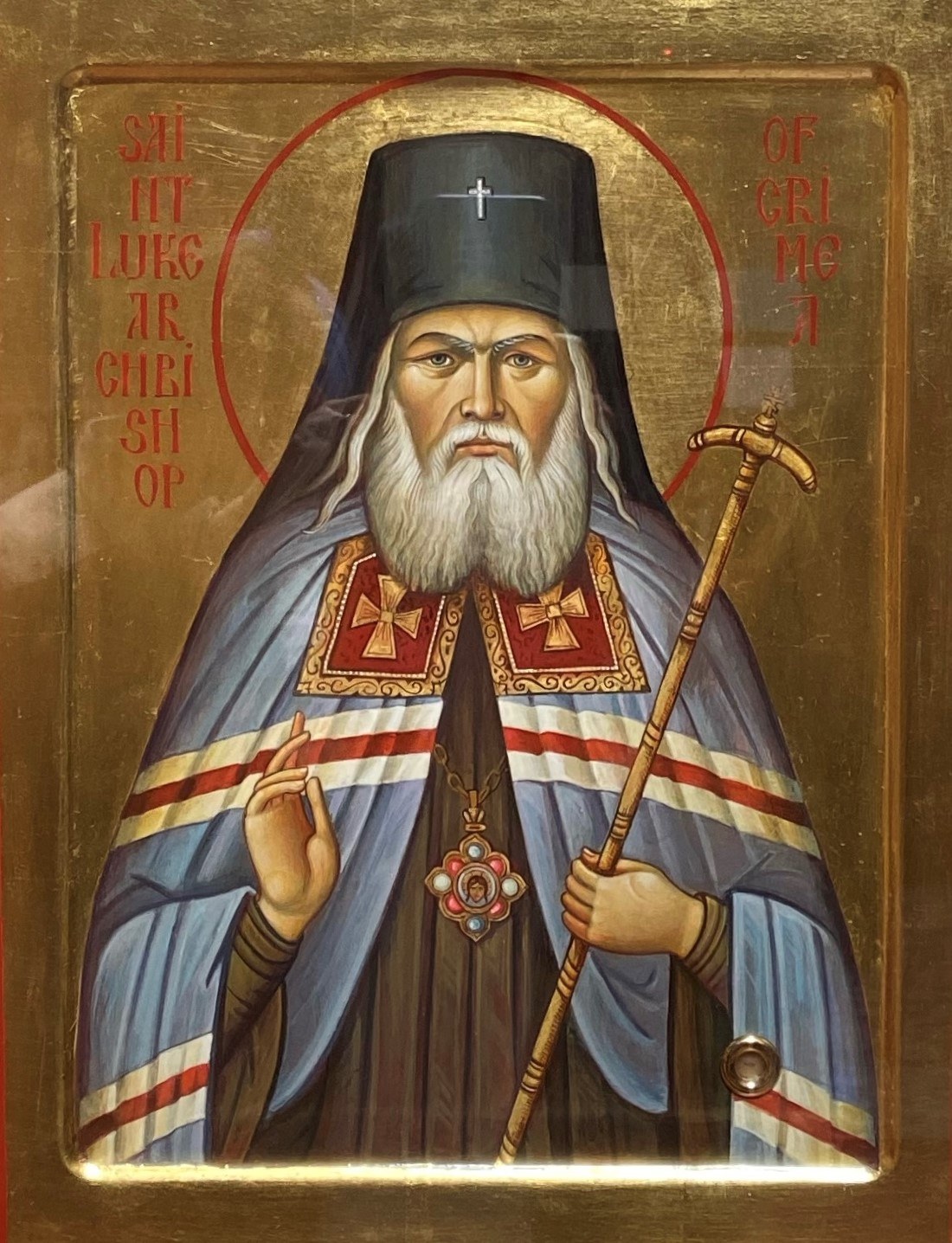
Why people ask St Luke of Crimea
Healing
He was a surgeon who became an archbishop, and he kept treating the sick through prison and exile under the Soviets. Greeks healed through his prayers gave 300 kilograms of silver for a reliquary to hold his relics.
Saint Luke, Archbishop of Simferopol, Orthodox Church in America
When it is said
The Church sings them on his feast, 11 June, which is 29 May in the old calendar.
This is the second of the two kontakia in his service, the one the Orthodox Church in America prints in English.
Anyone may sing or say them at home to ask his prayers.
Where it comes from
No author known
Who was St Luke?
Valentin Voyno-Yasenetsky was born in Kerch in 1877. He chose medicine to ease people’s suffering and wanted to be a doctor for the poor. He became a surgeon, and his doctoral thesis won a prize in 1916. His wife died in 1919, leaving him with four children. In 1921 he was ordained a priest in Tashkent, and two years later he became a monk named Luke and then a bishop.
St Luke, Archbishop of Simferopol, Orthodox Church in America
A surgeon in prison and exile
He was arrested days after becoming a bishop, and again in 1931 and 1937. Questioned for days on end in 1937, he went on hunger strike rather than sign statements written for him. He spent years in exile in Siberia and Arkhangelsk, and there he treated the sick and operated where he was allowed. In 1946 he won the Stalin Prize for his medical work and became Archbishop of Crimea.
St Luke, Archbishop of Simferopol, Orthodox Church in America
Honoured as a saint
He went completely blind in 1958 and died on 11 June 1961. The Church in Crimea counted him among its saints in 1995. In 1996 about 40,000 people walked with his relics from his grave to the cathedral in Simferopol. In 2000 the Russian Church honoured him as a saint in all its churches.
St Luke, Archbishop of Simferopol, Orthodox Church in America
In Church Slavonic
Возвести́телю пути́ спаси́тельнаго,
испове́дниче и архипа́стырю Кры́мския земли́,
и́стинный храни́телю оте́ческих преда́ний,
сто́лпе непоколеби́мый, Правосла́вия наста́вниче,
врачу́ богому́дрый, святи́телю Луко́,
Христа́ Спа́са непреста́нно моли́
ве́ру непоколеби́му правосла́вным дарова́ти
и спасе́ние, и ве́лию ми́лость.
Я́коже звезда́ всесве́тлая, доброде́тельми сия́ющи,
бы́л еси́, святи́телю,
ду́шу же равноа́нгельну сотвори́,
сего́ ра́ди святи́тельства са́ном поче́тся,
во изгна́нии же от безбо́жных мно́го пострада́,
и непоколеби́м ве́рою пребы́в,
враче́бною му́дростию мно́гия исцели́л еси́.
Те́мже ны́не честно́е те́ло твое́ от землены́х не́др обре́тенное ди́вно Госпо́дь просла́ви,
да вси́ ве́рнии вопие́м ти́:
ра́дуйся, о́тче святи́телю Луко́,
земли́ Кры́мския похвало́ и утвержде́ние.
From His service in the Menaion for 29 May, as printed on Azbyka.ru, a Russian Orthodox website.