
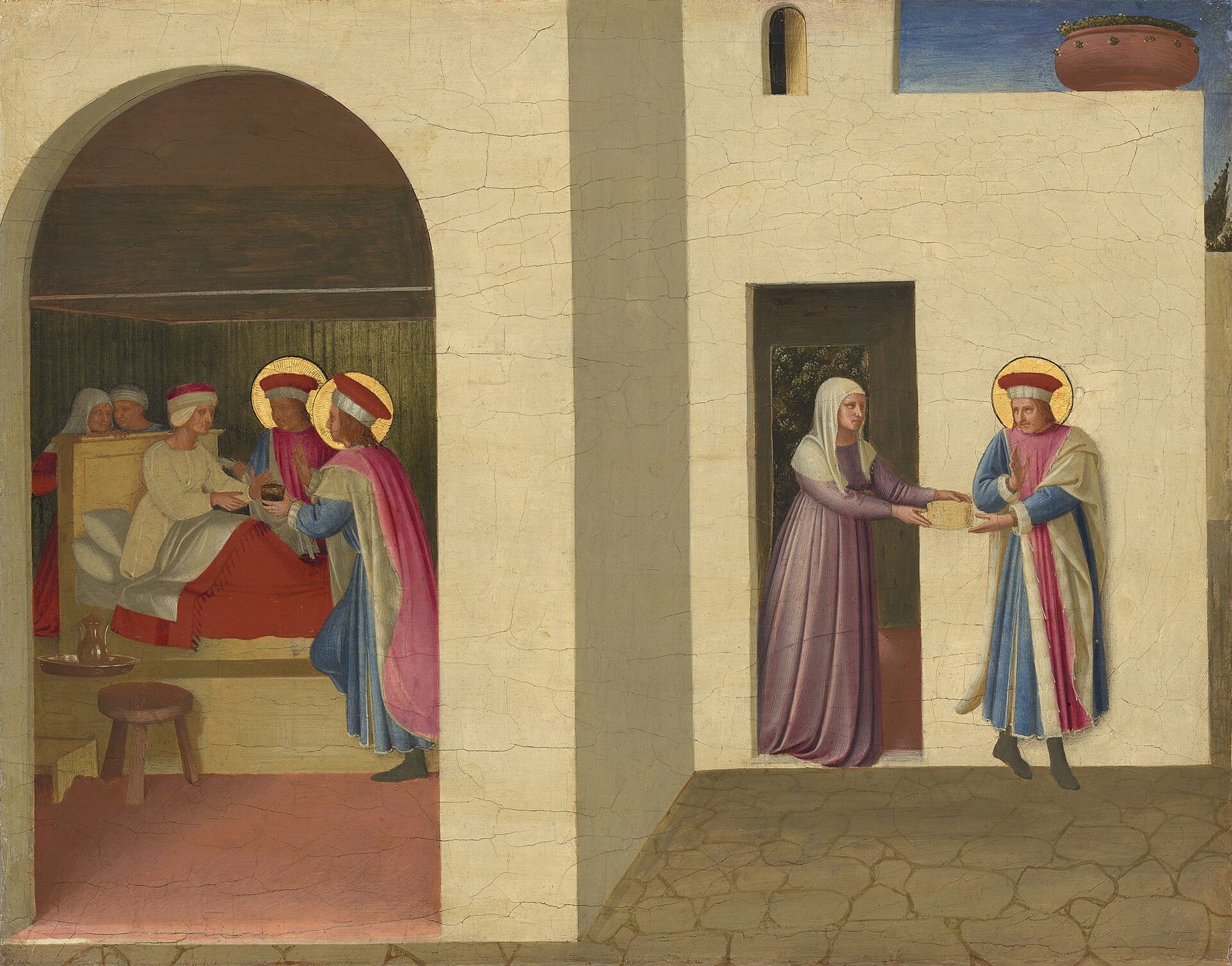
Why people ask Sts Cosmas and Damian
Healing
They head the list of healing saints in the Orthodox prayer over the oil when the Church anoints the sick. The emperor Justinian put his own cure from a dangerous illness down to their prayers.
The Service of Holy Unction, the prayer over the oil, Greek Orthodox Archdiocese of America; “Sts. Cosmas and Damian”, Catholic Encyclopedia, 1908
Their feast days
26 September: Their feast in the Catholic Church.
1 November: Their feast in the Orthodox churches on the new calendar. Those on the old calendar keep it on 14 November.
The Roman calendar, 26 September: Saints Cosmas and Damian, Martyrs; Holy Wonderworkers and Unmercenaries Cosmas and Damian, 1 November, Orthodox Church in America
When it is said
It is the troparion of Sts Cosmas and Damian on their feasts, 1 July and 1 November.
In Holy Unction, the service of anointing the sick, it is sung among the short hymns to the saints, straight after the hymn to St Panteleimon.
Where it comes from
No author known
Who were Cosmas and Damian?
Cosmas and Damian were brothers who worked as doctors and never took payment from the sick, so people called them the unmercenary physicians. The Church remembers three pairs of unmercenary saints with these names, those of Asia Minor on 1 November, of Rome on 1 July and of Arabia on 17 October.
Christ’s words in the hymn
The hymn’s last words are Christ’s own. He spoke them when He sent the twelve apostles out to heal the sick: “Freely you have received; freely give” (Matthew 10:8). Cosmas and Damian lived by that command, and the same passage is one of the Gospels read at Holy Unction.
Matthew 10:1-8; The service of Holy Unction (Greek Orthodox Archdiocese of America)
What the words mean
What “unmercenaries” means
The Greek calls the two saints anargyroi, which the traditional English renders “Unmercenaries”. The Church gives the title to saints who eased the sufferings of body and soul and asked nothing in return, above all the doctors of the early Church.
Isabel F. Hapgood, Service Book (1906), notes to Holy Unction
Why “visit”
The hymn’s Greek verb means to come and look after someone. Christ uses the same verb of those who cared for Him in the sick: “I was sick and you looked after Me” (Matthew 25:36). Some English books print “heal our infirmities”. The plain wording keeps the Greek, because the two doctors gave freely the healing they had freely received from God (Matthew 10:8).
The service of Holy Unction (Greek Orthodox Archdiocese of America)
The Scripture in it
Heal the sick, raise the dead, cleanse the lepers, drive out demons. Freely you have received; freely give.
Bible text: Berean Standard Bible, public domain.
In Greek
Ἅγιοι Ἀνάργυροι καὶ θαυματουργοί,
ἐπισκέψασθε τάς ἀσθενείας ἡμῶν,
δωρεὰν ἐλάβετε, δωρεὰν δότε ἡμῖν.