
Saint George
A soldier put to death for his faith about AD 303. Almost nothing about him is certain, yet East and West have honoured him for more than 1,500 years.
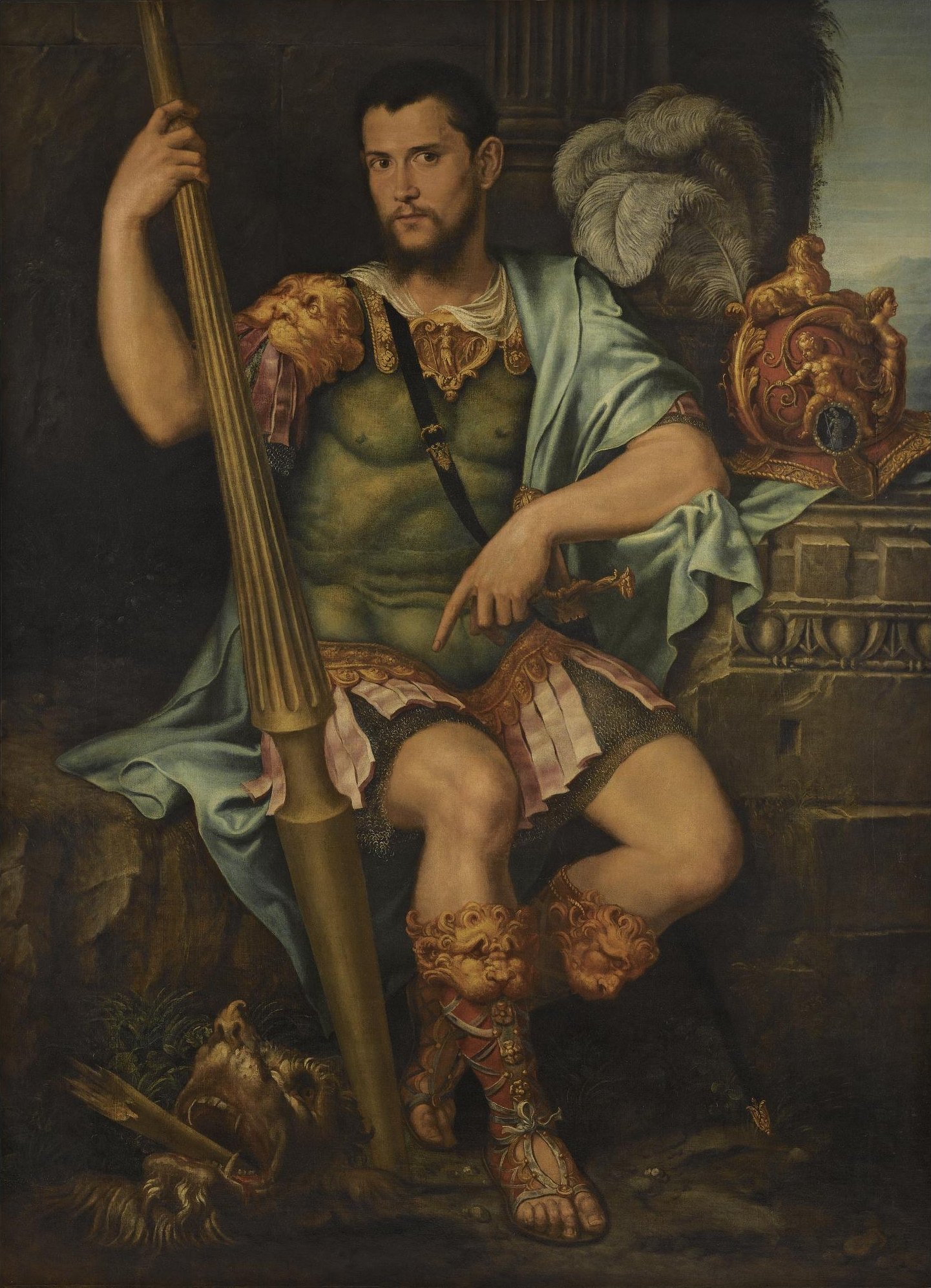
Picture: Portrait of a nobleman as Saint George, perhaps Jean de Dinteville, attributed to Francesco Primaticcio, about 1550. Public domain.
Who was George?
George was a soldier put to death for his faith about AD 303, probably under the emperor Diocletian, and buried at Lydda, in Palestine. Little else about him is certain. Some 750 years after his death, a legend grew up that he killed a dragon to save a king's daughter. England later made him its patron.
at a glance
His path, in order
- CappadocianBorn there, say the oldest stories
- SoldierAn officer in the Roman army
- MartyrBeheaded about AD 303, say his stories
- Great MartyrThe Orthodox title for the greatest martyrs
- Dragon-slayerIn a legend first written in the 1000s
- PatronOf England, soldiers and farmers
in numbers
- Times he died and rose, in his oldest story3
- A wheel of blades, a saw, then fire
- Christ raised him each time, the story says
- Men baptised in the dragon's city, in the best-known telling15k
- Women and children not counted
- In the Golden Legend, a medieval book of saints' lives
- Years from his death to the first written dragon story750
- About AD 303 to the late 1000s
- In the language of the country Georgia
did you know?
-
The earliest account of George known in Britain does not make him a martyr. Tied to a marble column at Lydda and flogged, he was set free and “lived for many years after the scourging”, wrote Adamnan, abbot of Iona, off Scotland.
Adamnan, The Holy Places, book 3, chapter 4, tr. J. R. Macpherson (1889) -
Where was the dragon? By a city of Libya, says the Golden Legend, a medieval book of saints' lives. In a lake near Beirut, says the Orthodox Church in America. By a city called Lasia, says the oldest text of the dragon story.
The Golden Legend; OCA, 23 April; Kevin Tuite (2025) -
In the Golden Legend, it took four ox-carts to haul George's dead dragon away. The king built a church there, with a spring that healed the sick.
The Golden Legend, Of S. George, Martyr
- Born
- In Cappadocia, in today's central Turkey, say the oldest stories. The Orthodox Church in America names Lydda, in Palestine, where his mother had her house.
- Died
- Probably about AD 303, when the emperor Diocletian began the last great persecution of Christians. The Orthodox give the day as 23 April 303. He died at or near Lydda, says the Catholic Encyclopedia.
- Buried
- At Lydda, also called Diospolis, today Lod in Israel. Pilgrims of the 500s to 700s found his tomb there. An Orthodox church stands over it.
- His name
- The Greek Γεώργιος, Georgios, from the word for a farmer, one who works the soil.
- Also called
- The Great Martyr, the Orthodox title for the greatest of the martyrs, and the Victory-Bearer. In the Coptic Church, the ancient church of Egypt, Prince of the Martyrs.
- Wrote
- Nothing.
- Status
- A saint to Catholics, Orthodox, Copts and Anglicans.
- Patron of
- England and soldiers. Farmers too, says the list of patron saints printed in the 1916 Roman Martyrology, the Church's book of saints, day by day. And Moscow, whose coat of arms shows him spearing the dragon. The Orthodox Church in America calls the country of Georgia “the Land of Saint George”.
- In art
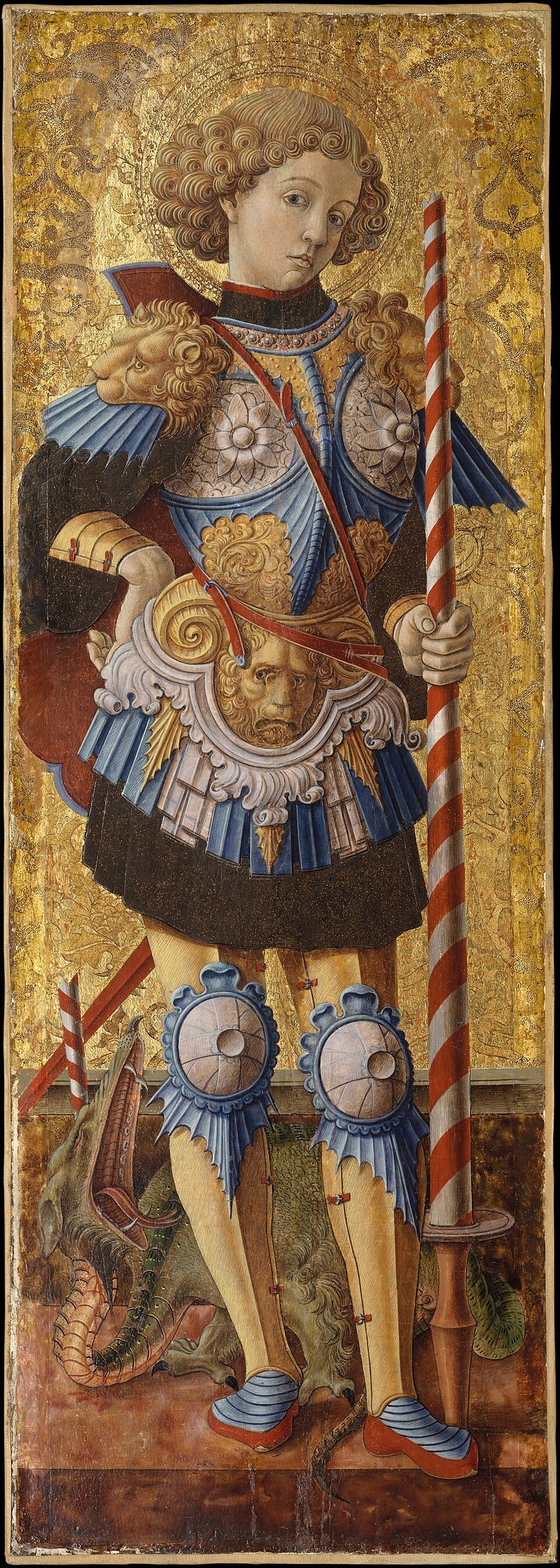
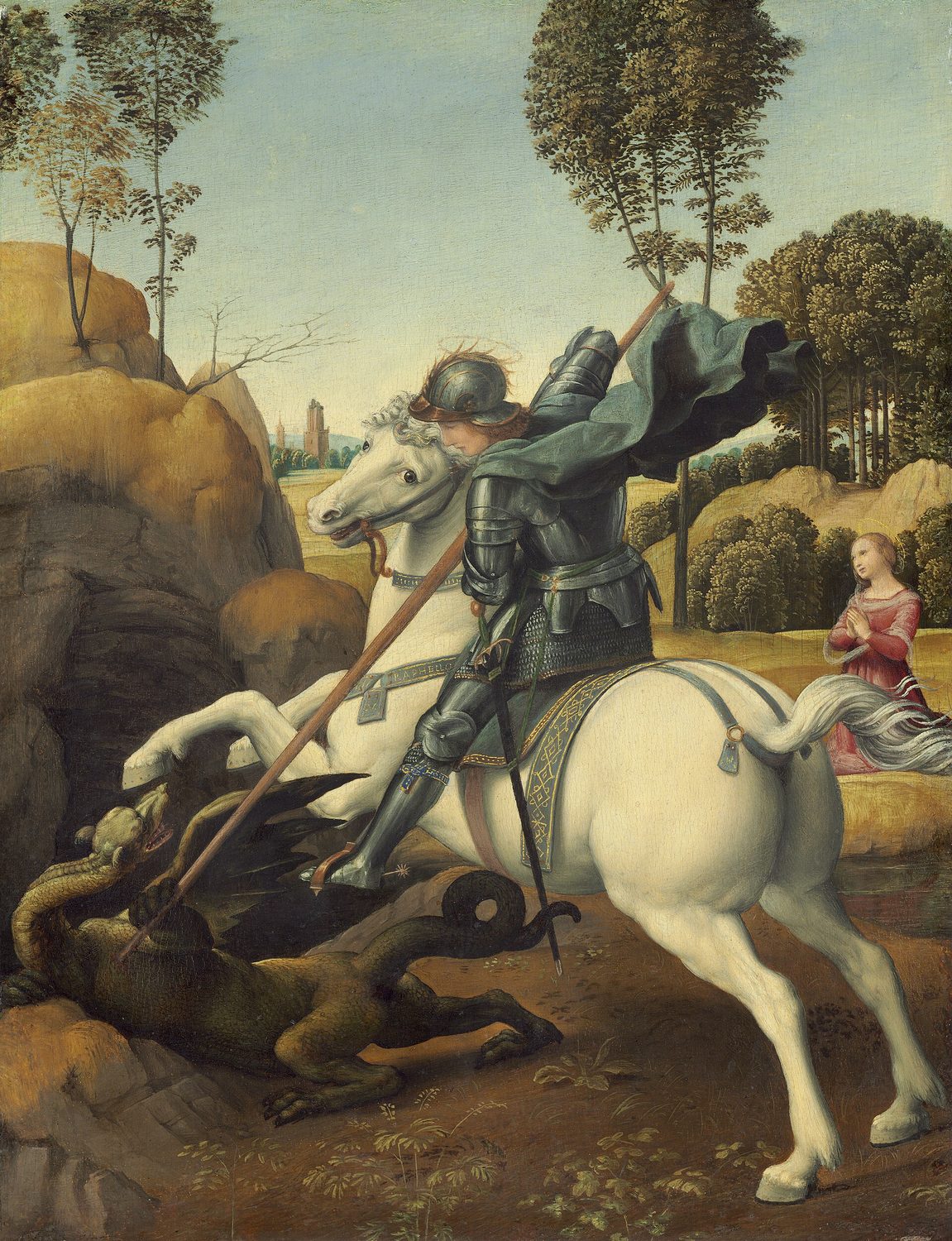
- A young soldier on a white horse, spearing a dragon, often with a king's daughter looking on. In the West his sign is a red cross on white, which is England's flag.
feast days
East and West
West
- Apr23
Catholic optional memorial, a feast each church may keep or leave. The Church of England keeps it as a Festival, for England's patron.
East
- Apr23
The day of his death, in the OCA and the other Orthodox churches on the new calendar.
- May1
The Coptic Church, on 23 Baramouda in its own calendar, the day of his martyrdom.
- May6
The day of his death, in the Russian Church and others on the old (Julian) calendar, 13 days behind.
- Nov3
The consecration of his church at Lydda, over his tomb, in the OCA.
- Nov16
The same feast of his church at Lydda, in the Russian Church on the old calendar, and in the Coptic Church, on 7 Hator.
- Nov26
The consecration of his church at Kiev in 1051, built by Prince Yaroslav, in the OCA.
Why so many days? 23 April is the day of his death in almost every church, and Rome has kept it since AD 683. The 1916 Roman Martyrology keeps him on that day too.
The November days mark two churches built in his honour: the one over his tomb at Lydda, and the one at Kiev built by Prince Yaroslav, who was baptised George. On the old calendar the Kiev feast falls on 9 December, the autumn feast of St George in Russia.
what was he like?
+humble
In his oldest story, George is the prisoner of Dadianus, governor of Tyre. To disgrace the Christians, Dadianus lodged him with the city's poorest widow. While she was out begging bread, the archangel Michael brought George a table of food.
She came back and fell at his feet in worship. George made her rise: “Rise up and stand upon thy feet, for I am not the God of the Christians, but only His servant.”
Martyrdom of Saint George, tr. Budge (1888), pp. 221 to 223+bold before the powerful
In the Golden Legend, a medieval book of saints' lives, some Christians give up their faith under persecution. George sells all he has for the poor, and walks among the pagans crying out that their gods are devils. The governor asks his name: “I am named George, I am a gentleman, a knight of Cappadocia, and have left all for to serve the God of heaven.”
The Golden Legend, Of S. George, Martyr+cheerful under torture
In the life told by the Orthodox Church in America, the emperor Diocletian had George shod in iron sandals with red-hot nails. In the morning George came back cheerful, his feet healed, and the emperor asked how he liked his shoes. Just his size, George said. He had already warned the emperor: “You will grow tired of tormenting me sooner than I will tire of being tormented by you.”
OCA, 23 April, Greatmartyr George+open-handed
In the Golden Legend, the king whose city George had saved from the dragon offered him a fortune. George would take none of it: “he refused all and commanded that it should be given to poor people for God's sake”. He asked the king only to care for the churches, honour the priests and pity the poor. Then he kissed the king and went on his way.
The Golden Legend, Of S. George, Martyrwhat others said of him
No writing from George's own time survives. These voices come from the centuries after.
…whose names are justly reverenced among men, but whose actions are only known to God.
Hence it is clearly shown in what honour George has been held with God, Whom he confessed amid tortures.
Heretics have written falsehoods in their books about the holy man who is called George.
…thou Saint George shalt called bee, Saint George of mery England, the signe of victoree.
Cry, “God for Harry! England and Saint George!”
his life in six moments
Tyre
The oldest storyA soldier of Christ
His oldest story makes George a young officer from Cappadocia, in today's Turkey, grown rich in the Roman army. He came to Tyre, a port in today's Lebanon, hoping for promotion. There the governor Dadianus and his fellow governors, seventy in all, had ordered everyone to worship the gods. For three years no one had dared to say “I am a Christian”.
Seeing the governors sacrifice, George gave up his rank: “I will become a soldier of my Lord Jesus Christ the King of heaven.” He gave his wealth to the poor and told the governors their gods had not made heaven and earth. Dadianus had him tortured and jailed.
Martyrdom of Saint George, tr. Budge (1888), pp. 203 to 208Tyre
The oldest storyChrist in the prison
George had been thrown into prison at Tyre for confessing Christ. On his first night there, the Lord appeared to him and promised to make him strong enough to bear everything.
Then He told him what was coming: “Thou shalt die three times, and I will raise thee up again, but after the fourth time, I Myself will come upon a cloud”, to take him to the place prepared for him. The Lord embraced George and went back up to heaven.
Martyrdom of Saint George, tr. Budge (1888), pp. 208 and 209Tyre
The oldest storyThe magician's two cups
The governor Dadianus said George bore his tortures by magic, and promised riches to any magician who could break it. A magician named Athanasius came. He called on demons over a cup of poison and gave it to George, who drank it and was unharmed. A second, stronger cup did him no harm either.
Athanasius believed in Christ, and begged George: “have mercy upon my soul, and give me the seal of Christ.” He meant baptism. In a rage, Dadianus had Athanasius put to death by the sword outside the city, and he died a martyr.
Martyrdom of Saint George, tr. Budge (1888), pp. 209 and 210Tyre
The oldest storyAlexandra hears the psalms
After seven years of torture, the governor Dadianus tried kindness, and George pretended to give in. Delighted, Dadianus took him into his palace like a son, and left him for the night in the room of his wife, Alexandra.
George knelt and prayed the psalms aloud. Alexandra asked him what the words meant, and who Christ was. George told her how God made the world, and how His Son became man to save it. She believed. But she was afraid of her husband, as savage as a wild beast, she said, and begged George to keep her faith a secret.
Martyrdom of Saint George, tr. Budge (1888), pp. 225 to 228Tyre
The oldest storyThe idol of Apollo
In the morning the governor called the whole city to watch George sacrifice to Apollo, as George had pretended he would. The widow who had lodged him came in grief, with her little son. The boy was blind and deaf, and George had already given him sight. Now he healed the boy's ears, and sent him into the temple to call the idol out in George's name.
The statue leaped from its stand, and the demon inside confessed he was the angel cast out of heaven for pride. George stamped, the earth opened, and demon and idol went down into the abyss. The priests tied George's hands and took him to the governor.
Martyrdom of Saint George, tr. Budge (1888), pp. 228 to 231Tyre
The oldest storyBaptised in her own blood
Alexandra, the governor's wife, had secretly become a Christian after hearing George pray the psalms. When George destroyed the idol of Apollo, she told her husband Dadianus to leave the Christians alone, for their God was the true God. He had her tortured.
She had never been baptised, and asked George what would become of her. Christians held that a martyr who died unbaptised was baptised in her own blood. So George told her: “Go, and thou shalt receive baptism by the pouring out of holy blood.” She was beheaded, and died a martyr.
Martyrdom of Saint George, tr. Budge (1888), pp. 232 and 233; Catholic Encyclopedia (1907), Baptism
his miracles
George's oldest story, known by the 400s, is full of wonders. At its heart are three deaths: three times the governor had him killed, and three times Christ raised him. Its teller says he is George's servant Pasikrates, who stayed with him to the end:
I have written down his holy martyrdom, and have added nothing thereto nor taken any thing therefrom.
3 times he died and rose, in the oldest story
-
Tyre
The first deathThe wheel of blades
In his oldest story, the governor Dadianus tied George to a wheel set with blades. George feared he would never come off it alive, then rebuked himself and prayed. The wheel broke his body into ten pieces, which were thrown into a dry pit.
The Lord came to the pit and sent the archangel Michael down for the bones. Then the Lord breathed on George's face, and he lived. He walked back into the governors' court, and a general knew him. The general and more than three thousand soldiers believed in Christ. Dadianus had them all put to death, and they went to Paradise.
“Of a truth this is George who has risen from the dead”
Martyrdom of Saint George, tr. Budge (1888), pp. 211 to 214 -
Tyre
The second deathSawn in two
In his oldest story, Magnentius, one of the seventy governors judging George, asked him for a sign. Let the wooden legs of their thrones blossom, he said, and he would believe. George prayed, and they did. But Magnentius credited his god Herakles.
When George called Herakles a blind and dumb idol, their chief, Dadianus, had him sawn in two. The pieces were boiled in a cauldron of lead and pitch, and buried. The Lord came, an angel lifted the cauldron out, and the Lord called George forth, as He once raised Lazarus. George rose as if he had felt no pain.
“For I am He that raised up Lazarus from the dead”
Martyrdom of Saint George, tr. Budge (1888), pp. 215 to 217 -
Mount Siris
The third deathLeft for the birds
In his oldest story, the governor heard that George had made the wooden pillar of a poor widow's house grow into a tree. He had George flogged and burned until he died, and his body left on a mountain for the birds.
As its four bearers walked away, thunder shook the mountain. The Lord came on a cloud and told George to rise. George ran after them. They fell at his feet and asked to be baptised, and he baptised them. They told the governors they were Christians, and were put to death.
“Wait a little for me until I come up with you.”
Martyrdom of Saint George, tr. Budge (1888), pp. 221 to 225
A poor woman's ox
In his oldest story, a poor woman named Schollastike cried out to George in the street. Her ox had fallen down dead in the field.
George handed her his own staff and told her to lay it on the ox and bid it rise, in his name and the name of Jesus Christ. She did, and the ox stood up at once. She praised God and called George a prophet. His words to her:
“Take this staff from my hands, and go to the field and lay it upon the dead ox”Martyrdom of Saint George, tr. Budge (1888), p. 218
The dead in the tomb
In his oldest story, a governor swore he would become a Christian if George's prayers could raise the dead of an old rock tomb. The governors opened it and found only dust. George knelt and prayed for an hour.
Lightning flashed on the dust, and five men, nine women and three children stood up. One said he had died more than two hundred years before. They begged George for baptism. He struck the ground, water welled up, and he baptised them. Sent to Paradise, they vanished. But the governors called it magic, and the oath was never kept.
“Depart in peace to Paradise”Martyrdom of Saint George, tr. Budge (1888), pp. 218 to 221
A later legend: the dragon
George's best-known story was first written in the 1000s. As the Golden Legend, a book of saints' lives, tells it, a dragon by a city of Libya poisons the people with its breath. They feed it sheep, then their children, chosen by lot. The lot falls on the king's daughter.
George rides by as the dragon charges. He makes the sign of the cross, wounds it with his spear, and has her tie her belt round its neck. She leads it into the city, and the people flee. George promises to kill it if they believe in Christ. The king and his people are baptised, and George cuts off its head.
“the dragon followed her as it had been a meek beast and debonair”The Golden Legend, Of S. George, Martyr, tr. William Caxton (1483); Kevin Tuite (2025), on the date
The column at Lydda
At Lydda stood a marble column where George had been tied and flogged, with his likeness carved on it. A rough unbeliever rode in and asked whose face it was. Told it was George's, he drove his lance at it in a rage.
The lance went into the stone as if into snow, and stuck fast. His horse fell dead, and as he fell, his ten fingers sank into the marble as if into clay. Terrified, he begged God and George with tears to free him. God forgave him and set him free. A pilgrim bishop, Arculf, later put his own fingers into the marks.
“as if it were a ball of snow”Adamnan, The Holy Places, book 3, chapter 4, tr. J. R. Macpherson (1889)
The horse he had promised
At Lydda, George's likeness was carved on a marble column in a house. A man riding in to join an army stood before it and promised George his beloved horse, if both came home safe. They did.
But he loved the horse more than gold, so he laid its price, twenty gold coins, before the likeness instead. The horse would not move. He added ten coins at a time until the pile reached sixty. At last he gave in: George could have the horse too. At once it could move. He led it inside, gave it to George before the likeness, and left praising Christ.
“…now I see clearly what thy will is.”Adamnan, The Holy Places, book 3, chapter 4, tr. J. R. Macpherson (1889)
was george real?
His stories are legends, and scholars agree on that. Most, but not all, think a real martyr stands behind them.
What is certain
The Catholic Encyclopedia of 1909 put everything certain about George in one line, which it called “all that can safely be affirmed about St. George”. It dates his death to before Constantine, the first Christian emperor:
“Martyr, patron of England, suffered at or near Lydda, also known as Diospolis, in Palestine, probably before the time of Constantine.”Catholic Encyclopedia (1909), St. George
The evidence of his tomb
The Catholic Encyclopedia held that George did live, because of the honour paid him at one place from very early times. Pilgrims of the 500s to the 700s found him honoured at Lydda, where his body lay. Ruined churches in Syria, Mesopotamia and Egypt bear old inscriptions to him. It calls such honour a cultus:
“An ancient cultus, going back to a very early epoch and connected with a definite locality, in itself constitutes a strong historical argument.”Catholic Encyclopedia (1909), St. George
The man who tore down the edict
In AD 303 the emperor Diocletian posted his first edict against the Christians at Nicomedia, his capital. The historian Eusebius, who lived through it, says a man of high rank tore it down at once, and was put to death.
Later tellings named him George. But the Catholic Encyclopedia says George “cannot safely be identified” with him, and the old lists of martyrs call the man John. Eusebius tells the deed:
“…seized the edict as it was posted openly and publicly, and tore it to pieces as a profane and impious thing”Eusebius, Church History, book 8, chapter 5, tr. McGiffert (1890), with his notes; Coptic synaxarium, 23 Baramouda; Catholic Encyclopedia (1909)
A doubter
Wallis Budge, who put George's oldest story into English in 1888, thought it grew from the man who tore down Diocletian's edict, and that each new telling added a new wonder. Of George himself, he wrote:
“As for Saint George the martyr it is very improbable that such a person ever lived.”E. A. Wallis Budge (1888), preface
Rome, 1969
When Rome revised its calendar of saints in 1969, it dropped some martyrs. It kept George and a few other martyrs honoured far and wide. It gave its reason in one Latin sentence. In our translation:
“Their stories of martyrdom are indeed legendary, but historians have no doubt at all that they lived and died as martyrs.”Calendarium Romanum (1969), our translation of the Latin
his words
George wrote nothing. These are the words his stories give him. Wallis Budge put his oldest story into English in 1888, and William Caxton the Golden Legend in 1483.
Back from the dead, to the governors
I am George whom ye slew yesterday, because ye despised my God.
In his oldest story, the governors had his body broken on a wheel of blades and thrown into a pit. Christ raised him, and the next day he walked back into their court.
Martyrdom of Saint George, tr. Budge (1888), p. 213Come Jesus, and help my infirmity, for I am a sinner; let these sufferings be light upon me.
Fair daughter, doubt ye no thing hereof for I shall help thee in the name of Jesu Christ.
Wherefore saidst thou not to me thus at the beginning? I am ready to do as thou sayest.
myths and misquotes
The dragon story is as old as George.
What the sources sayNo. His oldest story, known by the 400s, has no dragon, though it calls the cruel governor “the dragon of the abyss”. The dragon story was first written down in the 1000s, in the language of Georgia, some 750 years after his death. The Golden Legend, a book of the 1200s, carried it across Europe.
Kevin Tuite, Dumbarton Oaks Papers 79 (2025); Martyrdom of Saint George, tr. Budge (1888), p. 212George is the Greek hero Perseus under a new name.
What the sources sayNo. Perseus saved a princess from a sea monster, and a writer on his legend claimed that in George “the Church has converted and baptized the pagan hero Perseus”. The Catholic Encyclopedia called that “certainly not true”: George was honoured for centuries before any dragon joined his story.
Catholic Encyclopedia (1909), St. GeorgeHe was really George of Cappadocia, a bishop of Alexandria in the 300s.
What the sources sayNo. The historian Edward Gibbon suggested it in the 1700s. That George was an Arian, who held that the Son of God was created, and was made bishop in place of Saint Athanasius. Gibbon's editor said the idea “has nothing to be said for it”, and the Catholic Encyclopedia found the martyr honoured too early to be him.
Catholic Encyclopedia (1909), St. GeorgeThe Catholic Church dropped George from its calendar in 1969.
What the sources sayNo. Rome's new calendar of 1969 kept him on 23 April as an optional memorial, a feast each church may keep or leave. Its list of changes says of his day only Nil mutatur, nothing is changed.
Calendarium Romanum (1969)St George was English.
What the sources sayNo. Every telling makes him a man of the East: born in Cappadocia, in today's Turkey, or at Lydda, in Palestine, and buried at Lydda. England took him as its patron in the Middle Ages.
Catholic Encyclopedia (1909), St. George; OCA, 23 April and 3 Novemberfriends, family and rivals
The cruel governor of George's oldest story, who tortures him for seven years. The story calls him “the dragon of the abyss”. Later tellings turned him into the emperor Diocletian, whose name is close to his.
Martyrdom of Saint George, tr. Budge (1888); Catholic Encyclopedia (1909)The governor's wife in George's oldest story. George teaches her the faith in one night, and she dies a martyr before him. The Orthodox honour her as Alexandra the Empress, wife of the emperor Diocletian.
Martyrdom of Saint George, tr. Budge (1888); OCA, 23 April, Martyr Alexandra the EmpressHired by the governor, in the oldest story, to break George's supposed magic. When his poisoned cups did George no harm, he believed in Christ, and was put to death for it.
Martyrdom of Saint George, tr. Budge (1888)George's servant, named as the teller of his oldest story. He says he stayed with his master to the end. A later sermon adds that he helped carry the body home to Lydda.
Martyrdom of Saint George, tr. Budge (1888), and the Encomium of TheodosiusThe Roman emperor from AD 284 to 305. In AD 303 he began the last great persecution of Christians, and George probably died under it. Later tellings of George's story make him the persecutor.
OCA, 23 April; Eusebius, Church History, book 8The princess of the dragon legend. The lot falls on her to be fed to the dragon, and she leads the tamed beast into her city with her belt tied round its neck.
The Golden Legend, Of S. George, Martyrhow he died
No record from his own time says how he died. The stories of his martyrdom agree that he was beheaded, after long tortures.
In his oldest story, the governor Dadianus and the other governors signed George's death sentence, and he went to his execution rejoicing. For seven years these seventy men had tortured him. They had killed thousands of Christians, the governor's own wife among them, and when George raised the dead, they called it magic.
There George prayed for fire from heaven on them, and fire came down and burned them up. Then he prayed for mercy on all who would call on his name, and Christ promised it. He stretched out his neck, and when his head was cut off, water and milk flowed out.
A sermon credited to Theodosius, a bishop of Jerusalem about AD 450, says his servants took the body by ship from Tyre to Joppa, today's Jaffa, and on to his family's house at Lydda.
Later tellings end more gently. In the life told by the Orthodox Church in America, George prays that the Lord would forgive his torturers, who acted in ignorance.
His last prayer, in his oldest story
Grant that my name may heal all those afflicted by unclean spirits, who shall remember Thy servant George.
He asked too for rain in times of drought, and for the forgiveness of all who are kind to the poor in his name.
how england took him
George never saw England. Yet by the 1400s his day was kept there like Christmas, and English soldiers wore his red cross.
Known in Britain by the 700s
Adamnan, abbot of the island monastery of Iona, off Scotland, wrote down a pilgrim's stories of George's marble column at Lydda. The Catholic Encyclopedia thinks this probably made George well known in Britain, early in the 700s. Later Ælfric, an English monk, told his martyrdom in Old English, and England had churches of St George before the Norman Conquest of 1066.
Catholic Encyclopedia (1909); Macpherson (1889), note to Adamnan's book 3, chapter 4The saints at Antioch
The Crusades made George more popular in the West, says the Catholic Encyclopedia. In 1098 the First Crusade, an army from western Europe marching on Jerusalem, fought a great Turkish army outside Antioch. An eyewitness chronicle says that in the battle countless riders on white horses came down from the mountains, led by the soldier-saints George, Mercurius and Demetrius. The Turks fled, and the crusaders won. The chronicler adds:
“This is to be believed, for many of our men saw it.”Gesta Francorum, in A. C. Krey, The First Crusade (1921); Catholic Encyclopedia (1909), St. George
A red cross on white
The first sure sign of George's cross on an English flag is the seal of the town of Lyme Regis, in 1284: a ship flying a plain flag with a cross. In the 1340s King Edward III paid for 86 small flags bearing the arms of St George, his red cross on white, for his own ship, and 800 more for his men.
King Richard II later ordered every soldier invading Scotland to wear “a signe of the arms of St. George” before and behind. It is England's flag today.
Catholic Encyclopedia (1909), St. GeorgeThe Garter
About 1347 King Edward III founded the Order of the Garter, a company of knights, with George as its chief patron. Its church is St George's Chapel at Windsor Castle, and its badge shows George slaying the dragon. Why George? The Catholic Encyclopedia thought it might be the princess's belt in his dragon legend, a strap much like a garter.
Catholic Encyclopedia (1909), St. George; Wikipedia, Order of the GarterA feast like Christmas
In 1222 a church council at Oxford made 23 April a lesser holiday in England. In 1415 the Archbishop of Canterbury raised it to one of the greatest feasts of the year, to be kept like Christmas Day. The Church of England keeps it today as a Festival for George, “Martyr, Patron of England”.
Catholic Encyclopedia (1909); Church of England, Common Worship calendaris he a saint?
Yes. Catholics, Orthodox, Copts and Anglicans all count him a saint. The Orthodox call him a Great Martyr, their title for the greatest of the martyrs.
- CatholicSaintAn optional memorial on 23 April
- OrthodoxSaintGreat Martyr and Victory-Bearer, 23 April
- CopticSaintPrince of the Martyrs, 23 Baramouda, which is 1 May
- AnglicanSaintPatron of England, a Festival on 23 April
His honour began at his tomb at Lydda. In the East he has been counted among the greatest of the martyrs from the beginning, says the Catholic Encyclopedia. In the West, his church in Rome, St George in Velabro, is very old.
In its entry for 23 April, the old Roman Martyrology, the Church's book of saints, day by day, gives him one line:
…birthday of St. George, whose illustrious martyrdom is honored by the Church of God among the combats of other crowned martyrs.
what to read first
The Martyrdom and Miracles of Saint George of Cappadocia
E. A. Wallis Budge, 1888
The oldest story of his three deaths, put into English from Coptic, the old language of Egypt's Christians. The book adds his later miracles and two old sermons about him.
Read it freeOf S. George, Martyr
Jacobus de Voragine, in Caxton's English
The Golden Legend's chapter: the dragon, then the martyrdom, as the Middle Ages told them. About ten minutes.
Read it freeSt. George
Catholic Encyclopedia, 1909
One page: what is certain, what is legend, and how England took him.
Read it freeThe Holy Places
Adamnan, abbot of Iona, tr. J. R. Macpherson, 1889
The pilgrim Arculf's travels, as he told them to Adamnan. Its chapter on George tells the two stories of his marble column at Lydda, the oldest known to have been read in Britain. Printed as The Pilgrimage of Arculfus in the Holy Land.
Read it freetake the quizzes
 Quiz Which early Christian
thinks like you? And which would argue with you? Start
 Quiz Christian

Personality Test Which of eight types are you? Find your own. Start
sources
His life, and the stories
- E. A. Wallis Budge, The Martyrdom and Miracles of Saint George of Cappadocia: the Coptic texts, with an English translation. London, 1888.
- Jacobus de Voragine, The Golden Legend, “Of S. George, Martyr”. Tr. William Caxton (1483), ed. F. S. Ellis (1900).
- Eusebius, Church History, book 8, chapter 5. Tr. Arthur McGiffert, 1890, with his notes.
- Decretum Gelasianum, the Latin text, ed. Ernst von Dobschütz (1912).
- Adamnan, The Holy Places: tr. J. R. Macpherson as The Pilgrimage of Arculfus in the Holy Land. Palestine Pilgrims' Text Society, 1889.
- Ælfric's Lives of Saints, volume 1. Ed. and tr. W. W. Skeat, Early English Text Society, 1881.
- A. C. Krey, The First Crusade: the accounts of eyewitnesses and participants. Princeton, 1921.
- Kevin Tuite, The Miracle of St. George, the Princess, and the Dragon. Dumbarton Oaks Papers 79 (2025).
- Edmund Spenser, The Faerie Queene, Book 1, 1590.
- William Shakespeare, Henry V, about 1599.
Reference
- Catholic Encyclopedia, 1909, “St. George”
- Catholic Encyclopedia, 1907, “Baptism”, on the baptism of blood
- Catholic Encyclopedia, 1909, “Pope St. Gelasius I”
- Wikipedia, “Order of the Garter”
Calendars
- USCCB, Liturgical Calendar 2026, Saint George, Martyr, 23 April
- Calendarium Romanum, 1969, on 23 April
- The Roman Martyrology, 1916 edition, 23 April
- Church of England, Common Worship calendar
- OCA, Greatmartyr, Victory-bearer, and Wonderworker George
- OCA, the Consecration of the Church of the Great Martyr George in Lydda
- OCA, the Consecration of the Church of the Great Martyr George at Kiev
- OCA, Martyr Alexandra the Empress
- CopticChurch.net, the Coptic synaxarium, 23 Baramouda
- CopticChurch.net, the Coptic synaxarium, 7 Hator
Pictures
- Portrait of a nobleman as Saint George, attributed to Francesco Primaticcio, about 1550. Public domain.
- Saint George, Carlo Crivelli, 1472. The Metropolitan Museum of Art. CC0.
- Saint George and the Dragon, Raphael, about 1506. National Gallery of Art, Washington. CC0.