
Mercurius
A soldier martyr of the 200s, whom later Christians credited with killing an emperor more than a century after his own death.
Who was Mercurius?
Mercurius was a martyr honoured at Caesarea in Cappadocia, in what is now Turkey. Almost everything known about him comes from his Passion, the story of his martyrdom written centuries later. It makes him a Roman officer beheaded about AD 250. The Copts paint him with a sword in each hand and call him Abu Sefein, father of two swords.
at a glance
His path, in order
- SoldierIn his Passion, an angel gave him a sword
- GeneralThrew his belt and cloak at the emperor's feet
- MartyrHealed overnight in prison, then beheaded
- LegendCredited with killing the emperor Julian in AD 363
in numbers
- Swords in his Coptic icons2
- Coptic paintings show him with a sword in each hand over the fallen emperor Julian, so the Copts call him Abu Sefein, “father of two swords”.
- Years between his death and Julian’s113
- His Passion has him die about AD 250, and Julian, whom legend has him strike down, died in battle in AD 363.
- Churches of his in medieval Egypt30
- About that many appear in a list of Egypt’s churches and monasteries written in the early 1200s.
did you know?
-
The Orthodox icon carver Jonathan Pageau and his brother Matthieu write GodsDog, graphic novels on the old legend of Saint Christopher as a giant with a dog's head. Mercurius is one of its four heroes. His own Coptic and Ethiopian legend has dog-headed men in it too.
The Symbolic World; godsdog.com -
In 1098 the crusaders at Antioch were starving and surrounded by a great Turkish army. One of them wrote that when they marched out to fight, countless riders on white horses came down from the mountains, led by the soldier saints George, Mercurius and Demetrius: “This is to be believed, for many of our men saw it.” The Turks fled that day, and the crusaders took their camp.
Gesta Francorum, tr. Krey (1921)
- Died
- About AD 250, according to his Passion
- Relics
- Benevento in Italy has honoured relics as his since they were brought there in AD 768; the Jesuit scholar Hippolyte Delehaye argued they belong to another Mercurius, from Aeclanum in southern Italy
- Name
- His father called him Philopator, which means lover of his parents; his captain named him Mercurius (Mercury in English) when he became a soldier
- Home
- Son of a Scythian officer in the Coptic and Greek tellings; a native of Cappadocia or Rome in others
- Regiment
- His Passion puts him in the Martusians, a unit that had served in Armenia
- His church
- The church of Abu Sefein in Old Cairo, which its own tradition dates to AD 927; Coptic popes were consecrated and buried there
- Status
- Great Martyr in the Orthodox Church
- Feast day
- In most calendars 25 November; the Russian Church keeps 24 November, and the Copts 4 December
- Looked like
- Handsome and red-haired, about 20 years old, in the Coptic Passion; fair-haired and 25 years old in a Greek calendar
- In art
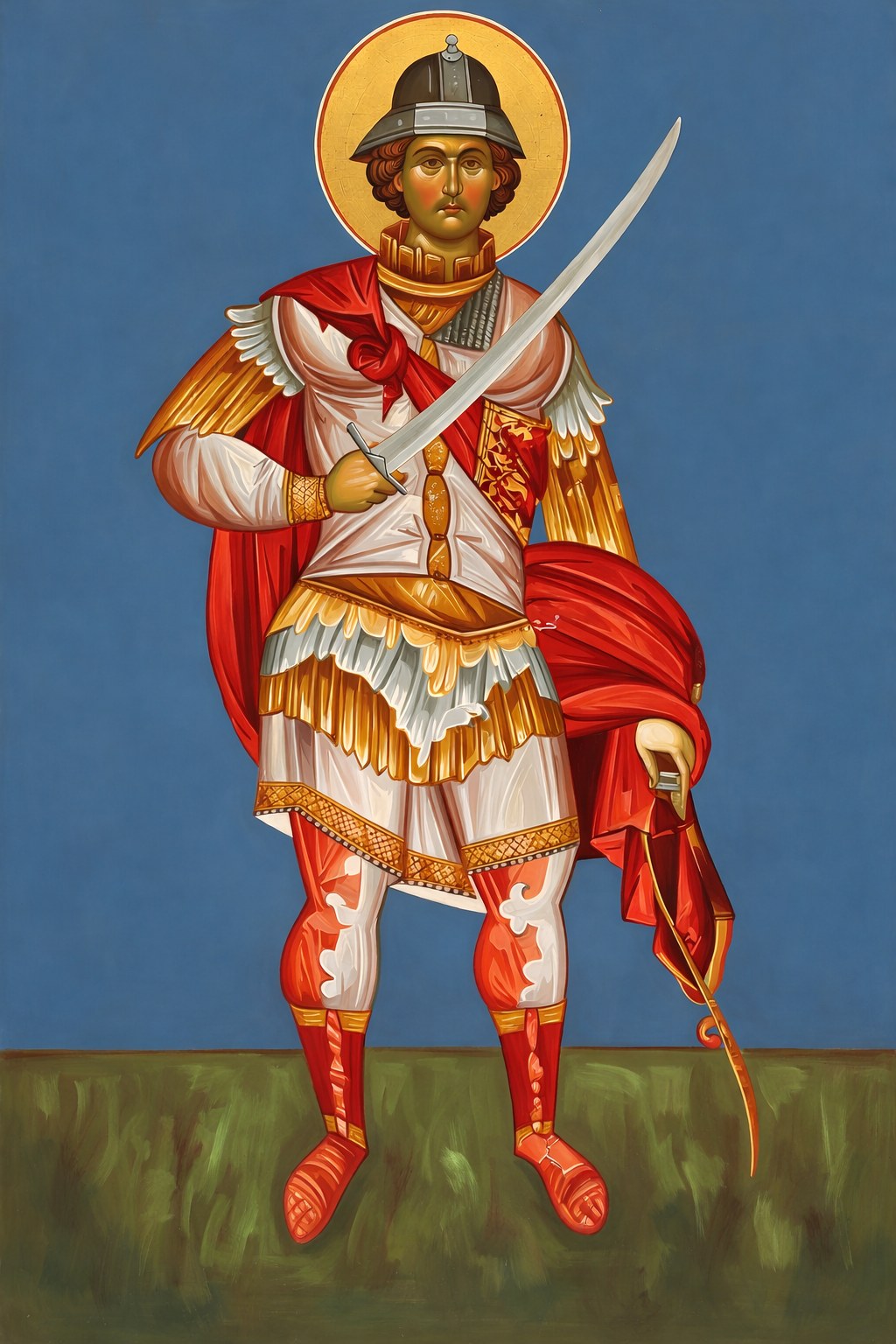
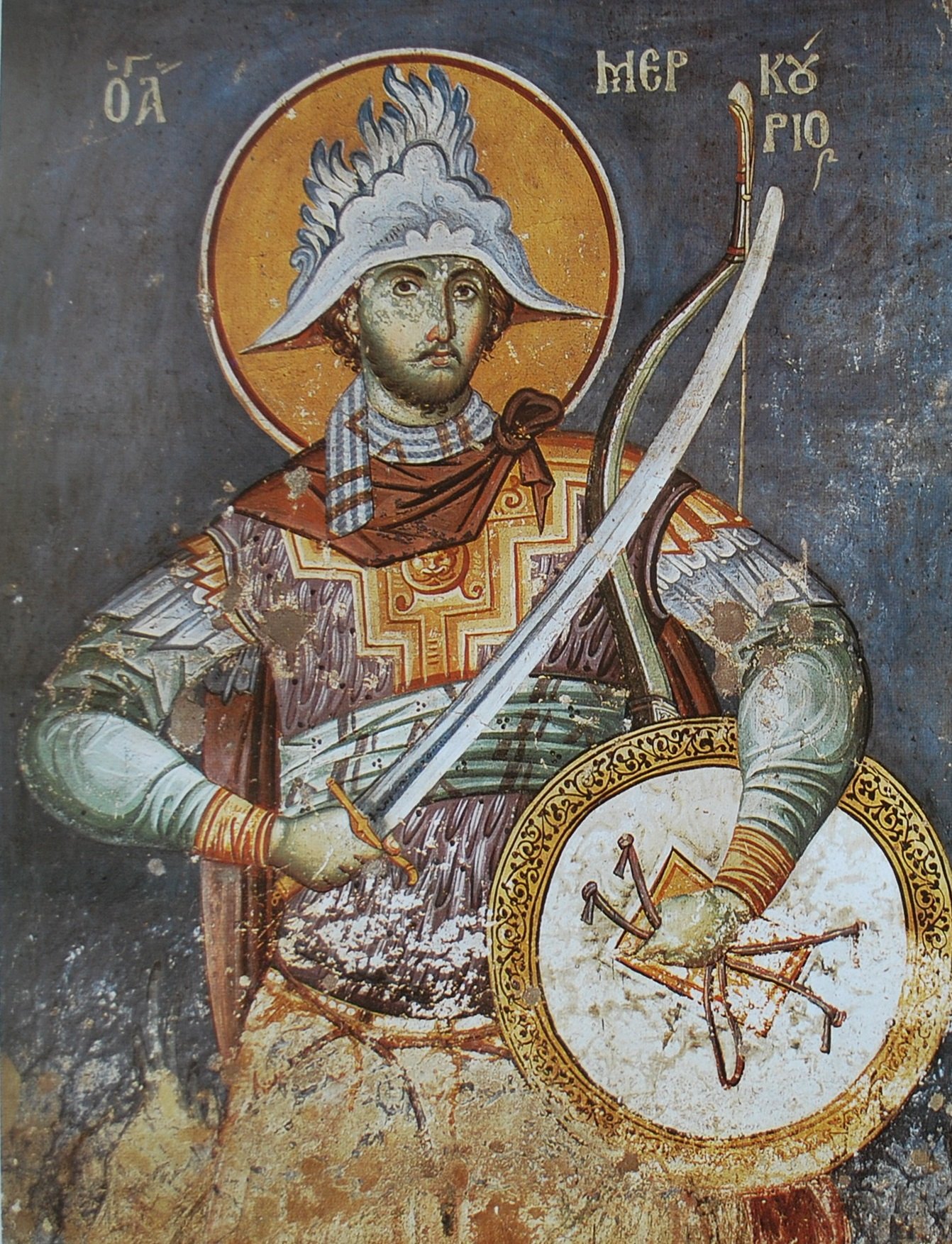
- An armoured soldier with sword, spear or bow, often with Julian fallen beneath him
feast days
East and West
West
- Nov25
Kept in the Roman Martyrology of the Catholic Church, on the same day as Catherine of Alexandria
East
- Aug1
Coptic Church, for the consecration of his church on 25 Abib
- Nov24
Russian Church, on 7 December by our calendar, and the OCA
- Nov25
Greek Orthodox, on the same day as Catherine of Alexandria
- Dec4
His martyrdom in the Coptic (25 Hator) and Ethiopian (25 Hedar) Churches
The old (Julian) calendar, which the Russian Church keeps, runs 13 days behind. The Coptic and Ethiopian calendars have months of their own, in which 25 Hator falls on 5 December in the year before a leap year.
The Russian calendar also keeps two other saints named Mercurius on 24 November: Mercurius of Smolensk, a soldier killed fighting the Mongols in 1239, and Mercurius the Faster of the Kiev Caves.
what others said of him
At Caesarea, in Cappadocia, St. Mercury, soldier, who vanquished the barbarians and triumphed over the cruelty of Decius through the protection of his guardian angel.
After Our Lady and St. George this is one of the most popular dedications in Egypt.
The story of S. Mercurius is a mere Greek romance, probably wholly destitute of foundation.
his life in four moments
With Decius's army
About AD 250A sword from a man of light
In his Passion, the emperor Decius had just ordered everyone to sacrifice to the gods when barbarians attacked the empire. Mercurius was a soldier about 20 years old in the army sent against them. After many days of even fighting, an angel came to him in a trance as a tall man of light, richly dressed and holding a drawn sword.
The angel handed him the sword, told him to attack without fear and warned him not to forget the Lord his God. Mercurius took him for one of the emperor's high officers. He charged, killed the enemy's commander, and the barbarians ran. Decius made him general over the whole army.
Martyrdom of Saint Mercurius (Coptic), tr. Budge (1915), pp. 810-812; the Greek Passion in Delehaye (1909)On the march to Rome
After the victoryA tree without fruit
As the army marched back to Rome, the angel woke him in the night in the same form as in the battle, and Mercurius was afraid. The angel reminded him of his warning and told him he would suffer for God's name and receive a crown in heaven.
Mercurius remembered his father Gordianus, a Christian officer, who had often told him that the soldier who serves the King of heaven is blessed. He knew the faith from his parents, and now he wept and called himself a sinner: “I am like a tree which is without fruit.” He was still weeping when Decius sent for him.
Martyrdom of Saint Mercurius (Coptic), tr. Budge (1915), pp. 812-813Before the emperor
At the victory sacrificeThe cloak and the belt
Decius thanked the gods for the victory and asked Mercurius to sacrifice with him at the temple of Artemis. On the way Mercurius slipped back and hid in his quarters. A man who wanted to set the emperor against him told Decius that his new general had stayed away. Decius suspected envy and would not believe it until he saw for himself, so he sent for Mercurius.
When Mercurius stood before him, Decius reminded him of the honours he had given him. Mercurius answered that God had won the battle, not he, and gave the honours back. He took off his officer's cloak and belt, threw them at the emperor's feet and cried, “I am a Christian.” Decius stared at him, then sent him to prison, hoping he would come to his senses.
Martyrdom of Saint Mercurius (Coptic), tr. Budge (1915), pp. 813-815Decius's prison
The next dayHealed in the night
The next day Decius had him stretched between four stakes and cut with knives, and red-hot coals were thrown on him until his own blood put them out. He was carried half dead to a dark cell, where an angel healed him in the night. By morning his guards swore there was not a mark on his body.
Decius blamed Christian magic and asked who had healed him. “It was my Lord Jesus the Christ, the True Physician of our souls and of our bodies,” Mercurius answered. He bore more tortures without a groan. Decius could not make him sacrifice, and word came that he must hurry to Rome, so he sentenced Mercurius to be beheaded in Cappadocia, where everyone would see.
Martyrdom of Saint Mercurius (Coptic), tr. Budge (1915), pp. 816-820
did he kill an emperor?
The emperor Julian died of a spear wound in Persia in AD 363. Christians began to say in the 500s that Mercurius had killed him, in a story that kept growing for centuries.
Why Julian threatened Caesarea
Julian became emperor in AD 361 and turned back to the old gods, although he had been raised a Christian. He hated Caesarea in Cappadocia, where Mercurius lay buried, because its Christians had pulled down its temples. He took away its standing as a city, seized about AD 300 pounds of gold from its churches, made its clergy serve as soldiers and taxed its Christians as heavily as villages.
He threatened that unless the temples were rebuilt, his anger would fall on the city “until none of the Galileans remained in existence”, his mocking name for Christians. The church historian Sozomen believed he would have carried it out had he not died soon after.
Sozomen, Church History V.4, tr. Hartranft (1890)A spear no one could trace
The officer Ammianus Marcellinus was with the army in Persia. In his account, on 26 June AD 363 Julian rushed into a fight without his armour, and a cavalryman's spear came from no one knew where, grazed his arm and pierced his side. He died about midnight.
Julian's friend Libanius argued that one of the emperor's own men had thrown it, because no one ever claimed the reward the Persian king offered. Sozomen took that to mean a Christian soldier, which he thought probably the truth.
Ammianus Marcellinus, Roman History XXV.3, tr. Yonge (1862) and Rolfe (1940); Sozomen, Church History VI.1-2Two messengers
In Sozomen's history a friend of Julian spent a night in a church on his way to join him in Persia. In a dream he saw the apostles and prophets meet to complain of the harm Julian was doing the Church, until two of them went out to end his rule.
The next night the two came back to tell the others that Julian was dead. Nearly 1,000 years later the Greek historian Nicephorus made Mercurius one of the two.
Sozomen, Church History VI.2, tr. Hartranft (1890); Delehaye (1909), on Nicephorus CallistusThree arrows
The Julian Romance is a tale written in the early 500s in Syriac, the language of the Christians of Syria.
In it the Christian officer Jovian grieved over closed churches and persecuted priests until he fell asleep and dreamed of Mercurius holding a bow and three arrows. One arrow was for Julian and two for the officials who urged him on against the churches. Mercurius promised that after their deaths the Church would have peace.
Later a voice from heaven cried over the armies in Persia, “The arrow of salvation in the camp of the Romans!” When Julian mocked it, an arrow flew from where the voice had come and struck him down. Dying, he told his men to make Jovian emperor in his place.
Julian the Apostate (the Syriac Julian Romance), tr. Gollancz (1928)Basil's dream
From the 500s, chroniclers told the story as a dream of Basil the Great, then a priest of Caesarea and later its bishop. In the late 600s the Egyptian bishop John of Nikiu gave the reason first: Julian had “shed the blood of many Christians”.
On the night Julian died, Basil saw heaven open, with Christ on His throne and Mercurius before Him in shining armour. Christ commanded, “Mercury, go and slay Julian the adversary of My anointed ones.” Mercurius vanished and came back to say it was done. The news of Julian's death arrived soon after.
Mary sends him instead in a Life of Basil from about the 800s, credited to his friend Amphilochius. In it Basil found Mercurius's tomb empty of his body and weapons, which were back by morning with the spear bloody. Julian never came back to carry out his threat against Caesarea.
John of Nikiu, Chronicle 79, tr. Charles (1916); Malalas, Chronographia XIII, ed. Dindorf (1831); The Golden Legend, Caxton's English (1900)The painting that bowed its head
John of Damascus told the story in the early 700s to show that icons were nothing new. In his telling Basil prayed for Julian's removal before an icon of Mary with Mercurius painted on it, and saw the martyr vanish from it and come back holding a bloody spear.
The Coptic telling puts Basil in Julian's prison, where he prayed for the other Christian prisoners. He saw a painting of Mercurius on horseback on the wall and begged him to free Christ's people from the emperor. At once the figure vanished and came back with its spear dripping blood.
When Basil asked if he had killed the emperor, it bowed its head. That is why Coptic painters show Mercurius with his head bowed and Basil before him.
John of Damascus, On Holy Images I, tr. Allies (1898); Coptic service book, tr. Butler, The Ancient Coptic Churches of Egypt, vol. 2 (1884), pp. 359-360his miracles
Most of his wonders are told by the Copts, in a book of his miracles that survives in a copy probably made in the 1000s. Like Benevento in Italy, the town of Edfu in Upper Egypt believed it held his body. The book's stories come from the years when its Christians built him a shrine there.
The body that chose its resting place
The Christians of Edfu wanted to bring his body in from outside the town, though a few feared the saint would not allow it. While they argued, the body moved by itself and set out for the town. Clergy walked before it singing hymns, with incense and branches of sweet-smelling flowers.
A man in the town tried to take it into his own house, but it became as heavy as lead and nobody could move it. The crowd took it to the church instead, where it stayed until a shrine worthy of it was built.
“He will not be persuaded to allow this; let us take him into the church.”The Miracles of Mercurius (Coptic), the third, tr. Budge (1915), pp. 830-831
The thief who carried the plank back
While the shrine was going up, a man of the town took a fine plank from the timber, swung it onto his back and set off home. Near the town he lost his way, because the saint had made his mind wander.
Mercurius then told the shrine's steward, a poor man to whom he often appeared, to open his door. There stood the thief with the plank on his back. The thief came to himself and confessed, and Mercurius forgave him through the steward.
Next morning the thief told the town what had happened and carried the plank back while everyone watched. Nobody stole from the shrine again, and he stayed to make bricks until it was finished.
“I have sinned against thee and I have stolen thy wood.”The Miracles of Mercurius (Coptic), the sixth, tr. Budge (1915), pp. 838-840
The screen that bore fruit
For the finished shrine the builders made a large wooden screen from three trees that belonged to a woman Mercurius had healed of blindness. As a crowd of men lifted it into place, a few of the workmen joked that they wished Mercurius would make the wood bear fruit for them to eat, and at once it did.
Many were cured by the fruit, which some of the men took home to keep as a charm. When word spread, the whole town came to see.
“And suddenly, whilst yet the words were coming out of their mouths, the wood sent forth branches laden with very fine ripe fruit.”The Miracles of Mercurius (Coptic), the seventh, tr. Budge (1915), pp. 840-841
his words
Mercurius left no writings, so these are the words his Passion gives him.
To Decius, under torture
Thou hast power over my body, but as concerning my soul God is its master.
After hot irons and torches, when Decius mocked him and asked where his healer was now.
Martyrdom of Saint Mercurius (Coptic), tr. Budge (1915), p. 819My city is the Jerusalem of heaven, the city of the Great King.
When I came forth from my mother's womb I was naked, and I will depart hence naked.
myths and misquotes
As he died, Julian cried, “Thou hast won, O Galilean.”
What the sources sayThose words were written down only long after his death, as hearsay. Ammianus's account has no such words. They first appear about AD 450 in the bishop Theodoret, who begins with “It is related”. The Coptic telling has Julian throw his blood toward heaven with other words: “Take this, O Christ, for Thou hast taken the whole world.”
Theodoret, Church History III.20; Budge (1915)Julian put Mercurius to death.
What the sources sayEvery telling of his Passion has him die under Decius about AD 250, long before Julian reigned. The mistake is in the Golden Legend, a medieval book of saints' lives that spread the story of Mary sending him, where he is “Mercury whom Julian the apostate hath slain”.
The Golden Legend, Caxton's English (1900)The Archangel Michael gave him his sword.
What the sources sayThe angel is named as Michael only in a later Coptic sermon in his praise, credited to a bishop Acacius of Caesarea. There the archangel appears “in the form of a general of the army” and hands him a sword. In his Passion the giver is “a man of light”, later called simply the angel.
Martyrdom and Encomium of Mercurius (Coptic), tr. Budge (1915)His two swords are his own and the one the angel gave him.
What the sources sayThat is how the Coptic calendar explains the name today, though it is one reading among several. In 1884 the scholar Alfred Butler put the name down to his many battles. In 1895 the editors of a medieval list of Egypt's churches traced it to the angel's two-edged sword, which became two in the popular telling.
Butler, The Ancient Coptic Churches of Egypt, vol. 2 (1884); Evetts and Butler (1895); Coptic Synaxarium, 25 HatorDog-headed men killed his father.
What the sources sayThe old Coptic and Ethiopian tellings have them kill his grandfather, not his father. Two men with dogs' faces met the two out hunting and killed the grandfather. An angel stopped them from killing the father, because good fruit would come from him.The angel ringed the dog-faced men with fire until they grew gentle. They became Christians and later went to war beside Mercurius, where “none could withstand them”.
Coptic service book, tr. Butler (1884); Ethiopic Synaxarium, tr. Budge (1928)Mercurius was St George's cousin.
What the sources sayNo old text makes them family. They are linked only as soldier saints, who are often named together.
Abu Salih, tr. Evetts (1895); Gesta Francorum, tr. Krey (1921)friends, family and rivals
 Basil the Great
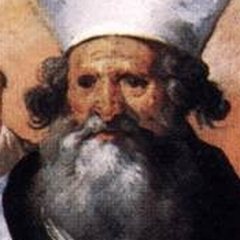
A bishop of Caesarea who lived a century after Mercurius. From the 500s, legend made him the one who dreamed or prayed while Mercurius went against Julian.
Malalas, Chronographia XIII; John of Nikiu, Chronicle 79His father, in the Passion a Scythian and a Christian. He served in the Martusian regiment and rose to be its chief officer, so father and son were in the same regiment.
Martyrdom of Saint Mercurius (Coptic), tr. Budge (1915), pp. 812, 816The Roman emperor from AD 249 to 251. Early in AD 250 he ordered everyone in the empire to sacrifice to the gods. Mercurius's Passion is built around that order.
Budge, Miscellaneous Coptic Texts (1915), p. cxiiihow he died
The only account of his death is his Passion, which has him beheaded at Caesarea in Cappadocia about AD 250.
After his tortures he swayed like a dead man, so the soldiers tied him onto a pack animal and carried him for several days to Caesarea. There the Lord appeared to him and told him to come and rest, because he had finished his course.
Strengthened, Mercurius told the soldiers to do their work quickly and prayed that God, Who calls everyone to repentance, would make them worthy of His grace. After they cut off his head, his body turned as white as snow and gave off a smell like the finest incense, so that many who saw it became Christians. He was buried in a shrine there, where many were healed.
is he a saint?
He is honoured as a martyr by the Orthodox, Coptic, Ethiopian and Catholic Churches, although scholars doubt almost everything in his story.
- OrthodoxGreat MartyrWith hymns of his own, on 24 or 25 November
- Coptic OrthodoxSaintAbu Sefein, among Egypt's best-loved saints
- Ethiopian OrthodoxSaintKept in the Synaxarium on 25 Hedar
- CatholicSaintNamed in the Roman Martyrology on 25 November
- Anglican and LutheranNot listedNone of their calendars names him
His Passion survives in Greek, Coptic, Latin and Ethiopic. Hippolyte Delehaye judged it a work of imagination, made of echoes of other saints' stories and stock scenes. He saw a sign of it in the ending, where Decius has Mercurius carried for days to Caesarea instead of killing him on the spot, so that the martyr dies in Cappadocia, where he was honoured.
Delehaye doubted the story, not the man. The oldest record, which he took as his starting point, speaks of Mercurius only as a local martyr of Caesarea.
what to read first
The Martyrdom of Saint Mercurius the General, and his Miracles
Coptic texts, tr. E. A. Wallis Budge (1915)
The fullest free English of his Passion, with the Coptic telling of Julian's death and the wonders at his shrine.
Read it freeChurch History, Book VI, chapters 1 and 2
Sozomen, tr. C. D. Hartranft (1890)
How Julian died, and the first visions of it, before anyone named Mercurius.
Read it freeRoman History, Book 25
Ammianus Marcellinus, tr. J. C. Rolfe (1940)
An officer's own account of the march into Persia and Julian's death.
Read it freeChronicle, chapter 79
John of Nikiu, tr. R. H. Charles (1916)
Basil's dream of Christ sending Mercurius against Julian.
Read it freeGreat Martyr Mercurius of Caesarea, in Cappadocia
Orthodox Church in America
The Orthodox Church's own telling of his life, with his hymns.
Read it freeSt. Mercurius, known as the saint with the two swords
Coptic Synaxarium, 25 Hator
The Coptic Church's own telling of his life and his two swords.
Read it freeThe Saint Who Killed an Emperor
Jonathan Pageau (2026)
A video on Mercurius, the death of Julian and the dog-headed men.
Watch it freetake the quizzes
 Quiz Which early Christian
thinks like you? And which would argue with you? Start
 Quiz Christian




Personality Test Which of eight types are you? Find your own. Start
people like him
sources
His Passion and miracles
- Miscellaneous Coptic Texts in the Dialect of Upper Egypt. The Martyrdom of Saint Mercurius the General, his Miracles and the Encomium credited to Acacius, tr. E. A. Wallis Budge, 1915.
- Les légendes grecques des saints militaires. Hippolyte Delehaye, 1909, chapter 5, on the Greek Passion and the Julian legend (French).
- The Legends of the Saints. Hippolyte Delehaye, tr. V. M. Crawford, 1907.
- The Ancient Coptic Churches of Egypt, vol. 2. Alfred J. Butler, 1884: the Coptic service book's two notices of Mercurius.
- The Book of the Saints of the Ethiopian Church, vol. 1. Tr. E. A. Wallis Budge, 1928: 25 Hedar.
- The Lives of the Saints, vol. 14. Sabine Baring-Gould, 1897: 25 November.
- Synaxarium ecclesiae Constantinopolitanae. Ed. H. Delehaye, 1902 (Greek).
- Itinera Hierosolymitana. Ed. P. Geyer, 1898: Theodosius, De situ terrae sanctae, about AD 530 (Latin).
The death of Julian
- Ammianus Marcellinus, Roman History, Book 25. Tr. C. D. Yonge, 1862.
- Ammianus Marcellinus, Book 25. Tr. J. C. Rolfe, 1940 (LacusCurtius).
- Sozomen, Church History, Book 5. Tr. C. D. Hartranft, 1890.
- Sozomen, Church History, Book 6. Tr. C. D. Hartranft, 1890.
- Theodoret, Church History, Book 3. Tr. B. Jackson, 1892.
- Julian the Apostate. The Syriac Julian Romance, tr. Hermann Gollancz, 1928.
- John of Nikiu, Chronicle. Tr. R. H. Charles, 1916.
- John Malalas, Chronographia. Ed. L. Dindorf, 1831 (Greek and Latin).
- John of Damascus, On Holy Images. Tr. Mary H. Allies, 1898.
- The Golden Legend, vol. 3. Caxton's English, ed. F. S. Ellis, 1900.
- Catholic Encyclopedia, St. Basil the Great, 1907.
Egypt, Antioch and today
- The Churches and Monasteries of Egypt. Attributed to Abu Salih, tr. B. T. A. Evetts, notes by A. J. Butler, 1895.
- The Ancient Coptic Churches of Egypt, vol. 1. Alfred J. Butler, 1884: the church of Abu Sefein in Old Cairo.
- Coptic Synaxarium, 2 Paona: Pope John XVIII, ordained and buried in the church of St Mercurius in Old Cairo.
- The First Crusade. The Gesta Francorum, tr. August C. Krey, 1921.
- Saint Mercurius Killing Emperor Julian the Apostate. National Museum in Warsaw.
- The Saint Who Killed an Emperor. Jonathan Pageau, The Symbolic World, 1 October 2026.
- GodsDog, the characters. Jonathan and Matthieu Pageau, Symbolic World Press.
Calendars
- OCA, Great Martyr Mercurius of Caesarea, in Cappadocia, 24 November.
- OCA, Martyr Mercurius of Smolensk, 24 November.
- Pravoslavie.ru, Great Martyr Mercurius of Caesarea, 24 November (Russian Church).
- Coptic Synaxarium, 25 Hator, his martyrdom.
- Coptic Synaxarium, 25 Abib, the consecration of his church.
- The Roman Martyrology, 1916 English edition, 25 November.
Pictures
- Saint Mercurius, mosaic, Hosios Loukas, Wikimedia Commons.
- Saint Mercurius, fresco credited to Manuel Panselinos, Protaton church, Wikimedia Commons.