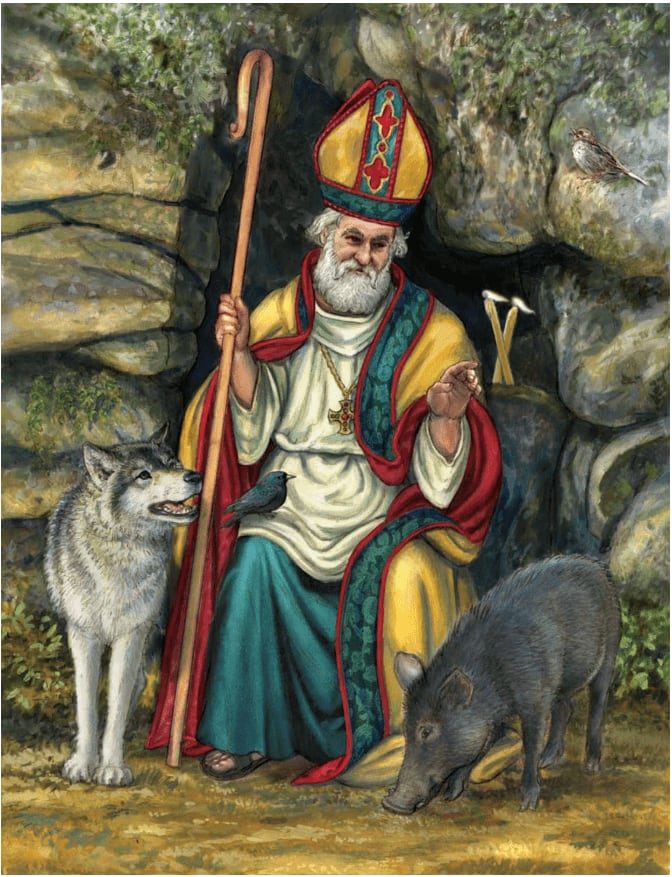
His story
His Acts were written long after his death, and the Catholic Encyclopedia calls their details legend; most of them place his martyrdom about AD 316.
His Acts say he was a physician at Sebaste in Armenia before the people chose him as their bishop. In a time of persecution he hid in a cave on Mount Argeos, where wild animals came and waited quietly until he had finished praying and blessed them. The governor’s hunters, looking for beasts to set on Christians, found him there and took him prisoner. On the way, a poor woman begged his help because a wolf had carried off her only pig, and at his word the wolf brought it back unharmed. In prison he saved a boy who was choking on a fishbone, and after he was tortured, the governor had him beheaded.
“St. Blaise”, Catholic Encyclopedia, 1907; Hieromartyr Blaise, Bishop of Sebaste, Orthodox Church in America
His feast days
3 February: His feast in the Catholic Church.
11 February: His feast in the Orthodox churches on the new calendar. Those on the old calendar keep it on 24 February.
The Roman Martyrology, 1916, 3 February; Hieromartyr Blaise, 11 February, Orthodox Church in America
Why people ask St Blaise
Animals and pets
In Russia he has long been the patron of cattle, and his Life says he healed sick animals by laying his hands on them.
Where it comes from
Who wrote it
This is the Byzantine hymn for a bishop who died a martyr, sung with St Blaise’s name on 11 February. No one knows who wrote it.
In Greek
Καὶ τρόπων μέτοχος, καὶ θρόνων διάδοχος, τῶν Ἀποστόλων γενόμενος,τὴν πρᾶξιν εὗρες θεόπνευστε, εἰς θεωρίας ἐπίβασιν·διὰ τοῦτο τὸν λόγον τῆς ἀληθείας ὀρθοτομῶν,καὶ τῇ πίστει ἐνήθλησας μέχρις αἵματος, Ἱερομάρτυς Βλάσιε·πρέσβευε Χριστῷ τῷ Θεῷ, σωθῆναι τὰς ψυχὰς ἡμῶν.
From Ὡρολόγιον τὸ Μέγα (Venice, 1838), pp. 295-296, 11 February.