
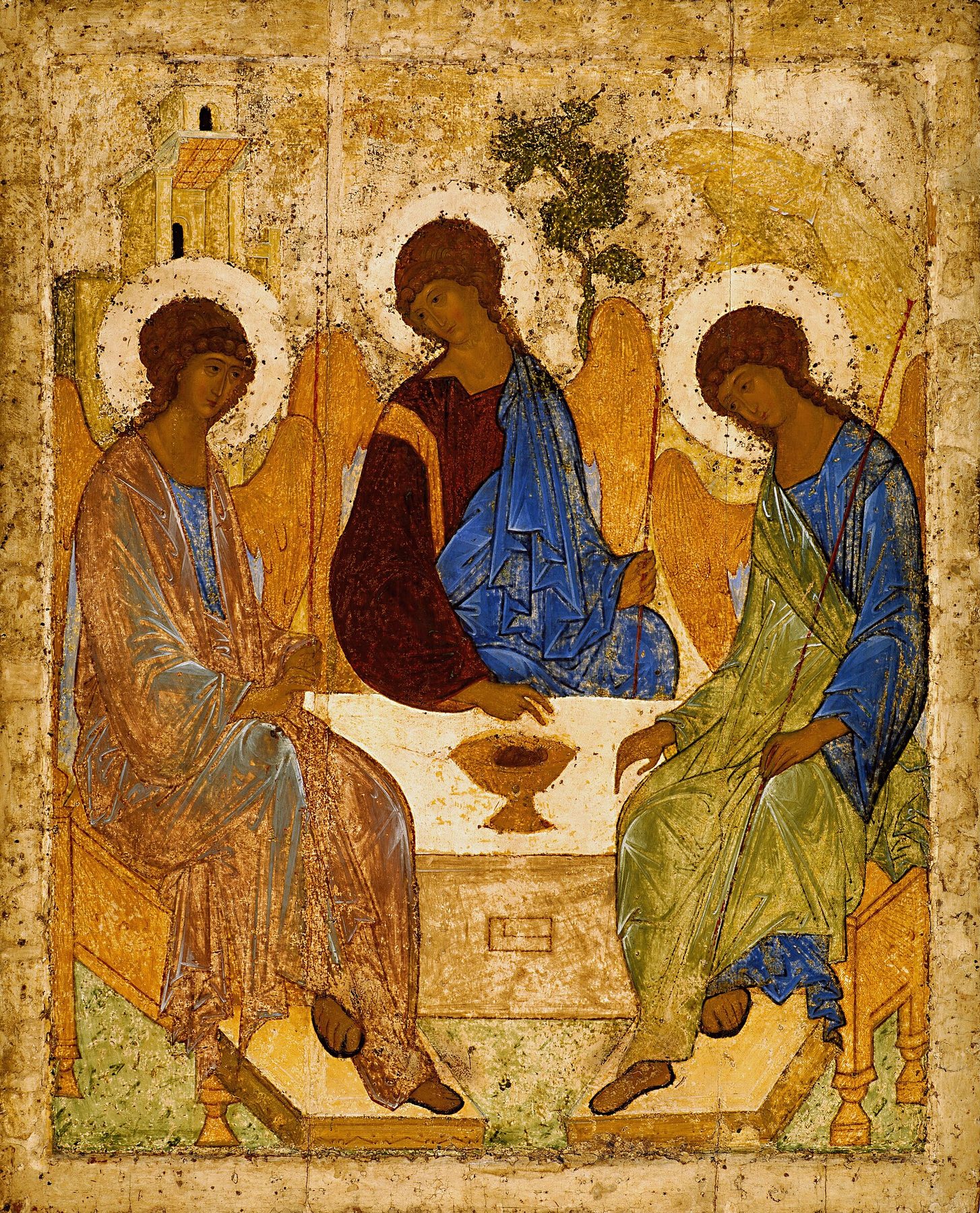
When it is said
It is said many times in every Orthodox service, and in prayers at home. In the opening prayers it comes after “Holy God, Holy Mighty, Holy Immortal”. It comes again after “Lord, have mercy”, said three times, just before the Lord’s Prayer.
It often ends a psalm or a group of psalms. Its two halves are often parted, with a hymn sung between them.
Where it comes from
No author known
Why it names all three
Many early Christian prayers gave glory to the Father “through” the Son “in” the Holy Spirit. In the 300s the Arians, who ranked the Son below the Father, pointed to those small words as proof of their teaching. So the Church came to give glory to all three side by side, as Jesus named them when He sent His disciples to baptize.
Catholic Encyclopedia (1909), Doxology; Matthew 28:19
St Basil under attack
St Basil the Great, a bishop of the 300s, once led his people in giving glory to God the Father in two ways: “with the Son, together with the Holy Spirit”, and “through the Son in the Holy Spirit”. Some who were there attacked him for bringing in new words. He answered them in his book On the Holy Spirit.
What the words mean
“As it was in the beginning” is Western
Many know this prayer as “Glory be to the Father ... As it was in the beginning, is now, and ever shall be, world without end.” The words “As it was in the beginning, is now, and ever shall be” came in the West. A council in Gaul ordered them in AD 529. No Eastern rite has ever used them, and the Greeks objected to them. The Orthodox say “now and ever, and to the ages of ages”.
“To the ages of ages”
The Greek ends “to the ages of ages”, and the old English keeps it: “unto ages of ages”. It is a Hebrew way of saying “for ever”, found in St Paul’s letters and often in the Book of Revelation. The plain English says “for ever and ever”.
The Scripture in it
Therefore go and make disciples of all nations, baptizing them in the name of the Father and of the Son and of the Holy Spirit …
… to Whom be glory forever and ever. Amen.
Jesus Christ is the same yesterday and today and forever.
Bible text: Berean Standard Bible, public domain.
In Greek
Δόξα Πατρὶ καὶ Υἱῷ καὶ Ἁγίῳ Πνεύματι.
Καὶ νῦν καὶ ἀεὶ καὶ εἰς τοὺς αἰῶνας τῶν αἰώνων. Ἀμήν.
From the Great Doxology, the morning hymn, on Greek Wikisource, where both halves are printed in full.