
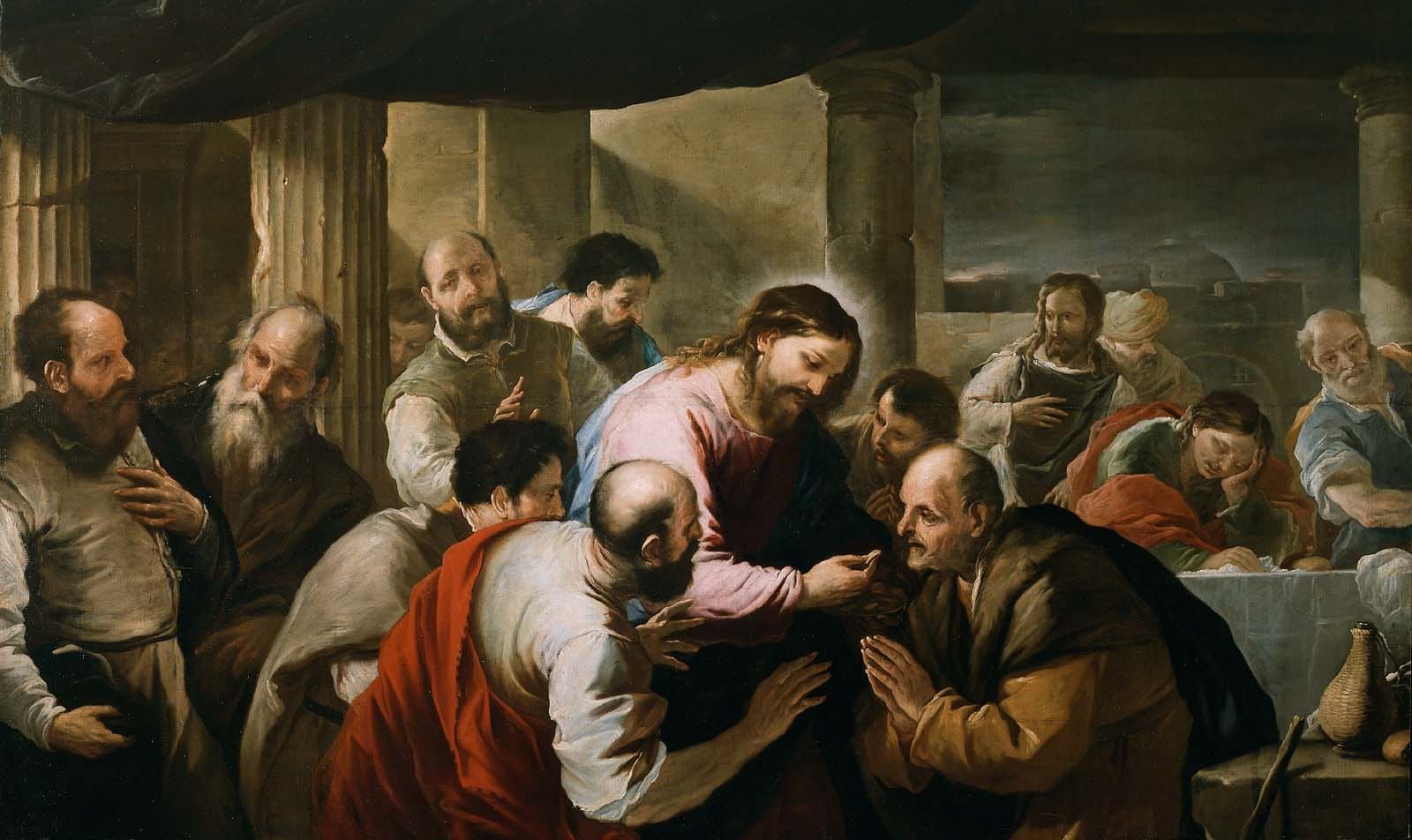
When it is said
It is said just before Holy Communion, at every Divine Liturgy. The priest and the deacon say it at the altar before they receive.
Then the priest says it aloud before the people come to the cup. In Russian parishes he reads it on behalf of everyone who will receive.
It is also one of the prayers people read to prepare for Communion. In the Greek prayer book it is the last of 10.
Where it comes from
Author doubtful
Did St John Chrysostom write it?
The prayer books head it with the name of St John Chrysostom, who died in AD 407. But Fr Mikhail Zheltov, a Russian Orthodox priest who studies the history of the services, finds it first in Greek service books of the 1100s, copied in southern Italy. There it was shorter, and it stood among prayers for various needs.
Fr Mikhail Zheltov, The forming of the core of the Order for Holy Communion (in Russian)
How it reached every Liturgy
In the 1200s and 1300s, the service books of Constantinople began to set it beside another Communion prayer, “Of Your mystical supper”, for the priest to say before he receives. A rule for the Liturgy edited by St Philotheos, Patriarch of Constantinople, carried that order across the Orthodox world. Since the 1300s, no book of the Liturgy has been without this prayer.
Fr Mikhail Zheltov, The forming of the core of the Order for Holy Communion (in Russian)
What the words mean
“Of whom I am the first”
These are St Paul’s words about himself, in his first letter to Timothy: Christ Jesus came into the world to save sinners, “of whom I am the foremost”. In this prayer, every person who comes to the cup says them of themselves.
1 Timothy 1:15
The Scripture in it
Simon Peter answered, “You are the Christ, the Son of the living God.”
This is a trustworthy saying, worthy of full acceptance: Christ Jesus came into the world to save sinners, of whom I am the worst.
While they were eating, Jesus took bread, spoke a blessing and broke it, and gave it to the disciples, saying, “Take and eat; this is My body.” Then He took the cup, gave thanks, and gave it to them, saying, “Drink from it, all of you. This is My blood of the covenant, which is poured out for many for the forgiveness of sins.”
Therefore, whoever eats the bread or drinks the cup of the Lord in an unworthy manner will be guilty of sinning against the body and blood of the Lord. Each one must examine himself before he eats of the bread and drinks of the cup. For anyone who eats and drinks without recognizing the body eats and drinks judgment on himself.
Bible text: Berean Standard Bible, public domain.
In Greek
Πιστεύω, Κύριε, καὶ ὁμολογῶ ὅτι Σὺ εἶ ἀληθῶς ὁ Χριστός, ὁ Υἱὸς τοῦ Θεοῦ τοῦ ζῶντος, ὁ ἐλθὼν εἰς τὸν κόσμον ἁμαρτωλοὺς σῶσαι, ὧν πρῶτός εἰμι ἐγώ.
Ἔτι πιστεύω ὅτι τοῦτο αὐτό ἐστι τὸ ἄχραντον Σῶμά Σου καὶ τοῦτο αὐτό ἐστι τὸ τίμιον Αἷμά Σου.
Δέομαι οὖν Σου· Ἐλέησόν με καὶ συγχώρησόν μοι τὰ παραπτώματά μου, τὰ ἑκούσια καὶ τὰ ἀκούσια, τὰ ἐν λόγῳ, τὰ ἐν ἔργῳ, τὰ ἐν γνώσει καὶ ἀγνοίᾳ·
καὶ ἀξίωσόν με ἀκατακρίτως μετασχεῖν τῶν ἀχράντων Σου μυστηρίων, εἰς ἄφεσιν ἁμαρτιῶν καὶ εἰς ζωὴν αἰώνιον. Ἀμήν.