
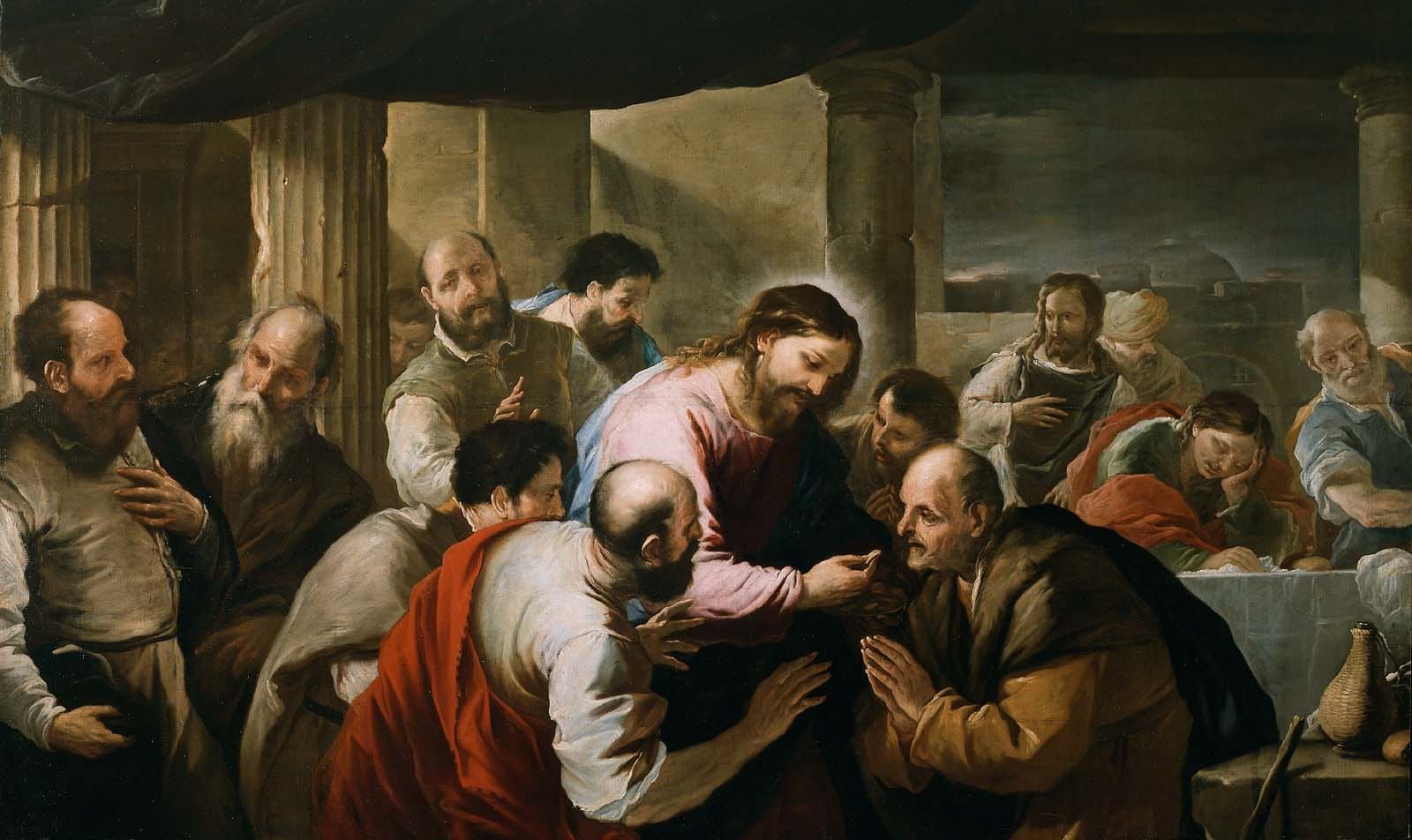
When it is said
It is said just before Holy Communion, straight after “I believe, O Lord, and I confess”. The clergy say it at the altar before they receive, and the people as they come to the cup.
The Greek and Russian prayers before Communion give it twice: after the short verses said on the way to the cup, and once more near the end. The Greek book calls it “the troparion”, a short hymn.
On Holy Thursday, the day of the Last Supper, the choir sings it at the Liturgy in place of three of the usual hymns.
Where it comes from
No author known
Once the priest’s only prayer
Fr Mikhail Zheltov, a Russian Orthodox priest who studies the history of the services, traced the prayers priests say before their own Communion. In Constantinople’s service books of the 1100s and 1200s, a priest usually said this prayer alone before his Communion. “I believe, O Lord” and the plea “not unto judgment or condemnation” joined it in the 1200s and 1300s.
Fr Mikhail Zheltov, The forming of the core of the Order for Holy Communion (in Russian)
The hymn of Holy Thursday
On Holy Thursday the Church keeps the day of the Last Supper. Its Liturgy is always that of St Basil, begun with Vespers, the evening service. There the choir sings this prayer in place of the Cherubic Hymn, then in place of the Communion hymn, and once more in place of the hymn after Communion.
What the words mean
Judas and the thief
The prayer sets two men side by side. Judas came to Jesus with a kiss, and betrayed Him. One of the two criminals crucified beside Jesus asked Him, “Jesus, remember me when You come into Your kingdom.” The one who prays turns from the first, and takes the second’s words.
Luke 22:47-48 and Luke 23:42
The Scripture in it
When the hour had come, Jesus reclined at the table with His apostles. And He said to them, “I have eagerly desired to eat this Passover with you before My suffering. For I tell you that I will not eat it again until it is fulfilled in the kingdom of God.” After taking the cup, He gave thanks and said, “Take this and divide it among yourselves. For I tell you that I will not drink of the fruit of the vine from now on until the kingdom of God comes.” And He took the bread, gave thanks and broke it, and gave it to them, saying, “This is My body, given for you; do this in remembrance of Me.” In the same way, after supper He took the cup, saying, “This cup is the new covenant in My blood, which is poured out for you.”
While He was still speaking, a crowd arrived, led by the man called Judas, one of the Twelve. He approached Jesus to kiss Him. But Jesus asked him, “Judas, are you betraying the Son of Man with a kiss?”
Then he said, “Jesus, remember me when You come into Your kingdom!”
Bible text: Berean Standard Bible, public domain.
In Greek
Τοῦ Δείπνου Σου τοῦ μυστικοῦ σήμερον, Υἱὲ Θεοῦ, κοινωνόν με παράλαβε·
οὐ μὴ γὰρ τοῖς ἐχθροῖς Σου τὸ μυστήριον εἴπω· οὐ φίλημά Σοι δώσω, καθάπερ ὁ Ἰούδας·
ἀλλ᾿ ὡς ὁ Λῃστὴς ὁμολογῶ Σοι· Μνήσθητί μου, Κύριε, ἐν τῇ βασιλείᾳ Σου.