Sign Up My Profile
Prayers

Orthodox prayers and hymns for Holy Week

Holy Week is the week before Pascha, Orthodox Easter. Most of its services are sung on the evening before their day.

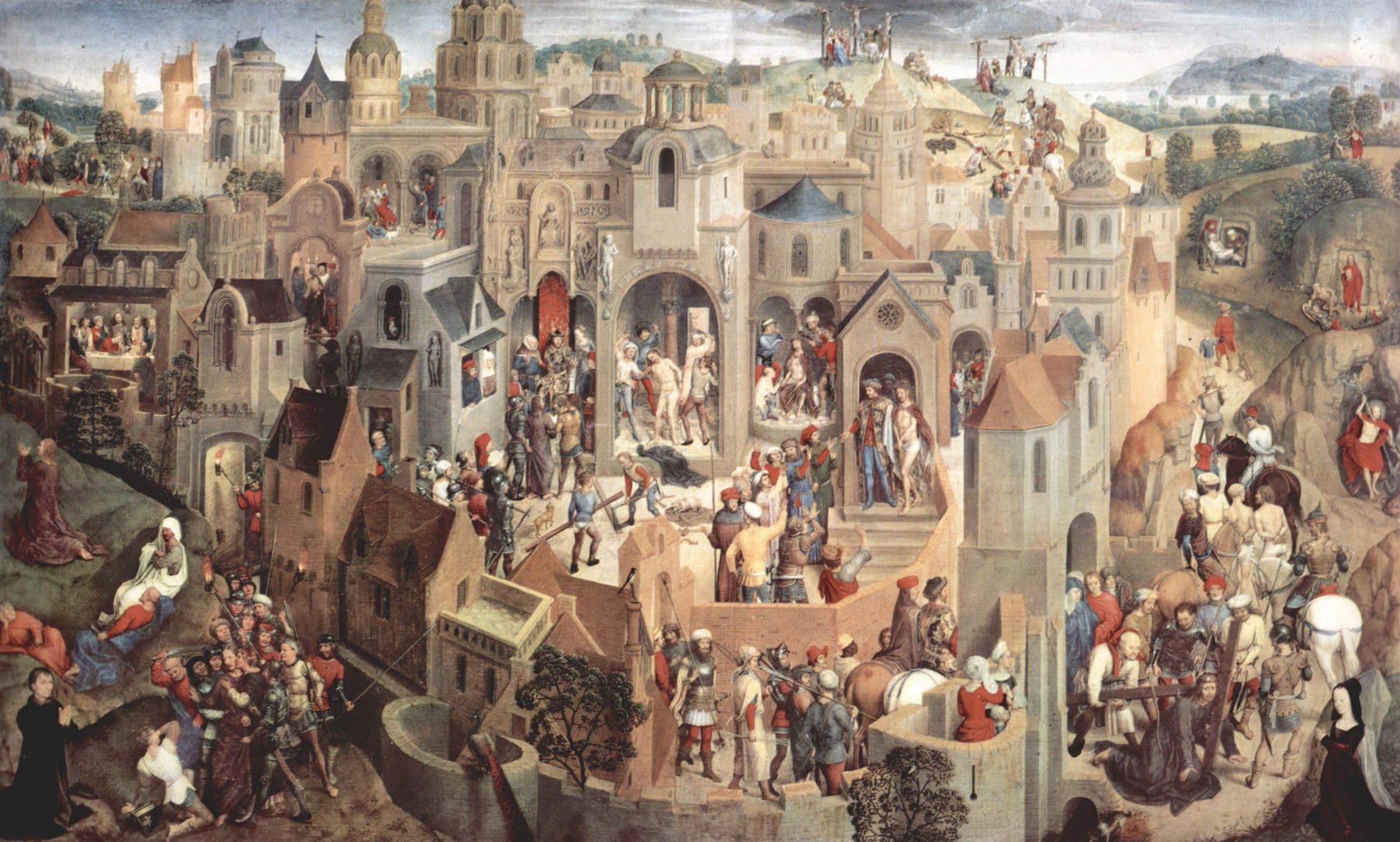
Picture: Hans Memling, Scenes from the Passion of Christ, about 1470

11 prayers

On Palm Sunday

By raising Lazarus from the dead

By raising Lazarus from the dead before Your Passion,You confirmed the resurrection of all, O Christ God.

So we too, like the children,carry the signs of victoryand cry out to You, the Conqueror of death:

Hosanna in the highest!Blessed is He Who comes in the name of the Lord!

Traditional wording

By raising Lazarus from the dead before Thy passion,Thou didst confirm the universal resurrection, O Christ God!

Like the children with the branches of victory,we cry out to Thee, O Vanquisher of Death:

Hosanna in the highest!Blessed is He that comes in the name of the Lord!

The hymn of Palm Sunday and of Lazarus Saturday the day before, sung at every service. Christ raised Lazarus before His Passion, and the crowds who had heard of it went out to meet Him with palms.

Plain English by Wiser Walk, from the Greek of the Triodion, with the OCA’s wording beside it. How the wording is made. Traditional wording: The Orthodox Church in America, The Orthodox Faith, Volume II: Worship.
Where it comes from, and the Greek

At the Bridegroom services, Sunday to Tuesday evening

Behold the Bridegroom

See, the Bridegroom is coming at midnight,and blessed is the servant He will find awake,but unworthy is the one He will find lazy.

So take care, my soul:do not let sleep weigh you down,or you will be handed over to deathand shut out of the kingdom.

Instead, wake up and cry out:Holy, holy, holy are You, O God.Through the Mother of God, have mercy on us.

Traditional wording, 1891

Behold the Bridegroom cometh in the middle of the night,and blessed is that servant whom He shall find watching,but unworthy he whom He shall find careless.

Beware then, my soul,lest thou be weighed down by sleep,lest thou be given over to deathand be shut out from the kingdom;

but awake, crying,Holy, holy, holy art Thou, O God.Through the Mother of God, have mercy upon us.

It is sung near the start of each Bridegroom service. It calls your soul to stay awake, because Christ may come at any hour.

Plain English by Wiser Walk, from the Greek of the Midnight Office, with Shann’s 1891 translation beside it. How the wording is made. Traditional wording: G. V. Shann, Euchology: A Manual of Prayers of the Holy Orthodox Church, 1891.

Where it comes from, and the Greek

I see Your bridal chamber

I see Your bridal chamber adorned, O my Savior,but I have nothing to wear to go in.

Make the robe of my soul shine, O Giver of light,and save me.Three times

Traditional wording, 1906

I behold Thy richly adorned dwelling-place, O my Saviour,and I have no festal raiment, that I may enter in.

Illumine Thou the raiment of my soul, O Light-giver,and save me.

It is sung slowly three times near the end of the same services. Like the guest in the parable of the wedding feast, the singer has nothing fit to wear and asks Christ for it.

Plain English by Wiser Walk, from the Greek of the Triodion, with Hapgood’s 1906 translation beside it. How the wording is made. Traditional wording: Isabel F. Hapgood, Service Book of the Holy Orthodox-Catholic Apostolic Church, 1906.

Hapgood translated from the Slavonic books, and her “dwelling-place” is the Greek’s bridal chamber.

Where it comes from, and the Greek

Also called the troparion of Kassiani

Hymn of Kassiani

O Lord, the woman who had fallen into many sinssenses that You are God.She takes up the task of the women who bring myrrhand, weeping, brings You myrrh before Your burial.

“Alas,” she says, “the night I live inis a frenzy of lust, dark and moonless,a love of sin.

Receive the springs of my tears,You Who draw the water of the sea up into the clouds.

Bend down to the groaning of my heart,You Who bowed the heavenswhen You emptied Yourself beyond all words.

I will kiss Your spotless feetand wipe them again with the locks of my hair,the feet whose sound Eve heard in Paradise in the evening,and hid herself in fear.

Who can trace the great number of my sinsor the depths of Your judgments,O my Savior, Savior of souls?

Do not pass me by, Your servant,You Whose mercy has no measure.”

Traditional wording

O Lord, the woman who had fallen into many sins,perceiving Thy divinity,fulfilled the part of a myrrh-bearer;and with lamentations she brought sweet-smelling oil of myrrh to Thee before Thy burial.

‘Woe is me,’ she said,‘for night surrounds me, dark and moonless,and stings my lustful passion with the love of sin.

Accept the fountain of my tears,O Thou Who drawest down from the clouds the waters of the sea.

Incline to the groanings of my heart,O Thou Who in Thine ineffable self-emptyinghast bowed down the heavens.

I shall kiss Thy most pure feetand wipe them with the hairs of my head,those feet whose sound Eve heard at dusk in Paradiseand hid herself for fear.

Who can search out the multitude of my sinsand the abyss of Thy judgments,O Saviour of my soul?

Despise me not, Thine handmaiden,for Thou hast mercy without measure.

Sung on Tuesday evening, at the last of the three services. The nun Kassiani gives voice to the sinful woman who wept at Christ’s feet and anointed Him before His burial.

Plain English by Wiser Walk, from the Greek of the Triodion, with the Antiochian Archdiocese’s translation beside it. How the wording is made. Traditional wording: The Antiochian Orthodox Archdiocese, Holy Tuesday: The Hymn of St. Kassiane.

Where it comes from, and the Greek

On Holy Thursday

Of Your mystical supper

Receive me today, O Son of God,as a partaker of Your mystical supper.

For I will not tell Your mystery to Your enemies,nor give You a kiss as Judas did,but like the thief I confess You:

Remember me, O Lord, in Your kingdom.

Traditional wording, 1906

Of Thy Mystical Supper, O Son of God, accept me to-day as a communicant;

for I will not speak of Thy Mystery to Thine enemies,neither like Judas will I give Thee a kiss;

but like the thief will I confess Thee:Remember me, O Lord, in Thy kingdom.

Holy Thursday remembers the Last Supper. At its Liturgy the choir sings this in place of the Cherubic Hymn and again at Communion, asking a place at Christ’s table.

Plain English by Wiser Walk, from the Greek, with Hapgood’s 1906 translation beside it. How the wording is made. Traditional wording: Isabel F. Hapgood, Service Book of the Holy Orthodox-Catholic Apostolic Church, 1906.

Where it comes from, and the Greek

On Holy Thursday evening, with the Twelve Gospels

The fifteenth antiphon

Today He Who hung the earth

Today He Who hung the earth upon the watersis hung upon the tree.Three times

The King of the angelsis crowned with thorns.

He Who wraps the sky in cloudsis wrapped in a mock purple robe.

He Who freed Adam in the Jordanaccepts a blow to the face.

The Bridegroom of the Churchis fastened with nails.

The Son of the Virginis pierced with a spear.

We worship Your Passion, O Christ.Three times

Show us also Your glorious Resurrection.

Let us not keep the feast as the Jews do,for our Passover, Christ God,was sacrificed for us.Instead, let us cleanse ourselves of every stainand pray to Him sincerely:Arise, O Lord, and save us,for You love mankind.

Your Cross, O Lord,is life and resurrection for Your people.Trusting in it,we praise You, our crucified God.Have mercy on us.

Glory to the Father, and to the Son, and to the Holy Spirit,now and ever, and for ever and ever. Amen.

A verse on the Mother of GodShe who bore You saw You hanging, O Christ,and she cried out:“What is this strange mystery I see, my Son?How do You die upon the tree,nailed to it in the flesh,O Giver of life?”

Traditional wording, 1891

To-day is suspended on the tree He that suspendeth the earth upon the waters.Three times

He that is the King of Angels is crowned with thorns.

He that covereth the heavens with clouds is covered with derisive purple.

He that freed Adam in the Jordan is buffeted.

The Bridegroom of the Church is pierced with nails.

The Son of the Virgin is wounded with a spear.

We bow down, O Christ, to Thy Passion.Three times

Let us also see Thy glorious Resurrection.

Not like the Jews do we keep festival,for our Pascha is Christ God sacrificed for us.Still, let us cleanse ourselves from every defilement,and in sincerity pray to Him,Arise, O Lord, save us as the Lover of mankind.

Thy Cross, O Lord, is life and resurrection to Thy people,and, trusting in the same, we sing Thee, O our crucified God.Have mercy upon us.

Glory. Both now.

A verse on the Mother of GodBeholding Thee hanging on the Cross, O Christ,she that brought Thee forth exclaimed,What is the strange mystery I behold, my Son?How dost Thou die upon the tree,with Thy flesh fixed thereupon,O Thou Bestower of life?

Matins of Holy Friday is held on Thursday evening and reads the Gospels of Christ’s Passion one after another. This antiphon follows the fifth, and its first hymn sets the Creator beside what He suffered.

Plain English by Wiser Walk, from the Greek of the Triodion, with Shann’s 1891 translation beside it. How the wording is made. Traditional wording: G. V. Shann, Euchology: A Manual of Prayers of the Holy Orthodox Church, 1891.

Where it comes from, and the Greek

The wise thief

In a single hour, O Lord,You made the wise thief worthy of Paradise.

By the tree of the Cross, give light to me too,and save me.Three times

Traditional wording, 1906

In one moment Thou didst graciously vouchsafe Paradise unto the wise thief, O Lord:

Illumine Thou me, also, by the tree of the Cross, and save me.

Sung three times after the eighth Gospel, which tells how the thief on the cross asked Jesus to remember him. It asks Christ, Who gave him Paradise, to give us light and save us too.

Plain English by Wiser Walk, from the Church Slavonic, with Hapgood’s 1906 translation beside it. How the wording is made. Traditional wording: Isabel F. Hapgood, Service Book of the Holy Orthodox-Catholic Apostolic Church, 1906.

Where it comes from, and the Church Slavonic

On Holy Friday

The noble Joseph

The noble Joseph took Your spotless bodydown from the tree.

He wrapped it in clean linen with spicesand laid it to rest in a new tomb.

Traditional wording

The noble Joseph,when he had taken down Thy most pure body from the Tree,

wrapped It in fine linen and anointed It with spices,and placed It in a new tomb

Sung in the afternoon as the winding-sheet, an icon of Christ lying dead, is carried out to a tomb in the middle of the church. It is sung again that night.

Plain English by Wiser Walk, from the Greek of the Triodion, with the OCA’s wording beside it. How the wording is made. Traditional wording: The Orthodox Church in America, The Orthodox Faith, Volume II: Worship.

Where it comes from, and the Greek

Also called the Enkomia, or Praises

Lamentations of Holy Friday

The first stasisBlessed are You, O Lord;teach me Your statutes.Blessed are those whose way is blameless,who walk in the law of the Lord.

Traditional wording, 1978

The first stasisBlessed art Thou, O Lord: teach me Thy statutes.Blessed are those that are blameless in the way,who walk in the law of the Lord.

Read all of it on its own page

That night, at Matins of Holy Saturday, the people stand around the winding-sheet and sing these verses of praise and mourning, between the verses of Psalm 119.

Plain English by Wiser Walk, from the Greek of the Triodion, with the Lenten Triodion’s 1978 English beside it; the verses of Psalm 119 that the Greek gives by their first words are made whole from the Greek psalm. How the wording is made. Traditional wording: Mother Mary and Archimandrite Kallistos Ware, The Lenten Triodion, 1978.

Where it comes from, and the Greek

On Holy Saturday

The Cherubic Hymn of Holy Saturday

Let all mortal flesh keep silence

Let all mortal flesh keep silence,and stand in fear and trembling,and think of nothing earthly.

For the King of kings and Lord of lordscomes forward to be slainand to be given as food to the faithful.

Before Him go the choirs of angelswith every principality and power,the many-eyed cherubimand the six-winged seraphim,covering their facesand crying out the hymn:

Alleluia, alleluia, alleluia.

Traditional wording, 1906

Let all mortal flesh hold its peace,and stand with fear and trembling,and meditate nothing earthly within itself:

for the King of Kings and the Lord of Lordscometh to be slain,and to give Himself to be the food of the faithful.

And before Him also come the Angelic Hostswith all dominion and power,the many-eyed Cherubim,and the six-winged Seraphim,covering their faces,and crying aloud the song:

Alleluia.

At the Liturgy of Holy Saturday it takes the place of the usual Cherubic Hymn, as the bread and wine are carried to the altar. It first belonged to the Liturgy of St James.

Plain English by Wiser Walk, from the Greek of the Triodion, with Hapgood’s 1906 translation beside it. How the wording is made. Traditional wording: Isabel F. Hapgood, Service Book of the Holy Orthodox-Catholic Apostolic Church, 1906.

Hapgood prints the last Alleluia once; the Greek sings it three times.

Where it comes from, and the Greek

Psalm 82

Arise, O God, judge the earth

Arise, O God, judge the earth,for You will inherit all the nations.

God stands in the assembly of the gods;in their midst He will judge the gods.Arise, O God, judge the earth,for You will inherit all the nations.

How long will you judge unjustlyand favor the wicked?Arise, O God, judge the earth,for You will inherit all the nations.

Defend the orphan and the poor;do justice to the lowly and the needy.Arise, O God, judge the earth,for You will inherit all the nations.

Rescue the poor and the needy;save them from the hand of the wicked.Arise, O God, judge the earth,for You will inherit all the nations.

They neither know nor understand;they walk on in darkness.Let all the foundations of the earth be shaken.Arise, O God, judge the earth,for You will inherit all the nations.

I said, “You are gods,and all of you sons of the Most High.”But you die like men,and fall like any one of the rulers.Arise, O God, judge the earth,for You will inherit all the nations.

Traditional wording

Arise, O God, judge the earth:for Thou shalt inherit all nations.

God stands in the assembly of gods;and in the midst of them will judge gods.Arise, O God, judge the earth:for Thou shalt inherit all nations.

How long will ye judge unrighteously,and accept the persons of sinners?Arise, O God, judge the earth:for Thou shalt inherit all nations.

Judge the orphan and poor:do justice to the low and needy.Arise, O God, judge the earth:for Thou shalt inherit all nations.

Rescue the needy,and deliver the poor out of the hand of the sinner.Arise, O God, judge the earth:for Thou shalt inherit all nations.

They know not, nor understand;they walk on in darkness:all the foundations of the earth shall be shaken.Arise, O God, judge the earth:for Thou shalt inherit all nations.

I have said, Ye are gods;and all of you children of the Most High.But ye die as men,and fall as one of the princes.Arise, O God, judge the earth:for Thou shalt inherit all nations.

Sung at the same Liturgy before the Gospel of the Resurrection, while the clergy change from dark robes into bright ones. Its refrain asks God to rise and judge the earth.

Plain English by Wiser Walk, from the Greek of the Septuagint as the Triodion sets it, with Brenton’s translation beside it. How the wording is made. Traditional wording: Sir Lancelot C. L. Brenton, The Septuagint Version of the Old Testament.

Brenton says the foundations “shall be shaken”; the Greek reads “let them be shaken”.

Where it comes from, and the Greek

Scripture for this

12The next day the great crowd that had come to the feast heard that Jesus was coming to Jerusalem. 13They took palm branches and went out to meet Him, shouting: “Hosanna!” “Blessed is He Who comes in the name of the Lord!” “Blessed is the King of Israel!”

John 12:12-13 Read at the Liturgy of Palm Sunday. The crowds take palm branches and go out to meet Jesus, crying “Hosanna!”

At midnight the cry rang out: ‘Here is the bridegroom! Come out to meet him!’

Matthew 25:6 The midnight cry in the parable of the ten virgins, the parable that Holy Tuesday’s services dwell on.

6While Jesus was in Bethany in the home of Simon the Leper, 7a woman came to Him with an alabaster jar of expensive perfume, which she poured on His head as He reclined at the table. 8When the disciples saw this, they were indignant and asked, “Why this waste? 9This perfume could have been sold at a high price, and the money given to the poor.” 10Aware of this, Jesus asked, “Why are you bothering this woman? She has done a beautiful deed to Me. 11The poor you will always have with you, but you will not always have Me. 12By pouring this perfume on Me, she has prepared My body for burial. 13Truly I tell you, wherever this gospel is preached in all the world, what she has done will also be told in memory of her.”

Matthew 26:6-13 On Holy Wednesday the services remember the woman who poured perfume on Jesus to prepare Him for burial.

23For I received from the Lord what I also passed on to you: The Lord Jesus, on the night He was betrayed, took bread, 24and when He had given thanks, He broke it and said, “This is My body, which is for you; do this in remembrance of Me.” 25In the same way, after supper He took the cup, saying, “This cup is the new covenant in My blood; do this, as often as you drink it, in remembrance of Me.” 26For as often as you eat this bread and drink this cup, you proclaim the Lord’s death until He comes.

1 Corinthians 11:23-26 Read at the Liturgy of Holy Thursday, the day the Church remembers the Last Supper.

31When Judas had gone out, Jesus said, “Now the Son of Man is glorified, and God is glorified in Him. 32If God is glorified in Him, God will also glorify the Son in Himself—and will glorify Him at once. 33Little children, I am with you only a little while longer. You will look for Me, and as I said to the Jews, so now I say to you: ‘Where I am going, you cannot come.’ 34A new commandment I give you: Love one another. As I have loved you, so you also must love one another. 35By this everyone will know that you are My disciples, if you love one another.”

John 13:31-35 The first of the Twelve Gospels, read on Holy Thursday evening, opens as Jesus begins His long farewell to His disciples.

62The next day, the one after Preparation Day, the chief priests and Pharisees assembled before Pilate. 63“Sir,” they said, “we remember that while He was alive that deceiver said, ‘After three days I will rise again.’ 64So give the order that the tomb be secured until the third day. Otherwise, His disciples may come and steal Him away and tell the people He has risen from the dead. And this last deception would be worse than the first.” 65“You have a guard,” Pilate said. “Go, make the tomb as secure as you know how.” 66So they went and secured the tomb by sealing the stone and posting the guard.

Matthew 27:62-66 The last of the Twelve Gospels. The tomb is sealed, and a guard is set over it.

3Or aren’t you aware that all of us who were baptized into Christ Jesus were baptized into His death? 4We were therefore buried with Him through baptism into death, in order that, just as Christ was raised from the dead through the glory of the Father, we too may walk in newness of life. 5For if we have been united with Him like this in His death, we will certainly also be united with Him in His resurrection.

Romans 6:3-5 Read at the Liturgy of Holy Saturday. All who were baptized into Christ’s death will share in His resurrection.

Bible text: Berean Standard Bible, public domain.

A psalm for this

My God, my God, why have You forsaken me? Why are You so far from saving me, so far from my words of groaning?

Psalm 22:1

One of the psalm verses sung at Vespers on Holy Friday afternoon. Jesus cried out its first words from the cross (Matthew 27:46).

Close to this

All prayers

Quiz What prayer do you need right now? A few honest taps about where you are, and a prayer of the Church for exactly that. 8 questions, about 3 minutes. Start

Suggest a correction

Berean Standard Bible