If you have an Orthodox friend, coworker or in-law, their Easter and Christmas come with words you may never have heard. In AD 380 or 381, St Gregory the Theologian began a Christmas sermon with the words “Christ is born, glorify Him. Christ from heaven, go out to meet Him.” More than 1,600 years later, Orthodox Christians still greet each other at Christmas with his opening words. Easter has a greeting of its own, and both are easy to learn.
What do you say on Orthodox Easter?
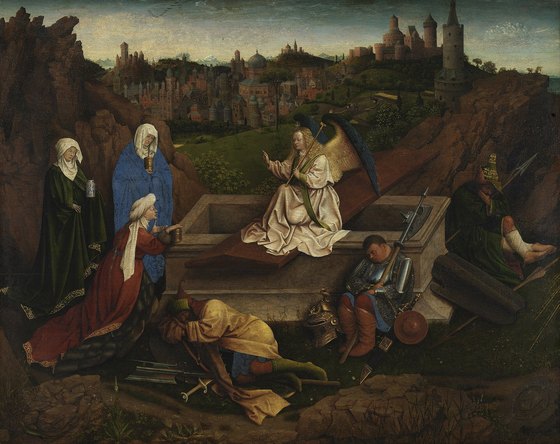
Say “Christ is risen!” The answer is “Truly He is risen!” St Michael Antiochian Orthodox Church in Beaumont, Texas, tells its people that “Indeed” works as well as “Truly”. The answer comes from the Gospel. On the first Easter evening the disciples in Jerusalem were telling each other, “The Lord has indeed risen and has appeared to Simon!” (Luke 24:33-34).
Orthodox Christians use the greeting in place of hello for the 40 days from Easter to the feast of the Ascension. The parish in Beaumont tells its people to answer the phone with it and start emails with it. In Greek it is “Christos anesti! Alithos anesti!”, in Russian “Khristos voskrese! Voistinu voskrese!” and in Serbian “Hristos vaskrse! Vaistinu vaskrse!” You can find many more in Christ is risen in different languages.
Is “Happy Easter” all right?
Orthodox clergy call the feast Easter themselves when they speak English, though its proper name is Pascha, the word for Passover. If you say “Happy Easter”, you may hear “Christ is risen!” back, and you can answer “Truly He is risen!” The same parish tells its people that when their Baptist mother calls to wish them a happy Easter, they can answer “Christ is risen!” If she doesn’t know what to say back, the parish adds, “that’s okay.”
Orthodox Easter usually comes later than Western Easter, because the Orthodox still work out its date on the old Julian calendar, as at the Council of Nicaea. In some years the two fall on the same Sunday, as in 2025 and 2028. The Orthodox Church of Finland always keeps the Western date. The Easter service begins at midnight on Saturday night, so don’t be surprised if your friend is at church then.
What are the red eggs about?
Many Orthodox families dye eggs red for Easter. Greek families also crack them against each other. Fr Paul Costopoulos (a Greek Orthodox priest in Alabama) describes how it goes. One person says “Christos anesti!” and the person holding the other egg answers “Alithos anesti!” For him the red stands for the blood of Christ, and the cracked shell for the broken tomb. The game is called tsougrisma, and the oldest in the family usually goes first. Eggs belong to Easter because the faithful give them up through Lent, together with meat and dairy, and eat them again when the fast ends.
What do you say on Orthodox Good Friday?
The Orthodox call the day Holy Friday. It has no special greeting that we know of, and “Happy Good Friday” would jar, because for the Orthodox it is a day of mourning and strict fasting. One parish closes its Holy Friday reflection with the wish “May your Holy Friday be blessed”, and “a blessed Holy Friday” is a safe thing to say. Through Holy Week, Greeks also wish each other “Kali Anastasi”, which means “a good Resurrection”. Archbishop Elpidophoros (who leads the Greek Orthodox Archdiocese of America) wished it to a whole church on Holy Thursday in 2026.
The day is sad without being hopeless, and the services of Friday evening already look ahead to Easter. In the words of the Orthodox Church in America, “All through the services the victory of Christ is contemplated and the resurrection is proclaimed.” Your friend may be at church most evenings that week. On Thursday night the Church reads the 12 Gospels of the Passion, and on Friday afternoon it keeps the burial of Christ, when a cloth icon of His body is laid in a tomb covered with flowers. On Friday night it sings the Lamentations around that tomb.
The fast is strictest at the end of the week. Those who are strong enough eat nothing at all on Good Friday, while others take a little bread and water after the afternoon service. So it is no week to plan a dinner with them. The week after Easter has no fast at all, which makes it the time to invite them. People keep the fast in different ways, as their priest advises, so it is kinder to ask than to guess.
What do you say on Orthodox Christmas?
Say “Christ is born!” The answer is “Glorify Him!” St Sophia Greek Orthodox Cathedral in Washington, DC, tells its people to greet everyone with it after the Christmas Liturgy and to keep using it for the 12 days of Christmas, up to the eve of Theophany, the feast of Christ’s baptism. In Greek it is “Christos gennatai! Doxasate!” Serbs greet each other with “Hristos se rodi!” and answer differently, with “Vaistinu se rodi!”, which means “Truly He is born!” They may begin with “Mir Božiji”, the peace of God. A Russian wishes you “S Rozhdestvom Khristovym!”, “a happy Nativity of Christ!”
“Merry Christmas” is fine too. Fr Vladimir Berzonsky (a priest of the Orthodox Church in America) made a point of wishing it to cashiers and ticket sellers who said “Happy holidays”, though he admits, “I don’t much like the phrase”, and calls “Christ is born!” the greeting that is “most near and spiritually meaningful”. Some Orthodox Churches, among them the Russian and the Serbian, keep Christmas on January 7, which is their December 25 on the old calendar, and why Orthodox Christmas is on January 7 tells the whole story.
Orthodox Christians keep a 40-day fast before Christmas without meat or dairy, so a box of chocolates may be better saved for after the feast. On Christmas Eve, Carpatho-Rusyn, Slovak and Ukrainian Orthodox families sit down to the Holy Supper, a meatless meal that begins when the first star appears. The father opens it with the Christmas greeting, and the whole family answers him. Between Christmas and the eve of Theophany there is no fast at all, which makes those days a good time to invite your friends over.