Sign Up My Profile
Prayers

The prayer of St Basil before Communion

One of the Orthodox prayers read to prepare for Holy Communion, on the morning one receives. The prayer books credit it to St Basil the Great.

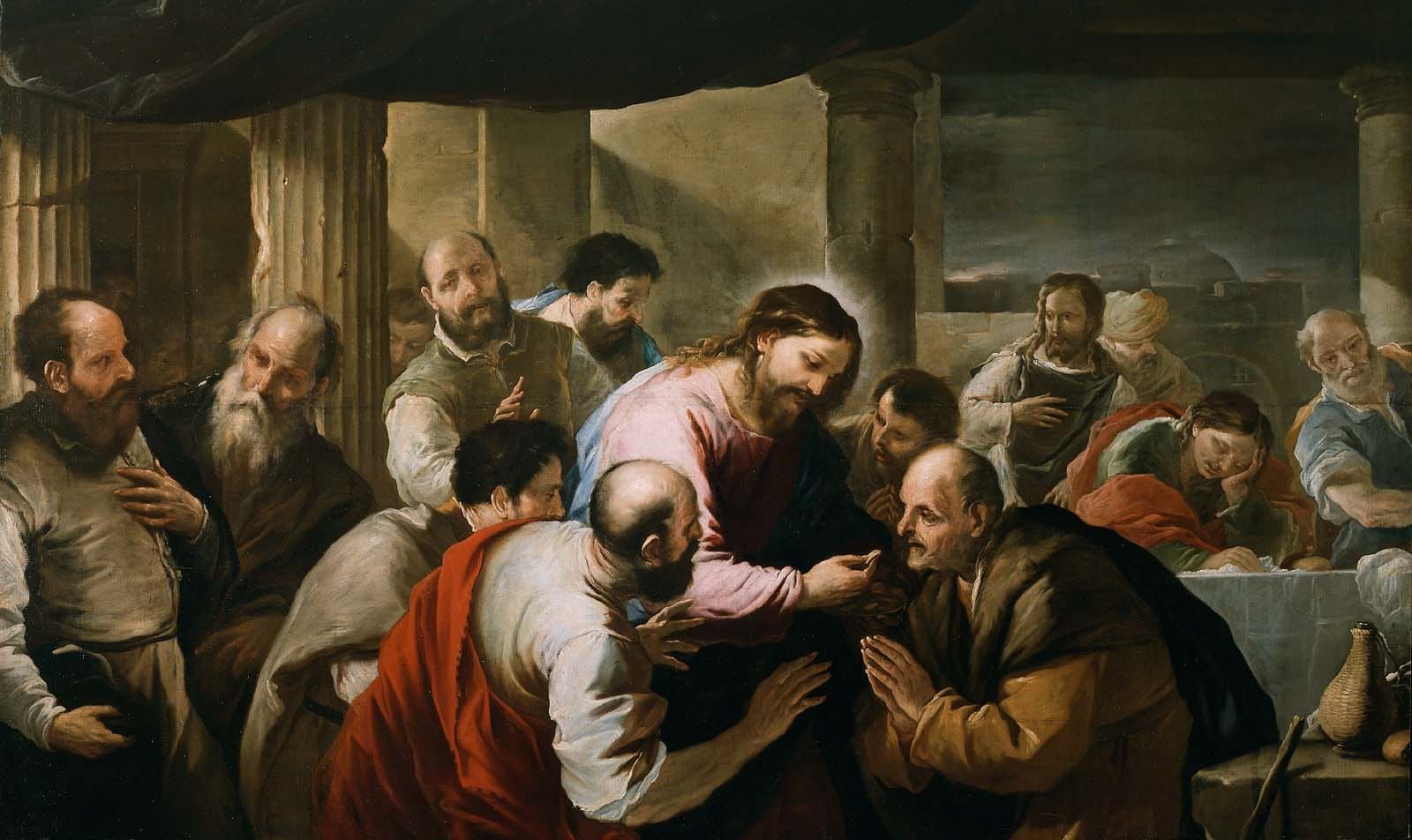
Picture: Luca Giordano, The Communion of the Apostles, before 1705

The words of the prayer

Plain English

I know, O Lord, that I receive Your most pure Bodyand Your precious Blood unworthily.I am guilty, and I eat and drink judgment on myself,not discerning the Body and Blood of Christ my God.

But I take courage from Your compassionand come to You, Who said:“Whoever eats My flesh and drinks My bloodabides in Me, and I in him.”

So have compassion, O Lord,and do not make an example of me, a sinner,but deal with me according to Your mercy.

Let these holy things be given to mefor healing, cleansing, enlightenment and protection,for salvation and holiness of soul and body,for driving away every evil imagining, every evil deedand every work of the devilat work in my body through my thoughts;

for boldness and love toward You,for a life set right and made firm,for growth in virtue and perfection,for keeping the commandments,for communion with the Holy Spirit,for provision on the way to eternal life,and for an acceptable defence before Your fearful judgment seat:not for judgment or condemnation.

Traditional wording, 1891

I know, O Lord, that I receive unworthily Thy most pure Body and Thy precious Blood,that I am guilty, O Lord, and that I eat and drink to my own condemnation,not discerning the Body and Blood of Christ my God;

but, trusting in Thy mercy, I come unto Thee Who hast said,He that eateth My Flesh and drinketh My Blood shall abide in Me and I in him.

Have compassion upon me therefore, O Lord, and make not an example of me, Thy sinful servant;but do with me according to Thy great mercy,

and grant that these holy things may rather operate in me to the healing, purifying, enlightening, guarding, saving and sanctifying of my soul and body,to the overthrow of every imagination, evil action, or work of the devil,to loving and acknowledging Thee, to the amendment and steadfastness of my life,to the increase of virtue, to the keeping of Thy commandments,to the fellowship of the Holy Spirit, to the hope of eternal life,and to be an acceptable apology before Thine awful judgment seat. Amen.

Plain English by Wiser Walk, from the Greek, with Shann’s 1891 translation beside it. How the wording is made. Traditional wording: G. V. Shann, Euchology: A Manual of Prayers of the Holy Orthodox Church, 1891.

Shann leaves out a few words the Greek has: the devil’s work “at work in my body through my thoughts”, “and perfection”, and the last line, “not for judgment or condemnation”. He ends with “Amen” instead.

When it is said

It is one of the prayers Orthodox Christians read to prepare for Holy Communion. The Greek prayer book has them said on the morning of Communion, after the usual morning service.

The evening before, a canon is said after Compline, the late-evening service. A canon is a long hymn in several parts.

In the Greek book it is the second of 10 prayers, straight after another prayer credited to St Basil.

Where it comes from

Author doubtful

Did St Basil write it?

Today’s Greek and Russian prayer books both give it to St Basil the Great, who died in AD 379. Its oldest known copies are Greek manuscripts of the 1000s, among them a book of hours now in Paris. But Fr Mikhail Zheltov, who studies the history of the services, lists it under two names: St John Chrysostom and St Basil.

Fr Mikhail Zheltov, The forming of the core of the Order for Holy Communion (in Russian)

Before there was a set order

In the 1000s and 1100s, the prayers before Communion had no fixed place yet. A copyist wrote out one, two or three of them, and the choice changed from book to book. So writes Fr Zheltov. This prayer was already among them.

Fr Mikhail Zheltov, The forming of the core of the Order for Holy Communion (in Russian)

What the words mean

Paul’s warning, said of oneself

The prayer opens with St Paul’s warning to the church in Corinth: whoever eats and drinks without discerning the body eats and drinks judgment on himself. Here the one praying owns that warning. Then the prayer turns to Jesus’s own promise: “Whoever eats My flesh and drinks My blood abides in Me, and I in him.”

1 Corinthians 11:29 and John 6:56

The Scripture in it

Therefore, whoever eats the bread or drinks the cup of the Lord in an unworthy manner will be guilty of sinning against the body and blood of the Lord. Each one must examine himself before he eats of the bread and drinks of the cup. For anyone who eats and drinks without recognizing the body eats and drinks judgment on himself.

1 Corinthians 11:27-29 Echoed Paul: whoever eats and drinks without discerning the body eats and drinks judgment on himself.

Whoever eats My flesh and drinks My blood remains in Me, and I in him.

John 6:56 Quoted Jesus’s own words, quoted in the prayer.

Bible text: Berean Standard Bible, public domain.

In Greek

Οἶδα, Κύριε, ὅτι ἀναξίως μεταλαμβάνω τοῦ ἀχράντου Σου Σώματος καὶ τοῦ τιμίου Σου Αἵματος καὶ ἔνοχός εἰμι καὶ κρῖμα ἐμαυτῷ ἐσθίω καὶ πίνω, μὴ διακρίνων τὸ Σῶμα καὶ τὸ Αἷμα τοῦ Χριστοῦ καὶ Θεοῦ μου·

ἀλλὰ τοῖς οἰκτιρμοῖς Σου θαῤῥῶν, προσέρχομαί Σοι τῷ εἰπόντι. Ὁ τρώγων Μου τὴν Σάρκα καὶ πίνων Μου τὸ Αἷμα ἐν Ἐμοὶ μένει, κἀγὼ ἐν αὐτῷ.

Σπλαγχνίσθητι οὖν, Κύριε, καὶ μὴ παραδειγματίσῃς με τὸν ἁμαρτωλόν, ἀλλὰ ποίησον μετ᾿ ἐμοῦ κατὰ τὸ ἔλεός Σου·

καὶ γενέσθω μοι τὰ ἅγια ταῦτα εἰς ἴασιν καὶ κάθαρσιν καὶ φωτισμὸν καὶ φυλακτήριον καὶ σωτηρίαν καὶ ἁγιασμὸν ψυχῆς τε καὶ σώματος·

εἰς ἀποτροπὴν πάσης φαντασίας καὶ πονηρᾶς πράξεως καὶ ἐνεργείας διαβολικῆς, κατὰ διάνοιαν τῆς ἐν τοῖς μέλεσί μου ἐνεργουμένης·

εἰς παῤῥησίαν καὶ ἀγάπην τὴν πρὸς Σέ· εἰς διόρθωσιν βίου καὶ ἀσφάλειαν· εἰς αὔξησιν ἀρετῆς καὶ τελειότητος· εἰς πλήρωσιν ἐντολῶν· εἰς Πνεύματος Ἁγίου κοινωνίαν·

εἰς ἐφόδιον ζωῆς αἰωνίου καὶ εἰς ἀπολογίαν εὐπρόσδεκτον, τὴν ἐπὶ τοῦ φοβεροῦ βήματός Σου· μὴ εἰς κρῖμα ἢ εἰς κατάκριμα.

From the Greek prayers for Holy Communion, from the book of hours (the Horologion), on the Greek Orthodox Archdiocese of America’s liturgical texts site, with capitals for God.

Close to this

All prayers

Suggest a correction

Berean Standard Bible