
When it is said
At every Divine Liturgy, the Orthodox Communion service, the deacon calls out: “The doors! The doors! Wisdom! Let us attend!” Then the Creed is sung or said.
It is also said at Compline, the service before sleep, and at the Midnight Office, a service of prayer in the night. In the Russian prayer book it is part of the morning prayers at home.
At a baptism, the one to be baptized says it aloud, or a godparent says it on their behalf.
Where it comes from
Author by tradition
Nicaea, 325, and Constantinople, 381
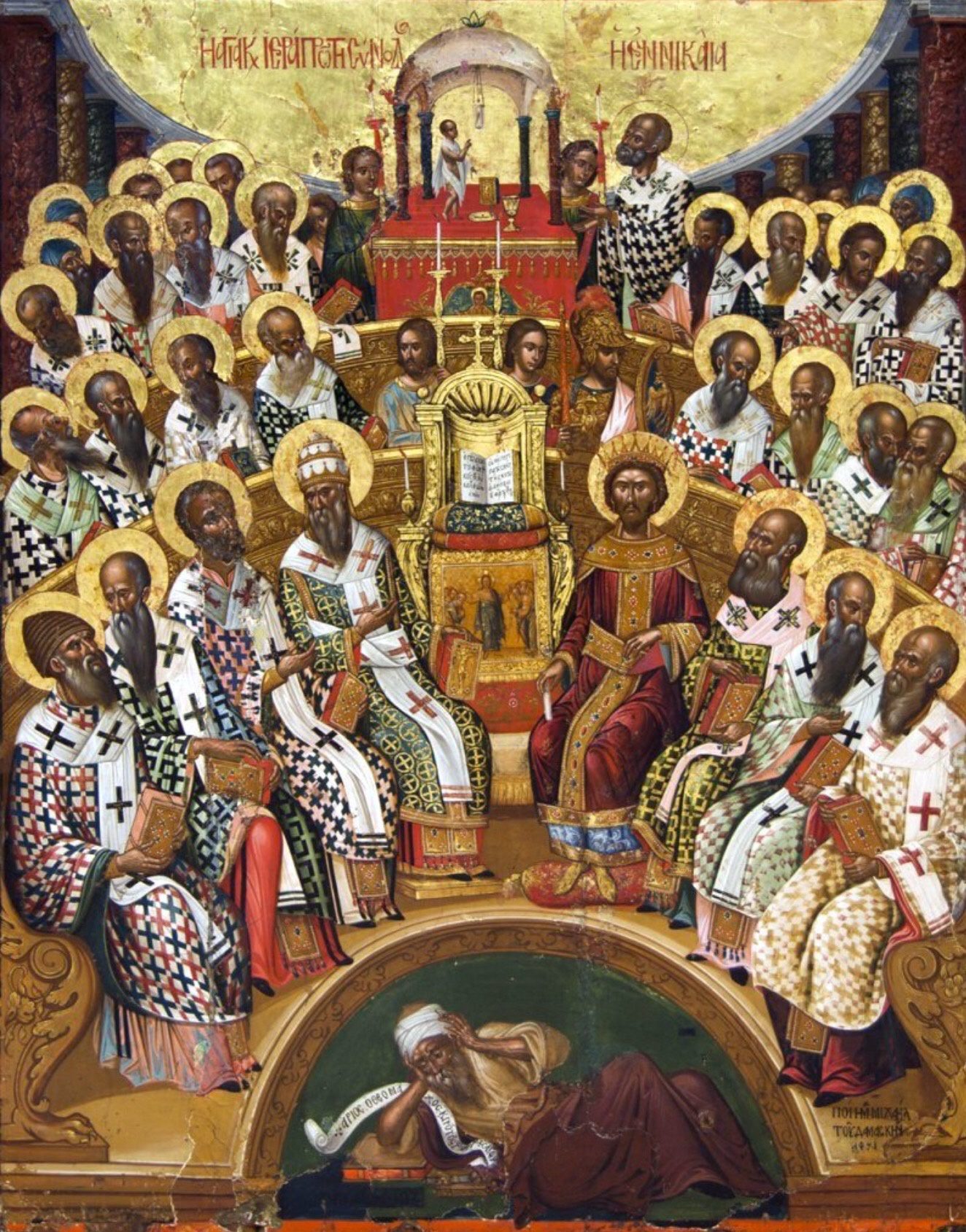
The Creed is named after the Council of Nicaea, a gathering of bishops in AD 325. The form said today is fuller. It adds 10 clauses and enlarges the part on the Holy Spirit. It is credited to the Council of Constantinople in AD 381. Its oldest copy is in the record of the Council of Chalcedon, in AD 451, which had it read out twice.
Catholic Encyclopedia (1911), Nicene Creed; The Russian Orthodox prayer book, on Azbyka.ru
Said at the font
The Creed holds what every early church confessed at baptism. In time the Creed of Nicaea became the profession of faith for those about to be baptized. It still is, and an English service book of 1884 has it said three times at a baptism.
Catholic Encyclopedia (1911), Nicene Creed; Isabel F. Hapgood, Service Book (1906), Holy Baptism; Nicholas Bjerring, The Offices of the Oriental Church (1884), Baptism
How “and the Son” came in
Spain was the first to sing the Creed with “and the Son” (Filioque, in Latin). This began after the Goths there gave up Arianism in AD 589. Arianism taught that the Son is lesser than the Father. A council at Aachen approved the words in AD 809. Pope Leo III agreed with their teaching but advised leaving them out of the Creed. Rome took them up around 1014. They became one occasion of the split between East and West.
What the words mean
“And the Son”
Most Western churches say the Spirit proceeds from the Father “and the Son”. Catholics teach that the Spirit proceeds from both as from one source. The Orthodox confess the Father as the one eternal source of the Spirit, as of the Son, and hold the added words to be unscriptural. They say the Creed without them, and so do the Eastern Catholic churches of the Byzantine rite.
Catholic Encyclopedia (1909), Filioque; Orthodox Church in America, The Orthodox Faith: The Holy Spirit; Wikipedia, Nicene Creed
“I believe”, not “we believe”
The councils wrote “We believe”: the bishops spoke together. In the Orthodox services each person says “I believe”, “I confess” and “I await”. So the Creed is the Church’s faith, confessed by each believer as their own.
“Catholic” means whole
“Catholic” in the Creed is not the name of one church. The Greek word means whole. Orthodox teaching explains it as “full, complete, whole, with nothing lacking”. The Orthodox say it of their own Church, and of each local Orthodox church.
The Scripture in it
… yet for us there is but one God, the Father, from Whom all things came and for Whom we exist. And there is but one Lord, Jesus Christ, through Whom all things came and through Whom we exist.
Through Him all things were made, and without Him nothing was made that has been made.
For what I received I passed on to you as of first importance: that Christ died for our sins according to the Scriptures, that He was buried, that He was raised on the third day according to the Scriptures …
When the Advocate comes, Whom I will send to you from the Father—the Spirit of truth Who proceeds from the Father—He will testify about Me.
… one Lord, one faith, one baptism …
Bible text: Berean Standard Bible, public domain.
In Greek
Πιστεύω εἰς ἕνα Θεόν, Πατέρα, Παντοκράτορα, ποιητὴν οὐρανοῦ καὶ γῆς, ὁρατῶν τε πάντων καὶ ἀοράτων.
Καὶ εἰς ἕνα Κύριον Ἰησοῦν Χριστόν, τὸν Υἱόν τοῦ Θεοῦ τὸν Μονογενῆ, τὸν ἐκ τοῦ Πατρὸς γεννηθέντα πρὸ πάντων τῶν αἰώνων.
Φῶς ἐκ Φωτός, Θεὸν ἀληθινὸν ἐκ Θεοῦ ἀληθινοῦ γεννηθέντα, οὐ ποιηθέντα, ὁμοούσιον τῷ Πατρί, δι' Οὗ τὰ πάντα ἐγένετο.
Τὸν δι' ἡμᾶς τοὺς ἀνθρώπους καὶ διὰ τὴν ἡμετέραν σωτηρίαν κατελθόντα ἐκ τῶν οὐρανῶν καὶ σαρκωθέντα ἐκ Πνεύματος Ἁγίου καὶ Μαρίας τῆς Παρθένου καὶ ἐνανθρωπήσαντα.
Σταυρωθέντα τε ὑπὲρ ἡμῶν ἐπὶ Ποντίου Πιλάτου καὶ παθόντα καὶ ταφέντα.
Καὶ ἀναστάντα τῇ τρίτῃ ἡμέρᾳ κατὰ τὰς Γραφάς.
Καὶ ἀνελθόντα εἰς τοὺς Οὐρανοὺς καὶ καθεζόμενον ἐκ δεξιῶν τοῦ Πατρός.
Καὶ πάλιν ἐρχόμενον μετὰ δόξης κρῖναι ζῶντας καὶ νεκρούς, Οὗ τῆς βασιλείας οὐκ ἔσται τέλος.
Καὶ εἰς τὸ Πνεῦμα τὸ Ἅγιον, τὸ Κύριον, τὸ Ζωοποιόν, τὸ ἐκ τοῦ Πατρὸς ἐκπορευόμενον, τὸ σὺν Πατρὶ καὶ Υἱῷ συμπροσκυνούμενον καὶ συνδοξαζόμενον, τὸ λαλῆσαν διά τῶν Προφητῶν.
Εἰς Μίαν, Ἁγίαν, Καθολικὴν καὶ Ἀποστολικὴν Ἐκκλησίαν.
Ὁμολογῶ ἓν Βάπτισμα εἰς ἄφεσιν ἁμαρτιῶν.
Προσδοκῶ ἀνάστασιν νεκρῶν.
Καὶ ζωήν τοῦ μέλλοντος αἰῶνος. Ἀμήν.