Sign Up My Profile
Prayers

St Augustine’s prayer for guidance

A prayer from St Augustine’s Soliloquies, written in the months before his baptism. He does not yet know the way to God, and asks God to show it to him.

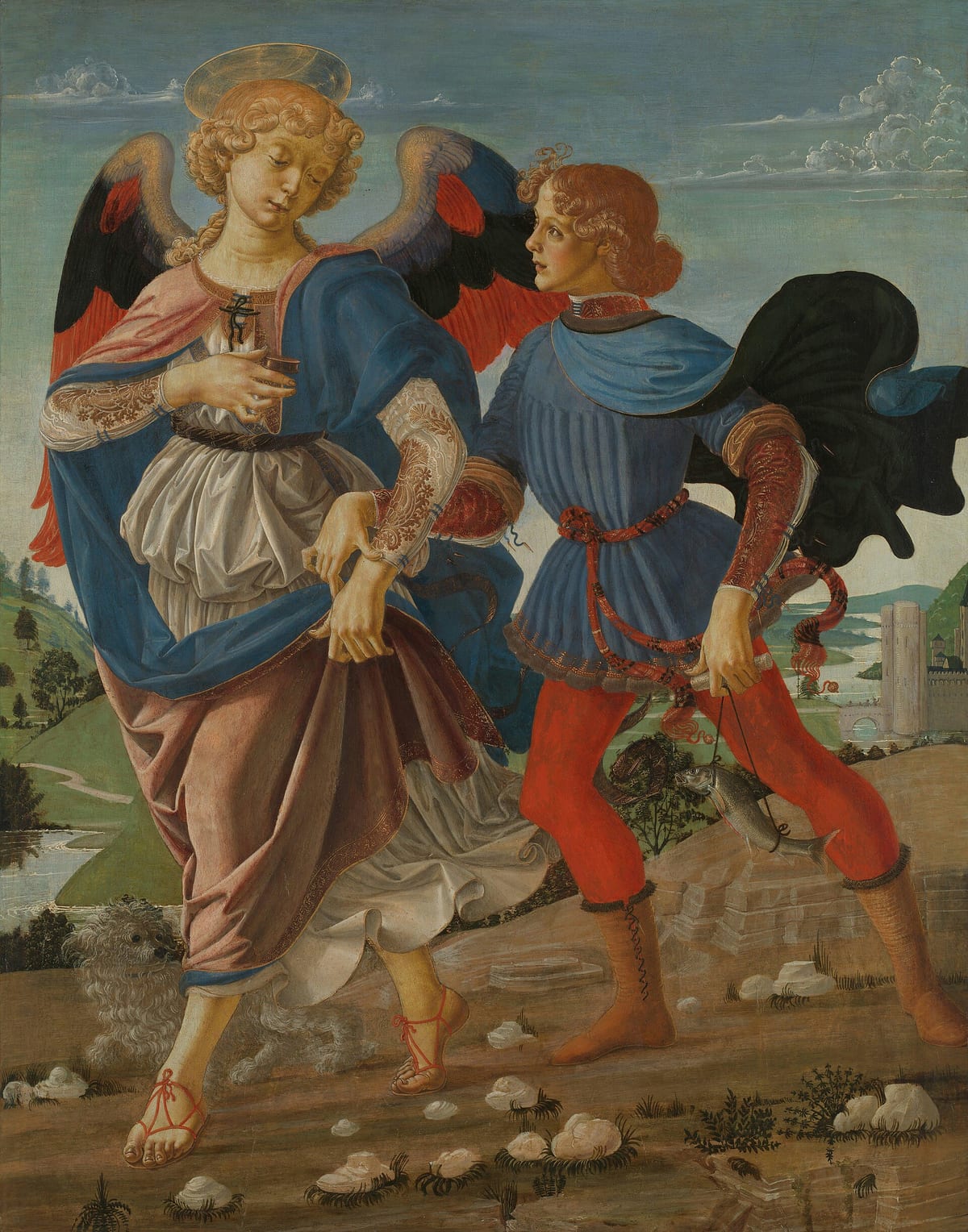
Picture: Workshop of Andrea del Verrocchio, Tobias and the Angel, 1470–75

The words of the prayer

Plain English

Now I love You alone.You alone I follow, You alone I seek.I am ready to serve You alone,for You alone rule by right.I long to be Yours.Order, I pray, and command whatever You will.But heal and open my ears,so that I may hear Your voice.Heal and open my eyes,so that I may see You beckon.Drive the madness out of me,so that I may know You again.Tell me where to look, so that I may see You,and I hope to do all that You command.

Lord, most merciful Father,take back, I pray, Your runaway.Surely I have been punished enough by now.Long enough I have served Your enemies,whom You hold under Your feet.Long enough I have been the plaything of lies.Receive me, Your servant, as I flee from Your enemies and their lies.For they took me in, though I was not theirs,when I was fleeing from You.

I feel that I must come back to You.I am knocking: let Your door be opened to me.Teach me how to reach You.I have nothing but the will to come.I know nothing but this:what passes and falls away must be rejected,and what is sure and eternal must be sought.This I do, Father, because it is all I know.But I do not know where the road to You begins.Prompt me, show me,give me what I need for the journey.

If those who run to You for refugefind You by faith, give me faith.If they find You by virtue, give virtue.If by knowledge, give knowledge.Increase my faith, increase my hope,increase my love.How wonderful, how matchless is Your goodness!

Traditional wording, 1888

Henceforth Thee alone do I love, Thee alone I follow, Thee alone I seek,Thee alone am I prepared to serve, for Thou alone art Lord by a just title,of Thy dominion do I desire to be.Direct, I pray, and command whatever Thou wilt,but heal and open my ears, that I may hear Thine utterances.Heal and open my eyes, that I may behold Thy significations of command.Drive delusion from me, that I may recognize Thee.Tell me whither I must tend, to behold Thee,and I hope that I shall do all things Thou mayest enjoin.

O Lord, most merciful Father receive, I pray, Thy fugitive;enough already, surely, have I been punished,long enough have I served Thine enemies, whom Thou hast under Thy feet,long enough have I been a sport of fallacies.Receive me fleeing from these, Thy house-born servant,for did not these receive me, though another Master’s, when I was fleeing from Thee?

To Thee I feel I must return: I knock; may Thy door be opened to me;teach me the way to Thee.Nothing else have I than the will:nothing else do I know than that fleeting and falling things are to be spurned,fixed and everlasting things to be sought.This I do, Father, because this alone I know,but from what quarter to approach Thee I do not know.Do Thou instruct me, show me, give me my provision for the way.

If it is by faith that those find Thee, who take refuge with Thee then grant faith:if by virtue, virtue: if by knowledge, knowledge.Augment in me, faith, hope, and charity.O goodness of Thine, singular and most to be admired!

Plain English by Wiser Walk, from the Latin, with Starbuck’s 1888 translation beside it. How the wording is made. Traditional wording: C. C. Starbuck, The Soliloquies of St. Augustin, 1888.

Starbuck says “Augment in me, faith, hope, and charity”; Augustine says “increase” three times, once for each, and this page keeps all three.

When it is said

It is not part of any Orthodox service or prayer book. Augustine wrote it as part of the long prayer that opens his Soliloquies.

Anyone may say it, at any hour. It fits a time when you do not know which way to go, or when faith feels thin and you want more of it.

Where it comes from

Author known

Where it comes from

Augustine wrote the Soliloquies in his 33rd year, at Cassiciacum, a friend’s country house near Milan. He spent half a year there before his baptism. It is his earliest Christian work, and it opens with a long prayer. This page prints one part of that prayer whole.

C. C. Starbuck, preface to the Soliloquies (1888); Philip Schaff, prolegomena to Augustine’s Confessions (1886)

A talk with Reason

The book opens as Augustine, after days of searching, hears a voice. Whether it was his own or another’s, within him or without, he says he does not know. He calls it Reason. When the prayer ends, Reason asks what he wants to know. He answers: God and the soul.

Augustine, Soliloquies, Book 1, tr. C. C. Starbuck (1888)

A new word

Augustine named the book himself. Since he was talking with himself alone, he called it Soliloquies: “a new name,” he wrote, “and perhaps a grating one”. Much later, King Alfred of England put parts of it into the English of his day.

Augustine, Soliloquies, Book 2, tr. C. C. Starbuck (1888); Nicene and Post-Nicene Fathers, volume 7, preface (1888)

What the words mean

Faith, hope and love

Near its end, Augustine asks God to increase faith, hope and love in him: the three that Paul names together. Augustine’s Latin word for love is caritas, which Starbuck translates “charity”.

1 Corinthians 13:13, Berean Standard Bible

The Scripture in it

Ask, and it will be given to you; seek, and you will find; knock, and the door will be opened to you.

Matthew 7:7 Echoed “I am knocking: let Your door be opened to me.” Jesus: knock, and the door will be opened to you.

And now these three remain: faith, hope, and love; but the greatest of these is love.

1 Corinthians 13:13 Echoed Faith, hope and love: the three Paul names together.

Bible text: Berean Standard Bible, public domain.

In Latin

Iam Te solum amo, Te solum sequor, Te solum quaero, Tibi soli servire paratus sum, quia Tu solus iuste dominaris; Tui iuris esse cupio.

Iube, quaeso, atque impera quidquid vis, sed sana et aperi aures meas, quibus voces Tuas audiam.

Sana et aperi oculos meos, quibus nutus Tuos videam.

Expelle a me insaniam, ut recognoscam Te.

Dic mihi qua attendam, ut aspiciam Te, et omnia me spero quae iusseris esse facturum.

Recipe, oro, fugitivum Tuum, Domine, clementissime Pater: iamiam satis poenas dederim, satis inimicis Tuis, quos sub pedibus habes, servierim, satis fuerim fallaciarum ludibrium.

Accipe me ab istis fugientem famulum Tuum, quia et isti me quando a Te fugiebam acceperunt alienum.

Ad Te mihi redeundum esse sentio: pateat mihi pulsanti ianua Tua; quomodo ad Te perveniatur doce me.

Nihil aliud habeo quam voluntatem; nihil aliud scio nisi fluxa et caduca spernenda esse; certa et aeterna requirenda.

Hoc facio, Pater, quia hoc solum novi; sed unde ad Te perveniatur ignoro.

Tu mihi suggere, Tu ostende, Tu viaticum praebe.

Si fide Te inveniunt qui ad Te refugiunt, fidem da; si virtute, virtutem; si scientia, scientiam.

Auge in me fidem, auge spem, auge caritatem.

O admiranda et singularis bonitas Tua!

From Augustine, Soliloquies, Book 1, as printed by augustinus.it, with capitals for God.

Close to this

All prayers

Suggest a correction

Berean Standard Bible