
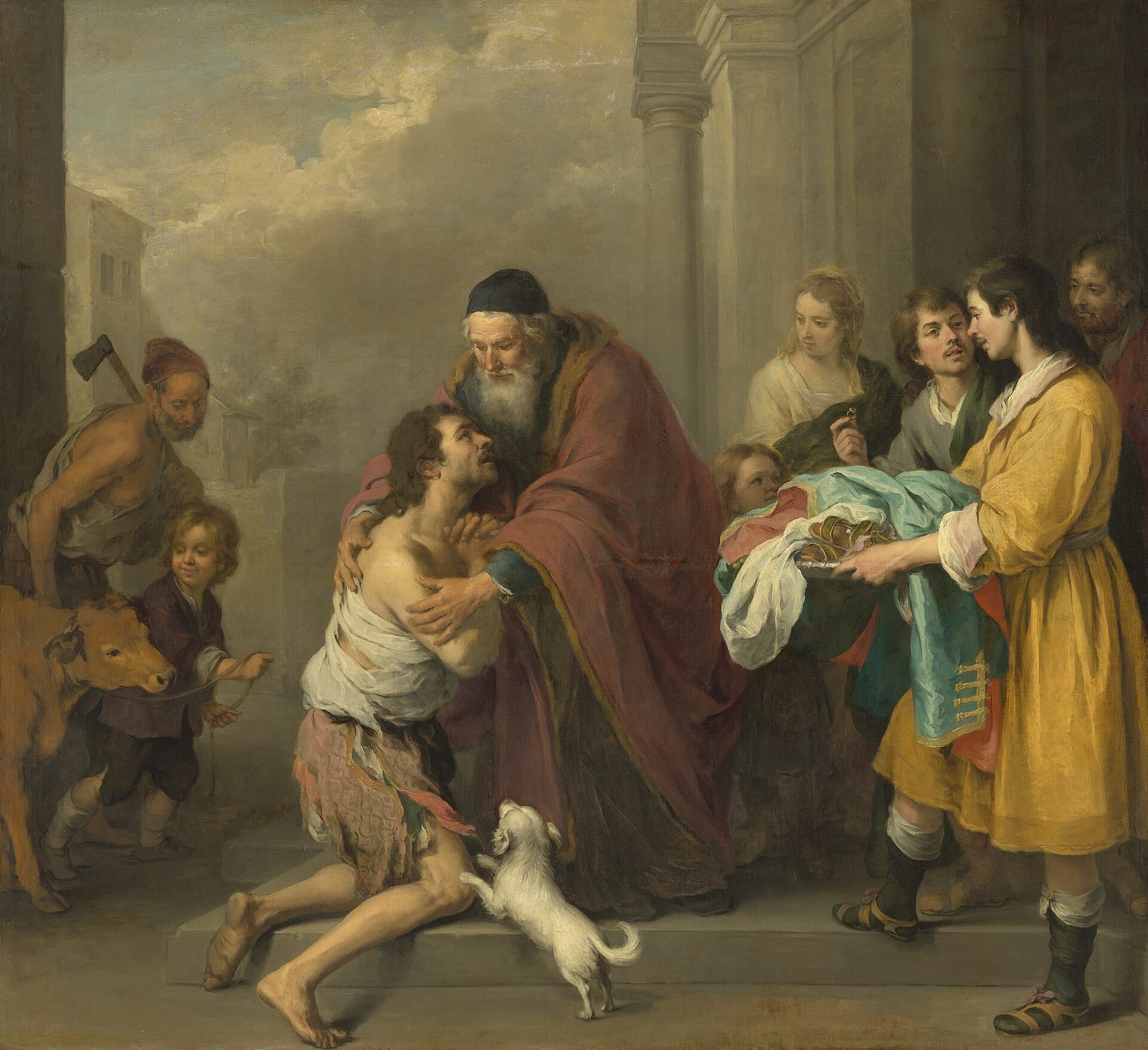
When it is said
It is not part of any Orthodox service or prayer book. Augustine wrote it in his Confessions, the story of his life told to God.
Anyone may pray it, at any hour, for someone who has walked away from God: a son or daughter, a husband or wife, a friend.
Where it comes from
Author known
Where it comes from
St Augustine, bishop of Hippo in North Africa, wrote his Confessions about AD 400: the story of his life, told to God. This prayer comes near the start of its fifth part, in a chapter on those who try to run from God. That part tells of his 29th year. He taught at Rome and Milan, heard Bishop Ambrose, and began to come to himself.
Augustine, Confessions, Book 5, tr. J. G. Pilkington (1886); Encyclopaedia Britannica, St. Augustine
The son of these tears
Augustine’s mother, St Monica, wept and prayed for him for nearly nine years. She wept, he says, more than mothers weep for a child who has died. She begged a bishop to talk with him and refute his errors. He refused: “Leave him alone for a time, only pray God for him.” When she kept weeping, he said: “It is not possible that the son of these tears should perish.”
He had been far away too
The paragraph ends with Augustine’s own story: “And where was I when I was seeking Thee? And Thou wert before me, but I had gone away even from myself.” At Milan, under St Ambrose, he studied the Scriptures and was baptized. The Orthodox Church in America honours him as Blessed Augustine on 15 June, and St Monica on 4 May.
Augustine, Confessions, Book 5, tr. J. G. Pilkington (1886); Orthodox Church in America, Blessed Augustine, Bishop of Hippo
What the words mean
“Let them turn back”
Augustine asks it twice: convertantur, “let them turn”. Pilkington’s English of 1886 says “let them be converted”. Between the two he gives the reason. They have abandoned their Creator, but God has not abandoned His creature. In Latin both halves use the same verb, deserere, to abandon.
The Scripture in it
Where can I go to escape Your Spirit? Where can I flee from Your presence? If I ascend to the heavens, You are there; if I make my bed in Sheol, You are there. If I rise on the wings of the dawn, if I settle by the farthest sea, even there Your hand will guide me; Your right hand will hold me fast.
“‘He will wipe away every tear from their eyes,’ and there will be no more death or mourning or crying or pain, for the former things have passed away.”
Bible text: Berean Standard Bible, public domain.
In Latin
Videlicet nesciunt quod ubique sis, Quem nullus circumscribit locus, et solus es praesens etiam his qui longe fiunt a Te.
Convertantur ergo et quaerant Te, quia non, sicut ipsi deseruerunt Creatorem suum, ita Tu deseruisti creaturam Tuam: ipsi convertantur.
Et ecce ibi es in corde eorum, in corde confitentium Tibi et proicientium se in Te et plorantium in sinu Tuo post vias suas difficiles.
Et Tu facilis terges lacrimas eorum, et magis plorant et gaudent in fletibus, quoniam Tu, Domine, non aliquis homo, caro et sanguis, sed Tu, Domine, Qui fecisti, reficis et consolaris eos.
From Confessions, Book 5, as printed by The Latin Library, with capitals for God.