Sign Up My Profile
Prayers

Orthodox prayers for hard times

Prayers for hard times, when everything seems to go wrong, from the Church’s service for those in sorrow, the Bible and a Mass book of the early 700s.

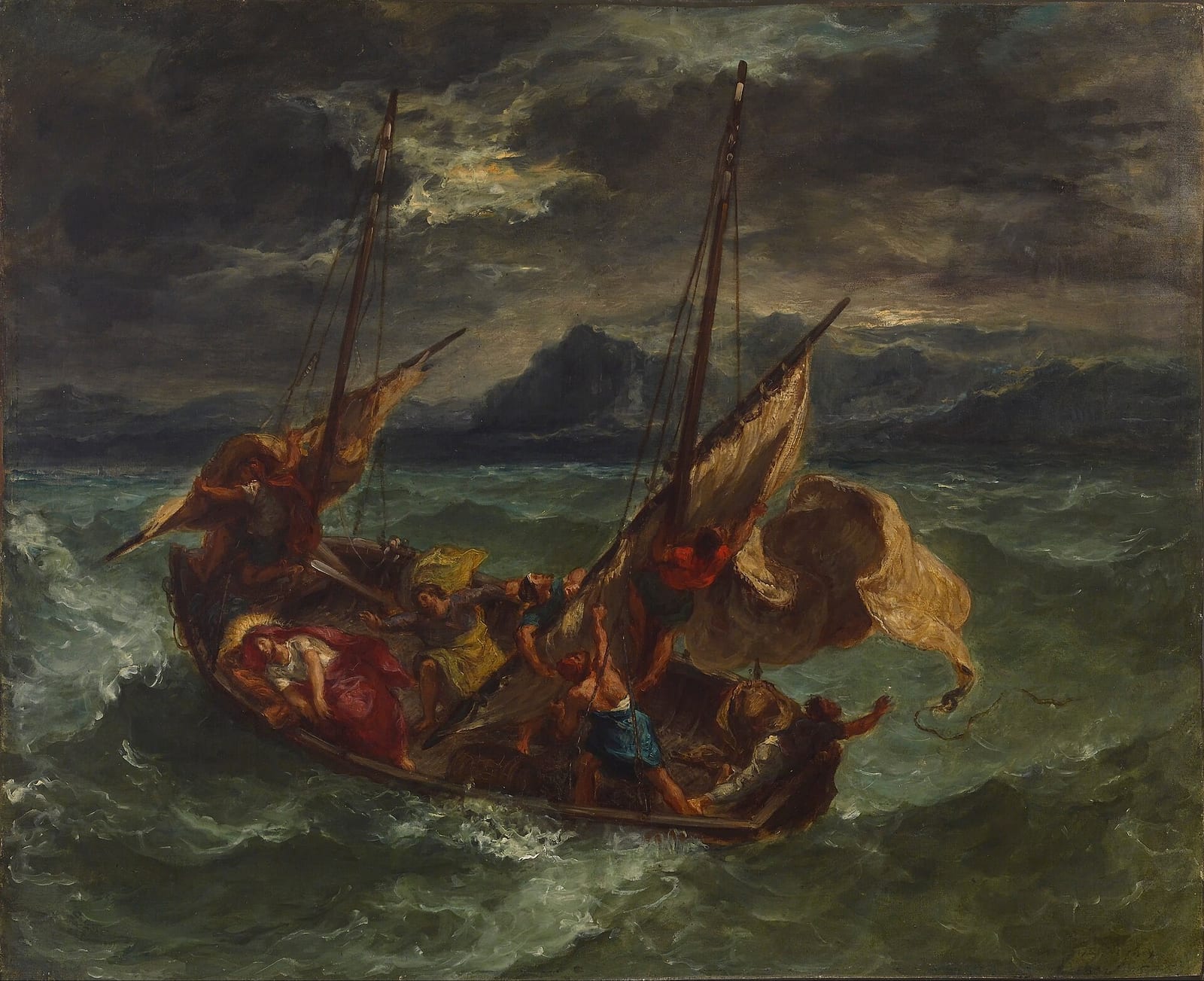
Picture: Eugène Delacroix, Christ on the Sea of Galilee, 1854

5 prayers

The Church’s prayer for hard times

Prayer in time of trouble

Plain English only: no traditional English wording is given for this prayer

O Master, Lord Jesus Christ our God,God of all mercy and compassion,patient and full of mercy,You love the righteousand have mercy on sinners.

With Your most pure lips You said:“Come to Me, all who are weary and burdened,and I will give you rest.”

See, we who are sinful and unworthy,worn out by sorrows and troubles,run to You, fall down before You and pray:heed the Mother of God, who bore You,as she pleads for us;receive the prayers of Your saints;bend down to our weakness,and show Your mercy to Your people,who trust in Your love for mankind,whatever their situation.

Comfort those who grieve,give courage to the downcast,strengthen those who have grown weak,heal the sick,send patience to the maimed and the paralysed,feed the hungry,clothe the naked,give shelter to the homeless,help those who labour,and give relief to those weighed downby the cares of life and by hard work.

Strengthen with patience those on trial,in prisons, in chains, shut away, in exileand in bitter labour,and bring them quickly out to freedom.Keep safe those at war,bring the captives home,bring together those who are parted,make peace between those at odds,show mercy to all in all things,and present everyone to Your holy Churchas people who please You.

For it is Yours to have mercy on usand to save us, O Lord our God,and we give glory to You,with Your Father, Who has no beginning,and the Holy Spirit,now and always,and for ever and ever. Amen.

The priest reads it at the Russian Orthodox service of prayer for those in sorrows and hardships. It brings Christ every kind of trouble, from grief and illness to prison and war.

Plain English by Wiser Walk, from the Church Slavonic. How the wording is made.

Where it comes from, and the Church Slavonic

A very present help

Psalm 46

God is our refuge and strength,a help always near in times of trouble.

So we will not fear, though the earth gives way,though the mountains slide into the heart of the sea,though its waters roar and foamand the mountains shake as it surges.

There is a river whose streams bring joy to the city of God,the holy place where the Most High dwells.God is within the city; it will not fall.God will help it at the break of day.

The nations rage, and kingdoms totter;He raises His voice, and the earth melts.The LORD of hosts is with us;the God of Jacob is our fortress.

Come and see the works of the LORD,the ruins He has made on the earth:He makes wars cease to the ends of the earth;He breaks the bow and snaps the spear;He burns the chariots with fire.

“Be still, and know that I am God.I will be exalted among the nations;I will be exalted in the earth.”

The LORD of hosts is with us;the God of Jacob is our fortress.

Traditional wording, 1611

God is our refuge and strength,a very present help in trouble.

Therefore will not we fear, though the earth be removed,and though the mountains be carried into the midst of the sea;Though the waters thereof roar and be troubled,though the mountains shake with the swelling thereof.

There is a river, the streams whereof shall make glad the city of God,the holy place of the tabernacles of the Most High.God is in the midst of her; she shall not be moved:God shall help her, and that right early.

The heathen raged, the kingdoms were moved:He uttered His voice, the earth melted.The LORD of hosts is with us;the God of Jacob is our refuge.

Come, behold the works of the LORD,what desolations He hath made in the earth.He maketh wars to cease unto the end of the earth;He breaketh the bow, and cutteth the spear in sunder;He burneth the chariot in the fire.

Be still, and know that I am God:I will be exalted among the heathen,I will be exalted in the earth.

The LORD of hosts is with us;the God of Jacob is our refuge.

It opens with God as our refuge and strength, a help always near in times of trouble. Twice the psalm answers its fears with “The LORD of hosts is with us.”

Plain English by Wiser Walk, from the Hebrew, with the King James Version beside it. How the wording is made. Traditional wording: The King James translators, The King James Version, 1611.

Where it comes from, and the original

One sentence to hold on to

Troparion in time of trouble

Plain English only: no traditional English wording is given for this prayer

Save Your people, O Lord,and bless Your inheritance.Help those who are weary and burdened,comfort those who grieve and those who lose heart,and keep Your servants from every trouble.

The Russian service for those in sorrow sings this short hymn twice near its start. It asks God to help the weary, comfort those who grieve and keep His servants from every trouble.

Plain English by Wiser Walk, from the Church Slavonic. How the wording is made.

Where it comes from, and the Church Slavonic

In any distress

O God, our refuge in hardship

O God, our refuge in hardship,our strength in weakness,our help in trouble,our comfort in tears:

spare, O Lord, spare Your people;do not hand over to the wild beaststhe souls that praise You.

Traditional wording, 1864

O God, our Refuge in pains,our Strength in weakness,our Help in tribulations,our Solace in tears;

spare, O Lord, spare Thy people,give not up to beaststhe souls that praise Thee.

Christians kept three days of prayer before Ascension to ask God’s protection in calamities, and this short prayer comes from the Mass for those days. It calls God our comfort in tears and asks Him to spare His people.

Plain English by Wiser Walk, from the Latin, with William Bright’s 1864 translation beside it. How the wording is made. Traditional wording: William Bright, Ancient Collects and Other Prayers, 1864.

Bright’s “pains” stands for a Latin word for toil and hardship, so the plain wording says “hardship”.

Where it comes from, and the Latin

When everything fails

Prayer of Habakkuk

Though the fig tree does not blossomand there is no fruit on the vines,though the olive crop failsand the fields give no food,though the flock is cut off from the foldand there are no cattle in the stalls,yet I will rejoice in the LORD;I will be glad in the God Who saves me.

The LORD God is my strength.He makes my feet like the feet of a deerand makes me walk on the heights.

Traditional wording, 1611

Although the fig tree shall not blossom, neither shall fruit be in the vines;the labour of the olive shall fail, and the fields shall yield no meat;the flock shall be cut off from the fold, and there shall be no herd in the stalls:Yet I will rejoice in the LORD, I will joy in the God of my salvation.

The LORD God is my strength, and He will make my feet like hinds’ feet,and He will make me to walk upon mine high places.

Habakkuk pictures the fig tree, the vines, the olives and the fields all failing at once, and still he will rejoice in the God Who saves him. He ends, “The LORD God is my strength.”

Plain English by Wiser Walk, from the Hebrew (chapter 3, verses 17 to 19), with the King James Version beside it. How the wording is made. Traditional wording: The King James translators, The King James Version, 1611.

In the King James Version “meat” means food, and a hind is a female deer.

Where it comes from, and the original

Scripture for this

28“Come to Me, all you who are weary and burdened, and I will give you rest. 29Take My yoke upon you and learn from Me, for I am gentle and humble in heart, and you will find rest for your souls. 30For My yoke is easy and My burden is light.”

Matthew 11:28-30 Jesus calls the weary and burdened to come to Him for rest. These words are the Gospel read at the service for those in sorrow.

“I have told you these things so that in Me you may have peace. In the world you will have tribulation. But take courage; I have overcome the world!”

John 16:33 The night before He died, Jesus told His friends to take courage in a world of trouble, because He has overcome the world.

8We are hard pressed on all sides, but not crushed; perplexed, but not in despair; 9persecuted, but not forsaken; struck down, but not destroyed.

2 Corinthians 4:8-9 Paul is writing of his own hard years, when trouble came at him from every side and yet never crushed him.

35Who shall separate us from the love of Christ? Shall trouble or distress or persecution or famine or nakedness or danger or sword? 36As it is written: “For Your sake we face death all day long; we are considered as sheep to be slaughtered.” 37No, in all these things we are more than conquerors through Him Who loved us. 38For I am convinced that neither death nor life, neither angels nor principalities, neither the present nor the future, nor any powers, 39neither height nor depth, nor anything else in all creation, will be able to separate us from the love of God that is in Christ Jesus our Lord.

Romans 8:35-39 Paul names hardship after hardship, and none of them can separate us from the love of God in Christ.

The LORD is good, a stronghold in the day of distress; He cares for those who trust in Him.

Nahum 1:7 The Lord is still good on the day distress comes. He is a stronghold, and He cares for those who trust in Him.

“Call upon Me in the day of trouble; I will deliver you, and you will honor Me.”

Psalm 50:15 God Himself speaks this verse. He asks His people to call on Him in the day of trouble, and promises to deliver them.

Bible text: Berean Standard Bible, public domain.

A psalm for this

In my distress I cried to the LORD, and He answered me.

Psalm 120:1

The Russian service for those in sorrow takes up this line among its psalm verses.

Psalm 120 Read the whole psalm, with St Athanasius’s advice on when to pray it.

Close to this

All prayers

Quiz What prayer do you need right now? A few honest taps about where you are, and a prayer of the Church for exactly that. 8 questions, about 3 minutes. Start

Suggest a correction

Berean Standard Bible