Sign Up My Profile
Prayers

The prayer for reconciling those at enmity

A prayer of the priest’s Book of Needs for people who were at enmity. It thanks God for the peace He has given them and asks Him to make it last.

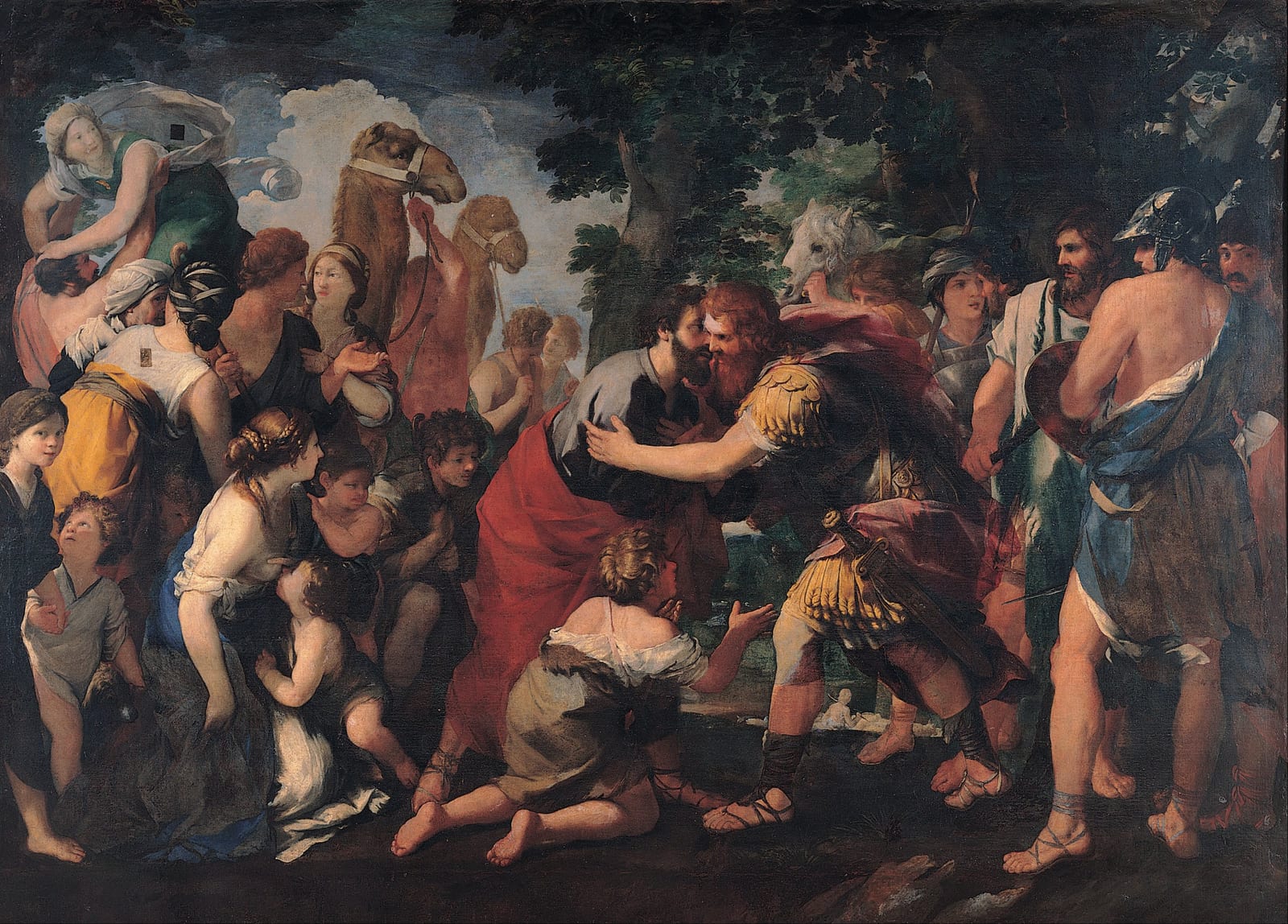
Picture: Raffaellino Bottalla, The Meeting of Esau and Jacob, 1636–41

The words of the prayer

Plain English

We thank You, O Master, Lover of mankind,King of the ages and Giver of good things.

You tore down the dividing walls of hostilityand gave peace to the human race,and now You have given peaceto Your servants too.

Root the fear of You in them,and make their love for one another firm.Quench every quarrel,and take away all discord and offence.

For You are our Peace,and to You we give glory,to the Father and the Son and the Holy Spirit,now and always, and for ever and ever.Amen.

Traditional wording, 1999

We thank Thee, O Master and Lover of Mankind,King of the ages and Giver of good things,

Who didst destroy the middle wall of enmityand didst grant peace unto the race of man,and Who now hast granted peace unto Thy servants.

Instill in them the fear of Thee,and confirm love for each other.Extinguish every disputeand banish every temptation to disagreement.

For Thou art our Peace,and unto Thee do we send up glory:to the Father, and to the Son, and to the Holy Spirit,now and ever, and unto the ages of ages. Amen.

Plain English by Wiser Walk, from the Church Slavonic, with St Tikhon’s Monastery’s 1999 translation beside it. How the wording is made. Traditional wording: St Tikhon’s Monastery, The Great Book of Needs, Volume III, 1999.

St Tikhon’s has one “middle wall” and “every temptation to disagreement”, where the Slavonic printed here has walls in the plural and “all discords, offences”.

When it is said

It is a prayer of the Book of Needs, the book a priest uses for services that meet people’s needs. The book gives it for people who were at enmity, and it thanks God for the peace He has now given them.

It belongs to the day peace is made, never before. At home, someone who has made up with a friend might pray it for the two of them.

Where it comes from

No author known

Where it comes from

The prayer is chapter 100 of the Great Book of Needs, the Slavonic book of services that a priest uses for the needs of his people. It stands among the services and prayers for times of trouble. St Tikhon’s Monastery in Pennsylvania translated it into English in 1999, for a volume of the book’s occasional services.

Большой требник (The Great Book of Needs), chapter 100; St Tikhon’s Monastery, The Great Book of Needs, vol. III (1999), preface and contents

Thanks for a peace already given

The book’s prayer thanks God for a peace He has already given to His servants. Only then does it ask Him to make that peace last. A form that asks for peace instead (“grant even now peace unto Thy servants”) was printed in 2022 by the Western European diocese of the Russian Orthodox Church Outside of Russia, among prayers its bishop blessed for those in conflict.

ROCOR Diocese of Great Britain and Western Europe, “Prayers for the Reconciliation of Those in Conflict” (2022)

The Scripture in it

For He Himself is our peace, Who has made the two one and has torn down the dividing wall of hostility

Ephesians 2:14 Echoed Paul says that Christ Himself is our peace and tore down the dividing wall of hostility

Bible text: Berean Standard Bible, public domain.

In Church Slavonic

Благодари́м Тя Влады́ко Человеколю́бче, Царя́ веко́в, и Пода́теля благи́х,

разруши́вшаго вражды́ средосте́ния, и мир пода́вшаго ро́ду челове́ческому,

дарова́вшаго и ны́не мир рабо́м Твои́м;

вкорени́ в них страх Твой, и друг к дру́гу любо́вь утверди́;

угаси́ вся́кую ра́спрю, отими́ вся разгла́сия собла́зны.

Я́ко Ты еси́ Мир наш, и Тебе́ сла́ву возсыла́ем,

Отцу́, и Сы́ну, и Свято́му Ду́ху, ны́не и при́сно, и во ве́ки веко́в, ами́нь.

From the Great Book of Needs (Большой требник), chapter 100, Azbyka.ru.

Close to this

All prayers

Suggest a correction

Berean Standard Bible