
Cuthbert of Lindisfarne
An English hermit living alone with God on a rock in the North Sea, until a king sailed out, knelt before him and begged him to become a bishop.
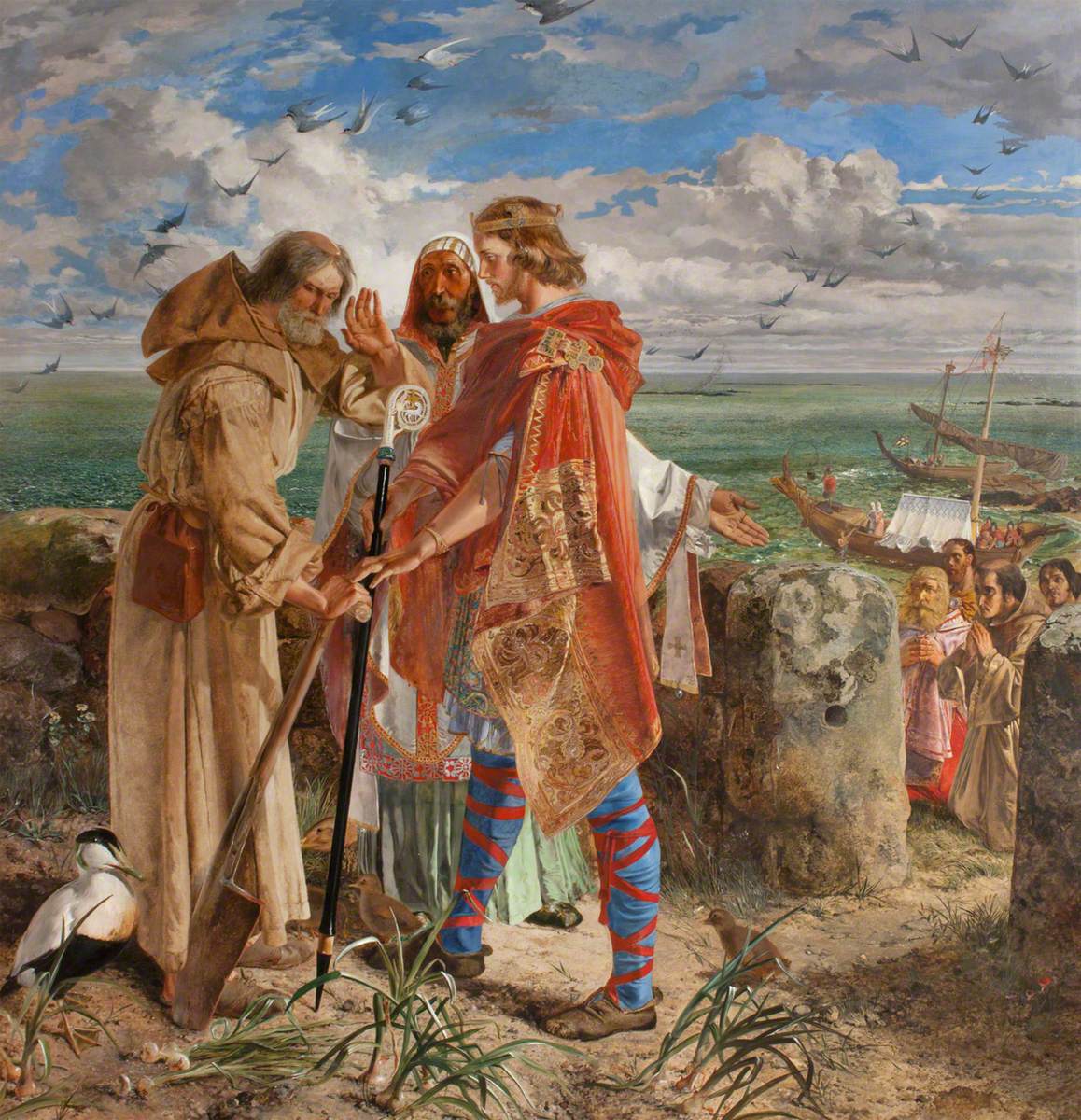
Picture: King Egfrid and Bishop Trumwine Persuade Cuthbert to Be Made Bishop, William Bell Scott, 1856 (detail). National Trust, Wallington. Public domain.
Who was Cuthbert?
Cuthbert was a shepherd boy from Northumbria who became a monk at Melrose, a preacher in the remote hill villages, a hermit on the island of Farne and, for two years, bishop of Lindisfarne. After his death his monks carried his body to Durham, where his shrine drew pilgrims for centuries.
at a glance
His path, in order
- ShepherdKept sheep in the hills near Melrose
- Monk of MelroseJoined the abbey on the Tweed, 651
- Guest-master at RiponLooked after travellers at a new monastery
- Prior of MelroseSecond in charge under the abbot, 664
- Prior of LindisfarneBrought the island's monks to new customs
- Hermit of FarneLived alone on a bare island, 676
- Bishop of LindisfarneMade bishop against his will, 685
in numbers
- Years on the road7
- His monks fled the Danes with his coffin and wandered from place to place.
- In AD 883 they settled at Chester-le-Street.
- A book from his coffin£9m
- Paid by the British Library in 2012 for a small copy of John's Gospel found in his coffin in 1104.
- It is the oldest European book that survives whole.
did you know?
-
Lindisfarne is an island only at high tide, and at low tide people walk to it from the mainland. Its other name is Holy Island.
Bede, Life of St Cuthbert, chapter 17; OCA -
Bede was a boy of about 14 at the monastery of Jarrow when Cuthbert died. Years later he wrote a Life of Cuthbert, and the elders of Lindisfarne read it and found nothing to change.
Bede, Life of St Cuthbert, preface; Medieval Sourcebook -
Cuthbert dressed plainly, and because of him the monks of Lindisfarne in Bede's day still wore only undyed wool.
Bede, Life of St Cuthbert, chapter 16 -
The skeleton found in his coffin in 1827 had a gold cross set with garnets on its breast, probably the one he wore as bishop. It is now at Durham Cathedral.
James Raine, Saint Cuthbert (1828); OCA
- Born
- About AD 634, in Northumbria, probably near Melrose
- Died
- 20 March 687, on the island of Farne, about 53 years old
- Buried
- Durham Cathedral, under a plain stone where his shrine once stood
- Also called
- Wonder-worker of England; in the Orthodox Church, Wonderworker of Britain
- Grew up
- In the hills near Melrose, where he kept sheep in his youth
- Lived at
- The abbeys of Melrose, Ripon and Lindisfarne, then the island of Farne
- Family
- Parents unknown; raised by a foster mother, Kenswith
- Teacher
- Boisil, prior of Melrose, who taught him the Scriptures
- Status
- A saint in the Catholic, Orthodox and Anglican churches
- Feast day
- 20 March; in England also 4 September
- Patron of
- Durham and the Catholic diocese of Hexham and Newcastle
- In art
- Holding the crowned head of King Oswald, killed in battle by a pagan king, which his monks laid in his coffin
 The Hearth
His personality type
Light-hearted, and at his best when life is quiet.
In Pope Gregory the Great's terms
- Cheerful
- Tranquil mind
Our reading, from the Christian Personality Test. Bede calls him “affable and pleasant in his character”, yet all his life Cuthbert longed for the quiet of living alone with God, as at last he did on Farne.
See The Hearthfeast days
East and West
West
- Mar20
Catholic Church, Church of England and Episcopal Church.
- Sep4
Catholic Church in England. The Church of England also allows it in place of 20 March.
East
- Mar20
The Orthodox Church in America, on the day he died.
He died on 20 March 687, and most churches keep his day then. In England 4 September is kept as well, the day in about AD 999 when his body was carried into the new stone church at Durham.
Orthodox churches that follow the old Julian calendar keep his day on 2 April by the civil calendar, because the old calendar runs 13 days behind.
what was he like?
+Glad to be woken
Cuthbert sometimes went three or four nights without sleep, praying or working with his hands to stay awake. Some monks grumbled when anyone woke them at night or from an afternoon nap.
Cuthbert told them he was always glad to be woken: “No one can displease me by waking me out of my sleep, but, on the contrary, give me pleasure; for, by rousing me from inactivity, he enables me to do or think of something useful.”
Bede, Life of St Cuthbert, chapter 16+He put ordinary monks above himself
Cuthbert would not let the monks think his life alone on Farne was higher than theirs. He told them that the monks to admire were those who obeyed their abbot in everything, down to when they prayed, fasted and worked, and that he had known many who far outdid him. Among them he named his old teacher Boisil.
Bede, Life of St Cuthbert, chapter 22+Modest about his own wonders
When Cuthbert told the monks stories of the holy men who had gone before them, he sometimes slipped in what God had done for him. He told it as if it had happened to someone else, though his listeners saw through it. Bede compares this to Paul, who wrote of a man caught up to the third heaven when he meant himself.
Bede, Life of St Cuthbert, chapter 7+Stern with sin, gentle with sinners
Cuthbert was quick to correct people who did wrong and just as quick to forgive those who were sorry. As they confessed, he often wept over their weakness, and he would do their penance himself to show them how to make up for their sins.
Bede, Life of St Cuthbert, chapter 16; OCA+Careless of his own comfort
On Farne Cuthbert gave so little thought to his body that he often went months without taking off his leather boots. Some years he kept them on from one Easter to the next, taking them off only for the washing of feet on Holy Thursday. Kneeling so often in them to pray left hard calluses on his ankles.
Bede, Life of St Cuthbert, chapter 18what others said of him
…he was above all things inflamed with the fire of Divine charity, of sober mind and patient, most diligently intent on devout prayers, and kindly to all that came to him for comfort.
In England, the demise of St. Cuthbert, bishop of Lindisfarne, who from his childhood to his death was renowned for good works and miracles.
Cuthbert was the most popular saint of the pre-Conquest Anglo-Saxon Church.
Durham Cathedral owes its very existence to him
his life in eleven moments
Northumbria
About eight years oldA child calls him bishop
As a boy Cuthbert loved games and boasted that he could beat anyone his age at running, jumping and wrestling. He was about eight when a child of about three ran up during a game and told him to train his mind as well as his body. Cuthbert laughed, and the child fell to the ground in tears.
While Cuthbert tried to comfort him, the child asked why holy Cuthbert, priest and bishop, was playing among children when God had made him a teacher even of his elders. Cuthbert went home a more serious boy. He lived to be both priest and bishop, and told the story himself to Bishop Trumwine, who told Bede.
Bede, Life of St Cuthbert, chapter 1Hills near Melrose
AD 651Angels in the night
As a young man Cuthbert kept sheep in the hills near Melrose. One night in AD 651, while the other shepherds slept and he stayed awake to pray, he saw a stream of light break through the dark and angels come down and carry a shining soul up to heaven. He woke the shepherds and told them he thought it was the soul of a holy bishop or of some other faithful servant of God.
In the morning news came that Bishop Aidan of Lindisfarne had died in the night, just as Cuthbert saw the angels. Cuthbert gave the sheep back to their owners and made up his mind to become a monk.
Bede, Life of St Cuthbert, chapter 4Melrose
AD 651Boisil sees him coming
To become a monk, Cuthbert chose the abbey of Melrose on the river Tweed because of the good name of its prior, Boisil. He rode up still dressed as a layman and gave his horse to a servant before going in to pray. Standing at the door, Boisil saw in the young man what he would become and said to the monks beside him, “Behold a servant of the Lord!”
A few days later Abbot Eata let Cuthbert join the monks at Boisil’s request. Cuthbert soon outdid them all at reading, work and prayer, just as Boisil had foreseen.
Bede, Life of St Cuthbert, chapter 6Melrose
AD 664Seven days with John's Gospel
Cuthbert caught the plague at Melrose in AD 664. The monks prayed all night for him, and when he heard in the morning what they had done, he said, “I did not think it possible that God should have neglected your prayers: give me my stick and shoes.” He soon recovered, though a pain inside never left him.
Boisil knew he would die of the plague in seven days and told Cuthbert to learn all he could while there was time. Boisil’s copy of John’s Gospel was in seven parts, so they read one a day. That week Boisil foretold Cuthbert’s whole future, even that he would be a bishop. After Boisil died, Cuthbert took his place as prior.
Bede, Life of St Cuthbert, chapter 8Villages around Melrose
As prior of MelrosePreaching in the hills
Many people in the villages around Melrose still turned to charms and amulets when plague struck. Cuthbert went out to preach to them, as Boisil had done, more often on foot than on horseback. He chose the poor villages up in the hills that other teachers were afraid to visit, and he would stay there for a week, two or three weeks, or even a month.
Wherever Cuthbert came, the whole village gathered to hear him, as the English did then for any priest. He spoke so well, and such a light shone in his face, that no one dared to hide anything from him, and they all confessed their sins openly.
Bede, Life of St Cuthbert, chapter 9; Ecclesiastical History, Book 4, chapter 27Lindisfarne
After the Synod of WhitbyWinning over Lindisfarne
Cuthbert had been trained in the Irish customs, which dated Easter differently from Rome. He had gone with Abbot Eata to found a new monastery at Ripon, but in AD 661 King Alchfrid told its monks to take up Rome’s customs or leave, and they went back to Melrose. In AD 664 the Synod of Whitby chose Rome’s date for all Northumbria. This time Cuthbert accepted the ruling, and Eata sent him to Lindisfarne as prior to bring its monks over to the new customs.
Some of them taunted him bitterly at the monks’ meetings. When the taunts wore him out, he would get up calmly and close the meeting, then come back the next day with the same advice as if nothing had happened, until he won them over.
Bede, Life of St Cuthbert, chapters 8 and 16; Ecclesiastical History, Book 3, chapter 25; Catholic EncyclopediaFarne
AD 676Alone on Farne
Cuthbert left Lindisfarne in AD 676 to be a hermit on Farne, an island nine miles out to sea where no one had dared to live alone for fear of the evil spirits there. Bede says the spirits fled when Cuthbert came. With the monks’ help he built a round hut of stone and turf, its floor dug down into the rock so that he could see nothing but the sky.
He meant to grow his own food, but the wheat he sowed never came up. He told the monks that if barley failed too, he would rather go back to the monastery than live on the work of others. The barley went in far too late, yet it came up thick and plentiful.
Bede, Life of St Cuthbert, chapters 17 to 19; Ecclesiastical History, Book 4, chapters 27 and 28Coquet Island
AD 684A question about the king
In AD 684 Cuthbert met Abbess Elfled on Coquet Island, and she begged him to tell her how long her brother King Egfrid would live. Cuthbert would not say plainly, but spoke of how short a life is when only one year of it is left. In tears, she asked who would be king after Egfrid, since he had no son or brother.
Cuthbert said the king would have an heir, one she would come to love as a sister loves a brother, and he pointed to the sea and its many islands, where God could easily find a king. She took him to mean Aldfrid, who was said to be her father’s son and was then studying on the islands off Scotland.
Bede, Life of St Cuthbert, chapter 24Farne and York
AD 684 to 685The king comes to fetch him
Late in AD 684 Archbishop Theodore of Canterbury led a council at Twyford that chose Cuthbert as bishop. Letters and messengers could not move him from Farne, so King Egfrid himself sailed to the island with Bishop Trumwine and many monks from Lindisfarne. They all knelt and begged him with tears, and at last they drew him, in tears himself, from Farne and took him to the council.
There he gave way, chiefly because Boisil had foretold that he would be a bishop. He had been chosen for Hexham, but he wanted Lindisfarne, where he had lived, so Eata (by then bishop of Lindisfarne) moved to Hexham. At Easter 685 seven bishops consecrated him at York, with the king looking on.
Bede, Ecclesiastical History, Book 4, chapter 28; Life of St Cuthbert, chapters 6 and 24Carlisle
20 May 685The day the king fell
King Egfrid led his army against the Picts in the north in AD 685, although his friends and Cuthbert warned him not to. Cuthbert went to Carlisle to wait for news with the queen. On 20 May the townspeople were showing him the Roman walls when he leaned on his staff, looked up to heaven and groaned, “Now, then, the contest is decided!”
He told the queen to leave for the royal city, in case the king was dead. Two days later a survivor of the battle brought word that Egfrid had been killed at the very time Cuthbert spoke. The new king was Aldfrid, the scholar Cuthbert had hinted at to Elfled.
Bede, Life of St Cuthbert, chapter 27; Ecclesiastical History, Book 4, chapter 26Carlisle
AD 685 or 686A promise to a friend
Cuthbert's old friend Herbert lived as a hermit on an island in Derwentwater and came to him every year for advice. Hearing that Cuthbert was in Carlisle, he went to see him there. As they talked, Cuthbert told him to ask now whatever he needed, because they would never see each other again in this life.
Herbert fell at his feet in tears and begged him to pray that, as they had served God together, they might go to heaven together too. Cuthbert prayed and then told him to stand up and rejoice, because God had granted what they asked. They never met again but died on the same day.
Bede, Life of St Cuthbert, chapter 28; Ecclesiastical History, Book 4, chapter 29
his miracles and visions
Bede tells these stories as wonders God worked through Cuthbert, and he often names the people who saw them.
4 times animals and the sea served him
-
Coldingham
His Melrose yearsThe otters on the shore
While Cuthbert was staying at the monastery of Coldingham, a monk saw him slip out one night and followed him. Cuthbert walked into the sea until the water reached his neck and spent the night there praising God. At dawn he came out and knelt on the sand to pray. Two otters came up from the sea, breathed on his feet and dried them with their fur.
The monk was so frightened that he could hardly get home. In the morning he begged Cuthbert's pardon. Cuthbert forgave him on one condition, that he tell no one while Cuthbert lived. The monk kept the secret until Cuthbert died, then told everyone he could.
“…breathed upon his feet, and wiped them with their hair…”
Seen by the monk who followed him.
Bede, Life of St Cuthbert, chapter 10 -
By a river
A preaching tripHalf a fish for the eagle
Cuthbert set out to preach in a distant village with only a boy for company and no food. When the boy worried that no one on the road would feed them, Cuthbert told him to trust God and pointed to an eagle overhead, saying that God could feed them even by that eagle.
Further on they found the eagle on a riverbank with a fish it had just caught. The boy ran and brought it all back. Cuthbert scolded him for leaving nothing for the eagle, which he called God’s handmaid, and told him to cut the fish in two and give her half. They had the other half cooked at a village and shared it with the people there while Cuthbert preached.
“Why have you not given part to God's handmaid?”
Seen by the boy who walked with him.
Bede, Life of St Cuthbert, chapter 12 -
Farne
After AD 676The crows who said sorry
Some crows nesting on Farne began pulling the thatch off the guest house Cuthbert had built for visiting monks. He told them to do no harm. They took no notice, so he ordered them in the name of Jesus Christ to leave the island. They flew off at once.
Three days later one came back while he was digging, spread its wings, bowed its head at his feet and begged, as well as a bird can, to be let back. Once he gave it leave, it fetched its mate.
The two brought him a lump of pig fat. He kept it to grease visitors' boots and showed it to them as a lesson in how quickly even a bird says sorry.
“…they brought in their beaks a large piece of hog's lard…”
The fat was shown to every monk who visited Farne.
Bede, Life of St Cuthbert, chapter 20 -
Farne
Before AD 684The beam the tide brought
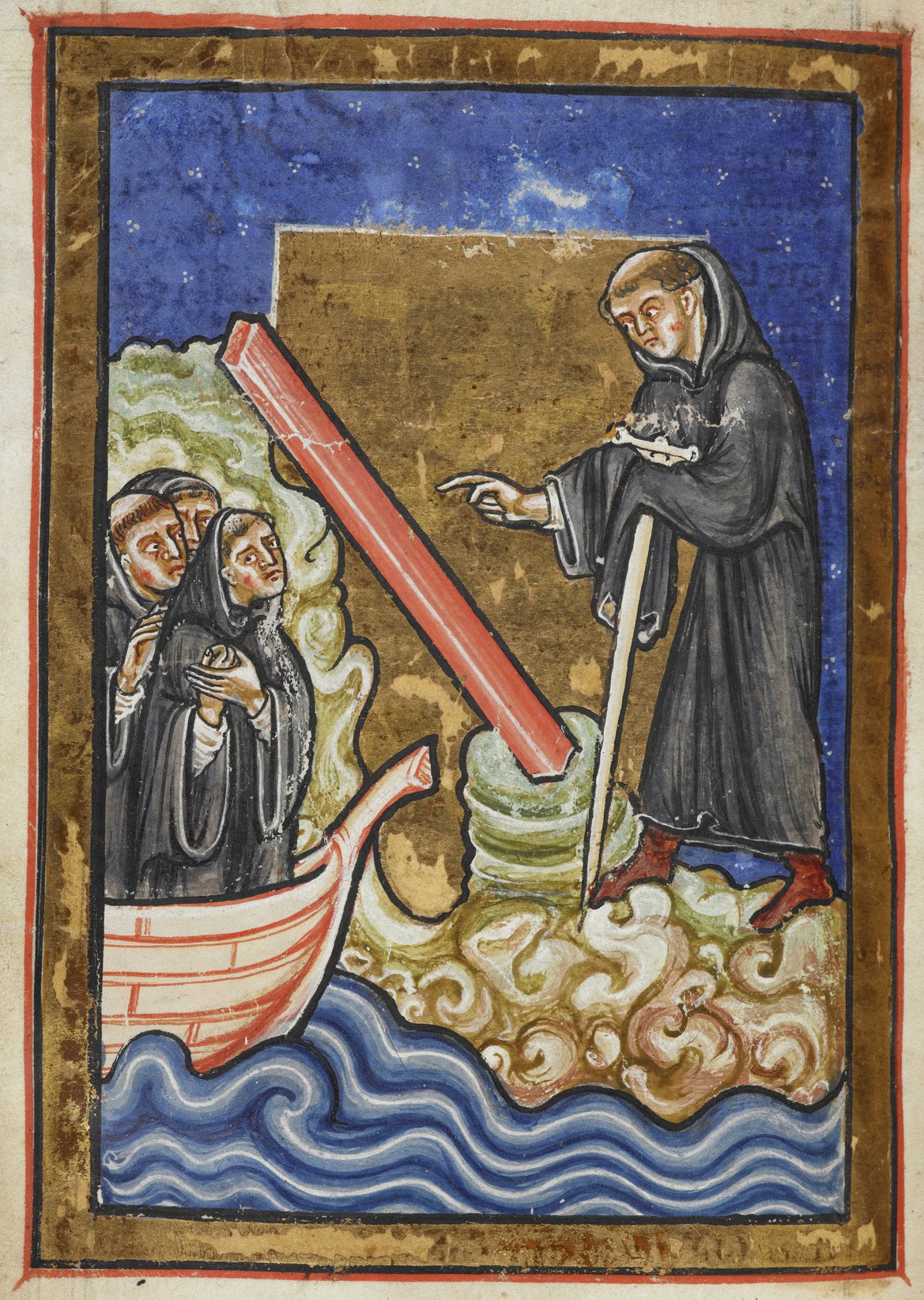
Cuthbert wanted to build a small room on Farne beside the sea, where the waves had cut a gap 12 feet wide in the rock. He asked the visiting monks to bring him a beam 12 feet long to span it. They promised, forgot, and came back without it. He welcomed them kindly, asked them to stay the night and said God would not forget what he needed.
In the morning they found that the tide had brought in a beam of the right length and left it on the very spot where the room was to stand. The monks were ashamed that the sea had obeyed him better than they had.
“I do not think that God will forget my service or my necessities.”
Seen by the monks who had forgotten the beam.
Bede, Life of St Cuthbert, chapter 21
Bede saw one reason behind all these stories: “it is no wonder that every creature should obey his wishes, who so faithfully, and with his whole heart, obeyed the great Author of all creatures.” Bede, Life of St Cuthbert, chapter 21
The guest who left no footprints
At Ripon, where he looked after the guest house, Cuthbert came in early one winter morning and found a young man sitting there. He washed the stranger’s feet himself and begged him to stay for a meal, so that he would not set out hungry into the snow.
While Cuthbert went to fetch hot bread, the guest vanished, and there were no footprints in the fresh snow outside. As Cuthbert cleared the table, he noticed a sweet smell and found three loaves there, whiter than any he had seen. He understood that his guest had been an angel, who had come to feed him rather than be fed.
“I perceive that it was an angel of the Lord whom I entertained, and that he came to feed us, not to be fed himself.”Bede, Life of St Cuthbert, chapter 7
Five boats blown out to sea
Before he became a monk, Cuthbert stood in a crowd on the bank of the Tyne and watched a storm blow five boats out to sea. They were bringing timber to a monastery across the river, and its monks knelt on a rock to pray for them. The crowd only jeered, because the monks had done away with the old customs of worship and nobody knew how the new ones were to be kept.
Cuthbert asked why they did not pray for the monks instead. They shouted back that no one should. Then he knelt, bowed his head to the ground and prayed. At once the wind changed and brought the boats ashore beside the monastery. The men who had jeered praised his faith there and then, and one of them was still telling the story years later.
“Would it not be better and more humane to entreat the Lord in their behalf, than thus to take delight in their misfortunes?”Bede, Life of St Cuthbert, chapter 3
A soul seen at dinner
In AD 686 Cuthbert went to consecrate a church on Abbess Elfled’s lands. At dinner with her his face changed, his eyes stared and the knife fell from his hand. A priest standing by saw it and told Elfled to ask him what he had seen.
Cuthbert tried to laugh it off, as if he had simply finished eating. Pressed, he said he had seen angels carry a holy man’s soul to heaven from her monastery, and that she would tell him the name at Mass.
The messenger she sent to find out met a cart with the body of Hadwald, a shepherd who had fallen from a tree at that hour. At Mass the next day, Elfled asked Cuthbert to pray for Hadwald by name.
“I was not able to eat the whole day, was I? I must have left off some time or other.”Bede, Life of St Cuthbert, chapter 34
his words
Cuthbert left no writings. His words survive in Bede’s books, as the monks who heard them remembered them.
Leaving for Farne
If by the grace of God it shall be granted to me, that I may live in that place by the labour of my hands, I will willingly abide there; but if not, God willing, I will very soon return to you.
To the monks of Lindisfarne in AD 676, about an island where no corn or trees grew
Bede, Ecclesiastical History, Book 4, chapter 28How often have they sent me headlong from the high rock! How many times have they thrown stones at me as if to kill me!
…not only the wicked but the innocent are sometimes permitted by God to be afflicted in body, and are even taken captive in spirit by the devil.
myths and misquotes
Cuthbert was the son of an Irish king.
What the sources sayThis comes from a later account of his birth, the Libellus de ortu, which makes him the son of an Irish king named Muriahdach. Some Irish churchmen have defended the story, while later English writers reject it as legend. Bede's verse Life points to a birth in Britain.
Catholic Encyclopedia, St. CuthbertCuthbert hated women.
What the sources sayThe idea comes from Symeon of Durham, writing more than 400 years later. He says that as bishop Cuthbert kept women out of his monks' church after monks and nuns at Coldingham grew lax together, building the women a church of their own. Bede shows him with friends among the abbesses, and out of love for one, Verca, he kept her gift of linen to be buried in.
Symeon of Durham, History of the Church of Durham, chapter 22; Bede, Life of St Cuthbert, chapters 10, 24 and 37Cuthbert wrote the Lindisfarne Gospels.
What the sources sayThe Lindisfarne Gospels were written after his death by Bishop Eadfrith of Lindisfarne, who made the book in Cuthbert's honour and laid it on his shrine. His monks took it with them when they fled the Danes with his body. It is now in the British Library in London.
Catholic Encyclopedia, St. Cuthbert; Symeon of Durham, History of the Church of Durham, chapter 27friends, family and rivals
Boisil taught Cuthbert the Scriptures at Melrose and showed him by his own life how to live them. In the seven days before Boisil died, they read John’s Gospel looking only for “that simple faith which operates by love”, leaving subtle questions alone.
Bede, Ecclesiastical History, Book 4, chapter 27; Life of St Cuthbert, chapter 8Eata was one of 12 English boys whom Bishop Aidan took in to train. He became Cuthbert’s abbot at Melrose and later at Lindisfarne, and Bede remembered him as “a man of great gentleness and simplicity”.
Bede, Ecclesiastical History, Book 3, chapter 26, and Book 4, chapter 27Cuthbert called her mother all his life, because she had nursed him as a baby. A fire once threatened her village while he was visiting her. She begged his help, and he lay praying face down at her door until the wind turned and spared her house.
Bede, Life of St Cuthbert, chapter 14; Catholic EncyclopediaAbbess Elfled could not walk after a long illness. She said she would be well if only she had something of Cuthbert’s, and soon a linen belt came from him unasked. She put it on and was well within three days.
Bede, Life of St Cuthbert, chapter 23As abbot of Lindisfarne, Herefrid washed Cuthbert’s sore feet in his last illness and gave him his last Communion. He told Bede how Cuthbert died, in words Bede copied into his Life.
Bede, Life of St Cuthbert, chapters 37 to 39Walhstod had long been ill with a bowel sickness that no doctor could cure. As Cuthbert lay dying, he chose Walhstod to help him into his hut, and from the moment Walhstod held him up, his own sickness was gone.
Bede, Life of St Cuthbert, chapters 37 and 38how he died
Cuthbert died on 20 March 687 on Farne, the island he went back to when he knew his death was near.
Soon after Christmas 686 Cuthbert gave up his duties as bishop and sailed back to Farne. As he got into the boat, an old monk asked when they would see him again. He answered, “When you shall bring my body back here.”
About two months later he fell ill and sent Herefrid and the other monks home. Storms kept every boat away for five days, and when Herefrid came back, he found Cuthbert in the guest house by the shore, where he had sat all that time with almost nothing to eat.
At the hour of the night prayers he received Communion, raised his eyes and hands to heaven and died. A monk signalled the news to Lindisfarne with a candle in each hand. The monks brought his body back there by boat, just as he had told the old monk they would.
His last counsel
Have peace, and Divine charity ever amongst you: and when you are called upon to deliberate on your condition, see that you be unanimous in council.
His message for the monks of Lindisfarne, given to Herefrid on the day he died
his body after death
His monks kept Cuthbert's body with them through two invasions, and Durham Cathedral was built to hold it.
Found whole, 698
The monks of Lindisfarne opened his grave in AD 698, 11 years after his death. They expected to find only bones, which they meant to move into a new coffin above the church floor. In Bede’s telling they found the body whole and even the robes fresh and bright. They dressed it in new robes and laid it in the sanctuary.
“…opening the grave, found all the body whole, as if he were still alive, and the joints of the limbs pliable, like one asleep rather than dead…”Bede, Ecclesiastical History, Book 4, chapter 30
Seven years on the road
Bishop Eardulf and the monks fled Lindisfarne with Cuthbert’s coffin in AD 875, as the Danes overran Northumbria, and many people went with them, counting the body worth more than their homes. In the coffin they also laid the head of King Oswald, whom a pagan king had killed in battle, and which had been buried on Lindisfarne.
Worn out after years of wandering, the leaders tried to take the coffin to Ireland. A storm drove their ship back to shore, where they begged Cuthbert’s pardon for trying to take him abroad. At last they settled at Chester-le-Street, in a church given by a Danish king who had become a Christian.
“Fleeing from the barbarians, we have now for seven years wandered up and down the whole province…”Symeon of Durham, History of the Church of Durham, chapters 22 to 27; Bede, Ecclesiastical History, Book 3, chapter 12; Catholic Encyclopedia
The book the sea gave back
During the storm that drove Cuthbert’s monks back from Ireland, they lost the Lindisfarne Gospels overboard. Soon afterwards Cuthbert came in a dream to one of the seven men chosen to care for his coffin and told him to search for the book.
The monks were then near Whithorn, and some of them went down to the shore. The sea had gone out much further than usual, and three miles out they came upon the book, with its gold, its gems and its painted pages unharmed.
“…the sea had receded much further back than usual, and going out three miles or more they discovered the volume of the holy gospels…”Symeon of Durham, History of the Church of Durham, chapters 26 and 27; Catholic Encyclopedia
Where the cart would not move, 995
In AD 995 Bishop Aldhun took the body to Ripon to keep it safe from pirates. On the way back a few months later, the cart carrying the coffin stuck fast near Durham, and even all the people with it could not shift it. Aldhun ordered three days of fasting and prayer, after which a man named Eadmer learned in a revelation that the body must go to Durham.
After that a few men could lift it. They built a church of branches for it, then a stone church, which Aldhun made his cathedral.
“…a very few of their number were now able to raise the saint's shrine, whereas the whole multitude had previously been unable even so much as to move it.”Symeon of Durham, History of the Church of Durham, chapters 36 and 39
Opened in 1104 and under Henry VIII
In 1104 the body was moved into the new Norman cathedral at Durham, built where Bishop Aldhun’s church had stood. Some people doubted that it was still whole, so the monks opened the coffin first, and in Symeon of Durham’s account they found it as whole as ever. With it lay King Oswald’s head and a small book of John’s Gospel.
When Henry VIII closed the monasteries, his men broke open the shrine for its jewels. According to a Durham account written in 1593, they too found the body whole, and the monks then buried it where the shrine had stood.
“lying whole, uncorrupt, with his face bare, and his beard as of a fortnight's growth”Symeon of Durham, History of the Kings, 1104; Rites of Durham (1593), in James Raine, Saint Cuthbert (1828); National Heritage Memorial Fund
What the grave held in 1827
On 17 May 1827 the clergy of Durham Cathedral opened the grave and found a skeleton wrapped in robes, with an ivory comb and a small silver altar. One of them, James Raine, held that the bones were Cuthbert’s and that only dry bones had ever lain in the coffin, wrapped so well that they passed for a body.
Others answered that Cuthbert’s whole body must have been taken out and these bones put in its place, and Archbishop Charles Eyre wrote that it was “very far from being proved that those were the bones of St. Cuthbert”. In 1899 an examination found them to be the bones of a man in his fifties, which was Cuthbert’s age when he died.
James Raine, Saint Cuthbert (1828); Charles Eyre, The History of St. Cuthbert (1887); Catholic Encyclopedia; OCAis he a saint?
Cuthbert is a saint in the Catholic, Orthodox and Anglican churches, honoured as one from the time of his death.
- CatholicSaint20 March; in England, 4 September
- OrthodoxSaint20 March, in the OCA
- AnglicanSaint20 March, or 4 September in England
Cures were reported at his grave on Lindisfarne soon after he died, and Bede added more in his history of the English Church. Later his shrine at Durham became “the great centre of devotion throughout the North of England” and stayed so until the Reformation.
the orthodox hymn to him
The Orthodox Church in America sings this short hymn on his day.
While still in your youth, you laid aside all worldly cares,
and took up the sweet yoke of Christ,
and you were shown forth in truth to be nobly radiant in the grace of the Holy Spirit.
Therefore, God established you as a rule of faith and shepherd of His radiant flock,
Godly-minded Cuthbert, converser with angels and intercessor for men.
what to read first
The Life and Miracles of St. Cuthbert
Bede
The main source for his life, in 46 short chapters, written for the monks of Lindisfarne from what people who knew him told Bede.
Read it freeEcclesiastical History of England, Book 4
Bede
Bede’s shorter telling of his life, in chapters 26 to 32, with cures at his tomb that Bede heard of later.
Read it freeHistory of the Church of Durham
Symeon of Durham
How his monks carried his body from Lindisfarne to Durham, told by a Durham monk of the early 1100s.
Read it freeSaint Cuthbert
James Raine
The opening of his grave in 1827, told in 1828 by one of the men who were there.
Read it freetake the quizzes
 Quiz Which early Christian
thinks like you? And which would argue with you? Start
 Quiz Christian
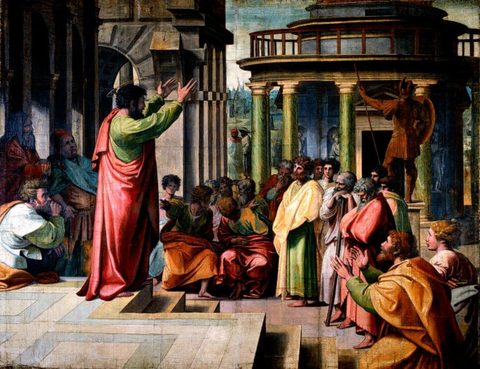
Personality Test Cuthbert reads as The Hearth. Find your own type. Start
people like him
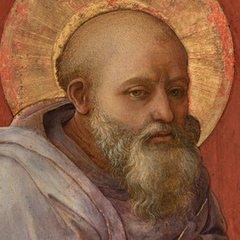 Anthony the GreatThe Hearth
Bede himself puts Cuthbert beside Anthony, who lived alone in the Egyptian desert three centuries earlier. When birds came to eat the barley Cuthbert had sown on Farne, he told them to go, and they never came back, just as Anthony drove the wild asses from his garden with a word.
Bede, Life of St Cuthbert, chapter 19; Athanasius, Life of Antony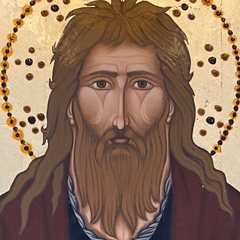 Guthlac of CrowlandThe Hearth
Like Cuthbert on Farne, Guthlac lived alone on an island, in the fens of eastern England. He too met his visitors in good humour. Two monks coming to see him once hid two bottles of ale to collect on the way home. He had not seen them, yet he asked “with merry countenance and laughing words” why they had not brought the bottles along.
The Anglo-Saxon Life of St Guthlac, chapters 3 and 15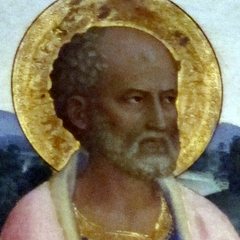 BarnabasThe Hearth
The apostles named Joseph of Cyprus Barnabas, “meaning Son of Encouragement”, and Cuthbert gave the same kind of comfort on Farne. People came to him from all over Britain with their sins, temptations and griefs, and Bede says that no one went home with the sorrow that had brought him.
Acts 4:36; Bede, Life of St Cuthbert, chapter 22sources
His life, and his words
- Bede, The Life and Miracles of St. Cuthbert. Tr. J. A. Giles, in the Everyman edition of 1910.
- Bede, Ecclesiastical History of England. Tr. A. M. Sellar, 1907. Book 4, chapters 26 to 32.
- Symeon of Durham, History of the Church of Durham. Tr. Joseph Stevenson, The Church Historians of England, volume 3, 1855. With the account of the opening of 1104.
- James Raine, Saint Cuthbert, 1828. The account of 1593 and the opening of 1827.
- Charles Eyre, The History of St. Cuthbert, 1887.
- Rites of Durham, written 1593. Surtees Society edition, 1903.
Reference
- Catholic Encyclopedia, 1908, “St. Cuthbert”
- British Library, “St Cuthbert Gospel saved for the nation”
- National Heritage Memorial Fund, on the £9m campaign for the St Cuthbert Gospel
- Athanasius, Life of Antony. Tr. H. Ellershaw, 1892.
- The Anglo-Saxon Version of the Life of St. Guthlac. Tr. Charles Wycliffe Goodwin, 1848.
Calendars
- The Roman Martyrology, 1916 edition, 20 March
- Liturgy Office of England and Wales, National Calendar for England, 4 September
- Church of England, Common Worship calendar
- The Episcopal Church, Lesser Feasts and Fasts 2022
- OCA, Saint Cuthbert, Wonderworker of Britain
- OCA, Troparion and Kontakion of Saint Cuthbert
Pictures
- King Egfrid and Bishop Trumwine Persuade Cuthbert to Be Made Bishop, William Bell Scott, 1856 (detail). National Trust, Wallington. Public domain.
- Cuthbert discovers piece of timber, British Library, Yates Thompson MS 26, folio 45v, late 1100s. CC0.
- Saint Cuthbert as bishop, British Library, Yates Thompson MS 26, folio 1v, Durham, late 1100s. Public domain. Also his card on the Saints page.
- King Athelstan presents Bede's Life of St Cuthbert to the saint, about AD 930. Corpus Christi College, Cambridge, MS 183. Public domain. His face in the personality test.