
Guthlac of Crowland
An English war leader who became a hermit and made his home on a fen island that everyone before him had fled.
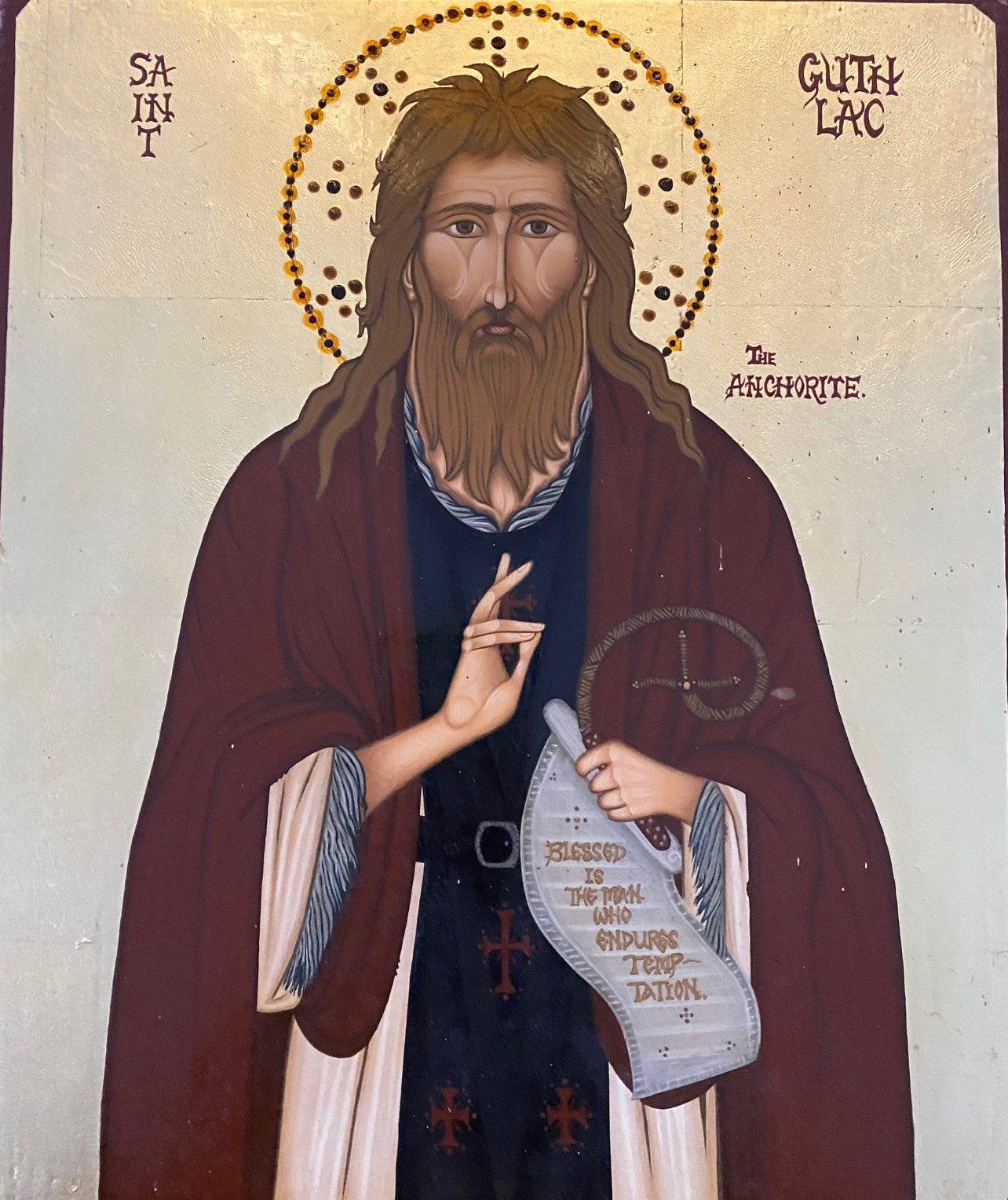
Picture: St Guthlac of Crowland. Icon by George Ioannou. Private collection.
Who was Guthlac?
Guthlac (lived from about AD 673 to 714) was a nobleman of the English kingdom of Mercia who led a war band for nine years, then became a monk and spent his last 15 years as a hermit on Crowland, an island in the great marsh of eastern England called the Fens. Crowland Abbey grew up over his grave.
at a glance
His path, in order
- WarriorNine years leading a war band
- MonkAt Repton monastery from the age of 24
- HermitAlone on Crowland from AD 699 until he died
- PriestOrdained on Crowland by Bishop Hedda
- CounsellorTo a hunted prince who became king
in numbers
- Years he led a war band9
- Burning towns and taking plunder
- He gave a third of the plunder back to its owners
- Years he lived as a hermit in the fens15
- From the age of 26 until he died
- On barley bread and water, once a day
did you know?
-
At his baptism he was named Guthlac after his clan, the Guthlacingas. Learned men in England gave the name's meaning in Latin as Belli munus, the reward of war.
Felix, Life of Guthlac, Old English version, chapter 2, with Goodwin's note (1848) -
The place where his hut stood, near the abbey ruins at Crowland, is called Anchor Church Hill, after the old word anchorite, which means a hermit.
Britannica (1911), “Crowland” -
Two Old English poems about him survive in the Exeter Book, a collection of poetry given to Exeter Cathedral in the 1000s.
Britannica (1911), “Exeter Book”; Dictionary of National Biography (1890), “Guthlac” -
The Guthlac Roll is nearly three metres long and only 17 centimetres wide, and the 18 round pictures that survive on it tell his life.
Crowland Abbey, “The Guthlac Roll”
- Born
- About AD 673, in Mercia in the English Midlands. His father Penwald was a rich nobleman related to the Mercian kings, and his mother was named Tette.
- Died
- On 11 April 714, the Wednesday after Easter, when he was about 41 years old. He died in the small church on Crowland.
- Buried
- In his church on Crowland, by his sister Pega. Crowland Abbey later grew up around his tomb.
- Also called
- Venerable Guthlac among the Orthodox, who give that title to monks who are saints. Some Orthodox Christians call him “the English St. Anthony the Great”, after Anthony the Great, the Egyptian hermit whose example drew the first monks into the desert.
- Lived
- He grew up in Mercia and spent two years as a monk at Repton. From AD 699 he lived on Crowland, which was then an island in the Fens and is now a small town in Lincolnshire.
- Wrote
- Nothing that survives. Almost everything known of him comes from the Life that a monk named Felix wrote a generation after his death.
- Status
- A saint to Catholics and the Orthodox, honoured since the year he died.
- In art
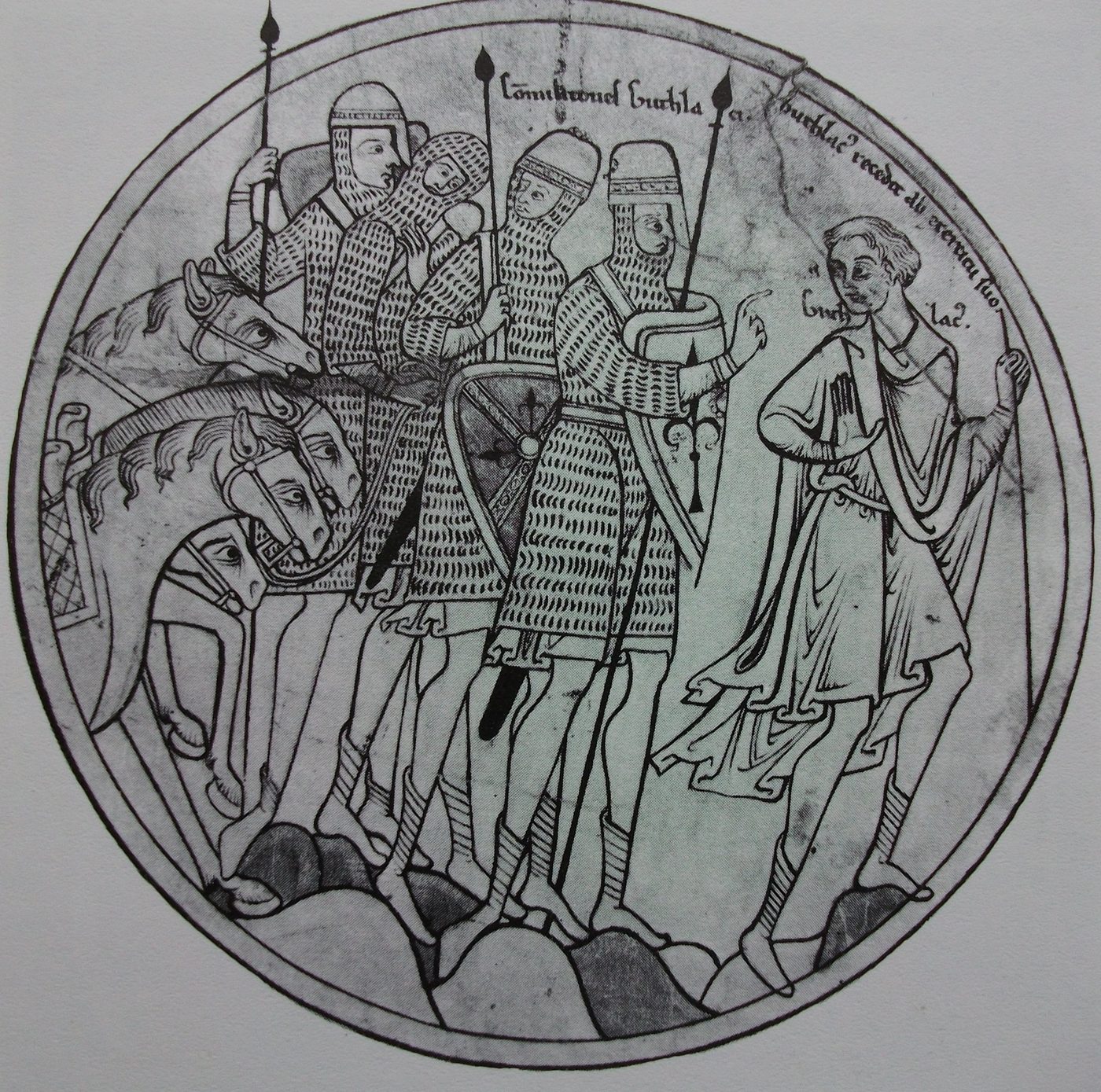
- The Guthlac Roll, a scroll of pen drawings of his life made about 1210 and now in the British Library. A medieval statue of him on the ruined front of Crowland Abbey holds the whip that, in a later legend, Saint Bartholomew gave him against the demons.
 The Hearth
His personality type
Light-hearted, and at his best when life is quiet.
In Pope Gregory the Great's terms
- Cheerful
- Tranquil mind
Our reading, from the Christian Personality Test. Guthlac's biographer Felix describes him as cheerful from boyhood, and even as a hermit Guthlac met his visitors in good humour. He loved his island because it lay so hidden in the fens.
See The Hearthfeast days
East and West
West
- Apr11
He died on this day in AD 714, and the English Church kept it as his day through the Middle Ages.
- Apr12
The Catholic Diocese of Nottingham covers Lincolnshire, where Crowland lies, and each of its parishes may choose to keep his day.
East
- Apr11
The Antiochian Orthodox Church in Britain keeps this day, and its parishes in eastern England go on pilgrimage to Crowland every year in his honour.
- Apr24
Russian Orthodox parishes on the old (Julian) calendar, which runs 13 days behind, keep his 11 April on this day.
In the words of the Catholic Encyclopedia, 11 April has “always been kept as his feast”. Nottingham keeps him on 12 April because the whole Catholic Church gives the 11th to Saint Stanislaus, a Polish bishop and martyr.
what was he like?
+quick to forgive
A priest named Beccel lived with Guthlac as his pupil. While shaving Guthlac one day, Beccel was seized by the urge to kill him and take over his island and the honour people paid him. He had said nothing, yet Guthlac told him he could see the evil plan in his heart. Beccel fell at his feet and confessed in tears. Guthlac forgave him and promised to stand by him in every trouble.
Felix, Life of Guthlac, Old English version, chapters 7 and 20+light-hearted
Two monks coming to visit Guthlac hid two bottles of ale under a clump of turf, meaning to pick them up on the way home. Guthlac talked with them about their souls. Then he asked them, “with merry countenance and laughing words”, why they had hidden the bottles instead of bringing them in. The monks were amazed that he knew, and they bowed and asked his blessing before going home.
Felix, Life of Guthlac, Old English version, chapter 15+glad of visitors
Bishops, abbots and nobles came to Guthlac's island from Mercia and from all over Britain, and so did the rich and the poor. He treated strangers just as he treated friends. When three men came to the landing place one day and sounded the signal for him, he went out to them “with cheerful countenance and good humour”.
Felix, Life of Guthlac, Old English version, chapters 11, 12, 15 and 20+patient with birds and beasts
Two greedy ravens lived on Guthlac's island and carried off anything they could grab, and he put up with them “that he might give men the example of his patience”. Felix writes that even the fish and the wild animals of the fens obeyed him, and that every day he fed them from his own hand, each with the food that suited its kind.
Felix, Life of Guthlac, Old English version, chapter 9+hard on himself
As a hermit Guthlac decided never again to wear wool or linen, and he dressed in animal skins for the rest of his life. From his first days on Crowland he ate nothing but barley bread and drank only water, and he took even that once a day, after the sun had set.
Felix, Life of Guthlac, Old English version, chapter 4+armed with the Psalms
Guthlac spent his two years at Repton learning the psalms, hymns and prayers of the church's services. On Crowland they became his weapons. When the demons attacked, he answered them with verses of the Psalms, which Felix calls “the arrows of holy psalmody”.
Felix, Life of Guthlac, Old English version, chapters 2 and 3what others said of him
Felix wrote the Life for King Ælfwald of the East Angles before AD 749, from what Abbot Wilfrid and others who had lived with Guthlac told him.
…never was aught else in his mouth but Christ's praise, nor in his heart but virtue, nor in his mind but peace and love and pity.
This year died Guthlac the holy…
My father, lo! thou knowest my miseries, thou wast ever my support in my afflictions; whither shall I now turn myself; who shall comfort me if thou forsakest me?
And they led St. Guthlac such a life, that the blessed St. Anthony himself had never been more tormented and scared by hideous shapes and foul temptations.
…one of the greatest hermit-saints of the early English Church…
his life in seven moments
Mercia
About AD 673A red hand at his birth
Felix's story begins with a sign at Guthlac's birth. While his mother Tette was in labour, people outside the house saw a bright red hand holding a golden cross reach down from the sky toward the door, then draw back up. They fell to the ground and prayed to know what it meant.
A woman ran out of the house and told them: “Be firm and of good heart, for a man of future glory is born here on this earth.” By sunset the story had spread across the English Midlands.
Felix, Life of Guthlac, Old English version, chapter 1Mercia and beyond
About AD 688 to 697Nine years of raiding
As he grew into a man, Guthlac began to think about the brave deeds of the heroes of the past. He took up arms and gathered a war band of young nobles like himself. For about nine years they took revenge on their enemies, burning their towns, killing many and carrying off their goods. Even then a warning from God in his heart made him give back a third of everything he took to its owners.
Felix, Life of Guthlac, Old English version, chapter 2; Dictionary of National Biography (1890), “Guthlac”His war band's camp
About AD 697A vow in the night
Back from a raid one night, Guthlac lay down to rest and remembered the kings of his family long ago. They had died wretchedly and their wealth had come to nothing, and he saw his own life hurrying to its end. Filled with fear and love of God, he vowed that if God spared him until morning, he would be His servant.
At dawn he told his men to find another leader. They begged him to stay, but at 24 years old he turned his back on them and on his home and his family's wealth to serve Christ.
Felix, Life of Guthlac, Old English version, chapter 2, with Goodwin's note (1848)Repton and the Fens
AD 697 to 699To Crowland by boat
Guthlac became a monk at the monastery of Repton, in today's Derbyshire, and from then on he would touch no drink that could make a man drunk. After two years there he heard stories of earlier hermits and began to long for the wilderness himself. He went to the Fens, a vast marsh of black pools, reed beds and islands that ran all the way to the North Sea.
There a man named Tatwine told him of an island where many had tried to live, but “no man could do it on account of manifold horrors and fears, and the loneliness of the wide wilderness”. Tatwine took him there by boat. Guthlac loved how hidden Crowland was and vowed to serve God there for the rest of his life.
Felix, Life of Guthlac, Old English version, chapters 2 and 3; Dictionary of National Biography (1890), “Guthlac”Repton and Crowland
24 August 699Settling on Crowland
Guthlac went back to Repton after a few days on the island, to greet the monks he had left without taking leave. He stayed with them 90 nights and returned to Crowland with two servants on 24 August 699, when he was 26 years old. It was the feast of the apostle Bartholomew, whose help Guthlac sought in everything.
An old burial mound on the island was said to be haunted, and treasure hunters had once dug a deep pit in its side. Guthlac built his hut over that pit and lived in it until he died.
Felix, Life of Guthlac, Old English version, chapters 3 and 4; Dictionary of National Biography (1890), “Guthlac”Crowland
19 August, years laterMade a priest, and a doubter answered
Bishop Hedda came to visit Guthlac, and on the road his men argued whether the hermit's miracles came from God or from the devil. A learned man named Wigfrith offered to find out, since he had lived among the Irish and knew true holy men when he saw them.
The bishop was so struck by Guthlac's teaching that he begged to ordain him a priest, and Guthlac agreed. No one had told Guthlac about the talk on the road, yet at the meal he asked Wigfrith what he now thought of the man he had meant to test. Wigfrith bowed to the ground and confessed, and Guthlac forgave him.
Felix, Life of Guthlac, Old English version, chapter 17Crowland
Between AD 709 and 714A prince in hiding
A Mercian prince named Æthelbald had tried for the throne, and King Ceolred hunted him from place to place. After Guthlac's old friend Abbot Wilfrid brought him to Crowland, the prince came back often for comfort.
When Æthelbald arrived in despair one day, Guthlac told him that he had prayed for him and that God had heard. He urged the prince to be patient, “for thou shalt not get the kingdom by means of worldly things, but with the Lord's help thou shalt get thy kingdom.” Æthelbald put his hope in God and believed everything Guthlac foretold. Æthelbald became king of Mercia in AD 716, two years after Guthlac died.
Felix, Life of Guthlac, Old English version, chapters 11, 19 and 21; Anglo-Saxon Chronicle, years 709 and 716
his miracles and fights with demons
In Felix's Life, demons attacked Guthlac again and again on Crowland, and the sick were healed through him, both while he lived and after his death.
Nor doubt I aught that my informants were able to remember and relate all the wonders of this blessed man; they were very widely known and famous through England.
5 fights with demons on the fens
-
Crowland
Soon after he settled, 699Three days of despair
Soon after he settled on Crowland, Guthlac fell into a despair that Felix blames on the devil. He began to doubt the life he had chosen, and his past sins seemed too great ever to make up for. For three days he did not know which way to turn.
On the third night he cried out to God with a verse of a psalm. Felix insists that Guthlac was awake and not dreaming when Saint Bartholomew came to him and promised to help him in all his troubles. The dark thoughts left him, and he was filled with joy.
“My Lord, in my trouble I cry unto Thee, and hear Thou me, and support me in my tribulations.”
Felix, Life of Guthlac, Old English version, chapter 4, tr. Goodwin (1848) -
His hut
His early years thereTwo demons preach a fast
Two demons came gliding down through the air to Guthlac while he was thinking how best to please God. They told him they had tested him enough and would trouble him no more. Instead they would teach him how the hermits before him had lived.
They reminded him that Moses, Elijah and Christ Himself had fasted, and promised that the harder he punished his body, the higher God would raise him. He should fast six days at a time and eat only on the seventh.
It sounded holy, but it came from demons, and Guthlac saw through it. He answered with a prayer that made them vanish like smoke, then ate his usual modest meal of barley bread, while the demons wailed that they were beaten.
“by six days' fast to adorn the spirit, and then on the seventh day to take meat and to rest the body”
Felix, Life of Guthlac, Old English version, chapter 5, tr. Goodwin (1848) -
The fen and the air
Not long after the fastCarried to the gates of hell
A horde of demons poured into Guthlac's hut one night, with huge heads, horses' teeth and fire in their throats. They dragged him through the black fen and the brambles until he was torn all over, then ordered him to leave the island. When he answered with a psalm, they beat him with iron whips and flew him to the smoking mouth of hell.
There they threatened to throw him in, but Guthlac told them scornfully that he was ready for whatever God willed. Saint Bartholomew appeared in shining light and ordered the demons to carry him home gently, and at dawn he was back in his hut.
“Woe to you! children of darkness, and seed of destruction; ye are dust and cinders and ashes”
Felix, Life of Guthlac, Old English version, chapter 5, tr. Goodwin (1848) -
Outside his hut
Between AD 704 and 709Demons who spoke Welsh
Guthlac knew the speech of the Britons, whose language became Welsh, from time spent among them in his youth. In the early 700s they were raiding the English. Dozing at his prayers one night, he seemed to hear a rioting crowd, and he went outside and heard Britons talking as they came toward his buildings.
Soon he saw his house in flames, and the Britons lifted him into the air on the points of their spears. Guthlac understood that it was the demons' doing. He sang Psalm 68, which opens with God rising up and His enemies scattering, and at its first verse they vanished like smoke.
“hung him up in the air on the spears”
Felix, Life of Guthlac, Old English version, chapter 6, tr. Goodwin (1848) -
His hut
At his night prayersBeasts in the dark
Guthlac heard cattle bellowing and wild animals howling before the shapes of beasts came into his hut to distract him. He saw a lion baring bloody teeth, a bull, an angry bear and snakes, while a hog grunted, wolves howled and ravens croaked.
He made the sign of the cross and mocked the devil, who had once tried to make himself equal to God and was now playing at being animals. When Guthlac ordered him in God's name to stop, every shape was gone.
“thou who once exaltedst thyself that thou mightest be equal to the eternal God”
Felix, Life of Guthlac, Old English version, chapter 8, tr. Goodwin (1848)
The page the raven stole
A visitor staying with Guthlac wrote something on a sheet of parchment and stepped outside. He came back to see a raven flying off over the fen with the sheet. Guthlac found him upset and told him he would get his writing back if he followed the raven in a boat.
The man rowed to a small lake near the island and found the sheet hanging on a reed in the middle of the water. He brought it back in wonder, but Guthlac would take no credit and told him it was God's mercy.
“even as though man's hand had hanged it there”Felix, Life of Guthlac, Old English version, chapter 9, tr. Goodwin (1848)
A madman healed
An evil spirit drove a nobleman of East Anglia named Hwætred mad. He tore at his own body, and when his family tried to tie him up, he killed three men with an axe. For four years priests and bishops failed to drive the spirit out, until his family would rather have seen him dead than let him go on harming people.
Then they heard of the hermit of Crowland and took Hwætred to him. Guthlac was filled with pity and prayed over him for three days. At sunrise on the third day he washed him with holy water and breathed into his face, and Hwætred came to himself and went home well, never to suffer the madness again.
“and this same man was as though he had awoke from a deep slumber”Felix, Life of Guthlac, Old English version, chapter 12, tr. Goodwin (1848)
The thorn that flew out
Prince Æthelbald's companion Ova was on his way to see Guthlac when he stepped in the dark on a thorn that went right through his foot. He struggled on to the island, but that night he swelled from the waist down and could neither sit nor stand for the pain.
Guthlac took off the shirt he wore next to his skin and put it on Ova. At once the thorn shot out of the foot, the swelling and the wound were gone, and soon Ova was talking cheerfully with Guthlac.
“this same thorn, as an arrow speeds from the bow, so did it fly from the man”Felix, Life of Guthlac, Old English version, chapter 16, tr. Goodwin (1848)
Salt for a blind man's eyes
After Guthlac's death, one of Æthelbald's boatmen was nearly blind for a year from a white film over his eyes that no doctor's ointment could clear. When he felt God telling him inwardly that he would be healed at Guthlac's grave, his friends took him to Crowland.
Guthlac's sister Pega was told how firm the man's faith was. She wetted some salt her brother had blessed and dropped it into one eye. Before she could treat the other, he could see everything in the room, and he went home healed.
“and he readily perceived what there was in the room, and he went home whole and sound”Felix, Life of Guthlac, Old English version, chapter 22, tr. Goodwin (1848)
his words
Guthlac's words are known only from Felix's Latin Life. They are quoted from an Old English version of it, which Charles Goodwin put into modern English in 1848.
When two swallows sat on him
And the man who would pass his life apart from worldly men, to him the angels approach nearer. But he who frequently longeth for the converse of worldly men cannot meet with angelic discourse.
Guthlac was talking with his friend Wilfrid when two swallows flew into the hut singing. They settled without fear on Guthlac's shoulders and then on his chest, his arms and his knees. Wilfrid asked why wild birds came to him so tamely, and Guthlac answered that wild animals and birds grow close to a man who lives by God's will, before he went on to speak of the angels.
Felix, Life of Guthlac, Old English version, chapter 10Lo! I am here present and ready, and await my Lord's will…
O! my son, I am not forgetful of thy conflicts and thy troubles…
myths and misquotes
Saint Bartholomew gave him a whip to drive the demons away.
What the sources sayThe whip comes from a later legend and is nowhere in Felix's Life, the earliest account of Guthlac. It turns up about 500 years after his death in the Guthlac Roll, whose drawings show Bartholomew bringing him one. Crowland Abbey also kept a whip among the relics it said Guthlac's sister Pega had left, and called it “the whip of St. Bartholomew”.
Felix, Life of Guthlac, Old English version, chapters 4 and 5; Anna Jameson, Legends of the Monastic Orders (1850; 1890 edition); Crowland Abbey, “The Guthlac Roll”Guthlac founded Crowland Abbey.
What the sources sayCrowland Abbey began only after Guthlac's death, when King Æthelbald founded it in his memory and honoured the place of his tomb “with manifold buildings”.
Felix, Life of Guthlac, Old English version, chapter 20; Catholic Encyclopedia (1908), “Abbey of Croyland”friends, family and rivals
Guthlac's sister, who also lived alone for God. He chose not to see her during his years on Crowland, but she was the one he asked to bury him.
Felix, Life of Guthlac, Old English version, chapter 20; Dictionary of National Biography (1890), “Guthlac”Guthlac's pupil, who was with him to the end and told Felix the story of his last days. Beccel heard Guthlac's last wishes and took the news of his death to Pega.
Felix, Life of Guthlac, Old English version, chapters 7 and 20One of Jesus' 12 apostles, who in Felix's Life comes to Guthlac's rescue twice when the demons are at their worst.
Felix, Life of Guthlac, Old English version, chapters 3, 4 and 5A kinsman of Guthlac from the royal house of Mercia, and the prince he counselled in exile. Æthelbald ruled Mercia for 41 years, from AD 716 until he was killed during a revolt in 757, and was buried at Repton, where Guthlac had become a monk.
Felix, Life of Guthlac, Old English version, chapters 11 and 19; Anglo-Saxon Chronicle, years 716 and 755; Dictionary of National Biography (1888), “Ethelbald”An abbot and an old friend of Guthlac. On one visit a raven took one of the gloves Wilfrid had left in the boat and tore at it on a roof. Guthlac scolded the bird until it flew off, and Wilfrid reached the glove down with a stick.
Felix, Life of Guthlac, Old English version, chapter 11The man who took Guthlac's place on Crowland. Asked by an abbess who would keep the island after him, Guthlac answered that it would be a heathen not yet baptised, and soon afterwards Cissa came to Britain and was baptised.
Felix, Life of Guthlac, Old English version, chapters 4 and 18how he died
He died on Crowland on 11 April 714, the Wednesday after Easter, on the eighth day of an illness that no source names.
Guthlac fell ill in his little church on the Wednesday before Easter and told his pupil Beccel that on the eighth day his soul would go to God.
On the seventh day he gave his last wishes. His sister Pega was to bury him in the linen shroud that the abbess Ecgburh had sent him. He had refused to wear linen all his life, but for love of Ecgburh he would be wrapped in her gift.
Beccel then dared to ask whom he had heard Guthlac talking with every evening and every dawn. Guthlac told him that God had sent an angel at those hours to comfort him.
At dawn on the eighth day Guthlac received Communion, raised his eyes and arms to heaven and died. Beccel saw a tower of fire rise from the earth to heaven while angels sang. A year later Pega opened the grave, and Felix says the body was found whole, “much more like a sleeping man than a dead one”.
His message for his sister Pega
…that I for this end here on earth avoided her presence and would not see her, that we two hereafter might see each other in heaven, before the face of God.
is he a saint?
He has been honoured as a saint since the year he died, and Catholics and the Orthodox still keep his feast in April.
- CatholicSaintA local saint in his own region, 12 April
- OrthodoxSaintVenerable Guthlac, 11 April
- AnglicanHonouredAt Crowland Abbey, a prayer walk through his life
Catholics honour him as a local saint in his own region, but his name is not in the Roman Martyrology, the Church's official list of saints.
Danish raiders destroyed Crowland Abbey in AD 866, and it burned twice more after that, but each time it was rebuilt. In 1539 it was surrendered to Henry VIII, who was closing England's monasteries. Its north aisle is still the parish church of Crowland, in the Church of England. The parish offers visitors “St Guthlac’s Pilgrimage”, a prayer walk around the church that follows his life.
…and the man who with all his heart seeks that place, through the intercession of the holy man he shall accomplish and bring about what he desires.
what to read first
The Anglo-Saxon Version of the Life of St. Guthlac
Felix, translated by Charles Goodwin (1848)
The whole Life in short chapters of plain Victorian English, with the Old English on the facing pages. It takes about an hour to read.
Read it freeThe Hermits, chapter “St. Guthlac”
Charles Kingsley (1868)
A Victorian novelist's lively picture of the wild fens in Guthlac's day, with his own doubts about the demons.
Read it free“Guthlac”, Dictionary of National Biography
Kate Norgate (1890)
A short and careful account of his life that works out the dates from the sources.
Read it freetake the quizzes
 Quiz Which early Christian
thinks like you? And which would argue with you? Start
 Quiz Christian
Personality Test Guthlac reads as The Hearth. Find your own type. Start
people like him
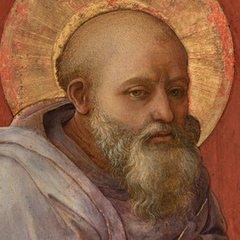 Anthony the GreatThe Hearth
Anthony fought demons alone in Egypt three centuries before Guthlac. He walled himself into an old fort, and friends heard a crowd shouting at him, though through a hole they saw no one. Expecting to find him dead, they heard him singing Psalm 68, which Guthlac sang on Crowland: “Let God arise and let His enemies be scattered”.
Athanasius, Life of Antony, chapters 12 and 13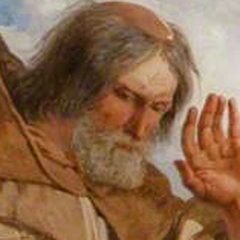 Cuthbert of LindisfarneThe Hearth
A generation before Guthlac, the English hermit and bishop Cuthbert also made his home on an island that everyone else avoided. Farne lay several miles out to sea, and before Cuthbert no one had “ever dared to inhabit this island alone, on account of the evil spirits which reside there”. In Bede's telling, the spirits fled when he came.
Bede, Life of St Cuthbert, chapter 17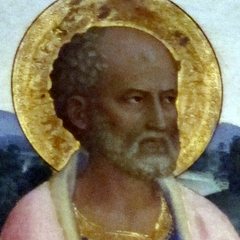 BarnabasThe Hearth
Barnabas gave second chances, as Guthlac did when he forgave the pupil who had thought of killing him. When the believers in Jerusalem were still afraid of Paul, who had persecuted them, Barnabas brought him to the apostles. Later he stood by Mark, who had once deserted him and Paul, even though it cost him his partnership with Paul.
Acts 9:26-27; 15:37-39sources
His life
- Felix, The Anglo-Saxon Version of the Life of St. Guthlac. Tr. Charles Wycliffe Goodwin, London, 1848. The Old English version of Felix's Latin Life, with Goodwin's preface and notes.
- The same book, a second scan, used where the first scan's text is faulty
- Paul Gonser, Das angelsächsische Prosa-Leben des hl. Guthlac, Heidelberg, 1909. Felix's Latin beside the Old English.
- The Anglo-Saxon Chronicle. Tr. James Ingram, 1823. Years 714, 716 and 755.
- Bede, Life of St Cuthbert. Tr. J. A. Giles. For Cuthbert's card.
- Athanasius, Life of Antony. Tr. H. Ellershaw. Nicene and Post-Nicene Fathers, series 2, volume 4. For Anthony's card.
Reference
- Kate Norgate, “Guthlac”, Dictionary of National Biography, volume 23, 1890
- “Ethelbald (d. 757)”, Dictionary of National Biography, volume 18, 1889
- John F. X. Murphy, “St. Guthlac”, Catholic Encyclopedia, volume 7, 1910
- D. O. Hunter-Blair, “Abbey of Croyland”, Catholic Encyclopedia, volume 4, 1908
- Britannica (1911), “Crowland”
- Britannica (1911), “Exeter Book”
- Charles Kingsley, The Hermits, first printed 1868 (the linked copy is of 1891), chapter “St. Guthlac”
- Anna Jameson, Legends of the Monastic Orders, first printed 1850 (the linked copy is of 1890), “St. Guthlac”
- Crowland Abbey, “The Guthlac Roll” and “History”, the parish church's own pages
- Crowland Abbey, “St Guthlac’s Pilgrimage”, the parish church's prayer walk through his life
- Dmitry Lapa, “Venerable Guthlac of Crowland, Wonder-Worker”, OrthoChristian
Calendars
- Martyrologium Romanum, 2004 edition, 11 April (he is not listed), and the Roman Martyrology of 1916, 11 April (not listed either)
- Nottingham Diocesan Ordo 2025-2026, the Catholic Diocese of Nottingham's calendar: Saint Guthlac, 12 April, an optional memorial of the diocese
- Community of Saint Silouan and All Saints of Britain and Ireland, Sheffield (Archdiocese of Russian Orthodox churches in Western Europe), “Canon to Venerable Guthlac”: 24 April, “11th of April in the Church calendar”
- Antiochian Orthodox Deanery of the United Kingdom and Ireland, “Crowland Pilgrimage for St Theodore and St Guthlac”, 2023
Pictures
- St Guthlac of Crowland, icon by George Ioannou. Private collection. From Marcus Plested, "The English Desert: St Guthlac of Crowland", Orthodox Station.
- Guthlac-Bartholemew.png, Wikimedia Commons: the Guthlac Roll, British Library, Harley Roll Y 6, about 1210 (the hub card). Public domain.
- The Life of Saint Guthlac.jpg, Wikimedia Commons: the Guthlac Roll's first roundel. Public domain.