
Cyprian of Carthage
Rich orator turned bishop of Carthage, who led his church through persecution and plague and died a martyr.
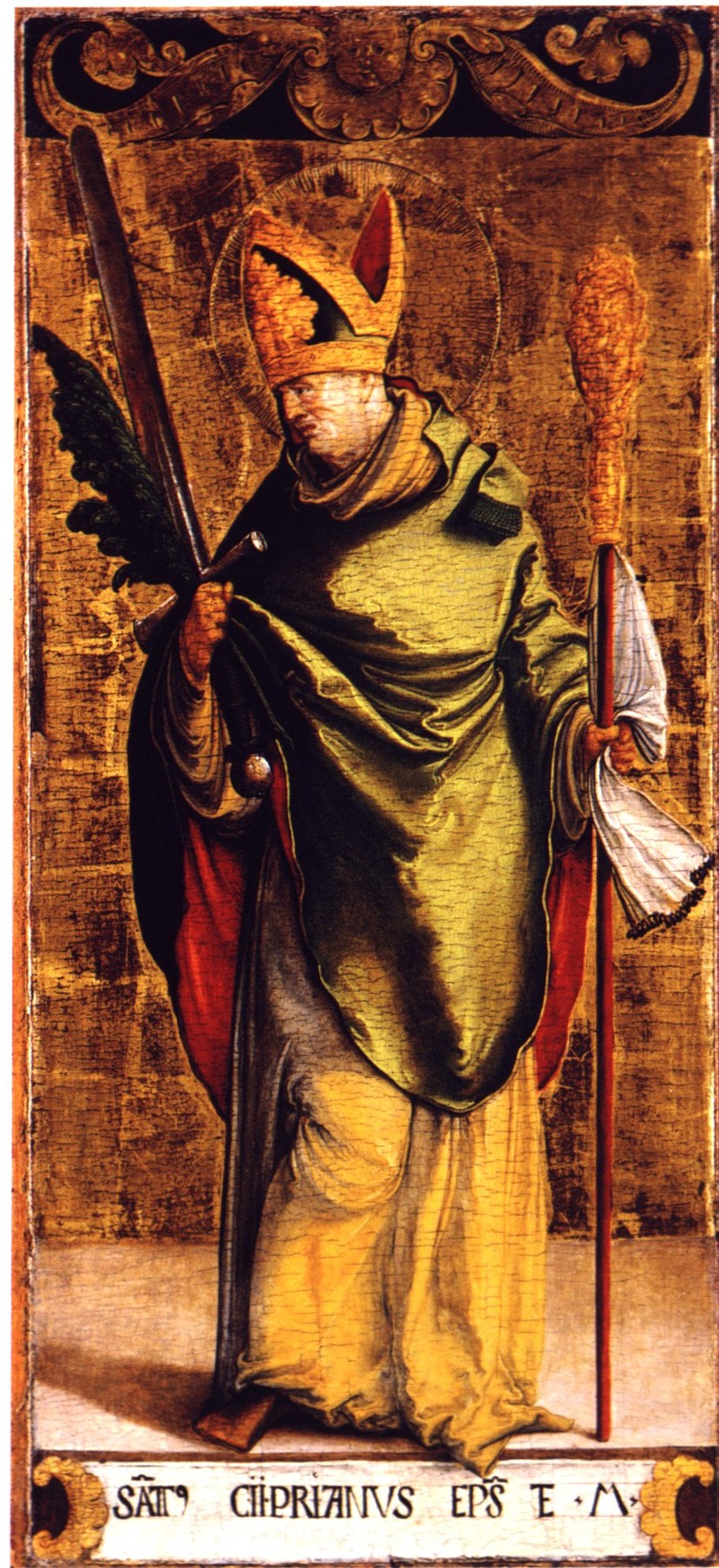
Picture: Saint Cyprian, Master of Messkirch, about 1535-1540. Staatsgalerie Stuttgart. Public domain.
Who was Cyprian?
Cyprian was a rich teacher of public speaking in Carthage. He became a Christian about 246, and the city's bishop two years later. He led his church through persecution, plague and quarrels, often by letter from hiding. He argued hard with the bishop of Rome. In 258 he was beheaded, the first bishop of Carthage to die a martyr.
at a glance
His path, in order
- OratorA famous teacher of rhetoric
- ConvertSold his estates for the poor
- PriestOrdained soon after baptism
- BishopOf Carthage, about 248 to 258
- MartyrBeheaded, 14 September 258
in numbers
- Years a Christian when made bishop2
- Baptised about 246, bishop about 248
- He stood back for older men, but the people insisted
- Sesterces he sent to free captives100k
- Raised by his church
- For Christians held by barbarians
- Bishops at his great council87
- Carthage, September 256, on baptism by heretics
- Each voted in a short speech, and the record survives
- Gold coins for his executioner25
- He told his friends to pay the man
- Then he bound his own eyes
did you know?
-
A bishop named Fidus wanted babies to wait eight days for baptism, as for circumcision. Cyprian's council of 66 bishops all said no. God's grace, they wrote, must be refused to no one born.
Letter 58, to Fidus -
Some churches used only water in the Eucharist cup in the morning, for fear the smell of wine would give a Christian away. Cyprian insisted on wine mixed with water, as the Lord had offered it.
Letter 62, to Caecilius, with the editors' notes
- Born
- Probably about 200. No early source says where. It is usually given as Carthage, near today's Tunis, where he spent all his known life.
- Before he was a Christian
- A famous teacher of public speaking, a pleader in the courts, and a rich man. His deacon Pontius, who wrote his Life, passes over these years on purpose.
- Died
- 14 September 258, beheaded with the sword on the estate of Sextus, near Carthage.
- Buried
- By night, with tapers and torches, in the burial ground of Macrobius Candidianus on the Mappalian Way.
- Also called
- His full name was Thascius Caecilius Cyprianus. The Roman court that tried him called him Thascius Cyprianus. At his baptism he took the name Caecilius, from the priest who converted him. The Orthodox call him Hieromartyr Cyprian: a martyr who was a bishop.
- Status
- A saint and martyr to Catholics, Orthodox and Anglicans. Lutherans remember him too.
- In art
- As a bishop in a mitre, with a sword for how he died and a martyr's palm. The Master of Messkirch painted him so, about 1535.
- Wrote
- About a dozen short books in Latin, and many letters. The best known is On the Unity of the Church.
- Pronounced
- SIP-ree-un of KAR-thij.
feast days
East and West, side by side
West
- Sep13
Episcopal Church, in Lesser Feasts and Fasts.
- Sep14
The day he died. The 1916 Roman Martyrology names him here, and keeps his feast on the 16th.
- Sep15
Church of England, a Lesser Festival.
- Sep16
Catholic memorial, shared with Pope Cornelius. Also Lutherans in the Missouri Synod and the ELCA.
East
- Aug31
OCA. Also the Russian Church, on the old calendar. That is 13 September on today's calendar.
- Oct2
Popular Greek calendars, which merge him with the legendary Cyprian of Antioch.
Jerome says he died on the same day of the year as Pope Cornelius, “but not in the same year”. The Catholic Church keeps the two together on 16 September. The day he died, 14 September, is also Holy Cross Day. The Church of England keeps Cyprian the day after it, and the Episcopal Church the day before.
what was he like?
+gave it away
Early in his faith he sold whole estates and gave the money to the poor. As bishop he was asked about an actor who no longer performed but still taught acting. He must give it up, Cyprian said. If he was poor, the church would keep him, “if he be content, that is, with very frugal but innocent food.”
Pontius, Life, chapter 2; Letter 60, to Euchratius+grave and warm at once
His deacon Pontius says his face was serious and glad together. “Neither was his severity gloomy, nor his affability excessive.” People could not tell whether he deserved more to be revered or to be loved. Pontius settles it: “he deserved both to be revered and to be loved.”
Pontius, Life of Cyprian, chapter 6+a sharp pen, an open door
In a quarrel he did not soften his words. He wrote of “the bitter obstinacy of our brother Stephen”, the bishop of Rome. Yet he opened his great council of 87 bishops by saying no bishop would be cut off for disagreeing. They would go on “judging no man, nor rejecting any one from the right of communion, if he should think differently from us.”
Letter 73, to Pompey; The Seventh Council of Carthage+forgave his opponents
Some of the clergy opposed his election as bishop. His deacon Pontius says Cyprian forgave them and counted them among his closest friends, “to the astonishment of many”. Not all were won over. The Catholic Encyclopedia says five priests stayed his enemies.
Pontius, Life, chapter 5; Catholic Encyclopedia+changed his mind, and said so
While the persecution under Decius raged, he was stern with Christians who had given in. Afterwards he let the repentant back after penance. He owned the change openly. Both, he wrote, were done “not without long-balanced and pondered reasons.”
Letter 51, to Antonianuswhat others said of him
His deacon Pontius shared his exile and wrote his Life soon after he died. Later writers praised his style, and argued with his views.
The blessed Cyprian like a fountain of pure water flows softly and sweetly
…his error was compensated by his remaining in catholic unity, and by the abundance of his charity; and finally it was cleared away by the pruning-hook of martyrdom.
Cyprianus, therefore, was above all others distinguished and renowned
his life in seven moments
Carthage
About 246A new man
An old priest named Caecilius brought him to faith. Cyprian had not believed he could ever shed habits as deep as his. “I used to indulge my sins as if they were actually parts of me,” he wrote. After baptism, what had seemed impossible became possible.
To Donatus, chapters 3 and 4; Pontius, Life, chapter 2Carthage
About 248Made bishop
He was still new to the faith when the people wanted him as their bishop. He stepped back, “giving place to men of older standing”. But the people would not have it. “A crowded fraternity was besieging the doors of the house”, says his deacon Pontius. When he came, they greeted him with great joy.
Pontius, Life, chapter 5In hiding
250Leading by letter
In January 250 the emperor Decius published an edict against Christians. In Carthage the crowds called again and again for Cyprian to be thrown to the lions. He went into hiding and led his church by letter. The clergy at Rome heard of it. Their letter reports that he “acted quite rightly”. But then it quotes Jesus on the hireling who “seeth the wolf coming, and leaveth the sheep, and fleeth”. So it hinted that he had deserted his flock. Cyprian sent them thirteen of his letters, to show what he had done.
Pontius, Life, chapter 7; Letters 2 and 14; Catholic EncyclopediaCarthage
251Second chances
Under Decius's persecution, many in Carthage had given in. Several thousand had bought certificates saying they had sacrificed to the pagan gods. When the storm passed, many wanted to come back. Cyprian chose a middle way: real penance, then return. He would be neither “too ungentle and pertinacious in repelling their repentance” nor “too lax and easy in rashly yielding communion”. At Carthage and at Rome, groups broke away from their bishops. At Rome, a priest named Novatian refused those who had given in any way back and set himself up as a rival bishop. Cyprian wrote On the Unity of the Church against such splits.
Letter 51, to Antonianus; Catholic EncyclopediaCarthage
About 252The plague
A plague swept the city. People abandoned the sick, even their own. Cyprian called his church together. He told them there was “nothing wonderful in our cherishing our own people only”. They must help everyone, even those who persecuted them. Those too poor to give money gave their work. So good was done, says his deacon Pontius, “to all men, not to those only who are of the household of faith.”
Pontius, Life, chapters 9 and 10Carthage and Rome
255 to 256The quarrel with Rome
Cyprian held that anyone baptised by heretics must be baptised again. Stephen, the bishop of Rome, said no: hands should only be laid on them. The church historian Eusebius says Stephen “was very indignant at this”. In September 256, 87 bishops met at Carthage under Cyprian and stood with him. Stephen would not even receive their messengers. Neither side gave way. After that, says the Catholic Encyclopedia, “we know no more of the controversy.”
Eusebius, Church History, Book 7, chapter 3; Letter 74, from Firmilian; Catholic EncyclopediaCurubis
257Exile
The emperor Valerian renewed the persecution. On 30 August 257 the proconsul questioned Cyprian at Carthage. He answered, “I am a Christian and a bishop.” He was sent into exile at Curubis. His deacon Pontius went with him.
Acts of Cyprian, chapter 1; Pontius, Life, chapter 12
visions and wonders
His deacon Pontius tells of no miracles worked by Cyprian. What Cyprian and Pontius record are visions, and wonders at the Eucharist. Cyprian says he saw one of them himself.
His death foretold
On his first night in exile, as he was falling asleep, he saw a very tall young man. The young man led him before the proconsul, who wrote a sentence on his tablet. The young man did not say it aloud. He showed it with his hand. Cyprian begged for one day's delay, and the young man signed that it was granted. Cyprian told this himself, and his deacon Pontius gives it in Cyprian's own words. Pontius says the day stood for a year. Cyprian died a year later, on the very day of the vision.
“with hand expanded and flattened like a blade, he imitated the stroke of the accustomed punishment”Pontius, Life, chapters 12 and 13
The persecution foreseen
He wrote to his clergy of a vision. A father of a family sat with a sad young man at his right hand. At his left stood one with a net, glad of the chance to destroy. Cyprian does not say who saw it. He says it was shown before the persecution came, and came true.
“This was shown long before the tempest of this devastation arose. And we have seen that which had been shown fulfilled”Letter 7, to the clergy
The child and the cup
Cyprian wrote, “Learn what occurred when I myself was present and a witness.” A baby girl had been fed bread and wine left from a pagan sacrifice, while her parents fled. Her mother, not knowing, brought her to church. The child wept, turned her face away and shut her mouth against the Eucharist cup. The deacon made her take a little. Then she sobbed and was sick.
“In a profane body and mouth the Eucharist could not remain”On the Lapsed, chapter 25
Fire and a cinder
A woman kept the Eucharist in a box. She “tried with unworthy hands to open her box”, and fire rose from it. A man who had given in under persecution took his share of the Eucharist in secret, and found only a cinder in his hands. Cyprian reports these two, but does not say he saw them.
“was deterred by fire rising from it from daring to touch it”On the Lapsed, chapter 26
Doubted by his English editor
The editor of the English translation did not believe Cyprian's stories of visions and wonders. He wrote that many things were “sincerely believed and honestly recorded” that a careful reader will not accept. He quoted the historian Henry Milman: “In what a high-wrought state of enthusiasm must men have been, who could relate and believe such statements as miraculous!” The edition's American editor answered in a note that believers should not be charged with “exceptional credulity”.
“many circumstances were sincerely believed and honestly recorded, which will not be for a moment received as true by the calm and critical reader”Ante-Nicene Fathers, volume 5, introduction to Cyprian
his words
He wrote in Latin. These lines are from R. E. Wallis's translation in the Ante-Nicene Fathers (1886).
To a church split in two, 251
He can no longer have God for his Father, who has not the Church for his mother.
Against those who broke away from their bishops. In Latin, Habere jam non potest Deum patrem, qui Ecclesiam non habet matrem.
On the Unity of the Church, chapter 6All our power is of God; I say, of God.
For custom without truth is the antiquity of error.
For God is the hearer, not of the voice, but of the heart.
Our prayer is public and common; and when we pray, we pray not for one, but for the whole people, because we the whole people are one.
They think that they possess, when they are rather possessed
We regard paradise as our country—we already begin to consider the patriarchs as our parents: why do we not hasten and run, that we may behold our country, that we may greet our parents?
his hardest words
Some of what he wrote is hard to read today. Here it is in his own words, beside what others have said.
The Jews
He gathered Bible passages under headings, in a handbook for a man named Quirinus. The English edition calls it Three Books of Testimonies Against the Jews. His preface says the first book shows that the Jews “had departed from God, and had lost God's favour”, while the Christians took their place. The Catholic Encyclopedia describes it as passages arranged “to illustrate the passing away of the Old Law and its fulfillment in Christ”.
“That the Jews have fallen under the heavy wrath of God, because they have departed from the Lord, and have followed idols.”Testimonies, preface and Book 1, the first heading
No salvation outside the Church
He held that no one outside the Church can be saved. Not even dying for Christ helps a heretic, he wrote, “because there is no salvation out of the Church”. He says the same in On the Unity of the Church. His own Latin is usually given as salus extra ecclesiam non est. The neater Extra ecclesiam nulla salus is often called his, but it is not his wording.
“He cannot be a martyr who is not in the Church”Letter 72, to Jubaianus; On the Unity of the Church, chapter 14
He lost the argument on baptism
Cyprian held that people baptised by heretics must be baptised again. Stephen, the bishop of Rome, said no, and the Western Church came to side with him. Augustine called him “that holy man”, but said he held “an opinion at variance with the true view”. Jerome claims the African bishops later dropped the practice themselves. The American editor of his letters, an Episcopal bishop, drew a sharper point.
“on the Roman theory, this glorious martyr died in schism. He is, nevertheless, a canonized saint in the Roman Calendar.”Catholic Encyclopedia; Augustine, On Baptism, Book 1, chapter 18; Jerome, Against the Luciferians; Ante-Nicene Fathers, note to Letter 82
Women's make-up
He wrote that not only virgins and widows but all women should leave their faces as God made them. No hair dye, no eye black, no rouge.
“the work of God and His fashioning and formation ought in no manner to be adulterated, either with the application of yellow colour, or with black dust or rouge”On the Dress of Virgins, chapter 15
often misquoted
He was a magician, converted by the virgin Justina. The Prayer of St Cyprian against witchcraft is his.
What the sources sayThat is Cyprian of Antioch, a figure of legend. Gregory of Nazianzus and the poet Prudentius already mixed the two men up, says the Catholic Encyclopedia, “a mistake often repeated”. It adds: “It is certain that no Bishop of Antioch bore the name of Cyprian.” Popular Greek calendars still merge the two on 2 October.
Catholic Encyclopedia, Sts. Cyprian and Justina; saint.grHe taught that the whole Church rests on the pope, as the heir of Peter.
What the sources sayChapter 4 of On the Unity of the Church comes down in two forms. One adds that “the primacy is given to Peter”. The notes to the English translation call such lines “beyond all question spurious”. The Catholic Encyclopedia says it is “now generally admitted” that Cyprian made the change himself. It also says that when he wrote of one chair, he always meant the office of bishop. Both sides agree he held that all the apostles had equal power.
On the Unity of the Church, chapter 4, with the editors' notes; Catholic EncyclopediaHe ran from persecution to save his own skin.
What the sources sayHe did hide in 250. He said he left so that his presence would not stir up the crowds further. In 258 friends begged him to escape, and offered him places to go. He refused. He hid only once more, so that he would not be tried at Utica. He wanted to die before his own people, “that I may confess among you, and there suffer, and thence depart to the Lord even as I ought.”
Letter 14; Pontius, Life, chapter 14; Letter 82, his lastHe was burned to death.
What the sources sayHe was beheaded with the sword. The mistake goes back to Theodoret, a bishop who wrote in 431 that he “found a death in the fire”. An editor of Theodoret notes that this “is either an error, or means the fiery trial of martyrdom”.
Theodoret, Letter 151, with the editor's note; Acts of CyprianHe nursed the plague victims and buried the dead with his own hands.
What the sources sayThe Orthodox Church in America's life of him says he “tended the sick and buried the dead himself”. His deacon Pontius, who was there, says Cyprian rallied his people to care for everyone, and they did the work. The Catholic Encyclopedia says he “raised a staff of workers and a great fund of money”.
Pontius, Life, chapters 9 and 10; OCA; Catholic Encyclopediawhere he stood
Each line is his own, in R. E. Wallis's translation. Letters are numbered as in the Ante-Nicene Fathers. TapClick “Show his line” to read it.
Your answers are next to his. From your result on . See your result
“Most of the time, it's better to say less.”
Cyprian agrees.
You
On record in On the Advantage of Patience. Not quoted here.
“There's nothing wrong with being rich, as long as you use it well.”
Cyprian agrees.
You
Show his line
Let the poor feel that you are wealthy; let the needy feel that you are rich.On the Dress of Virgins, chapter 11
“If someone you know is doing wrong, it's your job to tell them.”
Cyprian agrees.
You
On record in the Testimonies against the Jews. Not quoted here.
“Even if you believe you'll see them again, it's right to weep openly for someone you've lost.”
Cyprian strongly disagrees.
You
Show his line
Our brethren who are freed from this world by the Lord's summons are not to be lamented, since we know that they are not lost, but sent before.On Mortality, chapter 20
“Giving to the poor isn't generosity. It's paying back what's already theirs.”
Cyprian agrees.
You
“God still speaks to people through dreams.”
Cyprian strongly agrees.
You
Show his line
Although I know that to some men dreams seem ridiculous and visions foolish, yet assuredly it is to such as would rather believe in opposition to the priest, than believe the priest.Letter 68, to Florentius Puppianus
“Miracles still happen today, just as they did in the Bible.”
Cyprian agrees.
You
On record in On the Lapsed. Not quoted here.
“If you believe God is calling you, follow, even if your family begs you not to.”
Cyprian agrees.
You
Show his line
That, being redeemed and quickened by the blood of Christ, we ought to prefer nothing to Christ.Exhortation to Martyrdom, to Fortunatus, chapter 6
“A Christian can fight in a just war with a clear conscience.”
Cyprian disagrees.
You
Show his line
The whole world is wet with mutual blood; and murder, which in the case of an individual is admitted to be a crime, is called a virtue when it is committed wholesale.To Donatus, chapter 6
“Becoming a better person is mostly down to your own effort.”
Cyprian strongly disagrees.
You
“In the end, God will save everyone.”
Cyprian strongly disagrees.
You
Show his line
An ever-burning Gehenna will burn up the condemned, and a punishment devouring with living flames.To Demetrian, chapter 24
See where you stand beside him. Take the quiz
friends, family and rivals
 Tertullian
 His master, in books. An old man who had been Cyprian's secretary told Jerome that Cyprian read Tertullian every day. He would often say, “Give me the master”, meaning Tertullian.
Jerome, Illustrious Men, chapter 53An old priest of Carthage who brought him to faith. Cyprian took his name. When Caecilius was dying, he left his wife and children in Cyprian's care.
Pontius, Life, chapter 4; Jerome, Illustrious Men, chapter 67His deacon. He went into exile with him and wrote his Life. Jerome calls it “a notable volume”.
Jerome, Illustrious Men, chapter 68Bishop of Rome when Novatian split from him. Cyprian backed Cornelius and wrote to him often. Jerome says they died on the same day of the year. They share a feast.
Jerome, Illustrious Men, chapter 67; The Roman Martyrology (1916)A Roman priest who refused any way back to those who had given in under persecution. He set himself up as a rival bishop of Rome. Cyprian treated him as a schismatic.
Letter 51, to AntonianusBishop of Rome, who would not have people baptised by heretics baptised again. Cyprian wrote of his “bitter obstinacy”.
Letter 73, to PompeyA bishop in Cappadocia who took Cyprian's side on baptism against Stephen, the bishop of Rome. He wrote of “this so open and manifest folly of Stephen”.
Letter 74, from FirmilianA man who had confessed his faith under persecution, but doubted Cyprian was a true bishop. Cyprian's answer asks, “what swelling of pride is this, what arrogance of soul, what inflation of mind”.
Letter 68, to Florentius PuppianusStephen's successor as bishop of Rome, also called Sixtus. Cyprian's deacon Pontius calls him “the good and peace-making priest”. A few weeks before his own death, Cyprian heard that Xistus had been killed in a cemetery at Rome on 6 August 258.
Letter 81; Pontius, Life, chapter 14how he died
He was beheaded on 14 September 258, on an estate near Carthage.
Called back from exile, he waited at Carthage. On 13 September two officials came for him. He was held overnight in an officer's house. His people kept watch in the street outside.
In the morning the proconsul, Galerius Maximus, told him the emperors commanded him to perform the pagan rites. He said, “I refuse.” Told to think of his own good, he answered, “Do as you are bid. In so clear a case there is no need for consideration.” The proconsul gave sentence “hardly and reluctantly”: death by the sword. The crowd cried, “Let us also be beheaded with him.”
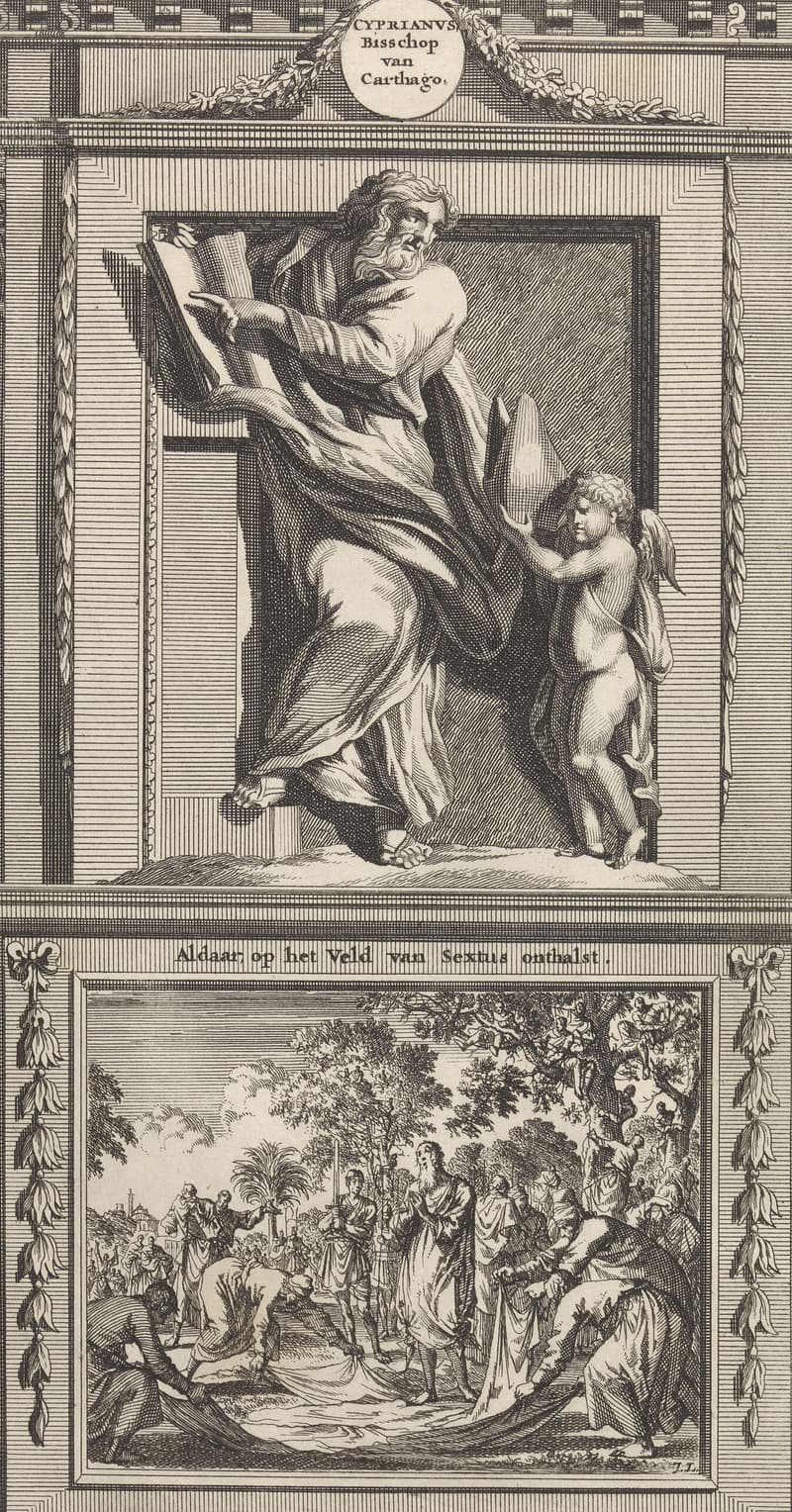
He was led out to the estate of Sextus. People climbed into the trees to see. He took off his cloak, knelt and prayed. He told his friends to give the executioner twenty-five gold pieces. He bound his own eyes, and two clergy, both named Julianus, tied the blindfold's ends for him.
The executioner's hand shook so that he could hardly grip the sword. Then, says his deacon Pontius, the centurion holding the sword was strengthened “with power granted from above”.
To an officer who offered him dry clothes
We apply medicines to annoyances which probably to-day will no longer exist.
On hearing the sentence
Thanks be to God!
In Latin, Deo gratias.
is he a saint?
Yes. Catholics, Orthodox and Anglicans count him a saint and martyr. Lutherans remember him too.
- CatholicSaintA memorial on 16 September, with Cornelius
- OrthodoxSaintA hieromartyr. 31 August in the OCA
- AnglicanSaintA Lesser Festival in the Church of England
- LutheranRememberedMissouri Synod and ELCA, 16 September
He was honoured from the first. The court record of his death ends by calling him “the most blessed martyr Cyprian”.
His name is also said in the Roman Canon, the old Eucharistic Prayer of the Latin Mass. Its first list of saints names twelve martyrs. The Catholic Encyclopedia says all the others are local saints of Rome.
Popular Greek calendars give him no day of his own. They fold him into the legend of Cyprian of Antioch, on 2 October. The Greek New Synaxaristis of Hieromonk Makarios of Simonopetra (2001) does give him a life of his own, in its September volume.
…St. Cyprian (d. 258), who had a serious misunderstanding with a Roman pope, is the only foreigner honoured by the Roman Church by being named among her own martyrs.
what to read first
The Life and Passion of Cyprian
Pontius the Deacon
Written by the deacon who shared his exile. It is short, and has the plague, the vision at Curubis and his last day.
Read it freeThe Acts of Cyprian
The Roman court record, tr. E. C. E. Owen, 1927
The record of his two trials and his death, almost word for word. Pages 93 to 99.
Read it freeOn the Unity of the Church
Cyprian
His most famous book: the Church as one mother, and the line about God as Father.
Read it freetake the quizzes
 Quiz Which early Christian thinks like you? And which would argue with you? See where you stand beside Cyprian. Start
  Quiz Christian Personality Test Which of eight types are you? Find your own. Start
 sources
His life, and his words
- Ante-Nicene Fathers, volume 5. Cyprian's works and Pontius's Life, tr. R. E. Wallis. American edition, 1886. Letters are numbered as in this edition.
- Pontius, The Life and Passion of Cyprian. Same edition.
- The Acts of Cyprian, in E. C. E. Owen, Some Authentic Acts of the Early Martyrs. Oxford, 1927.
- The Latin of the Acts. Ruinart's edition, with his notes.
- The Latin of On the Unity of the Church. Latin Wikisource, from Migne.
- Jerome, Lives of Illustrious Men, chapters 53, 67 and 68. Tr. E. C. Richardson. Nicene and Post-Nicene Fathers, second series.
- Jerome, Letter 58, to Paulinus, and
- Against the Luciferians. Tr. W. H. Fremantle. Same series.
- Augustine, On Baptism, Against the Donatists, Book 1. Tr. J. R. King. Nicene and Post-Nicene Fathers, first series.
- Lactantius, Divine Institutes, Book 5. Tr. William Fletcher. Ante-Nicene Fathers, volume 7.
- Eusebius, Church History, Book 7. Tr. Arthur Cushman McGiffert.
- Theodoret, Letter 151. Tr. Blomfield Jackson. Nicene and Post-Nicene Fathers, second series, volume 3.
Reference
- Catholic Encyclopedia, 1908, “St. Cyprian of Carthage”
- Catholic Encyclopedia, 1908, “Sts. Cyprian and Justina”
- Catholic Encyclopedia, 1908, “Canon of the Mass”
- Merriam-Webster, “Cyprian”, and
- “Carthage”, for how to say them
- Visit Cyprus, on the church at Lagoudera
Calendars
- USCCB, Memorial of Saints Cornelius, Pope, and Cyprian, Bishop, Martyrs
- Vatican News, saints of 16 September
- The Roman Martyrology, 1916 edition
- OCA, Hieromartyr Cyprian, Bishop of Carthage
- azbyka.ru, Russian
- saint.gr, Greek
- eortologio.net, Greek
- Koinonia Orthodoxias, his life from Makarios of Simonopetra's New Synaxaristis, September volume (Ormylia, 2001)
- Church of England, Common Worship calendar, and
- Lesser Festivals, with his collect
- The Episcopal Church, Lesser Feasts and Fasts 2022
- LCMS Southern District, and
- Concordia Publishing House, Missouri Synod
- Evangelical Lutheran Worship, ELCA, the church year
Pictures
- Saint Cyprian, Master of Messkirch, about 1535-1540. Staatsgalerie Stuttgart. Public domain.
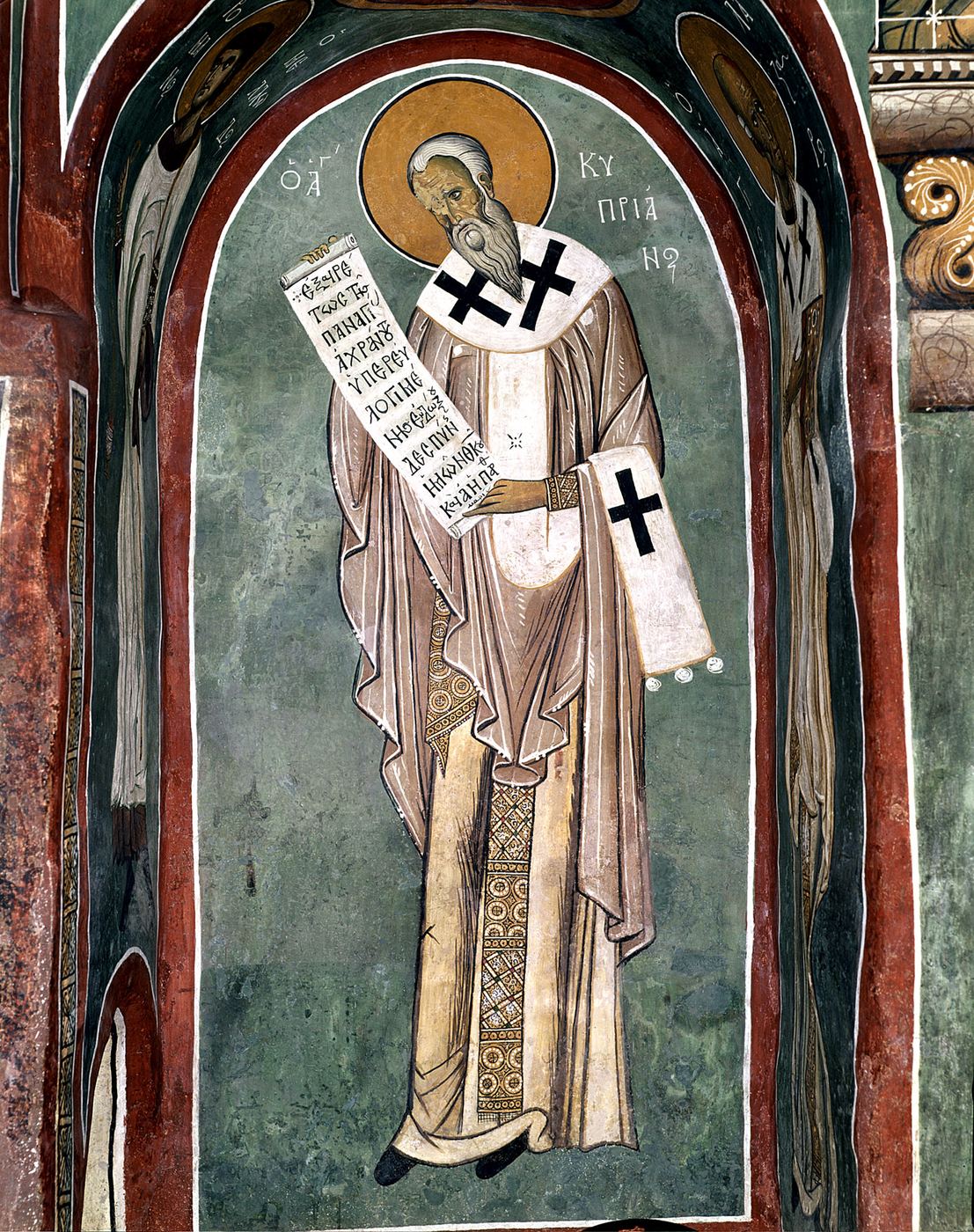
- St Cyprian, fresco at Lagoudera, late 12th century. Photo: Dumbarton Oaks, CC0.
- H. Cyprianus van Carthago, Jan Luyken after Jan Goeree, 1698, for William Cave's lives of the Fathers in Dutch. Rijksmuseum, Amsterdam, RP-P-1896-A-19368-1279. CC0.