
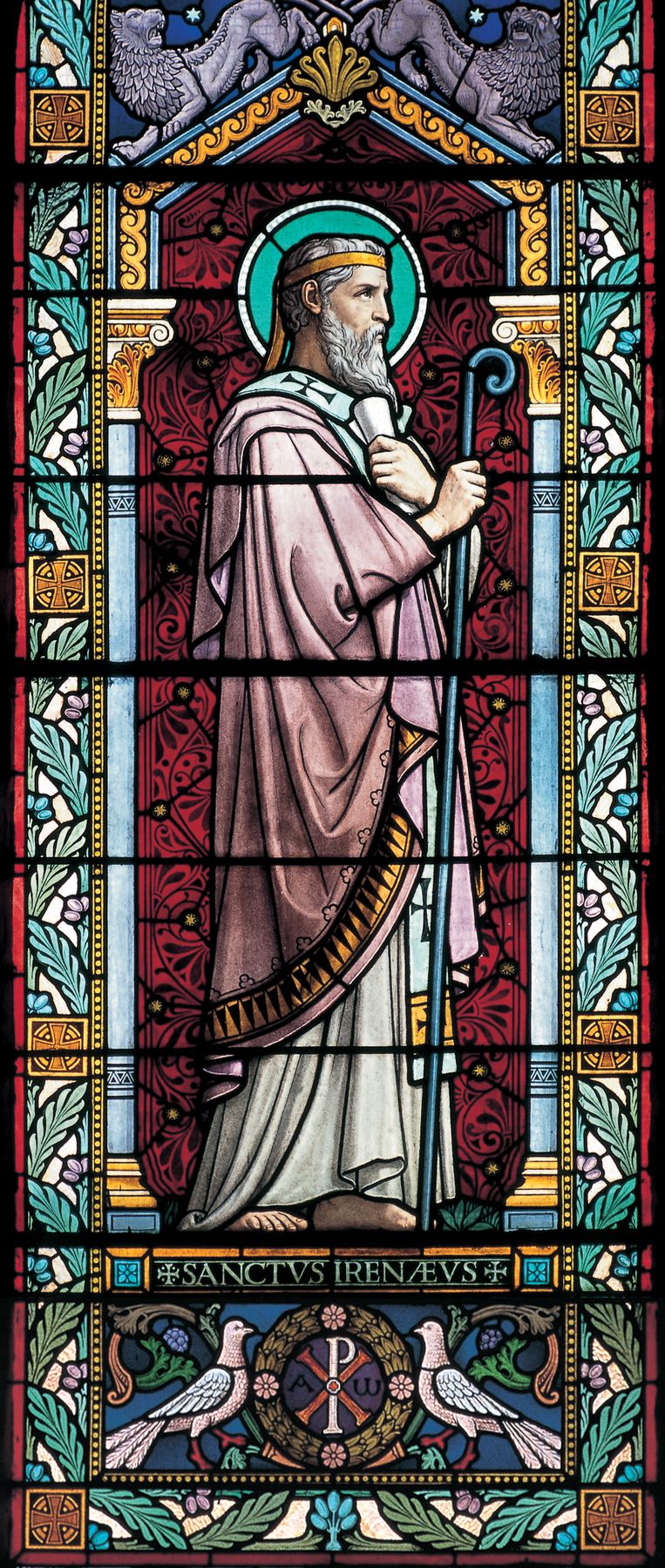
Irenaeus of Lyons
He heard Polycarp as a boy, then as bishop of Lyons took on the Gnostics.
Picture: Saint Irenaeus, a stained-glass window by Lucien Bégule, 1901. Église Saint-Irénée, Lyon. Public domain.
Who was Irenaeus?
Irenaeus was bishop of Lyons, in Gaul, in the late 100s. As a boy he heard Polycarp, who had known the apostle John. His five books Against Heresies answered the Gnostic teachers. When Rome tried to cut off the churches of Asia over Easter, he pleaded for peace. In 2022 he was named a Doctor of the Church.
at a glance
His path, in order
- PupilHeard Polycarp as a boy
- PresbyterOf the church at Lyons, 177
- BishopOf Lyons, after the martyr Pothinus
- WriterAgainst Heresies, about 180
- PeacemakerIn the Easter dispute, about 190
in numbers
- Books of Against Heresies5
- His great work against the Gnostics
- Gospels he defended4
- Matthew, Mark, Luke and John
- No more and no fewer, he wrote
- Against sects that kept only one Gospel, or wrote their own
- Bishops of Rome he listed12
- From the apostles to his own day
- Eleutherus, the twelfth, was bishop as he wrote
did you know?
-
He set down where each Gospel came from. Matthew wrote for the Hebrews in their own language. Mark wrote down what Peter preached, and Luke what Paul preached. John, who leaned on Jesus' breast, wrote his at Ephesus.
Against Heresies, Book 3, chapter 1 -
He paired each Gospel with one of the four living creatures around God's throne: John the lion, Luke the calf, Matthew the man, Mark the eagle. Jerome later gave Mark the lion and John the eagle, the pairing church art kept.
Against Heresies, Book 3, chapter 11; Jerome, Against Jovinianus, Book 1 -
He had a picture for how his opponents used the Bible: take a king's portrait made of jewels, set the same gems into a dog or a fox, and insist it is still the king.
Against Heresies, Book 1, chapter 8
- Born
- About 130, in Asia Minor, probably at Smyrna, today Izmir in Turkey. No one knows the year. Guesses run from about 115 to about 142.
- Grew up
- In Asia Minor. As a boy he listened to Polycarp, bishop of Smyrna, who had known the apostle John.
- Died
- About 200, probably at Lyons. No early source gives the date, the place or the cause.
- Buried
- At Lyons, says Gregory of Tours, writing in the late 500s. He lay in the crypt of the church of St John, between two martyrs, Epipodius and Alexander. The church was later renamed for him: Saint-Irénée.
- Also called
- Doctor of Unity, the title Pope Francis gave him in 2022. Hieromartyr Irenaeus in the Orthodox Church. A hieromartyr is a martyr who was a bishop. Irénée de Lyon in French.
- His name
- From the Greek εἰρήνη, peace. The historian Eusebius says he “truly was well named”.
- Status
- A saint to Catholics and Orthodox. A Doctor of the Church since 2022. Anglicans and Lutherans remember him too.
- Wrote
- Against Heresies, in five books, complete only in an early Latin translation. The Demonstration of the Apostolic Preaching, kept only in Armenian and found again in 1904. Other books and letters are lost, some known from fragments.
- Pronounced
- eye-ruh-NEE-us, with the stress on NEE.
feast days
East and West, side by side
West
- Jun28
Catholic memorial, and his day in the 1916 Roman Martyrology. Also the Church of England, the Episcopal Church, and Lutherans in the Missouri Synod and the ELCA.
East
- Aug23
The OCA, the Greek churches, and the Russian Church on the old calendar.
The old calendar runs 13 days behind, so the Russian Church's 23 August falls on 5 September on today's calendar.
what was he like?
+funny, and cutting
One Gnostic teacher had coined grand names for the first powers of all things. Irenaeus answered by coining his own. He starts with a mock cry of grief, “Iu, Iu! Pheu, Pheu!” Then there is “a power which I term a Gourd”, and beside it one he calls Utter-Emptiness. Together they bring forth a delicious fruit, the Cucumber, and then comes a Melon. From these, he says, came “the delirious melons of Valentinus”.
Against Heresies, Book 1, chapter 11+kind to his opponents
He spent five books taking apart the teachers he thought most dangerous. Yet he prayed for them to come back to the Church: “We pray for these things on their behalf, loving them better than they seem to love themselves.”
Against Heresies, Book 3, chapter 25+careful to the letter
He ended one book with a charge to anyone who copied it: “I adjure thee who mayest copy this book, by our Lord Jesus Christ, and by His glorious advent when He comes to judge the living and the dead, to compare what thou shalt write, and correct it carefully by this manuscript, and also to write this adjuration, and place it in the copy.” Eusebius held it up as an example of “painstaking carefulness”.
Eusebius, Church History, Book 5, chapter 20+never forgot a teacher
Years later he wrote that he remembered his boyhood more clearly than recent years. “I am able to describe the very place in which the blessed Polycarp sat as he discoursed, and his goings out and his comings in.”
Letter to Florinus, in Eusebius, Church History, Book 5, chapter 20+humble about his style
He warned his reader not to expect fine writing from a man living among the Celts: “Thou wilt not expect from me, who am resident among the Keltæ, and am accustomed for the most part to use a barbarous dialect, any display of rhetoric, which I have never learned.”
Against Heresies, Book 1, prefacewhat others said of him
Nearly everything known of his life comes from Eusebius. He copied letters by Irenaeus, and letters about him, into his history of the Church.
We have requested our brother and comrade Irenæus to carry this letter to you, and we ask you to hold him in esteem, as zealous for the covenant of Christ.
Thus Irenæus, who truly was well named, became a peacemaker in this matter, exhorting and negotiating in this way in behalf of the peace of the churches.
…Irenæus, that very exact inquirer into all doctrines…
his life in six moments
Asia Minor
As a boyListening to Polycarp
As a boy he listened to Polycarp, the old bishop of Smyrna. Polycarp told what he had heard from the apostle John and from others who had seen the Lord. Irenaeus wrote that he took it all down “not on paper, but in my heart”.
Letter to Florinus, in Eusebius, Church History, Book 5, chapter 20Lyons and Rome
177The martyrs' letter
By 177 he was a presbyter of the church at Lyons, in Gaul. Persecution broke out. Some Christians were beheaded, some thrown to wild beasts, and some died in prison. The Christians in prison sent Irenaeus to Rome with a letter for its bishop, Eleutherus. So he was away for at least part of the persecution.
Eusebius, Church History, Book 5, chapter 4Lyons
After 177Bishop after a martyr
The bishop of Lyons, Pothinus, was more than ninety and very frail. He was dragged before the governor, and the crowd beat him. “Scarcely able to breathe, he was cast into prison and died after two days.” Irenaeus became bishop of Lyons in his place.
Eusebius, Church History, Book 5, chapters 1 and 5Lyons
About 180Against Heresies
He set out to expose the Gnostic teachers, above all the followers of Valentinus. They claimed a secret knowledge. First he laid out what they taught, in detail. Then he answered them from Scripture, and from what the churches the apostles founded had always taught. He called the work “Refutation and Overthrow of the Knowledge Falsely So-called”. For centuries it was one of the main records of the Gnostics. When a library of their own books was found in Egypt in the 1940s, at Nag Hammadi, it showed his reports had been very precise, says Britannica.
Eusebius, Church History, Book 5, chapter 7; BritannicaLyons, writing to Rome
About 190Easter, and peace
The churches of Asia ended their Easter fast on the fourteenth day of the moon, whatever the weekday. Rome kept Easter on a Sunday. Victor, bishop of Rome, tried to cut the Asian churches off. Irenaeus kept Sunday himself, but he wrote to Victor not to cut off whole churches for an ancient custom. Polycarp and an earlier bishop of Rome, Anicetus, had differed on this too. Anicetus still let Polycarp celebrate the Eucharist in his church, and they “parted from each other in peace”. As Irenaeus put it, “the disagreement in regard to the fast confirms the agreement in the faith”.
Eusebius, Church History, Book 5, chapters 23 and 24Lyons, writing to Rome
Probably the 190sA letter to an old friend
Like Irenaeus, Florinus had known Polycarp. Irenaeus remembered him in Asia, a man of the royal court, trying to win Polycarp's approval. Florinus became a presbyter at Rome. Then, Eusebius says, he seemed to teach that God is the author of evil. He was also being drawn toward the Gnostic teacher Valentinus. Irenaeus wrote to him bluntly: “These doctrines, O Florinus, to speak mildly, are not of sound judgment.” If Polycarp had heard them, he said, the old man would have stopped his ears and cried, “O good God, unto what times hast Thou spared me that I should endure these things?”
Letter to Florinus, in Eusebius, Church History, Book 5, chapters 15 and 20
how he answered the gnostics
The Gnostic teachers claimed a secret knowledge, outside the churches. Irenaeus answered with what the churches had always held in common.
One faith, everywhere
The Church is scattered across the world, he says, but it keeps one faith, as if it lived in one house. The churches in Germany, Spain, Gaul, the East, Egypt and Libya teach nothing different.
“But as the sun, that creature of God, is one and the same throughout the whole world, so also the preaching of the truth shineth everywhere, and enlightens all men that are willing to come to a knowledge of the truth.”Against Heresies, Book 1, chapter 10
Bishops back to the apostles
The apostles handed the churches to the bishops who came after them, he says. So he lists the bishops of Rome, from the apostles down to Eleutherus, the twelfth, in his own day.
“In this order, and by this succession, the ecclesiastical tradition from the apostles, and the preaching of the truth, have come down to us.”Against Heresies, Book 3, chapter 3
Four Gospels
There are four Gospels, he says, no more and no fewer. As the world has four winds, the Church has four pillars. Christ, the Word, gave “the Gospel under four aspects, but bound together by one Spirit”.
“It is not possible that the Gospels can be either more or fewer in number than they are.”Against Heresies, Book 3, chapter 11
Christ starts the story again
When the Son of God became man, he says, He took up the whole human story and began it again. What we lost in Adam, the image and likeness of God, we get back in Christ.
“He commenced afresh the long line of human beings, and furnished us, in a brief, comprehensive manner, with salvation.”Against Heresies, Book 3, chapter 18
Made to grow
In his short handbook of the faith, he says Adam was made lord of the earth, but made as a child. He had to grow into what he was made for.
“…the lord, that is, man, was (but) small; for he was a child; and it was necessary that he should grow, and so come to (his) perfection.”Demonstration of the Apostolic Preaching, chapter 12
wonders in his own day
No early source tells of a miracle by Irenaeus himself. But he wrote that wonders were still happening in the churches of his own day. He was answering rival teachers, whose wonders he called illusions that vanish in a moment.
Demons driven out
Some believers, he says, truly drive out demons. Those set free often come to believe, and join the Church.
“For some do certainly and truly drive out devils, so that those who have thus been cleansed from evil spirits frequently both believe [in Christ], and join themselves to the Church.”Against Heresies, Book 2, chapter 32
The dead raised
He says the dead had been raised, and lived on among the believers for years. Eusebius quotes another line of his on how: when a whole church fasted and prayed for someone, “the spirit of the dead has returned”.
“Yea, moreover, as I have said, the dead even have been raised up, and remained among us for many years.”Against Heresies, Book 2, chapters 31 and 32; Eusebius, Church History, Book 5, chapter 7
Every language
He had heard believers prophesy, and speak all kinds of languages through the Spirit.
“In like manner we do also hear many brethren in the Church, who possess prophetic gifts, and who through the Spirit speak all kinds of languages.”Against Heresies, Book 5, chapter 6
Free, and no magic
The Church, he says, takes no reward for the wonders it works: “as she has received freely from God, freely also does she minister”. It uses no spells. It prays to the Lord and calls on the name of Jesus Christ.
“Nor does she perform anything by means of angelic invocations, or by incantations, or by any other wicked curious art.”Against Heresies, Book 2, chapter 32
At his tomb
Gregory of Tours wrote in the 580s. He says Irenaeus lay in a crypt at Lyons, between the martyrs Epipodius and Alexander. Dust gathered in faith from their tombs heals the sick at once, extemplo medetur infirmis. There is a great brightness in that crypt, he says, and he takes it as a sign of the martyrs' merit. So he credits the healings to all the martyrs there together.
Gregory of Tours, Glory of the Martyrs, chapter 49his words
He wrote in Greek, but the Greek of Against Heresies is lost, apart from lines others quoted. It survives whole in an early Latin translation. These lines are in the English of Alexander Roberts and W. H. Rambaut, as printed in the Ante-Nicene Fathers of 1885.
The whole sentence
For the glory of God is a living man; and the life of man consists in beholding God.
Usually only the first half is quoted. The second half says where that life comes from. In Latin, as the Catechism of the Catholic Church gives it, Gloria enim Dei vivens homo, vita autem hominis visio Dei.
Against Heresies, Book 4, chapter 20The Word of God, our Lord Jesus Christ, Who did, through His transcendent love, become what we are, that He might bring us to be even what He is Himself.
For where the Church is, there is the Spirit of God; and where the Spirit of God is, there is the Church, and every kind of grace.
Offer to Him thy heart in a soft and tractable state, and preserve the form in which the Creator has fashioned thee, having moisture in thyself, lest, by becoming hardened, thou lose the impressions of His fingers.
If, for instance, any one asks, “What was God doing before He made the world?” we reply that the answer to such a question lies with God Himself.
And thus also it was that the knot of Eve's disobedience was loosed by the obedience of Mary.
For no reformation of so great importance can be effected by them, as will compensate for the mischief arising from their schism.
often misquoted
“The glory of God is man fully alive.”
What the sources sayHalf a sentence, loosely put. The Latin says vivens homo, a living man. “Man fully alive” is the English wording of the Catechism of the Catholic Church. And the sentence goes on: “and the life of man consists in beholding God”.
Against Heresies, Book 4, chapter 20; Catechism of the Catholic Church, paragraph 294He was beheaded as a martyr in 202.
What the sources sayHe is honoured as a martyr, East and West. But Eusebius, who tells so much about him, says nothing of it. Gregory of Tours, in the late 500s, is the first to tell how he died. He gives no year and no sword. The beheading and the year 202 come from later tradition.
Eusebius, Church History, Book 5; Gregory of Tours, History of the Franks, Book 1, chapter 29; McGiffert's notes, 1890Polycarp baptised him, ordained him and sent him to Gaul.
What the sources sayIrenaeus says only that he saw and heard Polycarp as a boy. That Polycarp sent him to Lyons is first found in Gregory of Tours, about four centuries later. The baptism and the ordination are later tradition.
Against Heresies, Book 3, chapter 3; Gregory of Tours, History of the Franks, Book 1, chapter 29He taught that Jesus was fifty when He died.
What the sources sayClose, but not quite. He argued that Jesus had passed forty, and “did not then want much of being fifty years old”. His proof was what the crowd said to Jesus in John 8: “Thou art not yet fifty years old, and hast Thou seen Abraham?” He also cites the elders in Asia who knew the apostle John. He was answering teachers who said Jesus preached for one year only.
Against Heresies, Book 2, chapter 22Jesus said that in the kingdom every vine will have ten thousand branches.
What the sources sayIrenaeus did write this, but not from the Gospels. He says he had it from “the elders who saw John”, and from Papias, an early bishop and a friend of Polycarp. The historian Eusebius thought Papias had misread the apostles, and that Irenaeus followed him.
Against Heresies, Book 5, chapter 33; Eusebius, Church History, Book 3, chapter 39where he is argued over
He is a saint in both halves of the Church, but some of what he wrote is still argued over. Here it is in his words, and in his critics'.
A thousand years on earth
He expected Christ to reign on a renewed earth before the end, and he read the prophecies of that reign literally. Anyone who tries to “allegorize [prophecies] of this kind”, he wrote, will not be consistent. The historian Eusebius disagreed. He blamed an early bishop, Papias, for leading later Fathers into it. He called Papias a man “of very limited understanding”. Many later Christians did not follow Irenaeus here.
“But it was due to him that so many of the Church Fathers after him adopted a like opinion, urging in their own support the antiquity of the man; as for instance Irenæus and any one else that may have proclaimed similar views.”Against Heresies, Book 5, chapter 35; Eusebius, Church History, Book 3, chapter 39
Hard words for heretics
He prayed for his opponents. He also passed on, with approval, hard stories about them. The apostle John, he says, ran out of a bath-house at Ephesus because the heretic Cerinthus was inside. When Marcion asked Polycarp, “Dost thou know me?”, Polycarp answered, “I do know thee, the first-born of Satan.” And in a letter he asked the bishop of Rome to “expel these writings from among you”, meaning the books of Florinus.
“Such was the horror which the apostles and their disciples had against holding even verbal communication with any corrupters of the truth.”Against Heresies, Book 3, chapter 3; a letter to Victor, kept in Syriac
One sentence about Rome
In one sentence he says every church must agree with the church of Rome, “on account of its pre-eminent authority”. Catholics read it as an early witness to the primacy of Rome. Others point out that the Greek is lost. The Latin, propter potiorem principalitatem, is hard to pin down. They note too that Irenaeus himself rebuked a bishop of Rome. Even its English translators, Roberts and Rambaut, were “far from sure” of their own rendering.
“For it is a matter of necessity that every Church should agree with this Church, on account of its pre-eminent authority, that is, the faithful everywhere, inasmuch as the apostolical tradition has been preserved continuously by those [faithful men] who exist everywhere.”Against Heresies, Book 3, chapter 3, with the translators' note
where he stood
Each line is his own, from Against Heresies. In the line on the body, “he” is the apostle Paul, whom Irenaeus is reading. TapClick “Show his line” to read it.
Your answers are next to his. From your result on . See your result
“Wisdom is worth learning from anyone, even people who don't share your faith.”
Irenaeus disagrees.
You
On record in Against Heresies. Not quoted here.
“There's nothing wrong with being rich, as long as you use it well.”
Irenaeus agrees.
You
Show his line
For whatsoever we acquired from unrighteousness when we were heathen, we are proved righteous, when we have become believers, by applying it to the Lord's advantage.Against Heresies, Book 4, chapter 30
“Your body is a friend to look after, not an enemy to fight.”
Irenaeus agrees.
You
Show his line
Here he manifestly declares the body to be the temple in which the Spirit dwells.Against Heresies, Book 5, chapter 6
“God still speaks to people through dreams.”
Irenaeus agrees.
You
Show his line
Others have foreknowledge of things to come: they see visions, and utter prophetic expressions.Against Heresies, Book 2, chapter 32
“Miracles still happen today, just as they did in the Bible.”
Irenaeus strongly agrees.
You
Show his line
Others still, heal the sick by laying their hands upon them, and they are made whole.Against Heresies, Book 2, chapter 32
“Some questions about God are better left alone.”
Irenaeus strongly agrees.
You
Show his line
We are able by the grace of God to explain some of them, while we must leave others in the hands of God.Against Heresies, Book 2, chapter 28
“A Christian can fight in a just war with a clear conscience.”
Irenaeus disagrees.
You
On record in Against Heresies. Not quoted here.
“In the end, God will save everyone.”
Irenaeus strongly disagrees.
You
Show his line
Thus also the punishment of those who do not believe the Word of God, and despise His advent, and are turned away backwards, is increased; being not merely temporal, but rendered also eternal.Against Heresies, Book 4, chapter 28
See where you stand beside him. Take the quiz
friends, family and rivals
 Polycarp of Smyrna
 The old bishop Irenaeus heard as a boy, who had known the apostle John. Decades later he could still picture where Polycarp sat to teach.
Eusebius, Church History, Book 5, chapter 20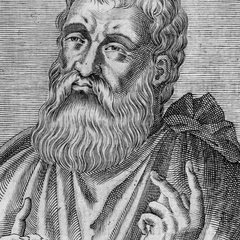 Justin Martyr
 Irenaeus read Justin and quotes him by name. One of the few lines left of Justin's lost book against Marcion is kept in Against Heresies: “I would not have believed the Lord Himself, if He had announced any other than He Who is our framer, maker, and nourisher.”
Against Heresies, Book 4, chapter 6Bishop of Lyons before Irenaeus, more than ninety years old. The governor asked him who the God of the Christians was. He answered, “If thou art worthy, thou shalt know.” He died in prison two days after a crowd beat him.
Eusebius, Church History, Book 5, chapter 1Tried to cut off the churches of Asia over the date of Easter. Irenaeus wrote to talk him out of it, and wrote to most of the other bishops too.
Eusebius, Church History, Book 5, chapter 24He knew Polycarp in Asia, as Irenaeus did. He was a presbyter at Rome but lost the office. He was drawn toward the Gnostic teacher Valentinus. Irenaeus wrote to him, and against him.
Eusebius, Church History, Book 5, chapters 15 and 20The Gnostic teachers whom Irenaeus's five books set out, above all, to refute.
Against Heresies, Book 1, prefaceJustin's own pupil. After Justin's martyrdom, says Irenaeus, he left the Church, “puffed up by the thought of being a teacher”, and taught that marriage was corruption.
Against Heresies, Book 1, chapter 28The historian, writing about a century later. He quoted Irenaeus often and said he was well named. But he blamed Papias, an early bishop, for Irenaeus's hope of a thousand-year kingdom on earth.
Eusebius, Church History, Book 5, chapter 24; Book 3, chapter 39how he died
No one knows how or when he died. After the Easter dispute of about 190, he drops out of the record.
Eusebius tells a great deal about him and says nothing of his death. The historian Arthur McGiffert says Jerome was the first to call him a martyr, in a commentary on Isaiah.
Catholics call him bishop and martyr, and the Orthodox a hieromartyr. The Episcopal Church's calendar is less sure: it calls his martyrdom a late and uncertain tradition. Even the Catholic Encyclopedia of 1910 thought it “not very probable”. No last words are recorded.
is he a saint?
Yes. Catholics and Orthodox count him a saint and a martyr. Since 2022 he has also been a Catholic Doctor of the Church. Anglicans and Lutherans remember him too.
- CatholicSaintA memorial on 28 June. Doctor of the Church, 2022
- OrthodoxSaintA hieromartyr, 23 August
- AnglicanSaintA Lesser Festival in the Church of England, 28 June
- LutheranRememberedMissouri Synod and ELCA, 28 June
He came from the East and served in the West. When Pope Francis named him a Doctor of the Church in 2022, he gave him the title Doctor unitatis, the Doctor of Unity. The decree gives the reason:
Saint Irenaeus of Lyon, who came from the East, exercised his episcopal ministry in the West: he was a spiritual and theological bridge between Eastern and Western Christians.
…After having strenuously opposed the heretics by speech and writing, he was crowned with a glorious martyrdom, with almost all the people of his city, during the persecution of Severus.
a prayer he wrote
In the middle of Against Heresies he stops to pray, for everyone who will read the book.
Wherefore I do also call upon Thee, Lord God of Abraham, and God of Isaac, and God of Jacob and Israel, Who art the Father of our Lord Jesus Christ, the God Who, through the abundance of Thy mercy, hast had a favour towards us, that we should know Thee, Who hast made heaven and earth, Who rulest over all, Who art the only and the true God, above Whom there is none other God; grant, by our Lord Jesus Christ, the governing power of the Holy Spirit; give to every reader of this book to know Thee, that Thou art God alone, to be strengthened in Thee, and to avoid every heretical, and godless, and impious doctrine.
what to read first
Against Heresies, Book 3
Irenaeus
The heart of the work: the apostles, the churches they founded, Polycarp, and the four Gospels. Book 1 is heavy going, so start here.
Read it freeThe Demonstration of the Apostolic Preaching
Irenaeus
A short handbook of the faith, written for a friend, Marcianus. Lost for centuries, and found in Armenian in 1904.
Read it freeChurch History, Book 5
Eusebius
Nearly everything known of his life: the letter of the martyrs of Lyons, his letter to Florinus about Polycarp, and the Easter dispute. See chapters 4, 5, 20 and 24.
Read it freeLives of Illustrious Men, chapter 35
Jerome
One page on him: his books, and his letter to Victor, bishop of Rome.
Read it freetake the quizzes
 Quiz Which early Christian thinks like you? And which would argue with you? See where you stand beside Irenaeus. Start
  Quiz Christian Personality Test Which of eight types are you? Find your own. Start
 sources
His life, and his words
- Irenaeus, Against Heresies. Tr. Alexander Roberts and W. H. Rambaut. Ante-Nicene Fathers, volume 1, 1885. With the fragments and the translators' notes.
- Irenaeus, The Demonstration of the Apostolic Preaching. Tr. J. Armitage Robinson, 1920.
- Robinson's introduction, on how the book was found in 1904.
- Eusebius, Church History, Book 5. Tr. Arthur McGiffert, 1890.
- Eusebius, Church History, Book 3, chapter 39. Same edition.
- McGiffert's note on Irenaeus, to Church History, Book 4, chapter 21.
- Jerome, Lives of Illustrious Men, chapter 35. Nicene and Post-Nicene Fathers, second series, volume 3.
- Tertullian, Against the Valentinians. Tr. Alexander Roberts.
- Gregory of Tours, History of the Franks. Tr. O. M. Dalton, 1927.
- Gregory of Tours, Glory of the Martyrs, chapter 49, in Latin. The Cult of Saints database, Oxford.
Reference
- Catholic Encyclopedia, 1910, “St. Irenaeus”
- Britannica, “Saint Irenaeus”
- Catechism of the Catholic Church, paragraph 294, in English
- Catechism of the Catholic Church, in Latin, paragraph 294
- Decree naming him a Doctor of the Church, 21 January 2022
- Catholic World Report, 21 January 2022
- Lippincott's Pronouncing Dictionary of Biography, “Irenæus”, for how to say it
Calendars
- USCCB, Memorial of Saint Irenaeus, Bishop and Martyr
- The Roman Martyrology, 1916 edition
- OCA, Hieromartyr Irenaeus, Bishop of Lyons
- Great Synaxaristes, Greek
- saint.gr, Greek
- azbyka.ru, Russian
- Church of England, Common Worship calendar
- The Episcopal Church, Lesser Feasts and Fasts 2022
- The Lutheran Church–Missouri Synod, Commemorations
- Evangelical Lutheran Worship, ELCA, the church year (final draft, 2006)
Pictures
- Saint Irénée, a window by Lucien Bégule, 1901. Église Saint-Irénée, Lyon. Public domain.
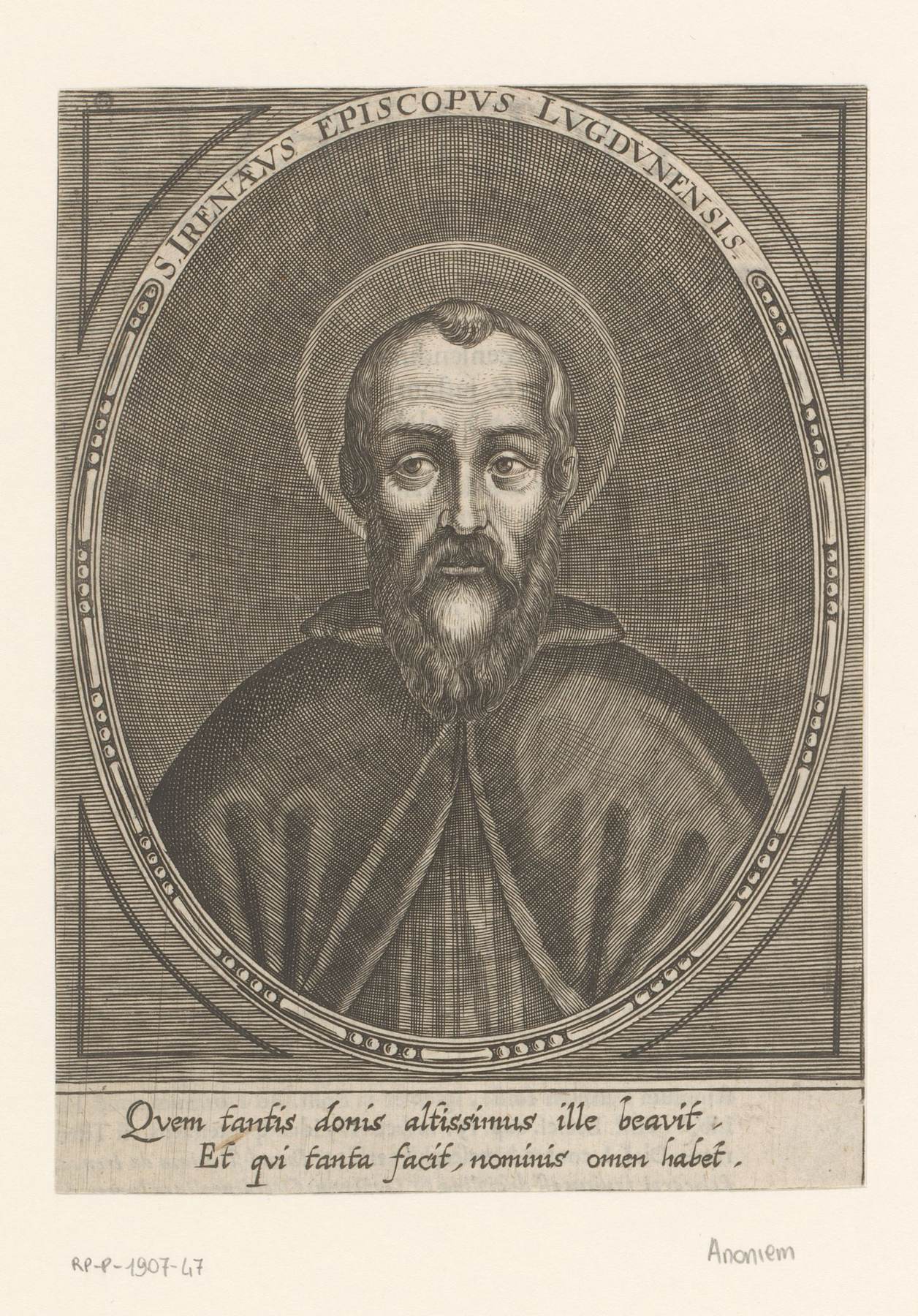
- H. Ireneüs van Lyon, anonymous, possibly the Netherlands, 1600s. Rijksmuseum, Amsterdam. CC0.
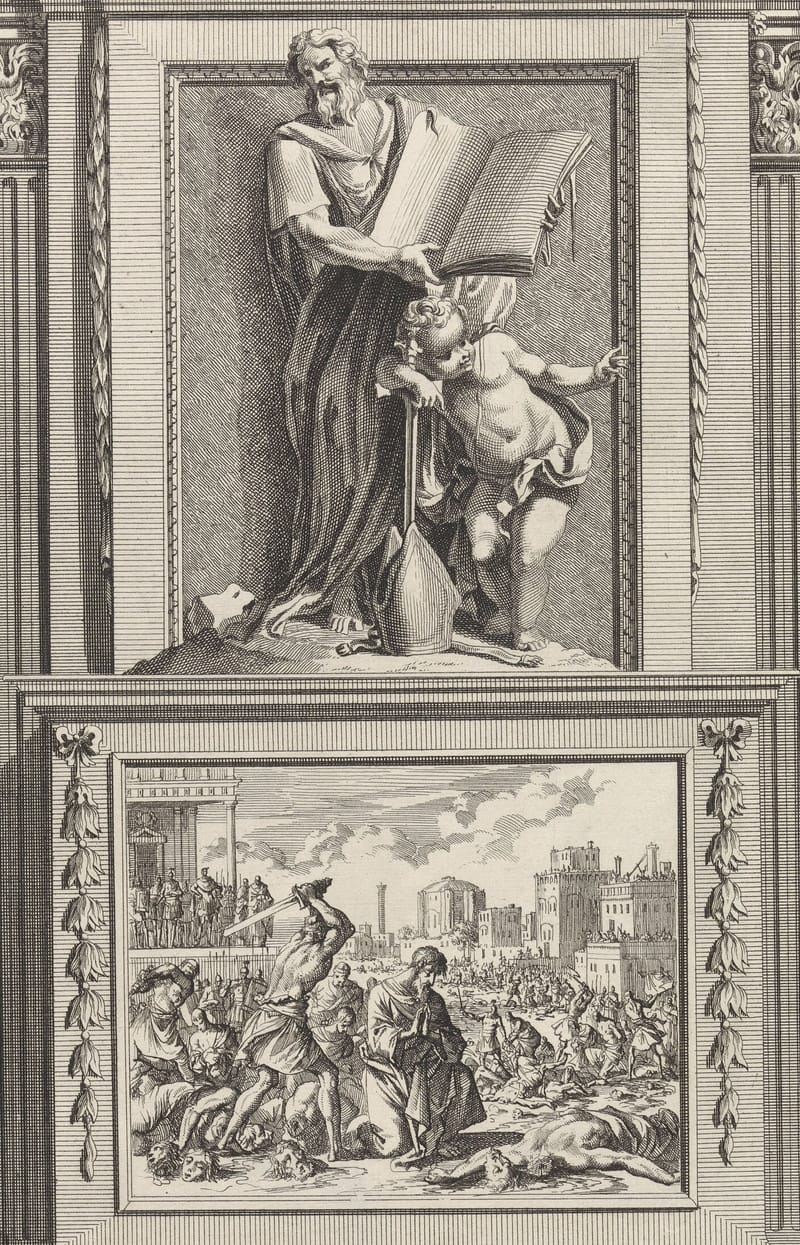
- H. Ireneüs van Lyon, kerkvader, Jan Luyken after Jan Goeree, 1698, for William Cave's lives of the Fathers in Dutch. Rijksmuseum, Amsterdam. CC0.