
Justin Martyr
A philosopher who became a Christian, defended the faith to the emperor, and was beheaded for it.
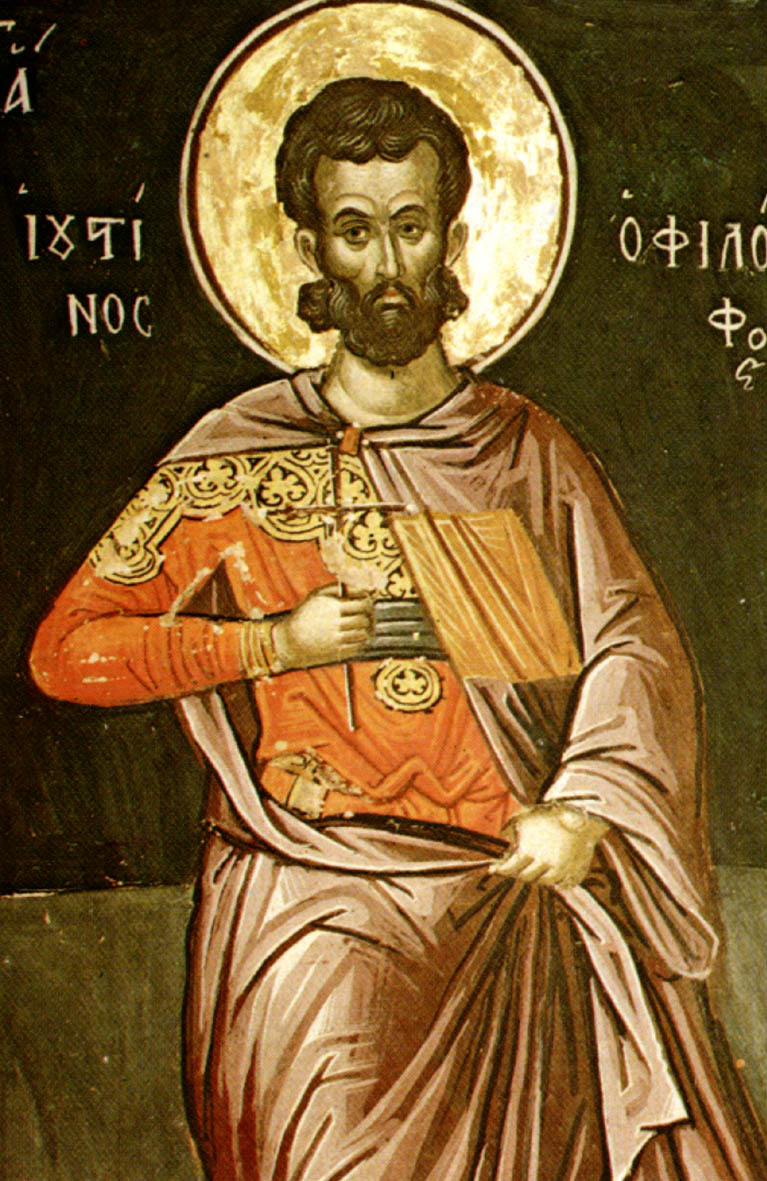
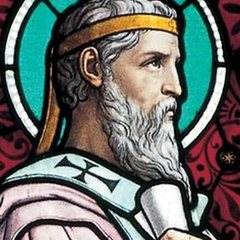
Picture: Saint Justin the Philosopher, fresco by Theophanes the Cretan and his son Symeon, about 1546. Stavronikita Monastery, Mount Athos. Public domain.
Who was Justin?
Justin was a philosopher from Samaria who became a Christian in the second century. He kept wearing his philosopher's cloak and taught in Rome. He wrote to the emperor to defend Christians, and described Christian worship in rare detail. About 165 he was beheaded in Rome with six companions.
at a glance
His path, in order
- PhilosopherTried four schools
- TeacherAt his home in Rome
- ApologistWrote to the emperor
- MartyrBeheaded, about 165
in numbers
- Schools of philosophy he tried4
- Stoic, Peripatetic, Pythagorean, Platonist
- All before he found Christ
- Died with him6
- Five men and one woman
- All refused to sacrifice to the gods
- His books that survive3
- All three come from one handwritten copy, finished in 1364
did you know?
-
The prefect who sentenced him, Junius Rusticus, was a Stoic philosopher. He had been the favourite teacher of Marcus Aurelius, who thanks him in his Meditations.
Meditations, Book 1; George Long, 1862 -
He told the emperor that a statue on the Tiber honoured Simon the magician as a god. A stone dug up on the Tiber island in 1574 honours Semo Sancus, a Sabine god. Most scholars think Justin misread it.
First Apology, chapter 26, and its note -
He sent the emperor to Rome's own files: the census lists made under Quirinius for Christ's birth at Bethlehem, and the Acts of Pontius Pilate for His death and healings. His editors think those Acts were lost early.
First Apology, chapters 34, 35 and 48 -
He saw the cross everywhere: in a ship's sail, a plough, the tools of diggers and craftsmen, and a man standing with his arms out. Rome's own banners, he told the emperor, carried it too.
First Apology, chapter 55
- Born
- About 100. Some say as late as 114. At Flavia Neapolis in Palestine, near ancient Shechem. Today it is Nablus.
- Grew up
- In a pagan family. His grandfather's name is Greek. His father's name and his own are Latin. He calls himself uncircumcised, and the Samaritans his people.
- Died
- About 165, in Rome. He was scourged and beheaded with six companions, on the sentence of Rusticus, prefect of the city.
- Buried
- The record of his trial does not say. Some believers took his body and his companions' in secret and laid them “in a suitable place”. The Orthodox Church in America says his relics rest in Rome.
- Also called
- Justin the Philosopher, in the Orthodox Church. In Greek he is also the Apologist. “Martyr” is a title, not a surname.
- Status
- A saint to Catholics, Orthodox and Anglicans. Lutherans remember him too, on the same day, 1 June.
- Patron of
- Philosophers, in Catholic devotion. The Orthodox Church in America says people ask his help with their studies.
- In art
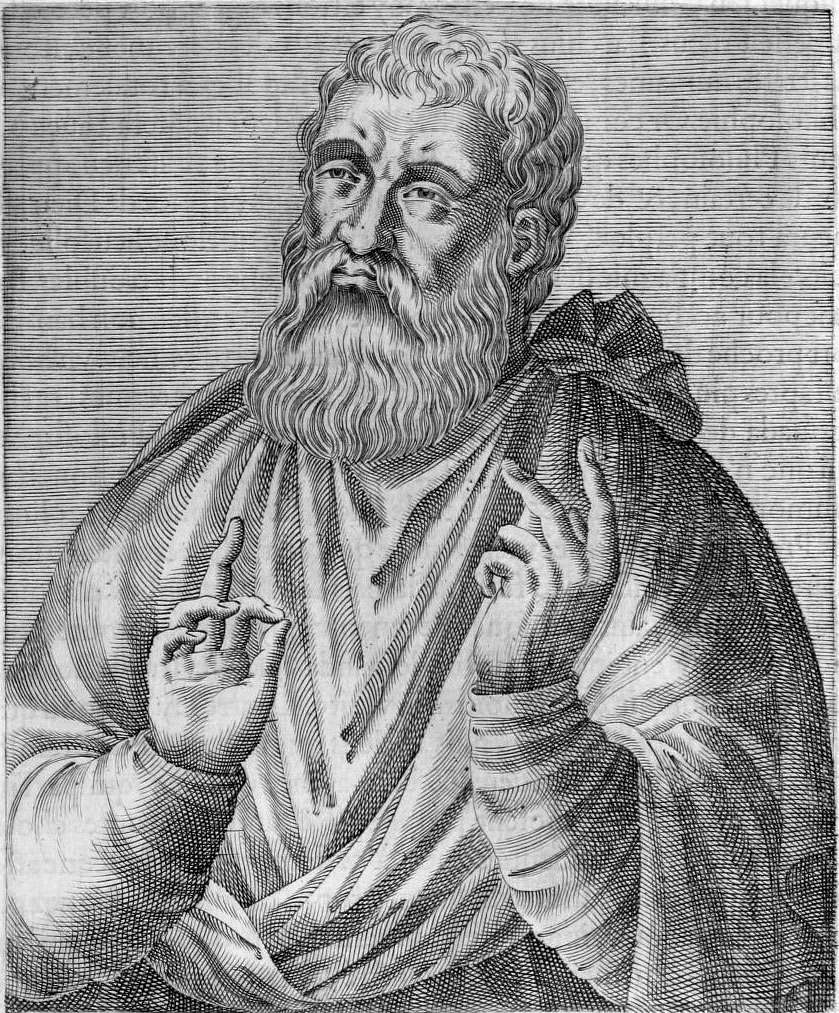
- In Eastern icons, such as the fresco at the top of this page, he is a dark-haired, bearded man in a cloak, with a martyr's small cross and a book. The fresco labels him “the Philosopher”. A Western print of 1584 imagines him as an old man with a long beard.
- Wrote
- The First Apology, the Second Apology and the Dialogue with Trypho. Eusebius lists more books, now lost. Several works printed under his name are not his.
- Pronounced
- JUS-tin MAR-ter.
feast days
East and West, side by side
West
- Apr14
The Catholic feast from Pope Leo XIII until 1969. The 1916 Roman Martyrology tells of his death the day before, on 13 April.
- Jun1
Catholic memorial since 1969. Also the Church of England, the Episcopal Church, and Lutherans in the Missouri Synod and the ELCA.
East
- Jun1
The Orthodox Church in America and the Greek churches. The Russian Church keeps 1 June by the old calendar, which is 14 June on today's calendar.
East and West now keep the same day. Rome kept 14 April from 1882. Its new calendar of 1969 moved him to 1 June. The reason it gives: 14 April often fell among the Easter feasts, and the Byzantine churches had kept 1 June since at least the 9th century. Churches on the old calendar keep each date 13 days later.
what was he like?
+a restless seeker
A famous Pythagorean told him to learn music, astronomy and geometry before he would teach him. Justin could not face the wait. “Accordingly I took it rather impatiently,” he admits. “I was not able to endure longer procrastination.”
Dialogue with Trypho, chapter 2+joked, and parted friends
When a Jew named Trypho stopped him to talk, Justin answered with a line of Homer. He says he “replied to him in jest”. After two days of hard argument they parted as friends, and Justin prayed for Trypho and his companions as they went.
Dialogue with Trypho, chapters 1 and 142+no double talk
Trypho, a Jew he debated for two days, asked if Justin truly believed what he had said, or only said it to win. “I am not so miserable a fellow, Trypho, as to say one thing and think another.” He told the emperor that Christians could deny their faith and walk free, “but we would not live by telling a lie”.
Dialogue with Trypho, chapter 80; First Apology, chapter 8+took on all comers
He questioned the Cynic philosopher Crescens, and “found most convincingly that he, in truth, knows nothing.” He offered to do it again in front of the emperor. While he was debating a Jew named Trypho, Trypho's friends jeered. He got up to leave, and Trypho caught hold of his garment.
Second Apology, chapter 3; Dialogue with Trypho, chapter 9+loved a pun
Christians were punished for their name alone. In Greek, Christ's name sounds like the word for good. So, Justin says, judged by the name, “we are most excellent people.” He called his rival Crescens “that lover of bravado and boasting”, words that sound in Greek like “philosopher”. His translators point out both puns.
First Apology, chapter 4; Second Apology, chapter 3what others said of him
Nearly everything about his life comes from his own books and the short record of his trial. His pupil Tatian left a line about him. Later writers who read him left more.
And the most admirable Justin has rightly denounced them as robbers.
Justin, philosopher and martyr
Justin of Neapolis, a man not far removed either from the times or from the virtues of the apostles
But Justin was especially prominent in those days. In the guise of a philosopher he preached the divine word, and contended for the faith in his writings.
his life in six moments
The schools
As a young manShopping for a philosophy
He went looking for God in the schools of philosophy. A Stoic taught him nothing about God. A Peripatetic asked for his fee after a few days, so Justin decided he was no philosopher at all. A proud Pythagorean sent him away for not knowing music, astronomy and geometry. The Platonists thrilled him. “Such was my stupidity,” he says, “I expected forthwith to look upon God.” The Catholic Encyclopedia warns that the story is shaped to make a point, and “cannot be taken too literally”.
Dialogue with Trypho, chapter 2A field near the sea
About 130The old man
He liked to walk alone near the sea, to think. One day an old man followed him there. The old man said he had come looking for some of his household, who had gone away. Then he took Justin's Platonism apart, question by question, and told him to read the prophets. “I have not seen him since,” Justin writes. While he was still a Platonist, he had seen Christians face death without fear. He saw that they could not be living in wickedness.
Dialogue with Trypho, chapters 3 to 8; Second Apology, chapter 12Ephesus
About 135Two days with Trypho
One morning a Jew named Trypho, who had fled the war in Judea, greeted him in a colonnade because of his philosopher's cloak. When Trypho's friends jeered, Justin got up to go, but Trypho caught hold of his garment. They argued over the Scriptures for two days. At the end Trypho asked him to “remember us as friends when you are gone”.
Dialogue with Trypho, chapters 1, 9 and 142; Eusebius, Church History, Book 4, chapter 18Rome
Two staysA teacher in Rome
He lived in Rome twice. He lodged “above one Martinus, at the Timiotinian Bath”. Anyone who wished could come to him there, and he told them “the doctrines of truth”. Among those who came was Tatian, who became his pupil.
The Martyrdom of Justin, chapter 2; Irenaeus, Against Heresies, Book 1, chapter 28Rome
About 150A letter to the emperor
He wrote to the emperor Antoninus Pius and his sons, for “those of all nations who are unjustly hated and wantonly abused, myself being one of them.” He asked that Christians be judged by what they did, not by their name. He also told what Christians did at baptism and on Sunday. To leave it out, he says, would seem unfair.
First Apology, chapters 1, 4 and 61 to 67Rome
Soon after 150He saw his death coming
The prefect Urbicus put a Christian teacher, Ptolemaeus, to death for being a Christian, and nothing else. A man named Lucius protested, and was led away too. Then a third man did the same. Justin wrote again, this time to the Romans. He expected to be plotted against, perhaps by his rival, the Cynic Crescens: “I too, therefore, expect to be plotted against and fixed to the stake”.
Second Apology, chapters 1 to 3; Catholic Encyclopedia, 1910
his words
Three of his books survive, and the record of his trial keeps his last answers. The lines quoted here are from the 1885 translation by Marcus Dods and George Reith.
To the emperor
You can kill, but not hurt us.
From the opening of the First Apology, to Antoninus Pius and his sons. No evil can be done to Christians, he says, unless they are proved to be evildoers. The thought goes back to Socrates at his own trial. In Greek, ὑμεῖς δ᾽ ἀποκτεῖναι μὲν δύνασθε, βλάψαι δ᾽ οὔ.
First Apology, chapter 2But straightway a flame was kindled in my soul; and a love of the prophets, and of those men who are friends of Christ, possessed me; and whilst revolving his words in my mind, I found this philosophy alone to be safe and profitable.
Whatever things were rightly said among all men, are the property of us Christians.
Those who lived reasonably are Christians, even though they have been thought atheists; as, among the Greeks, Socrates and Heraclitus, and men like them.
We who valued above all things the acquisition of wealth and possessions, now bring what we have into a common stock, and communicate to every one in need; we who hated and destroyed one another, and on account of their different manners would not live with men of a different tribe, now, since the coming of Christ, live familiarly with them, and pray for our enemies.
Brief and concise utterances fell from Him, for He was no sophist, but His word was the power of God.
sunday, as he described it
He described Christian worship for the emperor and for pagans. To leave it out, he says, would seem unfair. The Catholic Encyclopedia of 1910 praises its “richness of detail unique for that age”.
Baptism
Those who came to believe prayed and fasted for the forgiveness of their past sins, and the church fasted with them. Then they were washed in the name of God the Father, of Jesus Christ and of the Holy Spirit.
“Then they are brought by us where there is water, and are regenerated in the same manner in which we were ourselves regenerated.”First Apology, chapter 61
The kiss and the cup
The newly baptised were brought to the gathering, and all prayed together. Bread and a cup of wine mixed with water were brought to the one presiding. He gave thanks at length, and all the people said Amen. Deacons gave the bread and wine to everyone, and carried some to those who were absent.
“Having ended the prayers, we salute one another with a kiss.”First Apology, chapter 65
Not common bread
Only the baptised who lived as Christ taught could receive the Eucharist. Justin says why. His translators note that the passage is “claimed alike by Calvinists, Lutherans, and Romanists”. The Catholic Encyclopedia of 1910 finds the Real Presence of Christ in it “with a wonderful clearness”.
“For not as common bread and common drink do we receive these; but in like manner as Jesus Christ our Saviour, having been made flesh by the Word of God, had both flesh and blood for our salvation, so likewise have we been taught that the food which is blessed by the prayer of His word, and from which our blood and flesh by transmutation are nourished, is the flesh and blood of that Jesus Who was made flesh.”First Apology, chapter 66; Catholic Encyclopedia, 1910
On the day called Sunday
Christians from town and country met in one place. The Gospels or the prophets were read. He calls the Gospels the memoirs of the apostles. The one presiding preached, all rose to pray, and the bread and cup followed. Then those who had the means gave what they chose. It went to orphans and widows, the sick, prisoners and strangers.
“And on the day called Sunday, all who live in cities or in the country gather together to one place, and the memoirs of the apostles or the writings of the prophets are read, as long as time permits”First Apology, chapter 67
Why Sunday
Sunday was the first day of creation, and the day Christ rose.
“Sunday is the day on which we all hold our common assembly, because it is the first day on which God, having wrought a change in the darkness and matter, made the world; and Jesus Christ our Saviour on the same day rose from the dead.”First Apology, chapter 67
often misquoted
“What the soul is in the body, that are Christians in the world.”
What the sources sayNot his. It is from the Letter to Diognetus, chapter 6, by an unknown writer. After it was first printed in 1592 it was long credited to Justin. Its editors in the Ante-Nicene Fathers say its tone “points to some other writer than Justin.”
Ante-Nicene Fathers, vol. 1, note on the Letter to Diognetus“To yield and give way to our passions is the lowest slavery, even as to rule over them is the only liberty.”
What the sources sayNot in his three surviving works. It comes from a medieval book of sayings, the Melissa of Antonius, which credits it to Justin. The Ante-Nicene Fathers prints it among fragments whose authorship is disputed. Goodreads wrongly places it in his work on the resurrection.
Ante-Nicene Fathers, vol. 1, Other Fragments, fragment 18“Plain singing is not childish, but only the singing with lifeless organs, with dancing, and cymbals.”
What the sources sayThe line is from the Answers to the Orthodox, question 107, a later book printed under his name. His translators list it among works “unquestionably not the works of Justin”, and say it was written after the Council of Nicaea in 325.
Answers to the Orthodox, question 107, in Migne, Patrologia Graeca, vol. 6; Dods and Reith, introduction, Ante-Nicene Fathers, vol. 1“The devil is the author of all war.”
What the sources sayNot found in his works. It is usually quoted with words that paraphrase the First Apology, chapter 39. There Justin says Christians “who formerly used to murder one another” now refrain from making war on their enemies.
First Apology, chapter 39He became a Christian on “a walk along the beach at Ephesus”.
What the sources sayJustin names no town. He says only “a certain field not far from the sea”. Eusebius puts his later debate with Trypho at Ephesus, not his conversion.
Dialogue with Trypho, chapter 3; Eusebius, Church History, Book 4, chapter 18He died by drinking hemlock, like Socrates.
What the sources sayThe record of his trial says he was scourged and beheaded. The record's English translator calls the hemlock story “an absurd addition” made in some copies. The editor of that English edition thinks the story began among the Greeks, who gave a philosopher a philosopher's death. The verse for his day in the Greek synaxarion, the church's book of saints' days, still says hemlock took him.
The Martyrdom of Justin, chapter 5, and its introductory note; saint.grwhere he stood
Each line is from his own books, in the 1885 translation. TapClick “Show his line” to read it.
Your answers are next to his. From your result on . See your result
“Wisdom is worth learning from anyone, even people who don't share your faith.”
Justin strongly agrees.
You
Show his line
Whatever things were rightly said among all men, are the property of us Christians.Second Apology, chapter 13
“Nature can teach you as much about God as the Bible can.”
Justin disagrees.
You
On record in the Dialogue with Trypho. Not quoted here.
“God still speaks to people through dreams.”
Justin agrees.
You
Show his line
For the prophetical gifts remain with us, even to the present time.Dialogue with Trypho, chapter 82
“Miracles still happen today, just as they did in the Bible.”
Justin strongly agrees.
You
Show his line
For numberless demoniacs throughout the whole world, and in your city, many of our Christian men exorcising them in the name of Jesus Christ, Who was crucified under Pontius Pilate, have healed and do heal.Second Apology, chapter 6
“Some questions about God are better left alone.”
Justin disagrees.
You
Show his line
Philosophy is, in fact, the greatest possession, and most honourable before God, to Whom it leads us and alone commends us.Dialogue with Trypho, chapter 2
“A church should keep out people who openly live in serious wrongdoing.”
Justin agrees.
You
On record in the First Apology. Not quoted here.
“A Christian can fight in a just war with a clear conscience.”
Justin disagrees.
You
Show his line
We who formerly used to murder one another do not only now refrain from making war upon our enemies.First Apology, chapter 39
“Becoming a better person is mostly down to your own effort.”
Justin agrees.
You
On record in the First Apology. Not quoted here.
“In the end, God will save everyone.”
Justin strongly disagrees.
You
On record in the First Apology. Not quoted here.
See where you stand beside him. Take the quiz
hard questions
Three things in his books trouble readers today. Here they are in his own words.
The Jews
The Dialogue with Trypho is courteous, and it ends in friendship. But Justin tells Trypho that the Jews' sufferings after the war in Judea were deserved. He says they killed Christ and the prophets, and cursed Christians in their synagogues. Britannica sums up his case: that “the gentiles have been chosen to replace Israel as God’s chosen people”. Ben Zion Bokser, in the Encyclopaedia Judaica, is blunter. He writes that Justin's “invective against Jews and Judaism entered the mainstream of Christian thought and became a sinister influence”. He ties it to the growth of Christian antisemitism.
“Accordingly, these things have happened to you in fairness and justice, for you have slain the Just One, and His prophets before Him”Dialogue with Trypho, chapter 16; Britannica; Ben Zion Bokser, “Justin Martyr”, Encyclopaedia Judaica, 2007
The Son, second to the Father
Justin calls Christ God. He also calls Him “another God and Lord subject to the Maker of all things”. The Catholic Encyclopedia of 1910 credits him with teaching the Word's “Divinity and Incarnation”. It also faults “the subordinationism of Justin's theology”, which it puts down to philosophy. He wrote long before the Council of Nicaea in 325.
“We reasonably worship Him, having learned that He is the Son of the true God Himself, and holding Him in the second place, and the prophetic Spirit in the third.”First Apology, chapter 13; Dialogue with Trypho, chapter 56
A thousand years
He believed the dead would rise, and there would be a thousand years in a rebuilt Jerusalem. He also said plainly that many good Christians disagreed with him.
“Many who belong to the pure and pious faith, and are true Christians, think otherwise.”Dialogue with Trypho, chapter 80
friends, family and rivals
 Irenaeus
 Bishop of Lyon a generation later. He read Justin and quotes him with approval. He saved a line from Justin's lost book against Marcion: “I would not have believed the Lord Himself, if He had announced any other than He Who is our framer, maker, and nourisher.”
Irenaeus, Against Heresies, Book 4, chapter 6His father. Justin names him, and his grandfather Bacchius, in the first line of the First Apology.
First Apology, chapter 1A Jew who had fled the war in Judea. They argued over the Scriptures for two days, and parted as friends. Eusebius calls him “a most distinguished man among the Hebrews of that day”.
Dialogue with Trypho, chapters 1 and 142; Eusebius, Church History, Book 4, chapter 18A Cynic philosopher. Eusebius says Justin often refuted him in public. Justin's pupil Tatian says Crescens “endeavoured to inflict on Justin, and indeed on me, the punishment of death”. Eusebius's editor adds a fair warning: “we have his portrait only from the pen of his bitterest enemies.”
Second Apology, chapter 3; Tatian, Address to the Greeks, chapter 19; Eusebius, Church History, Book 4, chapter 16, with McGiffert's notesHe taught his followers to believe in another god, greater than the Creator. Justin wrote of him as “a man of Pontus, who is even at this day alive”. He also wrote a book against him, now lost.
First Apology, chapter 26His pupil. After Justin's death he broke with the Church and condemned marriage. Irenaeus, bishop of Lyon, says that “as long as he continued with him he expressed no such views”.
Irenaeus, Against Heresies, Book 1, chapter 28A servant of Caesar who died with him. Asked if Justin had made him a Christian, he said, “I willingly heard the words of Justin. But from my parents also I learned to be a Christian.”
The Martyrdom of Justin, chapter 3how he died
He was scourged and beheaded in Rome, about 165, with six companions, for refusing to sacrifice to the gods.
Rusticus, prefect of Rome, told Justin to obey the gods. He asked Justin what he taught and where the Christians met. Justin said he had tried every teaching: “I have acquiesced at last in the true doctrines, those namely of the Christians”.
His six companions each said in turn that they were Christians. Asked if Justin had made them Christians, Hierax said he always had been one. Paeon said he had his faith from his parents. Hierax's own parents were dead: “Christ is our true father, and faith in Him is our mother”.
The prefect Rusticus asked Justin if he supposed he would go up to heaven. “I do not suppose it,” he said, “but I know and am fully persuaded of it.” Told to sacrifice, he said, “No right-thinking person falls away from piety to impiety.”
Justin and his six companions all refused to sacrifice. They were scourged and beheaded, and some believers took their bodies away in secret.
His last recorded words
Through prayer we can be saved on account of our Lord Jesus Christ, even when we have been punished, because this shall become to us salvation and confidence at the more fearful and universal judgment-seat of our Lord and Saviour.
The passage can be read another way. Lord Hailes, following the common Latin version, gave it as: “It was our chief wish to endure tortures for the sake of our Lord Jesus Christ, and so to be saved.”
Justin and his companions, together
Do what you will, for we are Christians, and do not sacrifice to idols.
is he a saint?
Yes. Catholics, Orthodox and Anglicans count him a saint. Lutherans remember him too, on the same day, 1 June.
- CatholicSaintA memorial on 1 June
- OrthodoxSaintCalled Justin the Philosopher
- AnglicanSaintA Lesser Festival in the Church of England
- LutheranRememberedMissouri Synod and ELCA, 1 June
His martyrdom was known from the first. Irenaeus mentions it in passing, as a fact everyone knew. Tertullian already calls him “philosopher and martyr”. The Roman Martyrology of 1916 tells it like this:
There suffered at Rome that remarkable man, Justin the Philosopher, who had addressed to the emperors his second Apology in defence of our religion.
what to read first
Dialogue with Trypho, chapters 1 to 9
Justin Martyr
How he became a Christian, told by himself. The schools of philosophy he tried, the old man he met by the sea, and how he met a Jew named Trypho.
Read it freeThe First Apology
Justin Martyr
His defence of the Christians to the emperor. Chapters 61 to 67 describe baptism, the Eucharist and Sunday worship.
Read it freeThe Second Apology
Justin Martyr
Short, angry and personal. Written after Christians were put to death for being Christians, and nothing else.
Read it freeThe Martyrdom of Justin
An unknown early writer
The short record of his trial and death, in five chapters.
Read it freetake the quizzes
 Quiz Which early Christian thinks like you? And which would argue with you? See where you stand beside Justin. Start
  Quiz Christian Personality Test Which of eight types are you? Find your own. Start
 sources
His life, and his words
- Justin Martyr, First Apology. Tr. Marcus Dods and George Reith, Ante-Nicene Fathers, vol. 1, 1885.
- Justin Martyr, Second Apology. Same edition.
- Justin Martyr, Dialogue with Trypho. Same edition.
- The Martyrdom of Justin. Tr. Marcus Dods, same edition, with its introductory note.
- The Apologies in Greek. Ed. B. L. Gildersleeve, 1877.
- Answers to the Orthodox, question 107, in Greek. J.-P. Migne, Patrologia Graeca, vol. 6, 1857. A later book printed under his name.
- Other Fragments from the Lost Writings of Justin. Ante-Nicene Fathers, vol. 1.
- The Letter to Diognetus, with its editors' note. Ante-Nicene Fathers, vol. 1.
- Irenaeus, Against Heresies, Book 1, chapter 28, and Book 4, chapter 6. Tr. Alexander Roberts and W. H. Rambaut.
- Tatian, Address to the Greeks. Tr. J. E. Ryland.
- Tertullian, Against the Valentinians. Ante-Nicene Fathers, vol. 3.
- Methodius, Discourse on the Resurrection. Tr. W. R. Clark.
- Eusebius, Church History, Book 4. Tr. A. C. McGiffert, 1890, with his notes.
Reference
- Catholic Encyclopedia, 1910, “St. Justin Martyr”
- Henry Wace, Dictionary of Christian Biography, 1911, “Justinus Martyr”
- Britannica, “St. Justin Martyr”
- Ben Zion Bokser, “Justin Martyr”, Encyclopaedia Judaica, 2nd edition, 2007
- Franciscan Media, Saint of the Day, on his patronage
- Merriam-Webster, “Justin”, for how to say it
- Goodreads, where the misquotations above circulate
Calendars
- USCCB, Liturgical Calendar 2026: Saint Justin, Martyr, Memorial
- Calendarium Romanum, Vatican Press, 1969, pages 94 and 120, in Latin: why the memorial moved to 1 June
- The Roman Martyrology, 1916 edition, 13 and 14 April
- Catholic Culture, on the old date in the 1962 Missal
- OCA, Martyr Justin the Philosopher and those with him at Rome
- saint.gr, Greek
- Great Synaxaristes, Greek
- azbyka.ru, Russian
- Church of England, Common Worship calendar
- The Episcopal Church, Lesser Feasts and Fasts 2022
- Concordia Publishing House, LCMS commemorations
- Evangelical Lutheran Worship, ELCA, the church year
Pictures
- Saint Justin the Philosopher, fresco by Theophanes the Cretan and his son Symeon, about 1546. Stavronikita Monastery, Mount Athos. Public domain.
- Saint Justin Martyr, an imagined likeness engraved for André Thevet, 1584. Public domain.
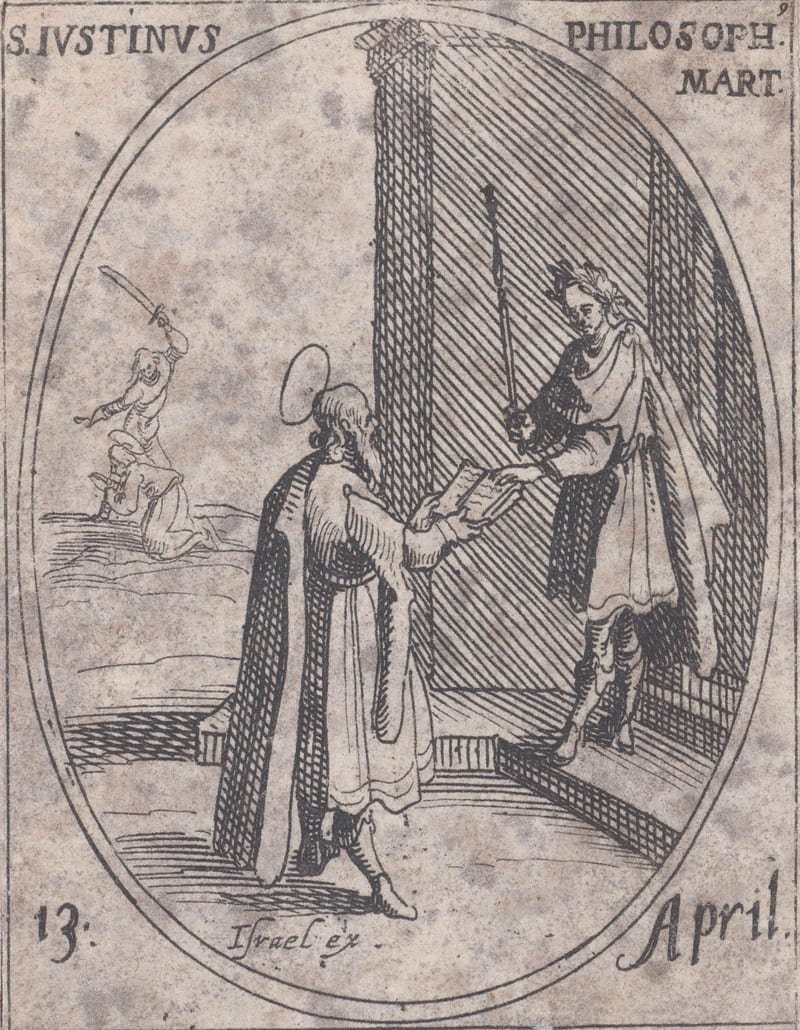
- S. Justin, philosophe, Jacques Callot, from Les Images de tous les saints, published 1636. The Metropolitan Museum of Art, New York. CC0.
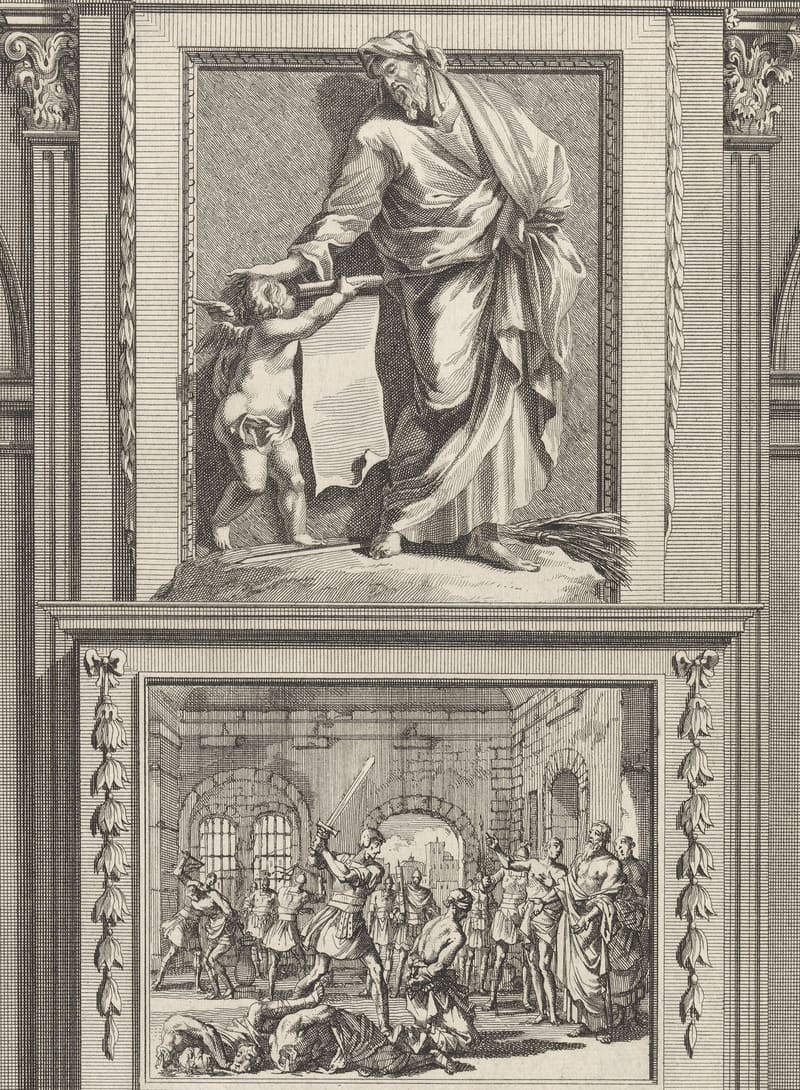
- H. Justinus de Filosoof, apologeet, Jan Luyken after Jan Goeree, 1698, for William Cave's lives of the Fathers in Dutch. Rijksmuseum, Amsterdam. CC0.