
Lawrence of Rome
A deacon of Rome who was told to hand over the Church's gold and brought out the city's poor instead.
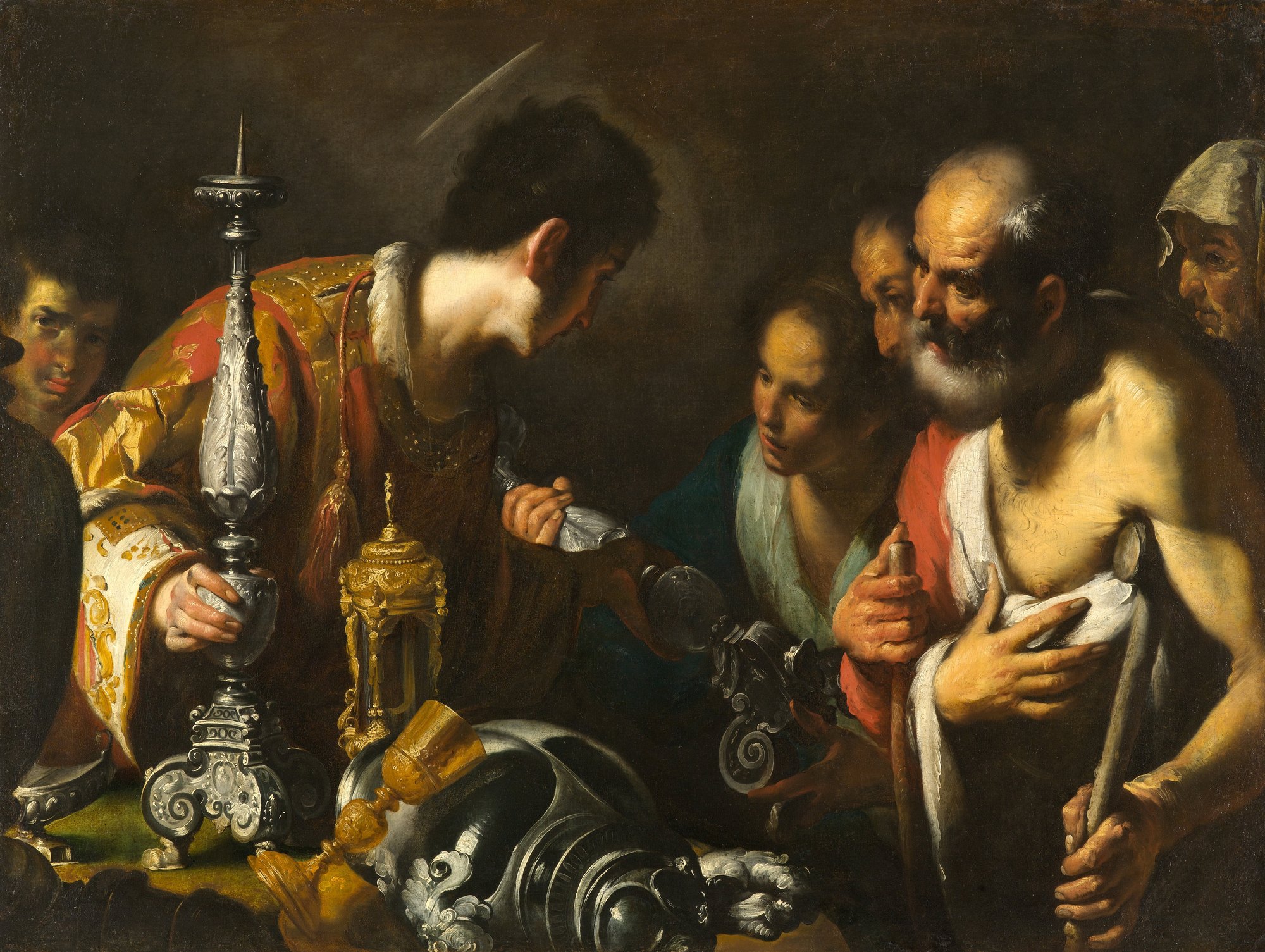
Picture: St Lawrence Distributing the Treasures of the Church, Bernardo Strozzi, about 1625. Saint Louis Art Museum
Who was Lawrence?
Lawrence was a young deacon in Rome who held the keys of the Church's storerooms and fed its poor. He died on 10 August AD 258, days after Pope Sixtus II. The story told since the 300s has him roasted alive on a gridiron, joking that the city's prefect should turn him over because that side was done.
at a glance
His path, in order
- Deacon of RomeServed Pope Sixtus II at the altar
- StewardGave out the Church's offerings to its poor
- Last deacon leftOutlived Sixtus and six other deacons by days
- MartyrPointed to the poor as the Church's treasure
in numbers
- Pounds of silver at his grave1,000
- The emperor Constantine set railings of purest silver weighing this much round the spot above his tomb.
did you know?
-
In the TV series Fargo (2014), a supermarket owner tells a hitman how the Romans burned Lawrence alive and what Lawrence said to them: “Turn me over. I'm done on this side.”
Fargo, season 1, episode 3, A Muddy Road (FX, 2014) -
The shooting stars seen every year around his feast day of 10 August are popularly called “the tears of St Lawrence”.
Encyclopaedia Britannica, 11th edition (1911), Lawrence, St -
Augustine once saw how few had come to church on Lawrence's day, and told them Lawrence's martyrdom was well known “at Rome, not here”.
Augustine, Sermon 303.1 (our translation)
- Born
- Date and place unknown
- Died
- 10 August AD 258, in Rome
- Buried
- Beside the Via Tiburtina, where San Lorenzo fuori le Mura now stands
- Also called
- Laurence; Laurentius in Latin; San Lorenzo in Italian
- Office
- Deacon of the Church of Rome, its archdeacon in Augustine's sermons
- Pope
- Sixtus II, put to death on 6 August AD 258
- Emperor
- Valerian, who ordered the clergy put to death in AD 258
- Feast day
- 10 August
- In art
- A young man in a deacon's robe, holding a gridiron
feast days
East and West
West
- Aug10
Catholic feast. Also the Church of England, the Episcopal Church and Lutherans.
East
- Aug10
Orthodox, with Pope Sixtus and others killed in the same days. On the old (Julian) calendar, 13 days behind, it falls on 23 August.
what was he like?
+Young, but trusted with the Church's goods
Augustine had heard that Lawrence was young in body but mature in spirit. He was the chief of Rome's seven deacons and held the keys of the Church's storerooms. He gave out its people's offerings himself, so he knew the poor who lived on them.
Pope Leo the Great called him outstanding “not only in the performance of the sacred rites, but also in the management of the church's property”.
Augustine, Sermon 305A.1 (our translation); Prudentius, Peristephanon II, lines 37-44 and 157-160; Leo the Great, Sermon 85.2 (tr. C. L. Feltoe, 1895)+Begged to die with Sixtus
A letter written at the time has Pope Sixtus killed where he was caught. Over a century later, Ambrose of Milan told of a parting.
Lawrence wept as Sixtus was led off to die, not for Sixtus's suffering but at being left behind. He asked why Sixtus would go without his deacon. Sixtus told him not to weep, because an old man's fight was the easier one and Lawrence would follow him “after three days”.
Ambrose, On the Duties of the Clergy I.41 (tr. H. de Romestin, 1896); Cyprian, Letter 80 (81), to Successuswhat others said of him
So by the courage of his mind he overcame the power of fire.
He loved Christ in his life; he imitated Him in his death.
He was a deacon, lower in office than a bishop, equal in crown to an apostle.
The flame of Christ's love could not be overcome by thy flames, and the fire which burnt outside was less keen than that which blazed within.
his life in three moments
Rome
6 August AD 258The emperor's order
Bishop Cyprian of Carthage in North Africa sent men to Rome for news, and his letter about what they found is the only report written at the time. Early in August AD 258 the emperor Valerian had ordered that bishops, priests and deacons be put to death at once. On 6 August Pope Sixtus was caught in one of the catacombs and killed there with four of his deacons.
Two more deacons died the same day, which left Lawrence the last of Rome's seven deacons.
Cyprian, Letter 80 (81), to Successus (tr. Ernest Wallis, 1886); Catholic Encyclopedia (1910), St. LawrenceRome
August AD 258The prefect asks for the gold
The prefect who governed Rome kept Lawrence alive for now, because he wanted the Church's wealth and Lawrence held its keys. About AD 400 the poet Prudentius told how the prefect sent for him and asked politely for the gold, saying the treasury needed it for the army. The prefect had heard that Christians used silver cups and gold candlesticks in church, and that their teaching was to give Caesar what is Caesar's (Matthew 22:21).
Lawrence calmly agreed that the Church was rich, richer even than the emperor, and promised to bring out everything precious that Christ owned. He asked only for time to count it all, and the delighted prefect gave him three days.
Prudentius, Peristephanon II, lines 45-140 (our translation); Leo the Great, Sermon 85.2 (tr. C. L. Feltoe, 1895)Rome
Three days laterThe Church's treasure
For three days Lawrence searched every street of Rome for the people the Church fed: the blind, the lame, a man with a withered hand, people covered in sores. He wrote down every name and lined them up outside a church. The prefect came for the gold, found a crowd of beggars crying for alms and turned on Lawrence in anger.
Lawrence told him these were the Church's riches. He had spent its money feeding and clothing them, so no persecutor could take it. He named its widows and the women vowed to God as its jewels. The prefect shouted that he was being mocked and sentenced Lawrence to a slow death by fire.
Prudentius, Peristephanon II, lines 141-360 (our translation); Ambrose, On the Duties of the Clergy II.28; Leo the Great, Sermon 85.2
his miracles
Every wonder told of Lawrence was written down at least a century after his death. When Augustine preached on Lawrence's day, he asked of his grave in Rome: “Who has prayed there and not been heard?”
His face shone on the fire
In Prudentius's poem Lawrence's face shone and light poured round him as the executioners stretched him on the fire. Prudentius likens it to the shine on Moses's face when he came down from the mountain (Exodus 34:29), and to the face of the first martyr Stephen as he looked up and saw heaven open while he was stoned (Acts 7:55-58).
Only the newly baptized could see the light, because baptism had made them ready to take in Christ, while the pagans watching saw nothing. Even the smell of his burning skin reached the two groups differently, a stench to the pagans and as sweet as nectar to the newly baptized.
“Christ is the true fire. He fills the righteous with light and burns the guilty.”Prudentius, Peristephanon II, lines 357-392 (our translation)
The beam that grew
About AD 590 Bishop Gregory of Tours wrote down a story from the Italian fortress of Brione, where a church named for Lawrence had fallen into ruin. When the people cut new beams to repair it, one came out too short. The priest in charge wept, because they could not afford another, and he begged Lawrence for help.
At once the beam grew so long that a large piece had to be cut off, and people took splinters of it to heal the sick. Gregory himself met a man whose toothache stopped as soon as he touched a splinter to the tooth.
“Most blessed Lawrence, laid on the fire and glorified, who always cared for and fed the poor: think of my poverty.”Gregory of Tours, Glory of the Martyrs 42 (our translation)
The broken crystal cup
Another of Gregory of Tours's stories is about a crystal cup used at Communion, kept in Lawrence's church at Milan. At a feast it slipped from a deacon's hands as he carried it to the altar and smashed on the floor. White with fear, the deacon gathered the pieces and laid them on the altar.
He spent the night there in prayer and tears, and in the morning the cup stood on the altar whole again. The news moved the people to ask for a feast of thanks to God, and the bishop hung the cup above the altar and made the feast a yearly one.
“He did not doubt that the martyr's power could make it whole.”Gregory of Tours, Glory of the Martyrs 46 (our translation)
Sight for a blind prisoner
A legend written about AD 500, the Acts of Lawrence, puts him in prison before he was given his three days. A jailer named Hippolytus held him there, and among the prisoners was a pagan named Lucillus who had wept until he went blind. Lawrence promised him his sight if he would believe in Christ, taught him the faith and baptized him, and Lucillus could see again.
More blind people came to Lawrence in prison and went away seeing. Hippolytus asked him for the Church's treasures, which the emperor had demanded. Lawrence told him that if he believed in Christ, he would be shown the treasures and promised eternal life. That same hour Hippolytus believed and was baptized with his whole household.
“If thou wilt believe in our Lord Jesu Christ, I shall show to thee the treasures.”The Golden Legend (about 1260), Caxton's English, ed. F. S. Ellis (1900)
his words
Lawrence left no writings. His words come down in the tellings of Ambrose and Prudentius, written more than a century after his death, and in the later legend of his prison.
Pointing to the poor
These are the treasures of the Church.
To the men who demanded the Church's riches, in Ambrose's telling
Ambrose, On the Duties of the Clergy II.28 (tr. H. de Romestin, 1896)Whither, father, goest thou without thy son? Whither, holy priest, art thou hastening without thy deacon?
Grant, Christ, to Your Romans that their city may be Christian.
My night hath no darkness, but all things shine in my sight.
myths and misquotes
His last words were “Turn me over. I'm done on this side.”
What the sources sayThose words are a modern English blend of two early tellings, and they were not his last. Ambrose of Milan has him say “It's roasted; turn it and eat.” In Prudentius he tells the prefect to turn over the part of his body that has burned long enough. The 1911 Encyclopaedia Britannica joins the two in English as “I am roasted enough on this side; turn me round, and eat.”
Ambrose, On the Duties of the Clergy I.41 (our translation); Prudentius, Peristephanon II, lines 397-408; Encyclopaedia Britannica (1911)He was born in Huesca, in Spain.
What the sources sayThe claim comes from the Middle Ages, and no early writer on Lawrence names his homeland. A book of saints' lives from about 1260 is the first to make him a Spaniard, on the word of a writer of the 1100s. A Spanish poem of the 1200s names Huesca as his home. Prudentius came from Spain himself, yet in 584 lines on Lawrence he never claimed him for Spain.
The Golden Legend, citing John Beleth; Gonzalo de Berceo, Martyrio de Sant Laurencio, stanza 2; Prudentius, ed. Obbarius (1845), note to Peristephanon IIHe sent the cup of the Last Supper to Spain, where it is kept as the Holy Grail.
What the sources sayNo early writer on Lawrence links him to the cup of the Last Supper, so this is a much later legend. It is told of the cup kept in Valencia Cathedral, whose known history begins in 1399, when the monks of San Juan de la Peña, in northern Spain, gave it to the king of Aragon.
Visit Valencia, the Holy Grail of Valenciahow he died
Lawrence was put to death in Rome on 10 August AD 258. The oldest tellings say he was roasted alive on a gridiron over a slow fire, though some historians think he was beheaded.
In Prudentius's poem the prefect had the coals kept low so that Lawrence would die slowly. When one side had burned for a long time, Lawrence called to the prefect to turn him over and eat, because that side was done. Then he prayed for Rome to become Christian, and died. He was buried beside the Via Tiburtina, the road east out of Rome.
Since 1900 those historians have pointed to the emperor's order, which had clergy put to death at once, as Sixtus was. They also thought Lawrence's story was borrowed from that of three Christians in what is now Turkey, who were roasted on gridirons in AD 362 and told their judge to turn them over.
The historian Paul Allard answered in 1907 that their story was first written down in the mid-400s, half a century after Ambrose had told Lawrence's.
is he a saint?
Lawrence was honoured as a saint in Rome from the 300s, long before the Church had any process for declaring saints. Catholics, Orthodox, Anglicans and Lutherans all keep his day.
- CatholicSaintFeast, 10 August
- OrthodoxSaint10 August
- AnglicanSaintLesser festival, 10 August
- LutheranRemembered10 August
Rome's list of its martyrs' days, made in AD 354, gives 10 August as his day and the Via Tiburtina as the place of his grave. Pope Damasus had verses carved for his altar before AD 384, saying that “only Lawrence's faith” could overcome the lashes, the flames, the torments and the chains. In the 590s Pope Gregory the Great sent a nobleman in Gaul a small cross set with relics of Lawrence's gridiron.
He is named with Sixtus and Cyprian among the martyrs remembered in the Roman Canon, the ancient prayer over the bread and wine that Catholic priests still say at Mass. In the Catholic calendar of 1969 his day ranks as a feast, second among Rome's early martyrs only to the apostles Peter and Paul.
what to read first
On the Duties of the Clergy, Book I, chapter 41
Ambrose of Milan
The earliest full telling, in a few paragraphs: Lawrence's plea to Sixtus and the gridiron.
Read it freeOn the Duties of the Clergy, Book II, chapter 28
Ambrose of Milan
Why Ambrose melted down his church's gold to buy back captives, with Lawrence and the Church's treasure as his proof.
Read it freeSermon 85, On the Feast of S. Laurence
Leo the Great
The whole story in two pages, preached by a bishop of Rome in the 400s.
Read it freeLetter 80, to Successus
Cyprian of Carthage
A letter from Carthage, written within weeks: the emperor's order and how Pope Sixtus died.
Read it freeSt. Lawrence
J. P. Kirsch, Catholic Encyclopedia (1910)
What is history and what is legend in his story, in one page.
Read it freetake the quizzes
 Quiz Which early Christian
thinks like you? And which would argue with you? Start
 Quiz Christian

Personality Test Which of eight types are you? Find your own. Start
sources
His life, and his words
- Cyprian, Letter 80 (81 in some numberings), to Successus. Tr. Ernest Wallis, 1886.
- Ambrose, On the Duties of the Clergy, Book I, chapter 41. Tr. H. de Romestin, 1896.
- Ambrose, On the Duties of the Clergy, Book II, chapter 28. Tr. H. de Romestin, 1896.
- Ambrose, De officiis ministrorum, Latin. Migne, Patrologia Latina 16.
- Prudentius, Peristephanon II, Latin. Written about AD 400. The English on this page is our translation.
- Augustine, Sermons 302 to 305A, Latin. The English on this page is our translation.
- Augustine, Tractates on the Gospel of John 27. Tr. John Gibb and James Innes, 1888.
- Leo the Great, Sermon 85, On the Feast of S. Laurence. Tr. C. L. Feltoe, 1895.
- Damasus, Epigrammata, ed. Maximilian Ihm, epigram 32. Leipzig, 1895. Our translation.
- The Chronograph of 354, the Roman list of martyrs' days
- The Book of the Popes (Liber Pontificalis). Tr. Louise Ropes Loomis, 1916.
- Gregory the Great, Letters III.33. Tr. James Barmby, 1895.
- Gregory of Tours, In gloria martyrum, Latin, chapters 42 and 46. Our translation.
- Jacobus de Voragine, The Golden Legend, The Life of S. Laurence. Caxton's English of 1483, ed. F. S. Ellis, 1900.
- The Roman Canon, in the Ordo Missae of 1570
Reference
- J. P. Kirsch, St. Lawrence. Catholic Encyclopedia, vol. 9, 1910.
- Hippolyte Delehaye, Lawrence, St. Encyclopaedia Britannica, 11th edition, 1911.
- Hippolyte Delehaye, The Legends of the Saints. Tr. V. M. Crawford, 1907.
- Analecta Bollandiana 19, review of Pio Franchi de' Cavalieri, S. Lorenzo e il supplizio della graticola. 1900, pp. 452-453.
- Paul Allard, Les dernières persécutions du troisième siècle. 3rd edition, Paris, 1907.
- Socrates Scholasticus, Church History III.15. Tr. A. C. Zenos, 1890.
- Prudentius, Carmina, ed. Theodor Obbarius. Tübingen, 1845: the note on Lawrence's homeland.
- Paul Lejay, Aurelius Clemens Prudentius. Catholic Encyclopedia, vol. 12, 1911.
- Gonzalo de Berceo, Martyrio de Sant Laurencio. 13th century; Madrid, 1864.
- R. Langton Douglas, Fra Angelico. 2nd edition, 1902.
- Visit Valencia, the Holy Grail
- Fargo, season 1, on Wikiquote
Calendars
- Calendarium Romanum (1969): Saint Lawrence, feast, 10 August.
- USCCB, Liturgical Calendar 2026
- The Roman Martyrology (1916), 10 August and 7 May.
- Orthodox Church in America, Martyr and Archdeacon Laurence
- Church of England, the Calendar
- The Episcopal Church, Lesser Feasts and Fasts 2022
- Lutheran Church, Missouri Synod, Feasts, Festivals and Commemorations
- Evangelical Lutheran Church in America, Evangelical Lutheran Worship
Pictures
- Fra Angelico, Saint Lawrence Giving Alms. Niccoline Chapel, Vatican. Public domain.
- Fra Angelico, The Ordination of Saint Lawrence. Niccoline Chapel, Vatican. Public domain.