
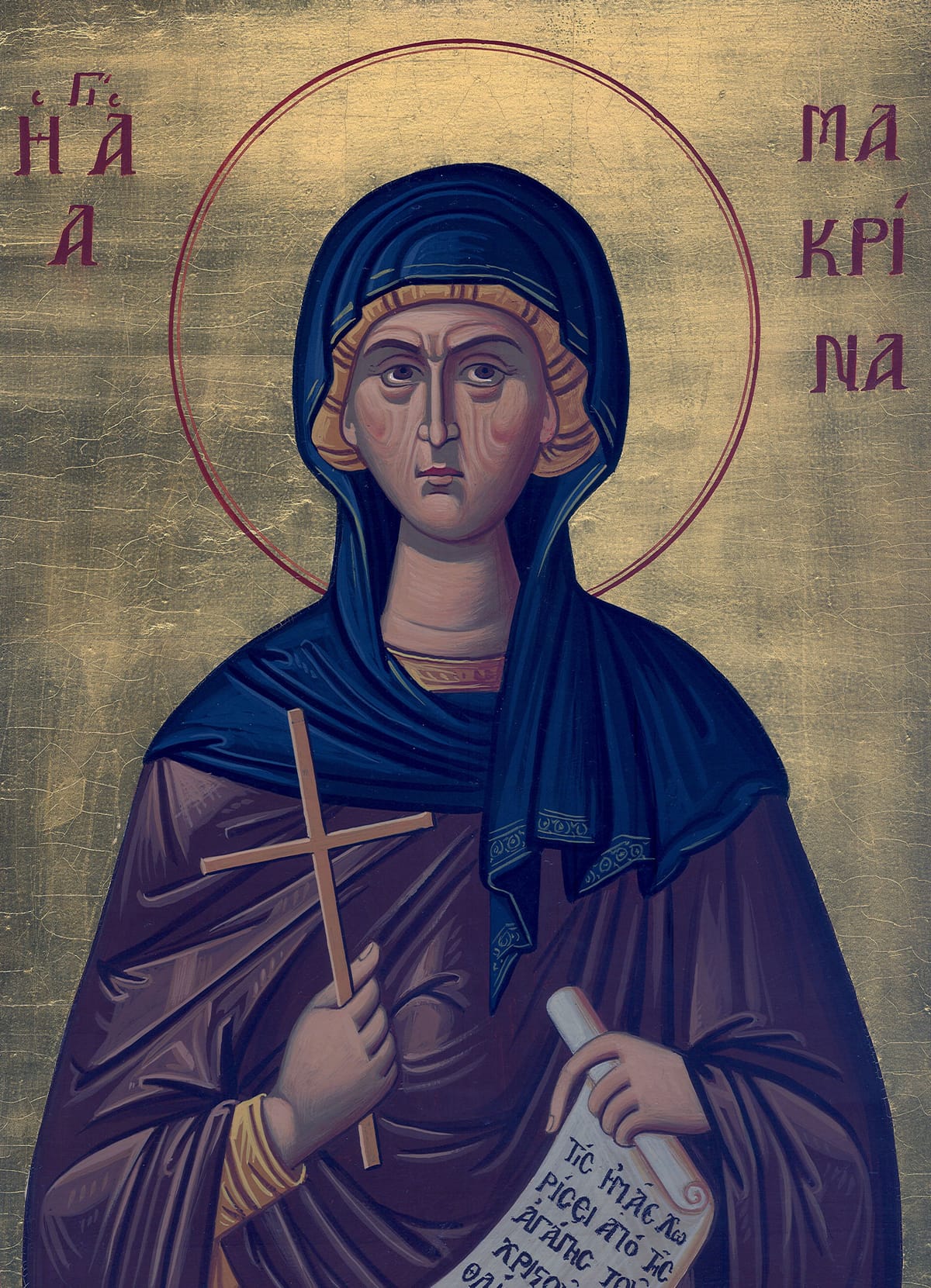
Macrina the Younger
The eldest sister of Basil the Great and Gregory of Nyssa. Gregory called her the Teacher.
Who was Macrina?
Macrina was the eldest sister of Basil the Great and Gregory of Nyssa. Her fiancé died, and she never married. She turned Basil from his pride. She turned her family's household into a community of women who lived as equals. Gregory called her the Teacher. She wrote nothing, so almost everything we know comes from him.
at a glance
Her path, in order
- DaughterWould not leave her mother
- Eldest sisterRaised Peter, turned Basil round
- AbbessOf a community on the Iris
- The TeacherIn Gregory's dialogue
in numbers
- Her age at betrothal12
- Her father chose a young lawyer
- The lawyer died before they could marry
- She would have no one else
- Children in her family10
- She was the first, Peter the tenth
- Nine lived past infancy
- Brothers who became bishops3
- Basil, Gregory and Peter
- Of Caesarea, Nyssa and Sebaste
- Years she and Gregory did not meet8
- Heretics drove Gregory from home
- Then Gregory found her dying
did you know?
-
Gregory says she was so beautiful that painters could not do her justice. Suitors crowded round her parents, drawn by the fame of her looks.
Life of Macrina, her betrothal -
Gregory's 1893 translators say she turned him round, as she had Basil. He had left his post as a church reader to teach rhetoric. Her persuasion brought him to Basil's monastery in Pontus.
NPNF volume 5, prolegomena
- Born
- About 330, probably at Neocaesarea in Pontus, today Niksar in Turkey. No ancient source gives the year.
- Grew up
- On the family's estates. Her mother taught her from the Bible, not the poets. She knew every part of the Psalms.
- Died
- In 379 or 380, of a fever, at her community on the river Iris in Pontus. Her brother Gregory was with her.
- Buried
- Beside her mother, in the family grave at the church of the Holy Martyrs, about a mile from her community.
- Also called
- Thecla, a secret name from a dream before her birth. The Teacher, in Gregory's dialogue. Venerable Macrina, in Orthodox churches. Macrina of Caesarea, in the Episcopal Church. The Younger, to tell her from her grandmother.
- Status
- A saint to Catholics and Orthodox. The Church of England and the Episcopal Church keep her day, and the ELCA remembers her.
- In art
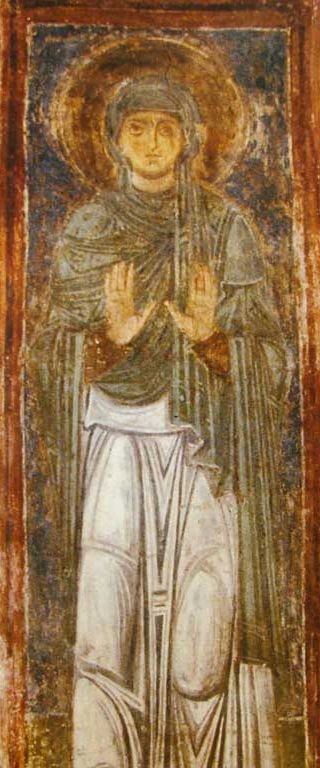
- In an 11th-century fresco in Kyiv, a veiled nun with both hands raised, palms out. On the colonnade of St Peter's Square, a young woman looking up, with one hand on her breast and a book in the other.
- Wrote
- Nothing that survives. All we know of her comes through her brother Gregory.
feast days
East and West, side by side
West
- Jun14
ELCA, with her brothers Basil and Gregory of Nyssa, and with Gregory of Nazianzus.
- Jul19
Catholic, in the 1916 Roman Martyrology. She is not on the General Roman Calendar. Also the Church of England, with her brother Gregory of Nyssa, and the Episcopal Church.
East
- Jul19
Greek churches and the OCA. Also the Russian Church, on the old calendar. That is 1 August on today's calendar.
Churches on the old calendar keep each date 13 days later, so 19 July falls on 1 August. Her grandmother, Macrina the Elder, has her own day in the Roman Martyrology, 14 January.
what was she like?
+steady in a disaster
Her favourite brother, Naucratius, died suddenly, and their mother collapsed at the news. Macrina did not. She held her mother up, and “by her own steadfastness and imperturbability taught her mother's soul to be brave”.
Life of Macrina, the one support of her mother+blunt with her brothers
Basil came home from his studies “puffed up beyond measure with the pride of oratory”, and she took him in hand. Years later Gregory poured out his troubles at her deathbed. She told him to stop and count his blessings.
Life of Macrina, Basil's return and Gregory's last visit+kept nothing
She kept none of her share of the family property. It all went “into the priest's hands according to the divine command”. She never turned anyone away, and she never asked anyone for help.
Life of Macrina, Gregory's last visit+no ranks at home
She talked her rich mother into living as an equal with her own maids. They shared “the same food, the same kind of bed”.
Life of Macrina, mother and daughter+strict about tears
She allowed her nuns “one occasion for tears”: at prayer. When Gregory came to her grieving for Basil, she gave way to his grief “for a little while, like a skilful driver”. Then she reined him in with Paul's warning against grieving like those who have no hope.
Life of Macrina, the sisters' lament; On the Soul and the Resurrection, the opening+a mother to the abandoned
In a famine she picked up children abandoned by the roadside, and nursed and raised them herself. When she died, they wept the hardest. They called her “mother and nurse”.
Life of Macrina, the sisters' lament+cheerful to the end
Dying of fever, she hid how hard it was to breathe, so as not to upset her brother. “In every way she tried to be cheerful,” Gregory says. She led the talk, and asked questions to keep her visitors talking.
Life of Macrina, Gregory comes to the monasterywhat others said of her
Almost everything we know comes from one brother. Gregory of Nyssa wrote her Life soon after she died, from what he saw himself and what those who lived with her told him.
…if indeed she should be styled woman, for I do not know whether it is fitting to designate her by her sex, who so surpassed her sex.
Store-cupboard indeed! You have in front of you all her treasure. There is the cloak, there is the head-covering, there the well-worn shoes on the feet. This is all her wealth, these are her riches.
Learn what manner of goodness has been taken away from human life.
her life in eight moments
Her birth
About 330A secret name
Her mother fell asleep in labour and dreamed. Someone “in form and raiment more splendid than a human being” called the baby Thecla, after the famous virgin of St Paul's day. He said it three times, and the birth was easy. Thecla stayed a secret name. To everyone else she was Macrina, after her grandmother.
Life of Macrina, her parents and her birthAt home
A childThe Psalms, all day
Her mother would not teach her the poets, with their tragic passions and crude comedies. She taught her the Bible instead, above all the Wisdom of Solomon. Macrina said the Psalms when she got up and when she went to bed, at her work and at her meals. The Psalter went everywhere with her, “like a good fellow-traveller that never deserted her”.
Life of Macrina, her childhoodAt home
About 12One marriage
Her father chose her a husband, a young man of good family who was making his name as a speaker in the law courts. The young man died before the wedding. Macrina said her father's choice already counted as a marriage, and “there was but one marriage, as there is one birth and one death”. Her fiancé lived to God, she said, and was “absent only, not dead”. She turned down every suitor after him.
Life of Macrina, her betrothal and the young man's deathAt home
After her father diedNever leaving her mother
She resolved never to leave her mother, even for a moment. She cooked her mother's meals herself and helped her run estates spread over three districts. Her mother used to say she carried her other children for a set time, but “Macrina she bore always”. When her youngest brother, Peter, was born, her father died. Macrina took the baby from his nurse and raised him, and became to him “father, teacher, tutor, mother, giver of all good advice”.
Life of Macrina, she resolves never to leave her mother; Peter, the youngest brotherAt home
Home from universityBasil comes home
Her brother Basil came back from his long studies, already a skilled speaker, and full of himself. He “looked down on the local dignitaries”. Macrina took him in hand. He soon gave up his fame and his property for a life of work with his hands.
Life of Macrina, Basil returns from the universityAnnesi
The children grownMistress and maids as sisters
She led her mother to give up her grand way of life and share the life of the maids, “treating all her slave girls and menials as if they were sisters”. Mother, daughter and maids ate the same food and slept on the same kind of bed. They prayed and sang hymns day and night, so that “to them this meant work, and work so called was rest”. In a famine, crowds came to them for food, and her brother Peter fed so many that “the desert seemed a city”.
Life of Macrina, mother and daughter; Peter, the youngest brotherAnnesi
Some years laterFirst-fruits and tenth
Their mother died with Macrina and Peter sitting on either side of her bed. She laid a hand on each and prayed, “To Thee, O Lord, I give the fruit of my womb as both first-fruits and tenths.” Macrina was her first child, and Peter her tenth. They buried her in their father's grave.
Life of Macrina, death of the motherAnnesi
379 or 380Gregory's last visit
Her brother Basil died. Nine months or so later, after a synod at Antioch, Gregory set out to see his sister. Exile and church troubles had kept them apart for about eight years. He found her lying on a board on the floor, burning with fever. She could not get up, but she raised herself on one elbow to greet him. They talked about Basil, and about the soul and the life to come. Gregory later wrote up their talk as a dialogue.
Life of Macrina, Gregory resolves to visit his sister; Gregory comes to the monastery
her miracles
Gregory tells two healings in full. Others he only names, leaving out the details on purpose. Of those, he says:
All are believed to be true, even though apparently incredible, by those who have investigated them accurately.
2 healings told in full
-
With her mother
While her mother livedThe tumour
A growth appeared on her breast, below the neck, and it threatened to spread to the heart. Her mother begged her to see a doctor, saying medicine was sent by God to save people. Macrina thought uncovering her body for a stranger was worse than the pain. She prayed all night in the sanctuary, weeping, and put the mud from her tears on the sore. Then she asked her mother to make the sign of the cross over it.
“But when the mother put her hand within her bosom, to make the sign of the cross on the part, the sign worked and the tumour disappeared.”
A nun named Vestiana told Gregory as they laid out Macrina's body. She held the lamp close to show him the tiny scar the tumour left.
Life of Macrina, the story of a scar -
Her community
On a family visitThe little girl's eye
A soldier and his wife came to visit with their small daughter. An illness had left the membrane round her eye swollen and whitish. Macrina held the child, kissed her eyes, and promised them a medicine if they stayed to eat. On the road home they realised they had forgotten it. Then the mother looked at her daughter. The eye was healed.
“She has indeed given her the true drug which cures disease; it is the healing that comes from prayer.”
The girl's father told Gregory on the road home from her funeral. He wept as he told it.
Life of Macrina, the soldier's story
The girl's father said that on the day she was healed he “understood the marvels of the Gospel that hitherto had been incredible” to him. Life of Macrina, the soldier's story
Grain that did not run out
In a famine, grain was handed out to the hungry again and again, and the heap never got smaller. Gregory heard this from people who lived with her.
“the corn for the relief of need, though constantly distributed, suffered no perceptible diminution”Life of Macrina, the conclusion
More he left out
Those who lived with her told Gregory of other wonders. He lists them in one line and leaves it there.
“Healings of diseases, and castings out of demons, and true predictions of the future.”Life of Macrina, the conclusion
Light from her body
On his way to her, Gregory dreamed three times that he carried martyrs' relics, shining like a mirror turned to the sun. After she died, they laid her mother's dark robe over her. Even so, he says, she seemed to shine, as in his dream.
“rays actually seemed to shine forth from her beauty”Life of Macrina, Gregory's journey and the story of a scar
her words
Macrina wrote nothing that survives. These are her words as her brother Gregory recorded them. The Life, in W. K. Lowther Clarke's translation of 1916, gives what Gregory remembered her saying. His dialogue On the Soul and the Resurrection, translated by William Moore and Henry Austin Wilson in 1893, puts his own ideas in her voice.
To Gregory, on her deathbed
Will you not cease to be insensible to the divine blessings? Will you not remedy the ingratitude of your soul?
Gregory had poured out his troubles to her: exile under the emperor Valens, and a Church in turmoil. She told him to compare his life with their parents' lives, and to see where his fame came from.
Life of Macrina, Gregory returns to MacrinaBut you are renowned in cities and peoples and nations. Churches summon you as an ally and director, and do you not see the grace of God in it all? Do you fail to recognise the cause of such great blessings, that it is your parents' prayers that are lifting you up on high, you that have little or no equipment within yourself for such success?
It is time, brother, for you to rest your body awhile, since it is wearied with the great toil of your journey.
Why, what is the especial pain you feel in the mere necessity itself of dying? This common talk of unthinking persons is no sufficient accusation.
And who could deny that truth is to be found only in that upon which the seal of Scriptural testimony is set?
…they are not the soul, but only like warts growing out of the soul's thinking part.
often misquoted
She suffered in the persecutions and learned from Gregory the Wonderworker.
What the sources sayThat was her grandmother, Macrina the Elder. In the Roman Martyrology the grandmother is kept on 14 January, the granddaughter on 19 July.
Roman Martyrology (1916), 14 January; Life of Macrina, her parentsHer book, On the Soul and the Resurrection.
What the sources sayShe wrote nothing that survives. The dialogue is Gregory's, written in her voice. The New Catholic Encyclopedia says its views are undoubtedly his.
New Catholic Encyclopedia; Lesser Feasts and Fasts 2022She died in her brother's arms.
What the sources sayGregory does not say so. He says she made the sign of the cross, drew one deep breath and died. Then he laid her hands on her face, as she had asked. It was her mother who died in the arms of two of her children, Macrina and Peter.
Life of Macrina, her dying prayer and the death of the motherHer nuns told Gregory how she healed a little girl's eye.
What the sources sayThe girl's father told him. He was a soldier from Sebastopolis, and Gregory met him on the road home from her funeral.
Life of Macrina, the soldier's storyShe was a deaconess.
What the sources sayThe Church of England's calendar calls her one. Gregory's Life does not. There the deaconess is Lampadia, “leader of the band of sisters”, and Macrina is the abbess.
Life of Macrina, Vestiana comes to help; Church of England calendarwhere she stood
Every line comes through her brother Gregory. In his dialogue the ideas are his own, in her voice. TapClick “Show her line” to read it.
Your answers are next to her. From your result on . See your result
“Wisdom is worth learning from anyone, even people who don't share your faith.”
Macrina disagrees.
You
On record in On the Soul and the Resurrection. Not quoted here.
“Anger at real wrongdoing can be a good thing.”
Macrina agrees.
You
Show her line
But, whenever their impulse is towards what is noble, then they become matter for praise, as his desire did to Daniel, and his anger to Phineas, and their grief to those who nobly mourn.On the Soul and the Resurrection, on the passions, as her brother Gregory wrote it
“If someone you know is doing wrong, it's your job to tell them.”
Macrina agrees.
You
Show her line
Will you not cease to be insensible to the divine blessings? Will you not remedy the ingratitude of your soul?Life of Macrina, at her deathbed, as her brother Gregory wrote it
“Even if you believe you'll see them again, it's right to weep openly for someone you've lost.”
Macrina strongly disagrees.
You
Show her line
She quoted the Apostle's words about the duty of not being grieved for them that sleep; because only men without hope have such feelings.On the Soul and the Resurrection, the opening, as her brother Gregory wrote it
“The best way to live is free of strong emotions, with only a steady peace inside.”
Macrina agrees.
You
Show her line
It will therefore be no detriment to our participation in the Good, that the soul should be free from such emotions.On the Soul and the Resurrection, on desire, as her brother Gregory wrote it
“Some questions about God are better left alone.”
Macrina disagrees.
You
On record in On the Soul and the Resurrection. Not quoted here.
“In many Bible stories, the deeper meaning matters more than the history.”
Macrina agrees.
You
Show her line
It is impossible to make the framework of the narrative correspond with the truth, if we understand it literally; we can do that only by translating each detail into an equivalent in the world of ideas.On the Soul and the Resurrection, on the rich man and Lazarus, as her brother Gregory wrote it
“In the end, God will save everyone.”
Macrina strongly agrees.
You
Show her line
But He that becomes all things will be in all things too; and herein it appears to me that Scripture teaches the complete annihilation of evil.On the Soul and the Resurrection, on God being all in all, as her brother Gregory wrote it
See where you stand beside her. Take the quiz
everyone saved in the end?
Gregory's dialogue gives Macrina a bold hope about the end of all things. The views are Gregory's own, in her voice.
A fire that heals
Gregory sums up her argument: God's fire is not chiefly punishment. It separates the good in each soul from the evil. She agrees, and adds that the pain will match the amount of evil in each one.
“That is my meaning; and also that the agony will be measured by the amount of evil there is in each individual.”On the Soul and the Resurrection, on the healing fire
God all in all
She reads Paul's words that “God will be all in all” to mean that evil itself will be gone. In the end the whole human race shares in God's good things, some made clean in this life and others later.
“…some having at once in this life been cleansed from evil, others having afterwards in the necessary periods been healed by the Fire.”On the Soul and the Resurrection, on God's one end for our race
What critics said
Those who hope that all will be saved point to these pages. Later critics said Gregory was following Origen here. Origen was a Bible scholar of Alexandria in the 200s, and ideas linked to him were condemned in the 500s. Yet Gregory himself “was never branded as a heretic”. A later Patriarch of Constantinople, Germanus, claimed that others had slipped the passages in. The dialogue's 1893 translators reject that. They also warn against claiming that Gregory hoped everyone would be saved, since the same dialogue puts a Last Judgment after the resurrection and the cleansing fire.
“…to claim him as one who favours the doctrine of ‘Eternal Hope’ in a universal sense is hardly possible”NPNF volume 5, the preface and the chapter on Gregory's Origenism
friends, family and rivals
 Basil the Great
 Her younger brother, later the great bishop of Caesarea. He came home from his studies proud of his speaking, and she turned him to a life of poverty and work. His letters, in their 1895 English translation, never name her.
Life of Macrina; Basil, Letters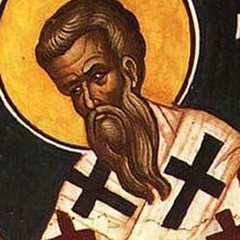 Gregory of Nyssa
 Her younger brother, bishop of Nyssa. He wrote her Life, and the dialogue that calls her the Teacher. He sat with her as she died. He laid her hands on her face, as she had asked, and helped carry her bier.
Life of Macrina; On the Soul and the ResurrectionHer youngest brother, born as their father died. She raised him herself. He later led the men's side of the community, and became bishop of Sebaste.
Life of Macrina; NPNF volume 8The brother next after Basil, and the most gifted. After a speech that thrilled a whole theatre, he left it all to live alone on the Iris. He fished to feed poor old people. Five years later he was brought home dead.
Life of Macrina, the story of NaucratiusHer mother. Macrina never left her side. Emmelia begged her daughter to see a doctor, and in the end lived as an equal with her own maids. She died in the arms of Macrina and Peter.
Life of Macrina; Clarke, introduction to the LifeHer father's mother, who confessed Christ in the persecutions. Macrina was named after her. Basil wrote that he learned about God as a boy from “my blessed mother and my grandmother Macrina”.
Life of Macrina, her parents; Basil, Letter 223Two of her sisters in the community. Lampadia, a deaconess, led the sisters. Vestiana, a senator's daughter widowed young, had put herself in Macrina's care. They laid out her body with Gregory.
Life of Macrina, Vestiana comes to helphow she died
She died of a fever in 379 or 380, at her community on the river Iris, with her brother Gregory beside her.
She lay on the floor, on a sack spread over a board. On her last day every breath was hard, but she kept talking to lift her visitors' spirits.
Toward sunset, with her couch turned to the East, she stopped talking to those with her. She prayed in a low voice that they could only just hear. When the fever dried her tongue, she prayed with her lips and hands. At the lighting of the lamps she tried to join the evening thanksgiving. Then she made the sign of the cross, and she “drew a great deep breath and closed her life and her prayer together”.
Her nuns broke into loud weeping. Gregory reminded them of her rule that they weep only at prayer, and turned their laments into psalms. People streamed in from the whole district for a vigil that lasted all night.
In the morning Gregory and the local bishop, Araxius, took up the front of her bier. The crowds were so thick that the short way to the church of the Holy Martyrs, about a mile, took most of the day. She was laid beside her mother, as both had prayed. Gregory threw himself on the grave and embraced the dust, and then went home.
Her first words to Gregory
This favour also Thou hast granted me, O God, and hast not deprived me of my desire, because Thou hast stirred up Thy servant to visit Thy handmaid.
When Gregory found her lying on the floor, the day before she died.
Her nuns, when she died
The light of our eyes has gone out, the light that guided our souls has been taken away.
her last prayer
She said this prayer on her last evening, facing the East, in a voice so low they could just hear it. Gregory wrote it down, and added, “we need not doubt that it reached God”.
The whole prayer, as Gregory gives it.
“Thou, O Lord, hast freed us from the fear of death. Thou hast made the end of this life the beginning to us of true life. Thou for a season restest our bodies in sleep and awakest them again at the last trump. Thou givest our earth, which Thou hast fashioned with Thy hands, to the earth to keep in safety. One day Thou wilt take again what Thou hast given, transfiguring with immortality and grace our mortal and unsightly remains. Thou hast saved us from the curse and from sin, having become both for our sakes. Thou hast broken the heads of the dragon who had seized us with his jaws, in the yawning gulf of disobedience. Thou hast shown us the way of resurrection, having broken the gates of hell, and brought to nought him who had the power of death—the devil. Thou hast given a sign to those that fear Thee in the symbol of the Holy Cross, to destroy the adversary and save our life. O God eternal, to Whom I have been attached from my mother's womb, Whom my soul has loved with all its strength, to Whom I have dedicated both my flesh and my soul from my youth up until now—do Thou give me an angel of light to conduct me to the place of refreshment, where is the water of rest, in the bosom of the holy Fathers. Thou that didst break the flaming sword and didst restore to Paradise the man that was crucified with Thee and implored Thy mercies, remember me, too, in Thy kingdom; because I, too, was crucified with Thee, having nailed my flesh to the cross for fear of Thee, and of Thy judgments have I been afraid. Let not the terrible chasm separate me from Thy elect. Nor let the Slanderer stand against me in the way; nor let my sin be found before Thy eyes, if in anything I have sinned in word or deed or thought, led astray by the weakness of our nature. O Thou Who hast power on earth to forgive sins, forgive me, that I may be refreshed and may be found before Thee when I put off my body, without defilement on my soul. But may my soul be received into Thy hands spotless and undefiled, as an offering before Thee.”Life of Macrina, her dying prayer
is she a saint?
Yes. Catholics and Orthodox count her a saint. Anglicans keep her day, and the ELCA remembers her.
- CatholicSaintIn the 1916 Roman Martyrology, 19 July
- OrthodoxSaintVenerable Macrina, 19 July
- AnglicanSaintA Lesser Festival in the Church of England. The Episcopal Church too, 19 July
- LutheranRememberedELCA, 14 June. Not in the Missouri Synod's calendar
She was honoured soon after she died, and Gregory calls her the saint all through her Life. An unusual number of the Life's manuscripts come from around Pontus, which points to strong local devotion. Devotion to her spread through the Greek, Egyptian, Syrian and Arab churches. It reached the West late, because the Life was not put into Latin until the 16th century.
She is not on the General Roman Calendar, so most Catholic parishes do not mark her day.
what to read first
The Life of St Macrina
Gregory of Nyssa
Short, and told by the brother who sat with her as she died. Almost everything on this page comes from it.
Read it freeOn the Soul and the Resurrection
Gregory of Nyssa
Her last conversation with Gregory, written up as a long dialogue with her as the Teacher.
Read it freeClarke's introduction
W. K. Lowther Clarke
A short guide to the family and to their community of men and women on the Iris, by the 1916 translator of her Life.
Read it freetake the quizzes
 Quiz Which early Christian thinks like you? And which would argue with you? See where you stand beside Macrina. Start
  Quiz Christian Personality Test Which of eight types are you? Find your own. Start
 sources
Her life, and her words
- Gregory of Nyssa, Life of Macrina. Tr. W. K. Lowther Clarke, 1916. Transcribed by Roger Pearse.
- The printed 1916 book, scanned. Columbia University Libraries copy.
- Clarke's introduction to the Life. Same edition.
- Gregory of Nyssa, On the Soul and the Resurrection. Tr. William Moore and Henry Austin Wilson, 1893.
- The same translation on New Advent
- NPNF volume 5, the preface, by William Moore, 1892. On Gregory and “Eternal Hope”.
- NPNF volume 5, prolegomena, “His Origenism”. On Germanus and the charge of Origenism.
- Basil, Letter 223, against Eustathius of Sebasteia. Tr. Blomfield Jackson, 1895.
- NPNF volume 8, prolegomena, on Basil's family.
Reference
- New Catholic Encyclopedia, 2nd edition, “Macrina, Ss.”
- Catholic Encyclopedia, 1910, “St. Macrina the Younger”
- Catholic Encyclopedia, 1911, “Neocæsarea”, for Niksar
- St Peter's Basilica guide, on the colonnade statue
Calendars
- The Roman Martyrology, 1916 edition, 19 July and 14 January
- OCA, Venerable Macrina, sister of Saint Basil the Great
- saint.gr, Greek
- azbyka.ru, Russian
- Church of England, Common Worship calendar
- The Episcopal Church, Lesser Feasts and Fasts 2022
- Evangelical Lutheran Worship, ELCA, the church year
- Concordia Publishing House, the Missouri Synod's commemorations
Pictures
- Saint Macrina the Younger, fresco, St Sophia Cathedral, Kyiv, 11th century. Public domain.
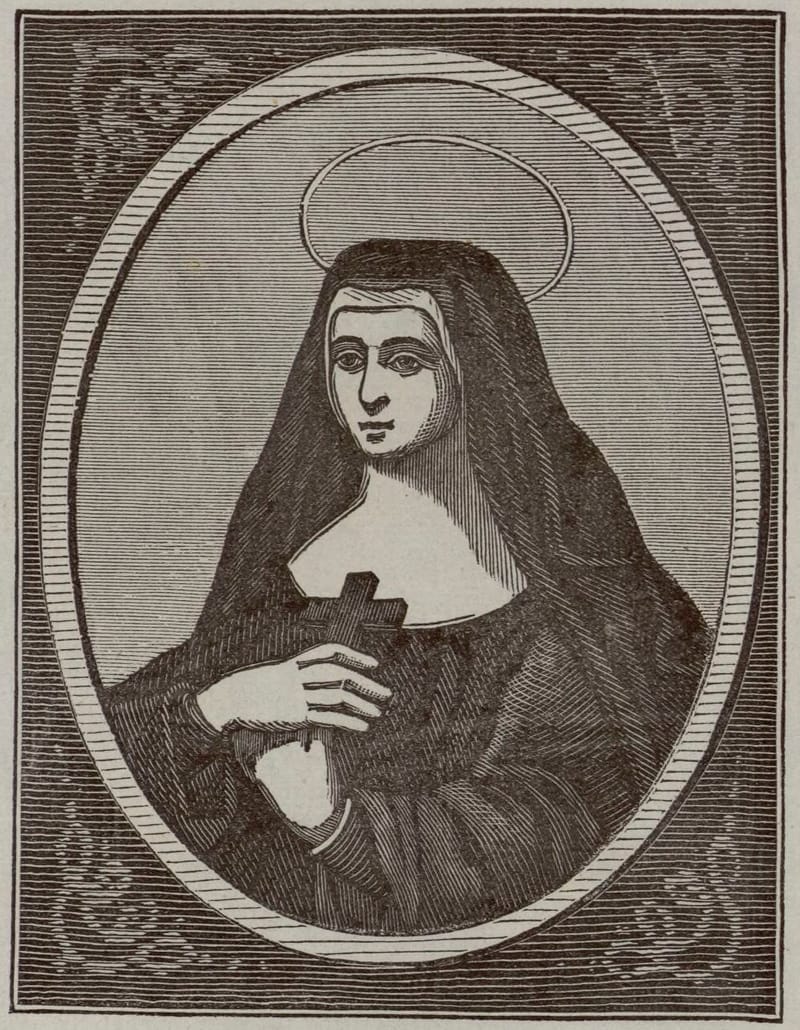
- Goigs en llahor de Santa Macrina, a hymn sheet printed by Lluís Tasso, Barcelona, 1870. Gallica, Bibliothèque nationale de France, from the libraries of Montpellier. Public domain.