
Perpetua of Carthage
A young mother from Carthage who wrote her own story in prison, and died for her faith in the arena beside Felicity, a slave.
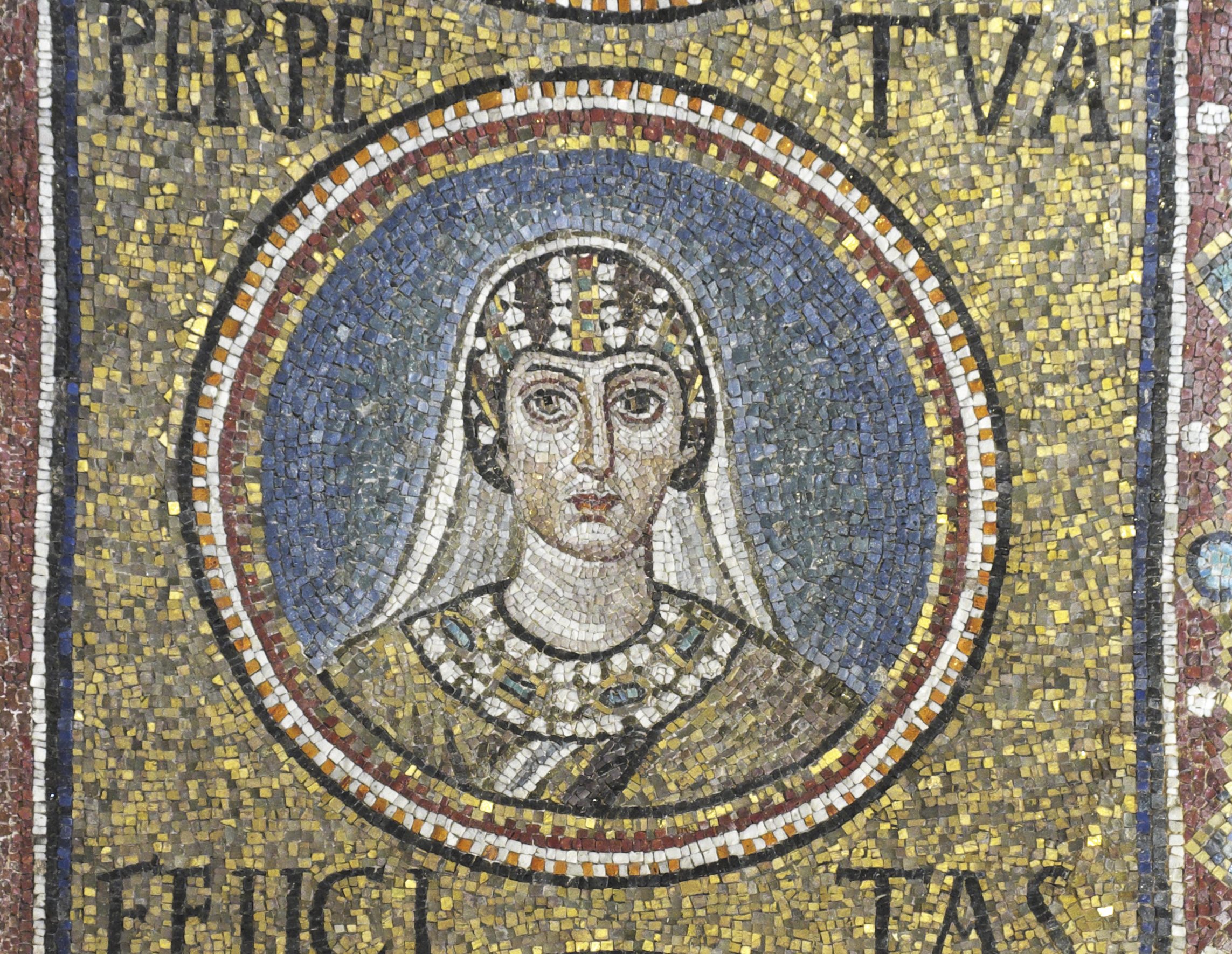
Picture: Saint Perpetua, a mosaic of the 500s in the Archbishop's Chapel, Ravenna. Photo: GFreihalter, CC BY-SA 3.0.
Who was Perpetua?
Perpetua, a young mother from a good family in Carthage, was arrested in AD 203 while preparing for baptism, because the emperor had made it a crime to become a Christian. In prison she kept a diary, one of the few writings by an ancient woman to survive. She died in the arena beside Felicity, a slave arrested with her.
at a glance
Her path, in order
- Wife and motherWell born and educated, with a baby boy
- New ChristianBaptized under guard, soon after her arrest
- PrisonerKept a diary of her trial and visions
- CondemnedSentenced to the beasts for refusing to sacrifice
- MartyrIn the arena at Carthage, 7 March 203
in numbers
- Her age when she was arrested22
- About twenty-two, says the account of her death
- Visions she wrote down in prison4
- One of a ladder to heaven, one of a fight in the arena
- Two about her little brother, who had died at seven
- Months Felicity was pregnant as the games drew near8
- Felicity was a slave arrested with Perpetua
- Roman law did not allow a pregnant woman to be put to death
- She gave birth three days before the games, so she was not parted from her friends
did you know?
-
Put together, their two names make the Latin perpetua felicitas, lasting happiness. Augustine, bishop of Hippo, saw in them the reward every martyr suffers for: “Perpetua and Felicity are the names of two, but the reward is for all” (our translation).
Augustine, Sermon 282, chapter 1 -
In the time of Augustine, bishop of Hippo, the story of their deaths was read aloud in church on the feast of Perpetua and Felicity. He heard it read, then preached on it.
Augustine, Sermon 280, chapter 1 -
In 1890 the scholar Rendel Harris found a Greek version of her story. The Catholic Encyclopedia judges the Latin to be the original, and the Greek a translation.
Catholic Encyclopedia (1909), “Sts. Felicitas and Perpetua” -
Britannica calls her a patron saint of mothers and, because a wild cow was set on her in the arena, of ranchers too. She is also a patron of Carthage, and of Catalonia in Spain.
Britannica, “Perpetua”
- Born
- About AD 181, most likely in Carthage. She was about twenty-two when she was arrested in AD 203.
- Died
- 7 March 203, by the sword, in the arena at Carthage, at games held for the birthday of the emperor's son Geta. Some calendars, like the Episcopal Church's, give the year as 202.
- Buried
- At Carthage. A great church, the Basilica Maiorum, was later built over the martyrs' tomb.
- Her name
- Vibia Perpetua, in the Latin account of her death. Calendars almost always pair her with Felicity, whose Latin name is Felicitas.
- Family
- A father who was not a Christian, a mother, an aunt, and two brothers, one of them also preparing for baptism. Another brother, Dinocrates, had died at seven. She was married, with a baby boy.
- Arrested with
- Four others preparing for baptism: two slaves, Revocatus and Felicity, and two young men, Saturninus and Secundulus. Their teacher in the faith, Saturus, was away when they were taken, and gave himself up soon after.
- Spoke
- Latin, and it seems Greek too. The Latin account of her death uses many Greek words, which suggests the martyrs spoke both, and that Greek was common in Carthage.
- Wrote
- A diary of her time in prison, in Latin, from her arrest to the day before the games. It makes up the middle of the Passion of Perpetua and Felicity, the account of their deaths. Britannica counts it among the few writings by a woman of the ancient world that survive.
- Status
- A saint to Catholics, Orthodox and Anglicans, and remembered by Lutherans.
- In art
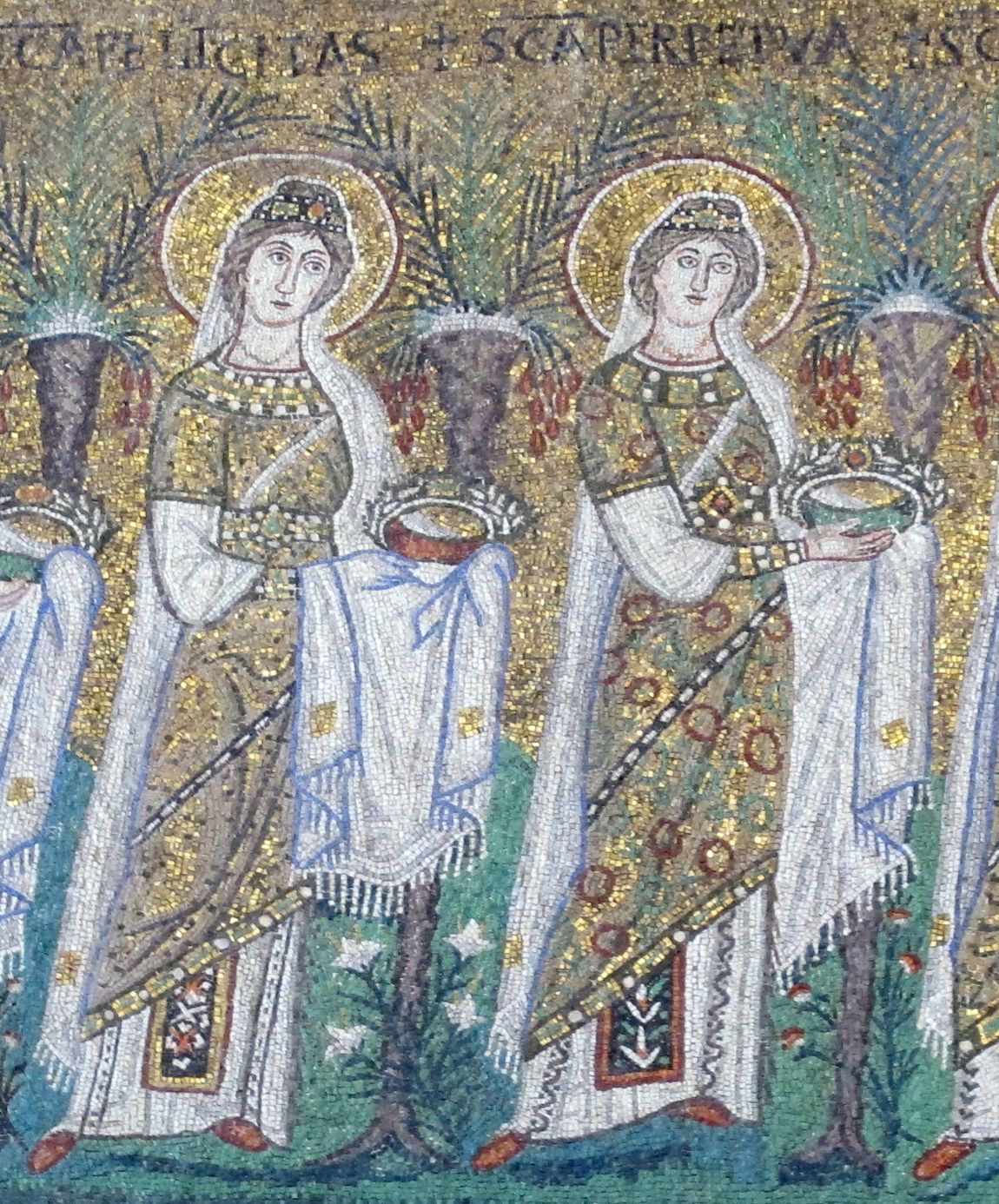
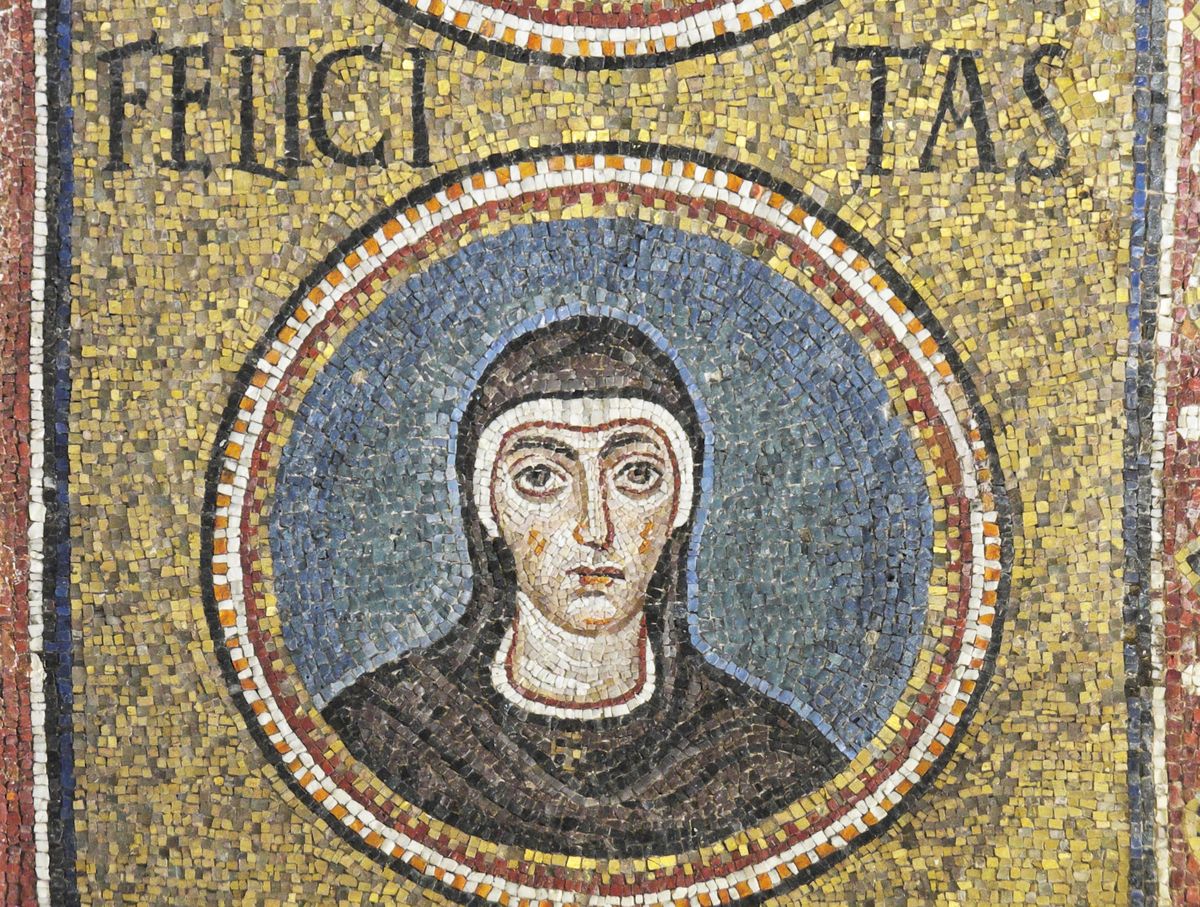
- Mosaics of the 500s in Ravenna, Italy, show her beside Felicity: a young woman in a white veil and jewels.
feast days
East and West
West
- Mar6
Perpetua and Felicity's day in the Catholic calendar from 1908 to 1969.
- Mar7
Catholic, optional in Lent. Also the Church of England and the Episcopal Church.
East
- Feb1
The Orthodox Church in America and the Greek churches.
- Feb14
The Russian Church, on the old (Julian) calendar.
Why 7 March? It is the day they died. In 1908 Rome moved them to 6 March, because 7 March was then the feast of Thomas Aquinas. In 1969 Aquinas moved to 28 January, and the two women got their own day back.
Lutherans in the Missouri Synod and the ELCA keep 7 March too. The Orthodox keep them on 1 February, which the old calendar puts on 14 February.
what was she like?
+tender to the father who pleaded with her
Perpetua's father was not a Christian, and he loved her more than all his sons. Four times he tried to talk her out of her faith, and four times she refused him. Yet she grieved for him. After his last visit, when he tore at his beard and threw himself face down on the ground, she wrote: “I grieved for his unhappy old age.”
Passion of Perpetua and Felicity, chapters 3, 5, 6 and 9+sure that God would answer her
Her brother, visiting her in prison, asked her to pray for a vision: would they die, or go free? She wrote: “I, who knew that I was privileged to converse with the Lord, Whose kindnesses I had found to be so great, boldly promised him, and said, To-morrow I will tell you.” She prayed, and was shown a ladder reaching up to heaven.
Passion of Perpetua and Felicity, chapter 4+unyielding, even at the arena gate
At the arena gate the guards tried to dress the men as priests of Saturn and the women as priestesses of Ceres, two Roman gods. Perpetua refused for them all.
They had given their lives, she said, so as not to do such a thing: “We have come thus far of our own accord, for this reason, that our liberty might not be restrained.” The officer gave way, and they went in as they were.
Passion of Perpetua and Felicity, chapter 18+dignified, even when thrown down
When a wild cow tossed her in the arena, her tunic tore down the side. She drew it back over her thigh, “rather mindful of her modesty than her suffering”. Then she pinned up her loosened hair, “for it was not becoming for a martyr to suffer with dishevelled hair, lest she should appear to be mourning in her glory.”
Passion of Perpetua and Felicity, chapter 20, in English and in Latin+glad, even when condemned
When the judge sentenced them all to the beasts, she wrote: “we went down cheerfully to the dungeon.” On the day of the games she walked into the arena singing psalms, “already treading under foot the head of the Egyptian”: in her last vision she had beaten an Egyptian wrestler, whom she took to be the devil.
Passion of Perpetua and Felicity, chapters 6 and 18what others said of her
Perpetua wrote much of her story herself, in prison, and a Christian who saw her die finished it. It was read aloud every year in the churches of Carthage for centuries. Two hundred years after her death, Augustine, bishop of Hippo in North Africa, heard it read on her feast day and preached on it.
Perpetua followed with placid look, and with step and gait as a matron of Christ, beloved of God; casting down the luster of her eyes from the gaze of all.
O most brave and blessed martyrs! O truly called and chosen unto the glory of our Lord Jesus Christ!
The crowd that filled the cruel arena then, to see them killed, was not as great as the crowd that fills the church now, to honour them.
So the head of the old serpent, which was a woman's downfall, became a step for a woman to climb.
I can hardly read it without tears, and it ought to make us love “the noble army of martyrs.”
…one of the most affecting accounts of the glorious warfare of Christian martyrdom in ancient times.
her life in nine moments
Carthage
Early 203Arrested for becoming a Christian
Carthage was the great Roman city of North Africa, and it had a growing church. But the emperor, Septimius Severus, had forbidden anyone to become a Christian. In AD 203, five people there who were preparing for baptism were arrested: two slaves, Revocatus and Felicity; two young men, Saturninus and Secundulus; and Vibia Perpetua, a well-born, educated wife of about twenty-two and the mother of a baby boy.
From her arrest to the eve of her death, Perpetua wrote down what happened to her, “by her own hand and with her own mind”.
Passion of Perpetua and Felicity, chapter 2; Dictionary of Christian Biography (1911), “Perpetua (1)”Under guard
The first daysA jug is a jug
While she was still held under guard, before she was taken to prison, her father came to talk her out of her faith. He was not a Christian, and he loved her. She pointed to a jug lying nearby and asked him: “Can it be called by any other name than what it is?” No, he said. Then neither could she call herself anything but what she was: a Christian.
Furious, he threw himself at her as if to tear her eyes out, but he stopped short of hurting her, and went away defeated. She did not see him for a few days, and thanked God for the peace.
Passion of Perpetua and Felicity, chapter 3The prison, Carthage
A few days laterBaptized, then jailed
Within days of her arrest, still under guard, Perpetua and the others were baptized. The Holy Spirit told her to ask nothing of her baptism but the strength to bear what her body would suffer. Then they were taken to the prison. She was terrified of its darkness and its stifling crowds.
Two deacons of their church paid the guards to let the prisoners into a better part of the prison for a few hours. Her mother and brother brought her baby, who was weak with hunger, and she fed him, then left him in their care. After days of worry she was allowed to keep him, and at once the prison felt like a palace.
Passion of Perpetua and Felicity, chapter 3The prison, Carthage
Days laterHer father at her feet
When word spread that the prisoners would soon be tried, her father came to the prison, worn out with worry, to plead with her. “Have pity my daughter, on my grey hairs,” he said. Think of your mother and your brothers, he begged, and of your son, who cannot live without you. He kissed her hands, threw himself at her feet in tears, and called her not ‘daughter’ but ‘my lady’, as a servant would.
It grieved her that he alone of her family could not be glad of her martyrdom. She comforted him: whatever God willed would happen at the trial, for they were in God's hands, not their own. He left in sorrow.
Passion of Perpetua and Felicity, chapter 5The forum, Carthage
Another dayOn trial
During a meal, the prisoners were suddenly taken to the forum for trial, and a huge crowd gathered. When Perpetua's turn came, her father appeared with her baby, pulled her down from the prisoners' platform and begged: “Have pity on your babe.”
The judge, Hilarianus, also urged her to spare her father and her baby, and to offer sacrifice for the emperors' welfare. “I will not do so,” she said. “Are you a Christian?” asked Hilarianus. “I am a Christian.” When her father kept on, the judge had him beaten with rods, and she felt every blow as her own. Then the judge condemned them all to the beasts. Afterwards her father kept the baby.
Passion of Perpetua and Felicity, chapter 6The camp prison
The last daysStanding up to the tribune
The condemned were moved to the prison of the army camp, to face the beasts at games for the birthday of Geta, the emperor's son. The tribune, the officer in charge, treated them harshly, because some men had falsely warned him they might escape by magic.
Perpetua told him to his face: why not let them eat and rest, when they were to be shown in the arena on Geta's birthday? “Or is it not your glory if we are brought forward fatter on that occasion?” The tribune shuddered and blushed. He had them treated more kindly, and let their fellow Christians in to visit.
Passion of Perpetua and Felicity, chapters 7 and 16The camp prison
Before the gamesFelicity's daughter
Felicity, a slave arrested with Perpetua, was eight months pregnant. Roman law would not execute a pregnant woman, so she feared she would die later, among common criminals, not with her friends. Three days before the games they all prayed for her, and at once her labour began.
As she groaned in pain, a jailer's servant jeered: if this hurts, what will you do among the beasts? She answered: “Now it is I that suffer what I suffer; but then there will be Another in me, Who will suffer for me, because I also am about to suffer for Him.” She had a baby girl, whom a Christian woman raised as her own.
Passion of Perpetua and Felicity, chapter 15The camp prison
The eve of the gamesTheir last meal
On the evening before the games, the condemned were given a last meal in public, as was the custom. The Christians made it a love feast, the shared meal of the early Church, and a crowd came to stare. The prisoners warned the onlookers of God's judgment and spoke of their own joy.
Saturus, who had taught them the faith, mocked the crowd's curiosity: was tomorrow's show not enough for them? Tonight they came as friends; tomorrow they would be enemies. “Yet note our faces diligently, that you may recognise them on that day of judgment.” The crowd went away shaken, and many of them came to believe.
Passion of Perpetua and Felicity, chapters 4 and 17The amphitheatre, Carthage
7 March 203Saturus and the leopard
Saturus, the prisoners' teacher, dreaded bears and hoped a leopard would kill him with one bite. A hunter tied him up and set a wild boar on him, but the boar gored the hunter instead. Then Saturus was tied before a bear, but it would not leave its den. Unhurt, he told Pudens, a soldier at the prison, to believe with all his heart: one bite of a leopard would be his end.
At the end of the games a leopard bit him once, drenching him in blood. He dipped Pudens's ring in his wound and gave it back as a keepsake. Near death, he was laid with the others to die by the sword.
Passion of Perpetua and Felicity, chapters 19 and 21
her visions in prison
In prison Perpetua had four visions and wrote each one down. Two were of her little brother, so they are told here as one.
The ladder and the dragon
Her brother asked her to pray for a vision that would show whether they would die or go free. She saw a golden ladder reaching up to heaven, so narrow that only one person could climb at a time, with swords, spears and hooks fixed to its sides. Under it lay a huge dragon.
Saturus, their teacher, climbed first, then turned and warned her of the dragon. “In the name of the Lord Jesus Christ, he shall not hurt me,” she answered. The dragon slowly raised its head as if afraid of her, and her first step up was on its head.
At the top, in a wide garden, a tall, white-haired man dressed as a shepherd sat milking sheep: the Lord, as Christians of her day pictured Him. He welcomed her, calling her daughter, and gave her a mouthful of cheese. She woke still tasting its sweetness, and knew that she would die a martyr.
Passion of Perpetua and Felicity, chapter 4, with the translator's noteHer little brother, Dinocrates
Dinocrates had died at seven, of a cancer that ate away his face. One day in prison, in the middle of a prayer, she found herself saying his name, and she took it as a sign to pray for him.
That night she saw him among many others in a dark place: Hades, where Christians of her day believed the dead wait for the Last Day. He was hot, thirsty and pale, the sore still on his face, and a wide gap lay between them, so she could not reach him. Beside him was a pool, but its rim stood higher than his head, and he could not drink.
She prayed for him day and night, in tears. Days later she saw him again. The dark place was bright now, and he was clean and well dressed, the sore healed to a scar. The pool's rim now came only to his waist, and a golden bowl on it never ran dry. He drank his fill, and she understood that he had been set free from his suffering.
“he went away from the water to play joyously, after the manner of children”Passion of Perpetua and Felicity, chapters 7 and 8; Tertullian, On the Soul, chapter 55
The fight with the Egyptian
The day before the games, she dreamed that Pomponius, a deacon who had cared for the prisoners, led her to the amphitheatre, told her not to be afraid, and left her alone in the middle of the arena before a huge crowd. No beasts came out. Instead an ugly Egyptian came to wrestle her, and handsome young men came to help her and rubbed her with oil, as wrestlers were before a bout.
A very tall man, carrying a rod like a trainer of fighters, held up the prize, a green branch hung with golden apples: if the Egyptian won, he would kill her with the sword; if she won, the branch was hers.
The Egyptian grabbed at her feet, and she kicked him in the face. Then she locked her fingers together round his head and threw him down on his face, and she trod on his head. The crowd roared.
She went to the trainer and took the branch, and he kissed her and said, “Daughter, peace be with you.” She walked in triumph toward the Gate of Life, the gate for those who left the arena alive. When she woke, she understood that her fight would be with the devil, not with beasts.
“Still I knew that the victory was awaiting me.”Passion of Perpetua and Felicity, chapter 10
her words
Most of the words here come from the diary she kept in prison. The English is R. E. Wallis's, from the Ante-Nicene Fathers (1885), a collection of early Christian writings in English.
To her father, under guard
Neither can I call myself anything else than what I am, a Christian.
Her father begged her to give up her faith. She pointed to a jug: it could be called nothing but a jug. Her Latin ends on one word: Christiana, a Christian.
Passion of Perpetua and Felicity, chapter 3I was very much afraid, because I had never felt such darkness. O terrible day!
…the dungeon became to me as it were a palace, so that I preferred being there to being elsewhere.
On that scaffold whatever God wills shall happen. For know that we are not placed in our own power, but in that of God.
…what passed at the exhibition itself let who will write.
myths and misquotes
She was a widow.
What the sources sayNot in the oldest account. It calls her “a married matron”: a wife, not a widow. The Episcopal Church's book of saints' days and the Orthodox Church in America's life of her both call her a widow.
Passion of Perpetua and Felicity, chapter 2; Lesser Feasts and Fasts 2022, 7 March; Orthodox Church in America, 1 FebruaryFelicity was Perpetua's slave.
What the sources sayNot in the oldest account. It calls Felicity the “fellow-servant” of Revocatus, another slave arrested with them, and names no owner. The Episcopal Church's book of saints' days makes Perpetua the owner of both.
Passion of Perpetua and Felicity, chapter 2; Lesser Feasts and Fasts 2022, 7 MarchSaturus was her brother.
What the sources sayNo. The account of her death lists her family as a father, a mother and two brothers. Saturus comes in separately, as the man who had taught the prisoners the faith and gave himself up after their arrest. The Orthodox Church in America's life of her calls him her brother.
Passion of Perpetua and Felicity, chapters 2 and 4, in English and in Latin; Orthodox Church in America, 1 FebruaryShe fell on a sword.
What the sources sayNot as the eyewitness tells it. A young gladiator's blow struck her between the ribs, and she cried out. Then she took his shaking hand and guided the sword to her own throat. The Lutheran Church–Missouri Synod repeats a tradition that she fell on a sword to spare her captors.
Passion of Perpetua and Felicity, chapter 21; Lutheran Church–Missouri Synod, Commemorations, 7 MarchThey died at Tuburbum, not at Carthage.
What the sources sayProbably not. The 1916 Roman Martyrology, the Catholic Church's official list of saints for each day, places their deaths “At Tuburbum, in Mauritania”, a Roman province of North Africa. Most scholars say Carthage, where they were buried: an old inscription with their names was found in the great church over their tomb, the Basilica Maiorum.
Roman Martyrology (1916), 7 March; Ante-Nicene Fathers, volume 3, introductory notice; Catholic Encyclopedia (1909), “Sts. Felicitas and Perpetua”where the story is argued over
Three questions about the Passion of Perpetua and Felicity, the account of their deaths, are still argued over.
Who wrote it down?
The account names all its writers but one. The middle is Perpetua's own diary, from her arrest to the day before the games. Saturus, her teacher in the faith, added a vision of his own. But the Christian who saw them die, and wrote the opening and the end, never gives his name.
Some think he was Tertullian, the great Christian writer of Carthage at the time: the Dictionary of Christian Biography finds the style “in many places very similar to his.” The Catholic Encyclopedia calls that “an unproved assertion”.
Dictionary of Christian Biography (1911), “Perpetua (1)”; Catholic Encyclopedia (1909), “Sts. Felicitas and Perpetua”Were they Montanists?
In the later 100s a new Christian named Montanus, in Phrygia in today's Turkey, began to prophesy in trances, with two women, Priscilla and Maximilla. They said the Holy Spirit was speaking through them. Christians in the region examined the prophecies, judged them false, and put his followers out of the Church. Tertullian, the leading Christian writer of Carthage, took up the Montanists' teaching about the time Perpetua died.
The account of her death opens by praising new visions as a gift of the Spirit, as the Montanists did. So some readers ask whether its writer, or even the martyrs, were Montanists.
Arthur Cleveland Coxe, who edited the account in English in 1885, found Perpetua and Felicity “evidently Montanistic in character and impressions”, yet granted that the Church had always counted them its own. The Catholic Encyclopedia finds no sign of it in the account:
“The statement that these martyrs were all or in part Montanists also lacks proof…”Passion of Perpetua and Felicity, chapter 1, with Coxe's note; Catholic Encyclopedia (1909), “Sts. Felicitas and Perpetua” and “Montanists”
Can prayer help the dead?
In her vision, Perpetua's prayers set her little brother, Dinocrates, free from his suffering among the dead. So can the prayers of the living help those who have died? The Dictionary of Christian Biography took the vision as “a clear proof that prayers for the dead were then used”. Arthur Cleveland Coxe, the account's English editor, said it “has nothing to do with prayers for the Christian dead”, because the boy had died a pagan.
Two centuries after Perpetua, a young writer used the vision to argue that children who die unbaptized can still be forgiven. Augustine, bishop of Hippo, answered that the boy may have been baptized and later drawn into worshipping idols by his father, and that the story is not Scripture.
Dictionary of Christian Biography (1911); Ante-Nicene Fathers, volume 3, notes and elucidation; Augustine, On the Soul and its Origin, Book 1, chapter 12, and Book 3, chapter 12friends, family and rivals
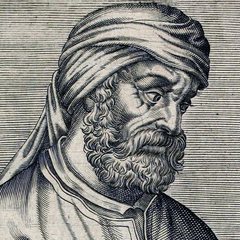 Tertullian
The great Christian writer of Carthage in her day. A few years after her death he called her “the most heroic martyr Perpetua”. Some think he wrote the opening and the end of the account of her death.
Tertullian, On the Soul, chapter 55; Catholic Encyclopedia (1909)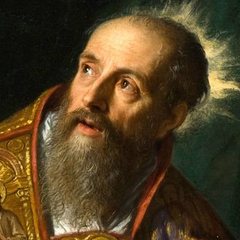 Augustine of Hippo
Bishop of Hippo, in North Africa, two centuries after her death. Several sermons he preached on her feast day survive. He also argued over what her vision of her dead brother, Dinocrates, can prove.
Augustine, Sermons 280 to 282; On the Soul and its Origin, Books 1, 3 and 4A slave, arrested with Perpetua while pregnant. Her daughter was born three days before the games, and a Christian woman raised the girl. In the arena, when a wild cow knocked Felicity down, Perpetua helped her up. The two died together by the sword.
Passion of Perpetua and Felicity, chapters 2, 15, 18 and 20The man who had taught Perpetua and the others the faith. He was away when they were arrested, and gave himself up to join them. In her vision he climbed the ladder to heaven first, and in the arena he was the first to die.
Passion of Perpetua and Felicity, chapters 4, 11 and 21Unlike her mother and brothers, he was not a Christian. He had loved her more than all his sons, he told her. Four times he tried to turn her from her faith, and at her trial he was beaten for pleading with her.
Passion of Perpetua and Felicity, chapters 3, 5, 6 and 9Unlike her father, they were Christians. Her mother and a brother visited her in prison, and Perpetua left her baby with them for a while. In the arena she called her brother to her and urged him to stand fast in the faith.
Passion of Perpetua and Felicity, chapters 3, 4 and 20Her little brother, who died at seven, of a disease that ate away his face. In prison she saw him twice in visions: first thirsty in a dark place, then, after her prayers, healed and drinking his fill.
Passion of Perpetua and Felicity, chapters 7 and 8Perpetua's baby boy stayed with her in prison until her trial, where her father brought him to plead with her. Afterwards her father kept him. By God's will, she wrote, the baby no longer wanted to nurse, and her milk gave her no pain.
Passion of Perpetua and Felicity, chapters 2, 3 and 6The three men arrested with Perpetua, all preparing for baptism. Revocatus was a slave, like Felicity. Secundulus died in prison. The other two faced a leopard and a bear, and died by the sword with the rest.
Passion of Perpetua and Felicity, chapters 2, 14 and 19A soldier who helped run the prison. He came to respect the prisoners and let their friends visit them. In the arena Saturus, the prisoners' teacher, urged him to believe, then dipped Pudens's ring in his own blood and gave it back as a keepsake.
Passion of Perpetua and Felicity, chapters 9 and 21The official who tried them, standing in for the governor, who had died. He ordered Perpetua to sacrifice for the emperors, had her father beaten for pleading with her, and condemned them all to the beasts.
Passion of Perpetua and Felicity, chapter 6how she died
She died by the sword in the arena at Carthage on 7 March 203, after a wild cow had tossed her.
On the morning of the games the prisoners walked from the prison to the arena with shining faces, as if they were going to heaven. Perpetua followed calmly, singing psalms. Felicity, the slave arrested with her, was glad that her baby had come in time for her to die beside her friends.
For the two women a savage cow had been brought in, an unusual beast, chosen, the eyewitness says, to match their sex. It tossed Perpetua first, and she fell on her back with her tunic torn open at the side. She pulled it back over herself, thinking more of her modesty than of her pain.
Then she asked for a pin and put up her hair, which had come loose. Loose hair was a sign of mourning, and she would not look as if she were mourning on the day of her glory. Seeing Felicity lying crushed on the ground, she went to her and lifted her up by the hand.
Moved for the moment, the crowd let the two women be led out through the Gate of Life, the gate for those spared in the arena.
There Perpetua looked around as if waking from sleep. She had been so caught up in the Spirit that she asked when they were going to face that cow, and would not believe it had already happened until she saw the marks on her body. She called her brother and Rusticus, a man preparing for baptism, and urged them to stand firm in the faith.
At the end of the games the crowd demanded to watch the martyrs die in the middle of the arena. They walked out on their own, and first gave one another the kiss of peace. The others died by the sword in silence, without moving.
The gladiator sent to kill Perpetua was young and unsure, and his first blow struck her between the ribs. She cried out. Then she took his trembling hand and guided the sword to her own throat. Perhaps, the eyewitness wrote, a woman so great, feared even by the devil, could not have been killed unless she herself willed it.
Her last recorded words, to her brother and to Rusticus
Stand fast in the faith, and love one another, all of you, and be not offended at my sufferings.
is she a saint?
Yes. Catholics, Orthodox and Anglicans honour her as a saint, and Lutherans remember her too, almost always together with Felicity.
- CatholicSaintFeast day 7 March, with Felicity
- OrthodoxSaintA martyr, 1 February
- AnglicanSaintChurch of England and Episcopal Church, 7 March
- LutheranRememberedMissouri Synod and ELCA, 7 March
She was honoured from the start. Rome's list of its martyrs' days, drawn up in AD 354, names Perpetua and Felicity on 7 March, though they died in Africa. An early calendar of the churches of Syria names them too.
When Rome cut back its calendar in 1969, it kept few martyrs from outside the city. Perpetua and Felicity were among them, with Polycarp of Smyrna and Cyprian of Carthage, as the most famous martyrs of the early Church.
what to read first
The Passion of Perpetua and Felicity
Perpetua, Saturus, and a Christian who saw them die
Her diary, Saturus's vision and the story of their deaths, in English. About half an hour's reading.
Read it freePassio Sanctarum Perpetuae et Felicitatis
The same, in Latin
The same story in the Latin it was first written in.
Read it freePerpetua, Vibia
Dictionary of Christian Biography (1911)
A short scholarly life: the date, the emperor's ban, and who wrote which part.
Read it freetake the quizzes
 Quiz Which early Christian
thinks like you? And which would argue with you? Start
 Quiz Christian

Personality Test Which of eight types are you? Find your own. Start
sources
Her life, and her words
- The Passion of the Holy Martyrs Perpetua and Felicitas. Tr. R. E. Wallis. Ante-Nicene Fathers, volume 3, 1885, with the notes of its American editor, A. Cleveland Coxe.
- Passio Sanctarum Perpetuae et Felicitatis, the Latin text, The Latin Library.
- Tertullian, On the Soul, chapter 55. Tr. Peter Holmes. Ante-Nicene Fathers, volume 3.
- Augustine, On the Soul and its Origin, Book 1, with Books 3 and 4. Tr. Peter Holmes and Robert Ernest Wallis. Nicene and Post-Nicene Fathers, first series, volume 5, 1887.
- Augustine, Sermons 280, 281 and 282, for their feast day, in Latin. The translations on this page are our own.
Reference
- Catholic Encyclopedia, 1909, “Sts. Felicitas and Perpetua”, by J. P. Kirsch
- Catholic Encyclopedia, 1911, “Montanists”
- Dictionary of Christian Biography, 1911 edition, “Perpetua (1)”
- Britannica, “Perpetua”
Calendars
- USCCB, Liturgical Calendar 2026, 7 March on a Lenten weekday
- Calendarium Romanum, 1969, on the list of 354, the move of 1908 and the martyrs it kept
- The Roman Martyrology, 1916 edition, 6 and 7 March
- Church of England, Common Worship calendar
- The Episcopal Church, Lesser Feasts and Fasts 2022
- The Lutheran Church–Missouri Synod, Commemorations
- Evangelical Lutheran Worship, ELCA, the church year (final draft, 2006)
- Orthodox Church in America, Martyrs Perpetua, a woman of Carthage, and the catechumens
- Great Synaxaristes, Greek, 1 February
- azbyka.ru, Russian, 14 February 2026 (1 February on the old calendar)
Pictures
- Archbishop's Chapel (Ravenna) - Perpetua, a mosaic of the 500s, cut from a photograph by GFreihalter (Ravenna Cappella Arcivescovile 169). CC BY-SA 3.0.
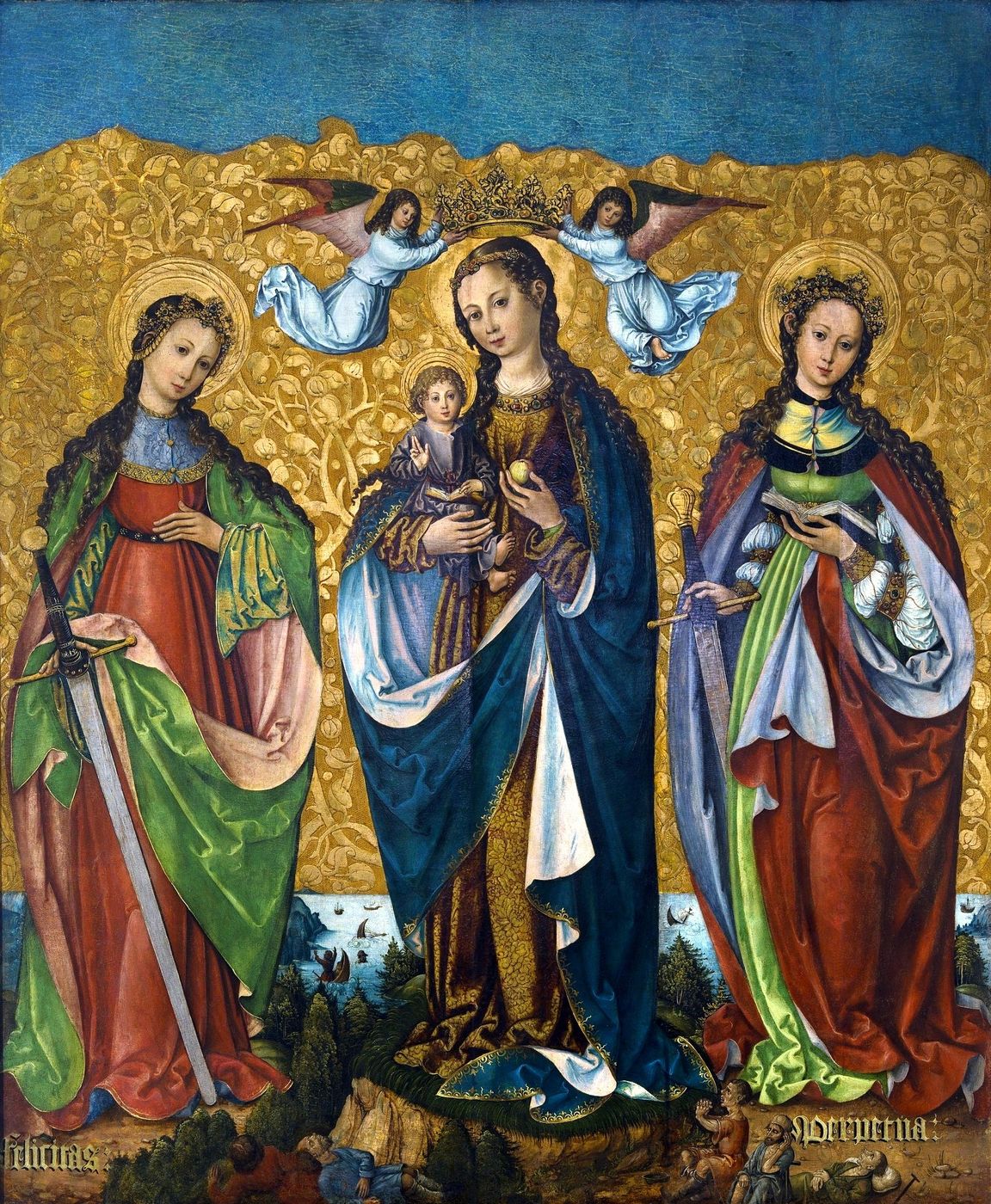
- Mary and Child with Saints Felicity and Perpetua, Greater Poland, about 1520. National Museum, Warsaw. Public domain.
- Ravenna, Sant'Apollinare Nuovo, the procession of women martyrs, a mosaic of the 500s. Photo: Sailko, CC BY-SA 3.0; cropped to Felicity and Perpetua.
- Archbishop's Chapel (Ravenna) - Felicitas, a mosaic of the 500s, cut from the same photograph by GFreihalter. CC BY-SA 3.0.