Charismatic non-denominational
- 6Axes
- 5Poles named
- 17Others
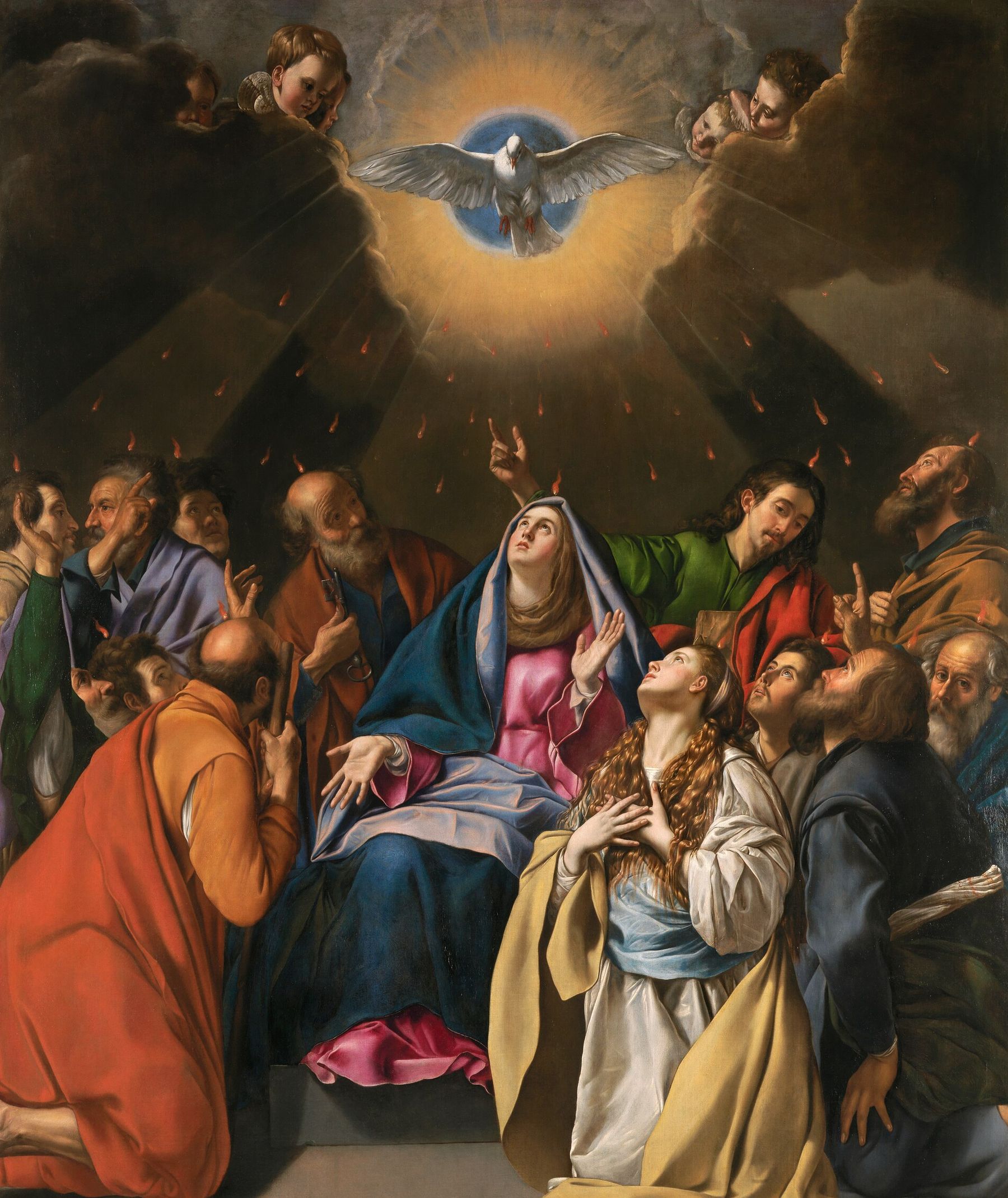
Picture: Pentecost, Juan Bautista Maíno, 1615–20. Museo del Prado, Madrid.
Charismatic non-denominational in a sentence
Independent churches, often with no denominational name at all, that expect the Holy Spirit to speak and heal today. Services are built around sung worship and praying for people.
Continuationist, free in worship, memorialist
What marks it out
Everything begins with the gifts. These churches hold that every gift Paul lists is still given: prophecy, healing, words of knowledge, and tongues, which means praying in a language the speaker has never learned.
What separates them from Pentecostals is one sentence they decline to say. Classical Pentecostals teach that speaking in tongues is the first physical evidence that someone has been baptized in the Holy Spirit. Charismatics of this kind treat tongues as one gift among many, given to some and not to others, which is what Paul’s own run of questions in 1 Corinthians 12 expects.
On Israel and the church the map names nothing, and the silence is accurate: these churches rarely take a side on prophecy charts at all. What they did absorb is George Eldon Ladd’s reading of the kingdom of God as already begun and not yet finished. John Wimber turned that into a reason to pray for a sick person right now. If the kingdom has genuinely broken in, some of its effects should be visible before the end.
On grace the sketch leans to the cooperating side: God’s grace comes first and makes faith possible, and each person must answer and may decline. On authority the Bible stands alone, with no confession, bishop or synod above it. That combination is what makes a church like this quick to plant and hard to generalise about, because there is usually no document you can read to find out what the one down your road actually teaches.
A service is long on singing and short on ceremony: a band, a stretch of worship, a sermon from an open Bible, and time at the end when people come forward and are prayed for by name. The Lord’s Supper is a remembrance, taken as often as the church decides. Nothing about the room says what century you are in.
Did you know?
-
The movement got its name in a seminary classroom. C. Peter Wagner called it the third wave of the Holy Spirit, after Pentecostalism and after the charismatic renewal inside the older denominations, while he and John Wimber were teaching a Fuller Seminary course called Signs and Wonders in 1983.
C. Peter Wagner’s term “Third Wave”, popularised around the 1983 Fuller course MC510, Signs and Wonders, taught with John Wimber.
-
The Vineyard, the best-known network of this kind, was recognized as an association in 1982, and it came out of Calvary Chapel rather than out of Pentecostalism. John Wimber’s church in Yorba Linda separated that year over how freely the gifts should be used on a Sunday morning.
Association of Vineyard Churches recognised 1982; Calvary Chapel Yorba Linda became Anaheim Vineyard under John Wimber.
Where it came from
A wing of the twentieth century’s Pentecostal awakening rather than a denomination. Pentecostalism came first, from Azusa Street in Los Angeles in 1906. The charismatic renewal followed in the 1960s, inside Anglican, Catholic and mainline parishes that stayed where they were. This third group came later still and mostly outside all of them: the Vineyard, and thousands of single congregations with one-word names and no denominational tie at all. Its nearest relatives here are the Pentecostals and Calvary Chapel.
Where it sits on all six questions
Your answers are marked. From your result on . See your result
In the hatched middle the quiz names neither pole.
Which traditions are closest?
Nearness is not agreement: two families can land in the same band for different reasons.
- Pentecostal (Assemblies of God, Church of God, COGIC) Closest 87%match
- National Baptist (NBC USA / historically Black Baptist) 81%match
- Anabaptist / Mennonite (peace church) 78%match
- Calvary Chapel 74%match
- Southern Baptist (non-Calvinist) 63%match
- Reformed charismatic (Sovereign Grace, Newfrontiers) 58%match
Side by side
One page puts this tradition next to another: what they share, where they part, and how it came to be.
What we read
Read to place this tradition
Vineyard USA Statement of Faith; Ladd, A Theology of the New Testament (the inaugurated kingdom Vineyard teaches); Third Wave practice.
-
The Vineyard USA Statement of Faith
Short and online. The sections on the Holy Spirit and on the kingdom are where this tradition parts from Pentecostalism.
-
George Eldon Ladd, A Theology of the New Testament
Not a charismatic book at all, but the source of the already-and-not-yet kingdom these churches pray out of.