Pentecostal (Assemblies of God, Church of God, COGIC)
- 6Axes
- 6Poles named
- 17Others
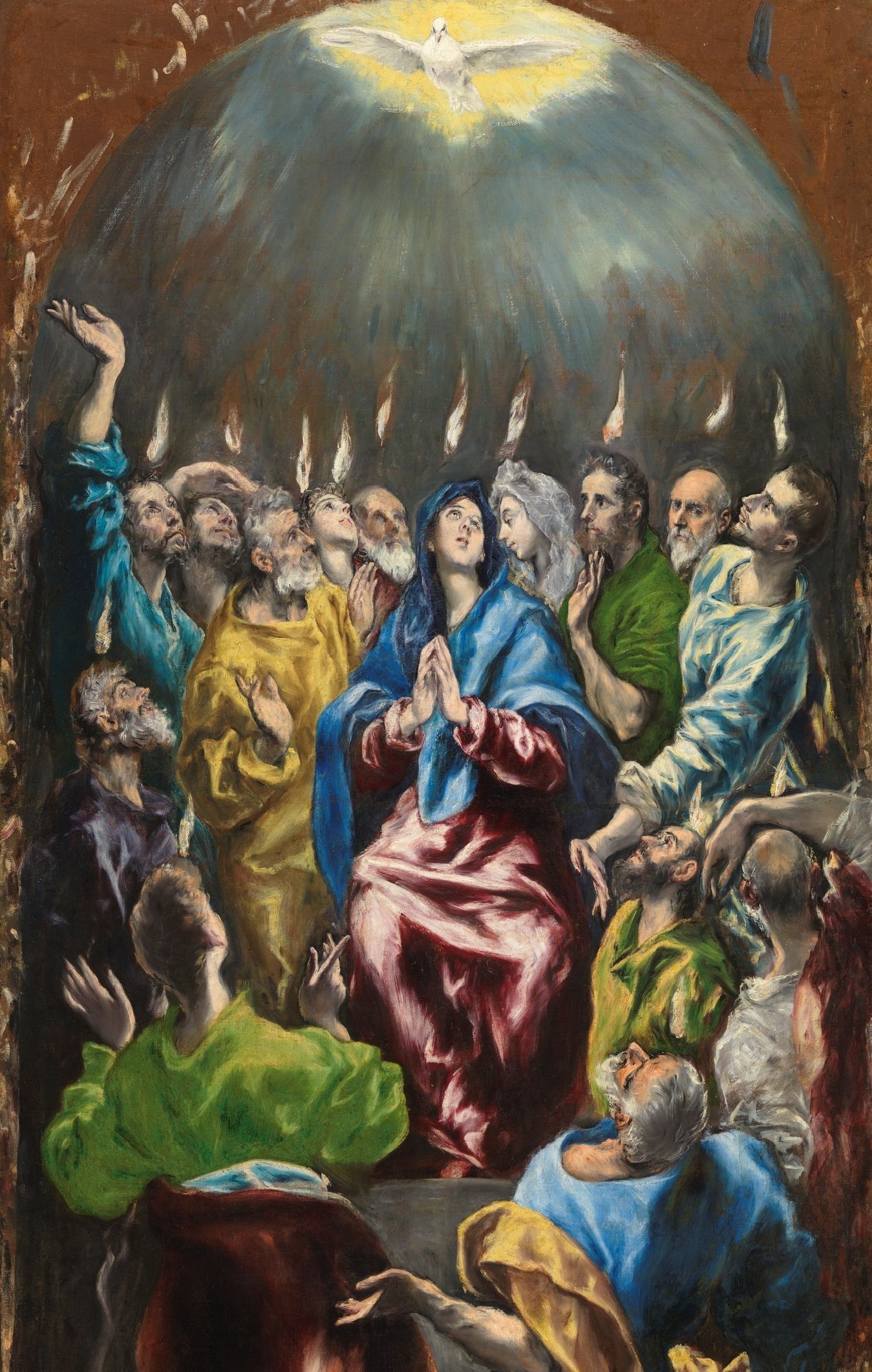
Picture: Pentecost, El Greco, about 1600. Museo del Prado, Madrid.
Pentecostal in a sentence
Churches born out of the revivals of the early 1900s, which expect the Holy Spirit to act audibly and visibly now. Tongues, prophecy and healing are looked for today, as they happen in Acts.
Continuationist, free in worship, firmly synergist
What marks it out
The gifts reading sits as far over as the map goes, which is the whole point. The Assemblies of God teaches that baptism in the Holy Spirit is a distinct experience after conversion, “witnessed by the initial physical sign of speaking with other tongues”. It is the normal Christian inheritance, not a prize for the unusually holy.
On grace Pentecostals stand firmly on the free-response side. Grace comes first and reaches everyone, each person has to say yes, and most Pentecostal bodies hold that someone can later walk away, so assurance is real but is not a sealed verdict.
Worship is free to the edge of the scale: no prayer book, no set readings, a service that can change shape in the room. The Table matches it. The Supper is a memorial of the Lord’s suffering and death, and baptism is for people old enough to ask for it.
On Israel and the church this is openly dispensational, and the statements say so rather than leaving it to custom: the Fundamental Truths name “the Blessed Hope”, the church caught up before the tribulation, and a millennial reign that includes the salvation of national Israel. Authority is Scripture alone, argued from Acts rather than from a council.
Assemblies of God congregations sum the whole thing up in four cardinal doctrines: salvation, baptism in the Holy Spirit, divine healing, and the second coming. Healing is the one most visible from a pew. Prayer for the sick is not tucked into a quiet slot midweek. It happens at the front, out loud, with hands laid on, because these churches hold that healing is provided for in Christ’s atonement and is meant for now.
Did you know?
-
The founding moment had no denomination behind it: a revival that began in 1906 in a run-down mission at 312 Azusa Street, Los Angeles, led by William J. Seymour, the son of former slaves, with Black and white worshippers together in a segregated city.
Flower Pentecostal Heritage Center, AG History; Assemblies of God (USA), “History”.
-
The three bodies here began in three different decades: the Church of God at Barney Creek, Tennessee, on 19 August 1886; the Church of God in Christ, organized by Charles Harrison Mason in 1907 after he received the Spirit at Azusa Street; the Assemblies of God at Hot Springs, Arkansas, in April 1914.
Church of God (Cleveland, Tennessee) published history; COGIC history; Assemblies of God (USA), “History” (Hot Springs, 2–12 April 1914).
Where it came from
Pentecostalism grew from the Wesleyan holiness movement, which is why its account of grace still sounds like Wesley, and from the Azusa Street revival, which gave it tongues. Downstream are the charismatic and non-denominational churches, which took the gifts without the denominations. The “Oneness” Pentecostals, who baptize in Jesus’ name only and reject the doctrine of the Trinity, separated in the 1910s and are not what this sketch describes.
Where it sits on all six questions
Your answers are marked. From your result on . See your result
In the hatched middle the quiz names neither pole.
Which traditions are closest?
Nearness is not agreement: two families can land in the same band for different reasons.
- Charismatic non-denominational Closest 87%match
- National Baptist (NBC USA / historically Black Baptist) 82%match
- Calvary Chapel 77%match
- Anabaptist / Mennonite (peace church) 71%match
- Southern Baptist (non-Calvinist) 64%match
- Bible church (independent, dispensational) 49%match
Side by side
Two pages put this tradition next to another: what they share, where they part, and how it came to be.
What we read
Read to place this tradition
Assemblies of God Statement of Fundamental Truths 1, 6, 7, 8, 13, 14; Church of God (Cleveland) Declaration of Faith.
-
Assemblies of God, Statement of Fundamental Truths
Sixteen short articles. Numbers 7 and 8 cover Spirit baptism and tongues; 13 and 14 cover the rapture and the millennium.
-
Church of God (Cleveland, Tennessee), Declaration of Faith
Fourteen single sentences on one page, and a quick way to tell shared Pentecostal ground from one body’s own.