Bible church (independent, dispensational)
- 6Axes
- 5Poles named
- 17Others
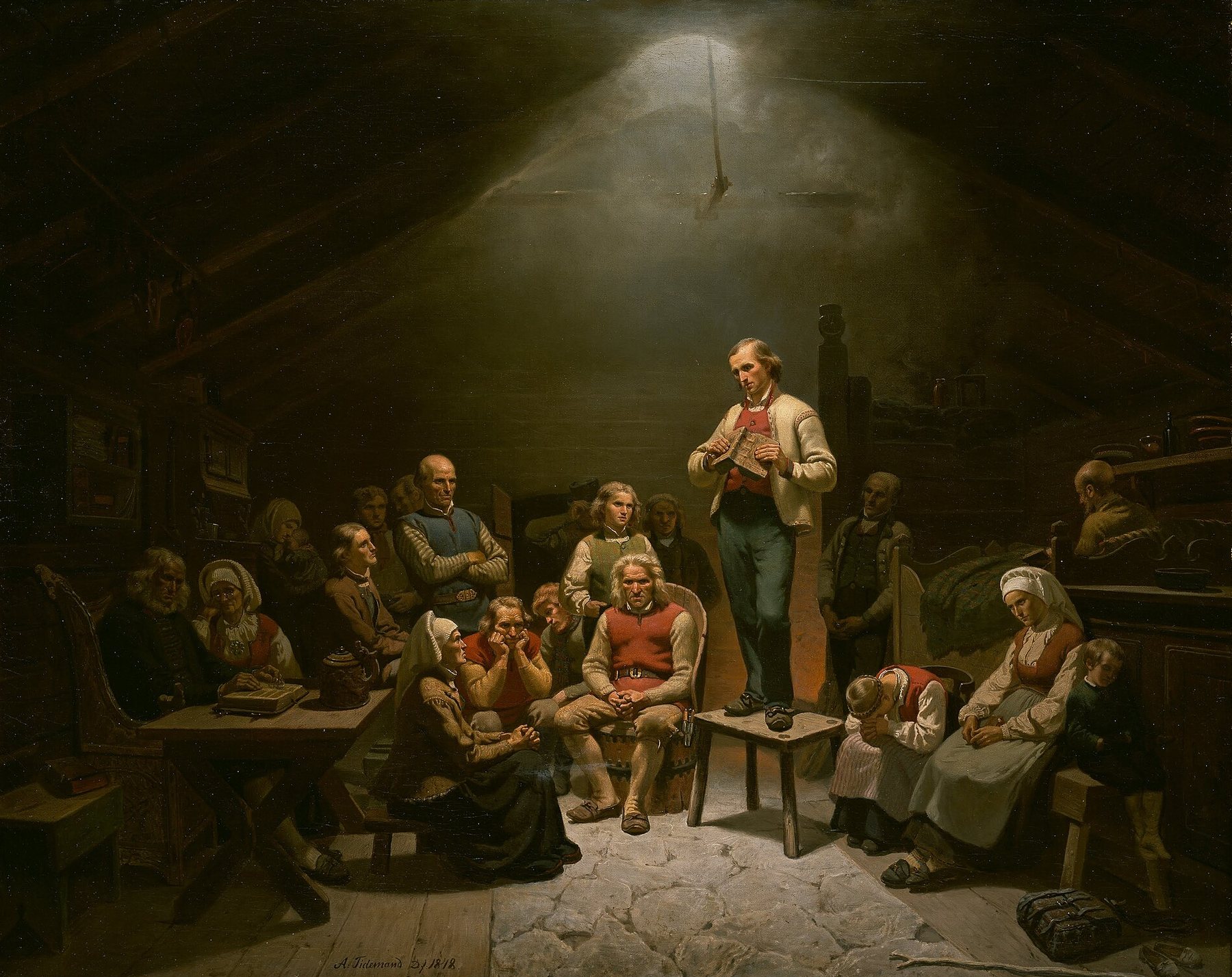
Picture: The Haugeans, Adolph Tidemand, 1848. National Museum, Oslo.
Bible church in a sentence
Independent congregations built around verse-by-verse Bible teaching, which keep Israel and the church distinct as two peoples of God. Most expect Christ to take the church home before the world’s last troubles.
Memorialist, cessationist, dispensational
What marks it out
Start with the word. A dispensation is a stretch of history in which God deals with people under a particular arrangement, and dispensationalists read the Bible as a sequence of them. But the load-bearing claim is not the number of periods. It is the distinction: Israel is Israel and the church is the church, and the promises of land and throne made to Israel will be kept to Israel rather than quietly transferred to the church. Charles Ryrie, who taught at Dallas, named three things a dispensationalist must hold: that distinction, a consistently literal reading of prophecy, and God’s own glory rather than salvation as the point of history.
The church is expected to be taken up to meet Christ in the air before the tribulation, the period of judgment described in Revelation, with the visible return following afterwards. This is the rapture that most people have heard of even if they have never heard the word dispensational, and it is why these churches sit at the far end of the Israel-and-the-church axis.
On grace the map names no position here, and the founding documents show why. These churches are largely Calvinist on election and on the believer’s security, but they will not say Christ died only for the chosen: the Dallas statement says He “gave His life as a ransom for all”. Holding four of Calvinism’s five points leaves you sitting on the line rather than on one side of it.
Everything else follows one instinct, which is that the text is enough. The sermon is the service, and it walks through a book of the Bible a paragraph at a time. The Lord’s Supper is a remembrance, kept as often as the congregation decides. No bishop, synod or denomination stands over the elders, which is what independent means on the sign outside. And the spectacular gifts, tongues and prophecy and healing, are held to have belonged to the years when the apostles were laying the church’s foundation and finished with it.
Did you know?
-
Dispensationalism reached ordinary readers through a Bible rather than a book. C. I. Scofield’s reference Bible, published by Oxford University Press in 1909, printed the whole scheme in the margin beside the text. For two generations of American Christians the notes and the Scripture were read as one page.
Scofield Reference Bible, Oxford University Press, 1909. Its seven dispensations: Innocence, Conscience, Human Government, Promise, Law, Grace, Kingdom.
-
Dallas Theological Seminary, founded in 1924 by Lewis Sperry Chafer, is where most of this movement’s pastors trace their teaching. Its own doctrinal statement is more restrained than the famous charts: it treats three dispensations at length, the Mosaic Law, the present age of grace, and the millennial kingdom still to come.
Dallas Theological Seminary doctrinal statement, Article V; seminary founded 1924.
Where it came from
The independent Bible church grew out of the Bible and prophecy conferences of the late nineteenth century, and behind those stands John Nelson Darby, an Irish curate who left the Church of Ireland for the Plymouth Brethren in the 1820s and worked the system out on long preaching tours of North America. From there it spread far beyond the churches that carry the label: Baptists, Calvary Chapel and much of American evangelicalism absorbed the rapture and the charts without ever taking the name.
Where it sits on all six questions
Your answers are marked. From your result on . See your result
In the hatched middle the quiz names neither pole.
Which traditions are closest?
Nearness is not agreement: two families can land in the same band for different reasons.
- Southern Baptist (non-Calvinist) Closest 78%match
- Southern Baptist (Calvinist) 71%match
- National Baptist (NBC USA / historically Black Baptist) 65%match
- Calvary Chapel 64%match
- Churches of Christ / Christian Churches 55%match
- Pentecostal (Assemblies of God, Church of God, COGIC) 49%match
What we read
Read to place this tradition
Dallas Theological Seminary doctrinal statement, Articles III-V and XVIII-XX; Ryrie, Dispensationalism; Chafer, Systematic Theology IV.
-
The Dallas Theological Seminary doctrinal statement
Short, numbered and online. Article V is the dispensations, XIII the church as distinct from Israel, XVIII the rapture.
-
Charles Ryrie, Dispensationalism
The movement explaining itself to its critics, including the three marks it says are essential to the system.