Southern Baptist (Calvinist)
- 6Axes
- 5Poles named
- 17Others
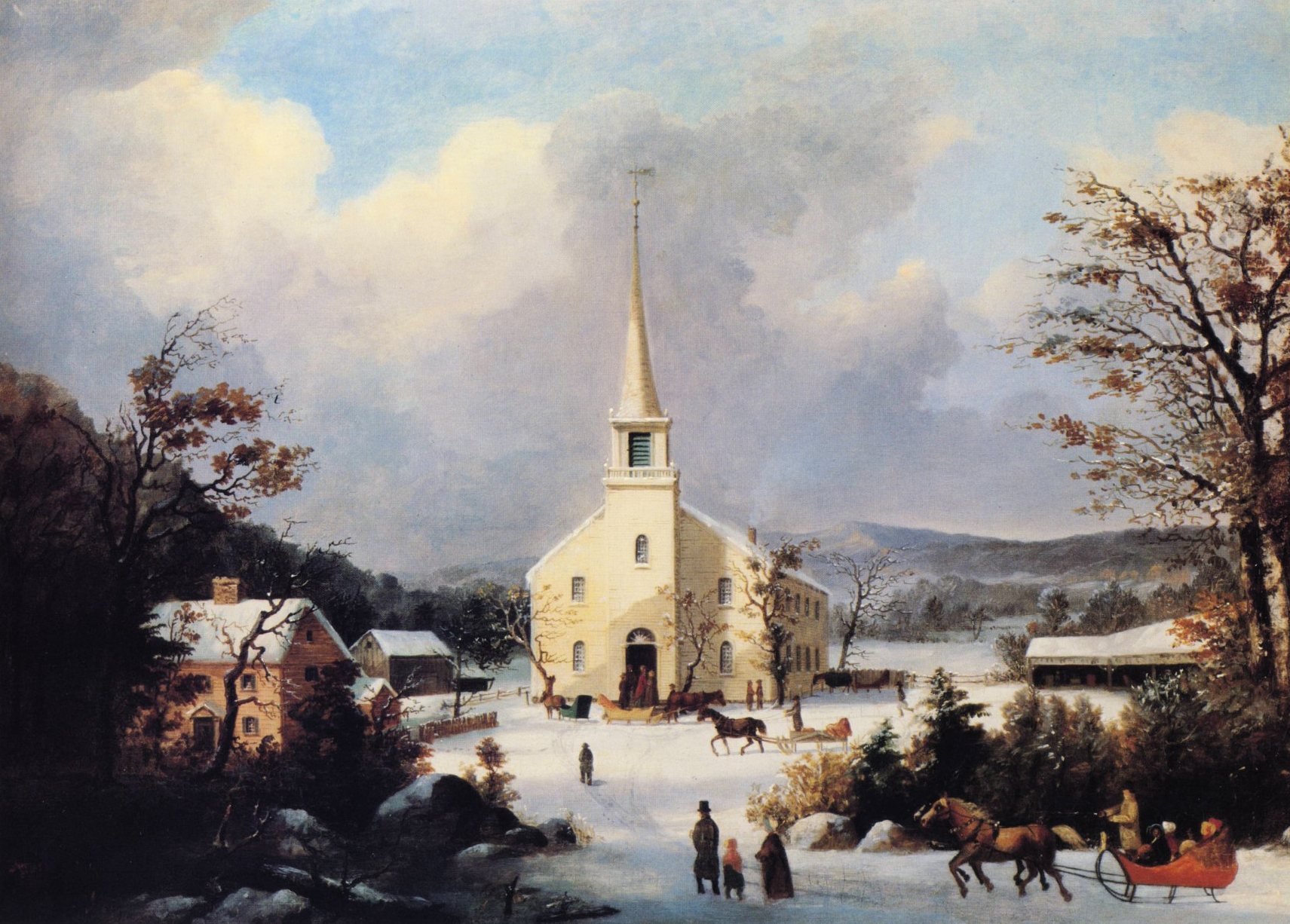
Picture: Going to Church, George Henry Durrie, 1853.
Southern Baptist (Calvinist) in a sentence
Southern Baptists who hold the doctrines of grace: election, effectual calling and perseverance. Everything around that is ordinary Baptist practice, with believer’s baptism, a memorial Supper and no bishop anywhere.
Memorialist, Scripture alone, free in worship
What marks it out
Grace sits at the monergist edge, monergism being the view that God alone brings a person to believe, and it has a document behind it older than the argument. The Abstract of Principles of 1858 defines election as “God’s eternal choice of some persons unto everlasting life”, and every professor at Southern Seminary has taught in accordance with it since.
Everything else is plain Baptist, and three readings sit at the very edge. Authority is Scripture alone: no creed, no bishop and no convention binds a congregation. The Supper is “a symbolic act of obedience” remembering the Redeemer’s death, baptism is the immersion of a believer, and the order of service belongs to the church itself.
On Israel and the church the map names no position, and that is the convention’s doing. The Baptist Faith and Message says Jesus will return personally and visibly and that the dead will be raised and judged, then stops. It says nothing about a millennium or a rapture, so Calvinist Southern Baptists scatter right across that range.
The gifts reading leans cessationist without reaching the pole, which is honest: no Southern Baptist confession says the gifts have ended. The practice is simply cautious, and the case in this stream is argued from the sufficiency of Scripture rather than from a rule.
The recovery has been as much about how a church is run as about election. Founders Ministries, and later Mark Dever’s 9Marks, pressed for membership that means something, church discipline that is actually used, and preaching that works through a book of the Bible rather than around a theme. That is usually the first thing a visitor notices, long before anybody mentions Calvin.
Did you know?
-
Southern Baptists run two confessions at once: the Abstract of Principles of 1858, which binds one seminary’s faculty and is mildly Calvinist, and the Baptist Faith and Message of 2000, the convention’s own statement, written broadly enough to hold both sides.
SBTS “Fundamental Laws”, charter of 30 April 1858; Baptist Faith and Message 2000.
-
The argument is smaller than the noise. When Lifeway Research polled Southern Baptist pastors in 2012, 30 percent called their congregation Calvinist and exactly 30 percent called it Arminian; 16 percent personally held all five points.
Lifeway Research, “SBC Pastors Polled on Calvinism and Its Effect”, June 2012.
Where it came from
Southern Baptist, and older in the convention than the label suggests: several of the men who founded it in 1845 and wrote the Abstract in 1858 were Calvinists, the emphasis faded across the twentieth century, and Founders Ministries began pressing for its recovery after a prayer meeting in November 1982. Nearest relatives: the non-Calvinist Southern Baptists it shares a convention with, and Reformed Baptists, who hold the same doctrine inside a full confession.
Where it sits on all six questions
Your answers are marked. From your result on . See your result
In the hatched middle the quiz names neither pole.
Which traditions are closest?
Nearness is not agreement: two families can land in the same band for different reasons.
- Bible church (independent, dispensational) Closest 71%match
- Reformed Baptist (1689) 63%match
- Southern Baptist (non-Calvinist) 63%match
- Calvary Chapel 61%match
- National Baptist (NBC USA / historically Black Baptist) 60%match
- Reformed charismatic (Sovereign Grace, Newfrontiers) 56%match
What we read
Read to place this tradition
Abstract of Principles IV-VI; Baptist Faith & Message 2000 I, II, VII, VIII, X.
-
The Abstract of Principles (1858)
Twenty articles, about two pages. Articles 4 to 6, on providence, election and the fall, carry the grace reading.
-
The Baptist Faith and Message (2000)
The convention’s own statement. Article 10, on last things, is worth reading for what it leaves unsaid.