Southern Baptist (non-Calvinist)
- 6Axes
- 6Poles named
- 17Others
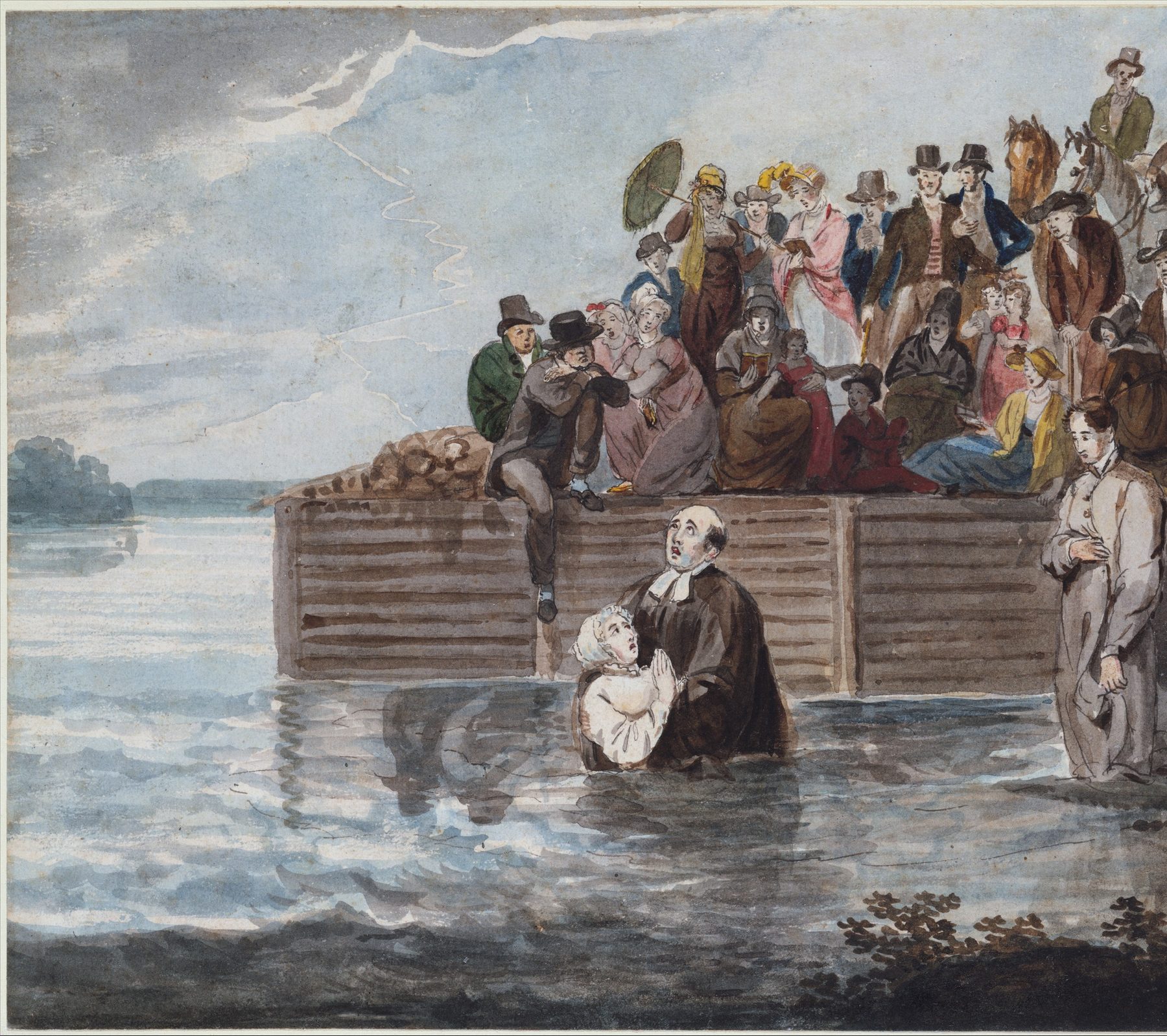
Picture: A Philadelphia Anabaptist Immersion during a Storm (a Baptist baptism in the Schuylkill River), Pavel Svinin, about 1811–13. The Metropolitan Museum of Art, New York.
Southern Baptist (non-Calvinist) in a sentence
The traditional Southern Baptist answer on grace, named by a statement its own senior figures published in 2012. God’s call goes out to everyone, each person must decide, and everyone who truly decides is kept for good.
Memorialist, Scripture alone, free in worship
What marks it out
The grace reading leans towards free response without reaching the pole, because of a very Baptist pairing. Grace goes to all and can be refused, which is synergism: the view that a person freely cooperates with the grace God gives, or in the plainer word, free will. But once someone truly believes, God keeps them, which is eternal security, or “once saved, always saved” in the phrase people actually use. Classical Arminians hold that a believer can fall away; these churches do not, so they reject both labels.
Three readings sit at the very edge, and they are the marks of a free church rather than of that argument. Authority is Scripture alone, with no creed and no bishop over a congregation. The Supper is a memorial and baptism the immersion of a believer. Worship belongs to the church, not to a book.
On Israel and the church the sketch leans dispensational: a distinct future for national Israel, and a church caught up in the rapture before a time of tribulation. The Baptist Faith and Message does not require it, since its article on last things settles nothing, but the expectation runs through the preaching and the study Bibles this stream grew up reading.
The gifts reading leans cessationist without reaching the pole. No confession says the gifts have ended; there is simply a long settled practice of not seeking them, and a conviction that Scripture is enough without them.
What all this looks like on a Sunday is the invitation. The service ends with the congregation standing, a hymn, and a call to come to the front and settle it now, which makes sense only if the decision is genuinely the hearer’s to make. Churches in the Calvinist stream have often dropped that moment, and when the two sides argue about it they are really arguing about the doctrine underneath.
Did you know?
-
This side of the argument has a founding date. On 30 May 2012 A Statement of the Traditional Southern Baptist Understanding of God’s Plan of Salvation went online, and within weeks it carried the names of five former presidents of the convention and two seminary presidents.
Statement published by Eric Hankins, 30 May 2012; Baptist Press, “Statement on Calvinism draws approval, criticism”, June 2012.
-
The convention tried to settle it with a committee. Frank Page, a non-Calvinist himself, assembled an advisory team whose seven-page report, Truth, Trust and Testimony in a Time of Tension, went to the 2013 convention in Houston and concluded that both sides belong.
SBC Calvinism Advisory Committee report, presented at the Southern Baptist Convention, Houston, June 2013.
Where it came from
Baptist by way of the American frontier revivals, where the gospel was offered to whoever happened to be in the tent, and Southern Baptist since the convention formed in 1845. Its nearest relative is the Calvinist stream it shares a convention, a hymnbook and a mission board with; beyond that, the independent Bible churches and other free-church evangelicals.
Where it sits on all six questions
Your answers are marked. From your result on . See your result
In the hatched middle the quiz names neither pole.
Which traditions are closest?
Nearness is not agreement: two families can land in the same band for different reasons.
- National Baptist (NBC USA / historically Black Baptist) Closest 80%match
- Bible church (independent, dispensational) 78%match
- Calvary Chapel 69%match
- Churches of Christ / Christian Churches 69%match
- Anabaptist / Mennonite (peace church) 66%match
- Pentecostal (Assemblies of God, Church of God, COGIC) 64%match
Side by side
Five pages put this tradition next to another: what they share, where they part, and how it came to be.
What we read
Read to place this tradition
Baptist Faith & Message 2000; "A Statement of the Traditional Southern Baptist Understanding of God's Plan of Salvation" (2012).
-
The Baptist Faith and Message (2000)
Article 4 on salvation and article 5 on God’s purpose of grace are the two this page’s grace reading turns on.
-
A Statement of the Traditional Southern Baptist Understanding of God’s Plan of Salvation (2012)
Ten short articles, each an affirmation followed by a denial: this side setting out its own terms.