Anabaptist / Mennonite (peace church)
- 6Axes
- 6Poles named
- 17Others
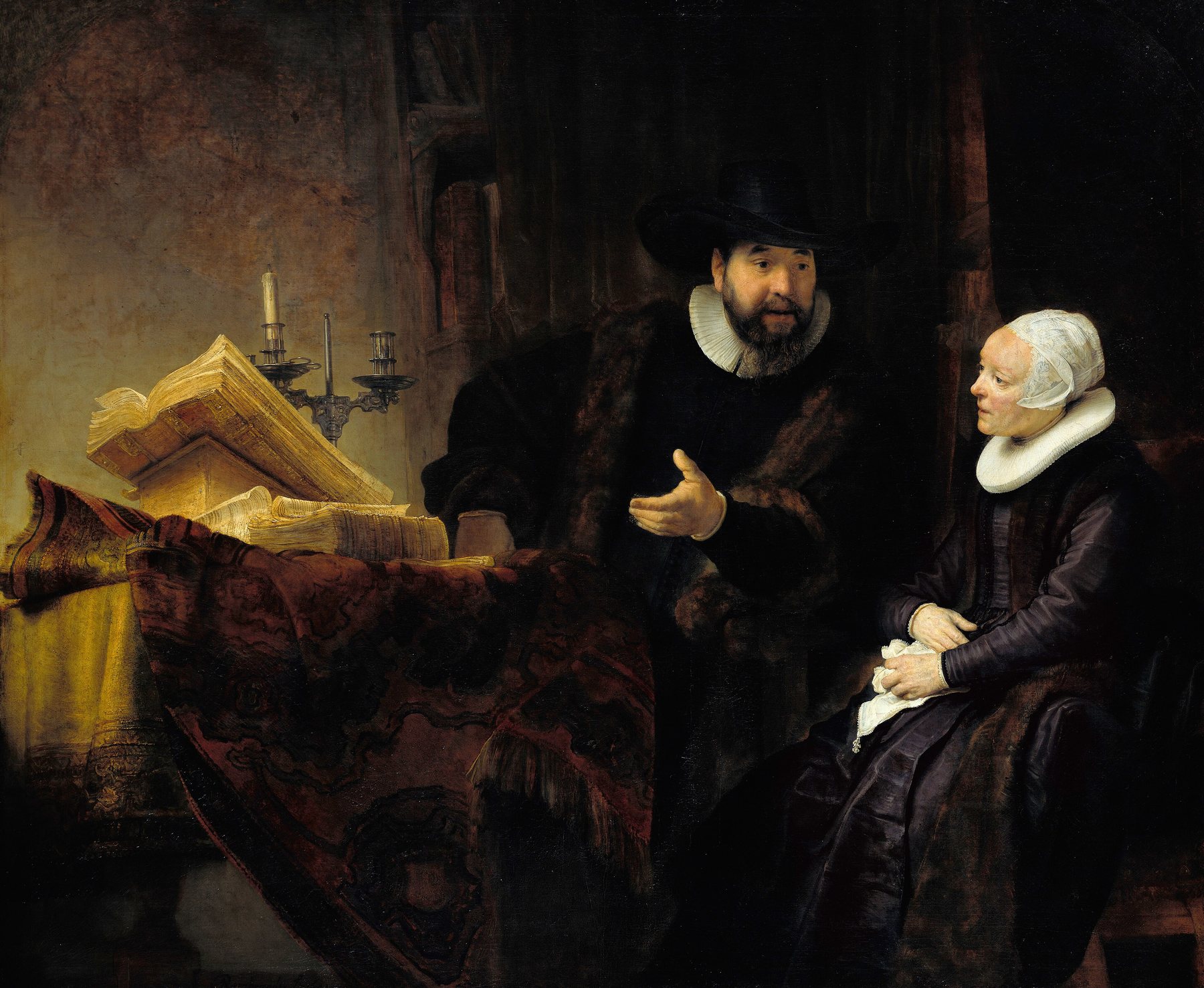
Picture: The Mennonite Preacher Anslo and His Wife, Rembrandt, 1641. Gemäldegalerie, Berlin.
Anabaptist / Mennonite in a sentence
Churches that baptize only people old enough to ask for it, read the Sermon on the Mount as a way of life rather than an ideal, and refuse to carry a weapon. Mennonites, Hutterites and the Amish all belong here.
Firmly synergist, memorialist, Scripture alone
What marks it out
The founding argument was about baptism, and it has never stopped being the center of the thing. In January 1525, in a private house in Zurich, a handful of young men baptized one another as adults, having decided that a baby cannot make the promise baptism asks for. Their opponents called them Anabaptists, which means rebaptizers. It was not a nickname. It was a criminal charge.
The second mark is nonresistance: the refusal to use force, including in war, in self-defense and in the courts. The Schleitheim Confession of 1527 works through it in its sixth article, on the sword. Anabaptists read the instruction not to resist an evildoer (Matthew 5:39) as an order given to the church, meant to be obeyed now, rather than as an ideal for a better world. Most of the other distinctives follow from taking the Sermon on the Mount as instructions.
On grace the sketch puts them firmly on the synergist side, where God’s grace comes first and the person freely cooperates with it. Anabaptists rarely argue about predestination at all. Their weight falls on what happens after conversion: a faith you can watch someone live, inside a congregation that holds its members to it.
The rest follows the same instinct. The Lord’s Supper is a remembrance of Christ’s death and a sign that the congregation is one body, not a change in the bread; many churches wash one another’s feet at the same service, which the Dordrecht Confession of 1632 treats as an ordinance in its own right. Scripture stands alone above every creed, but it is read out and argued over by the gathered congregation rather than settled by a scholar. Worship is plain, and Mennonites are known for unaccompanied four-part singing.
Did you know?
-
Felix Manz, one of the men in that Zurich house, was drowned in the river Limmat on 5 January 1527. The council had ruled the year before that rebaptizers should be put to death by drowning. The punishment was chosen to mock what they had done.
Zurich council edict of 7 March 1526; Manz executed 5 January 1527, the first Anabaptist martyred by Protestant authorities.
-
On 23 April 1529 the Diet of Speyer made rebaptism a capital offense across the whole Holy Roman Empire, with Catholic and Lutheran princes voting the same way. Four days earlier the same diet had produced the formal protest that gave Protestants their name.
Imperial mandate of 23 April 1529, Diet of Speyer; the Protestation at Speyer, 19 April 1529.
-
The Amish are Mennonites who left in 1693. Jakob Ammann, an elder in Switzerland, wanted members under discipline shunned in daily life; Hans Reist and the elders of the Emmental did not, and the argument split the Swiss Brethren in two.
The Amish Division, 1693, over Meidung (shunning); Ammann and Reist.
Where it came from
The radical wing of the Reformation. It began in Zurich in 1525 among men who had been Zwingli’s own students and concluded that he had stopped halfway. Mennonites take their name from Menno Simons, a Dutch priest who joined them in 1536 and spent the rest of his life gathering scattered survivors. Hutterites, the Amish, the Brethren in Christ and the Bruderhof all grew from the same root. Quakers are not descended from them, but arrive at much the same place on peace.
Where it sits on all six questions
Your answers are marked. From your result on . See your result
In the hatched middle the quiz names neither pole.
Which traditions are closest?
Nearness is not agreement: two families can land in the same band for different reasons.
- Charismatic non-denominational Closest 78%match
- National Baptist (NBC USA / historically Black Baptist) 74%match
- Pentecostal (Assemblies of God, Church of God, COGIC) 71%match
- Southern Baptist (non-Calvinist) 66%match
- Churches of Christ / Christian Churches 63%match
- Calvary Chapel 60%match
What we read
Read to place this tradition
Schleitheim Confession (1527) 1-4; Dordrecht Confession (1632) 7-9; Confession of Faith in a Mennonite Perspective (1995) 11-12.
-
The Schleitheim Confession (1527)
Seven short articles, agreed in a Swiss village two years after the first rebaptism. Article 1 is baptism, article 4 separation from the world, article 6 the sword.
-
Confession of Faith in a Mennonite Perspective (1995)
Twenty-four articles, and the working confession of North American Mennonites today. Article 11 is baptism; article 22 is peace, justice and nonresistance.