Churches of Christ / Christian Churches
- 6Axes
- 5Poles named
- 17Others
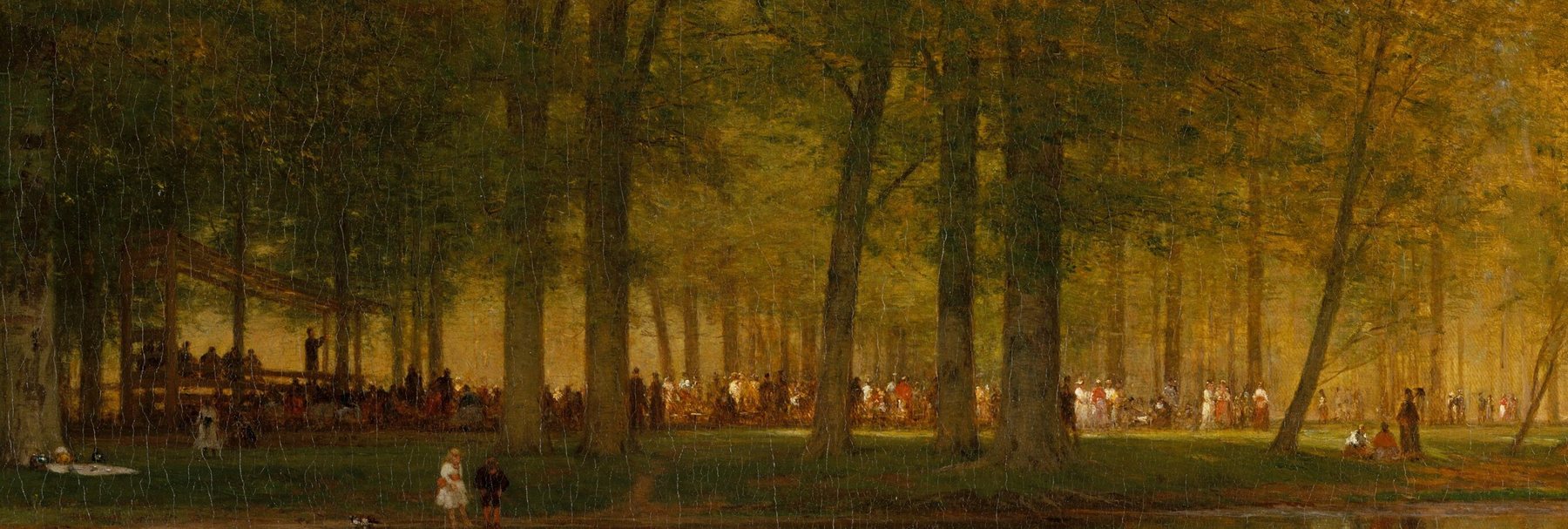
Picture: The Camp Meeting, Worthington Whittredge, 1874. The Metropolitan Museum of Art, New York.
Churches of Christ / Christian Churches in a sentence
Churches that set out to be simply Christians, with no denominational name and no creed but the New Testament. They baptize believers by immersion for the forgiveness of sins.
Firmly synergist, cessationist, Scripture alone
What marks it out
Baptism is where this tradition parts company with most of evangelical America. Acts 2:38 reads: “Repent and be baptized, every one of you, in the name of Jesus Christ for the forgiveness of your sins.” These churches take that ‘for’ at face value. Immersion is the moment a believer is saved, not a sign that he already was, and they insist it is nothing he performs: it is being buried with Christ and raised with Him.
The rule behind almost everything else is Thomas Campbell’s: where the Scriptures speak, we speak; where the Scriptures are silent, we are silent. Applied strictly it takes a great deal out. No bishops, no synods, no denominational headquarters, no creed beyond the confession that Jesus is the Christ. In the a cappella congregations it takes out the instruments too, since the New Testament mentions Christians singing and never mentions them playing.
On communion the map names no position, and the reason is genuinely odd. These churches take the Lord’s Supper every single Sunday, more faithfully than most sacramental churches manage, and yet describe it as a memorial of Christ’s death rather than a change in the bread. The frequency points one way and the definition points the other, so the rail stays in the middle.
On grace they sit as far from Calvinism as this map goes. A person hears, believes, repents, confesses and is baptized, and none of it happens to him without him. On the gifts they are firmly cessationist, holding that tongues and prophecy belonged to the years before the New Testament was finished and were withdrawn once it was. Worship is plain, the sermon is the center, and in an a cappella congregation the singing is the whole room and nothing else.
Did you know?
-
A census split the movement in two. Disagreement over instruments in worship and over missionary societies had been growing for decades, and in 1906 the United States Bureau of the Census listed Churches of Christ and Disciples of Christ as separate bodies for the first time. The paperwork made official a division that had already happened.
1906 US Census of Religious Bodies listed Churches of Christ separately from the Disciples; the split turned on instrumental music and missionary societies.
-
One of its two founders came out of the largest revival on the American frontier. Barton W. Stone was a Presbyterian minister at the Cane Ridge camp meeting in Kentucky in 1801, where thousands camped for days. He left the Presbyterians soon after, and in 1832 his people and Alexander Campbell’s joined forces.
Cane Ridge revival, Kentucky, 1801; the Stone and Campbell movements united in 1832.
Where it came from
The Stone-Campbell Restoration Movement, an American original born on the frontier in the early 1800s out of sheer exhaustion with denominational quarreling. Three bodies came out of it: the a cappella Churches of Christ, the instrumental Christian Churches and Churches of Christ, and the Christian Church (Disciples of Christ), which went in a mainline direction. This page covers the first two. Baptists are the nearest relatives in practice, and the long family argument with them is almost entirely about what baptism does.
Where it sits on all six questions
Your answers are marked. From your result on . See your result
In the hatched middle the quiz names neither pole.
Which traditions are closest?
Nearness is not agreement: two families can land in the same band for different reasons.
- Southern Baptist (non-Calvinist) Closest 69%match
- Anabaptist / Mennonite (peace church) 63%match
- National Baptist (NBC USA / historically Black Baptist) 57%match
- Bible church (independent, dispensational) 55%match
- Reformed Baptist (1689) 52%match
- Southern Baptist (Calvinist) 49%match
Side by side
One page puts this tradition next to another: what they share, where they part, and how it came to be.
What we read
Read to place this tradition
Alexander Campbell, The Christian System; the Acts 2:38 and Acts 2:47 teaching on baptism and on the church begun at Pentecost; "no creed but Christ".
-
Thomas Campbell, Declaration and Address (1809)
The founding document, thirteen propositions long. The first of them: the Church of Christ upon earth is essentially, intentionally, and constitutionally one.
-
Alexander Campbell, The Christian System (1839)
The movement’s theology laid out in full by its ablest debater, and still the best single source for why it does what it does.