
Clement of Alexandria
Church Father, not a saint in most traditions
A teacher at Alexandria who wanted Christians to learn from the Greek philosophers, and called the whole of life a festival.
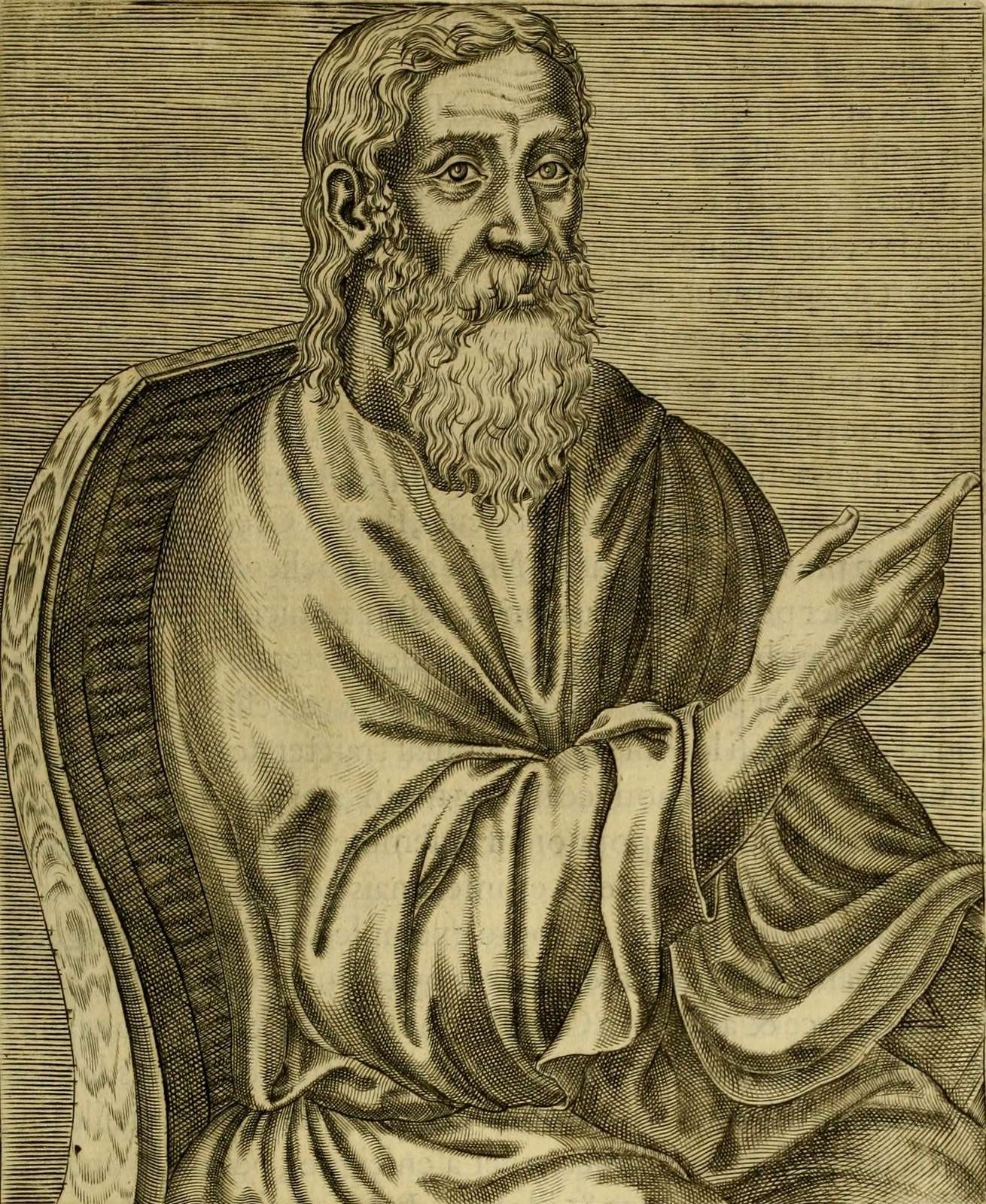
Picture: Clement of Alexandria, from André Thevet, Les vrais pourtraits et vies des hommes illustres, 1584. Boston Public Library. Public domain.
Who was Clement?
Clement was a Christian teacher in Alexandria, Egypt, around the year 200. He led the church's school there, and the young Origen was among his pupils. He wanted Christians to read Greek philosophy without fear. His books range from God becoming man to when to laugh. No one recorded how or where he died.
at a glance
His path, in order
- SeekerSix teachers, then Egypt
- TeacherHead of the school, about 190
- WriterThree books for three stages
- HelperTo a bishop in prison, about 211
in numbers
- Teachers he learned from6
- In Greece, southern Italy, the East, then Egypt
- He found rest with the last of the six
- His books listed by the historian Eusebius10
- Four survive, whole or nearly
did you know?
-
He is the first Greek writer known to name the Buddha. Some Indians, he wrote, follow Buddha's precepts, and honour him as a god for his holiness.
Miscellanies, Book 1, chapter 15; Catholic Encyclopedia, Buddhism -
No writer before him is known to give a day for Jesus' birth. Some in Egypt, he says, put it on 20 May. Others put it on 19 or 20 April.
Miscellanies, Book 1, chapter 21; Catholic Encyclopedia, Christmas -
Only he is known to tell this story of Peter. Seeing his own wife led out to die, Peter rejoiced that she was going home. He called her by name, and told her to remember the Lord.
Miscellanies, Book 7, chapter 11; McGiffert, notes to Eusebius -
He says the apostle Paul was married. Paul greets his wife in a letter, Clement writes, but left her behind so as not to slow his work. Tertullian and Jerome say Paul had no wife.
Eusebius, Church History, Book 3, chapter 30, with McGiffert's note
- Born
- About 150, probably at Athens. As early as the 300s, some said he was born at Alexandria.
- Grew up
- Nothing is recorded of his parents. He had a wide Greek education, and knew the pagan poets and philosophers well. He became a Christian as an adult, by his own choice.
- Died
- Between about 211 and 215. No one recorded where, or how.
- Buried
- No source records his grave.
- Also called
- Titus Flavius Clemens, his full name. In Latin, Clemens Alexandrinus. A later writer, Cassiodorus, calls him the Stromateus, the man of the Miscellanies.
- Status
- Church Father. A presbyter (a priest) of Alexandria, never a bishop. Anglicans in North America keep his day. Not on the Catholic or Orthodox calendars. Coptic writers call him St Clement.
- In art
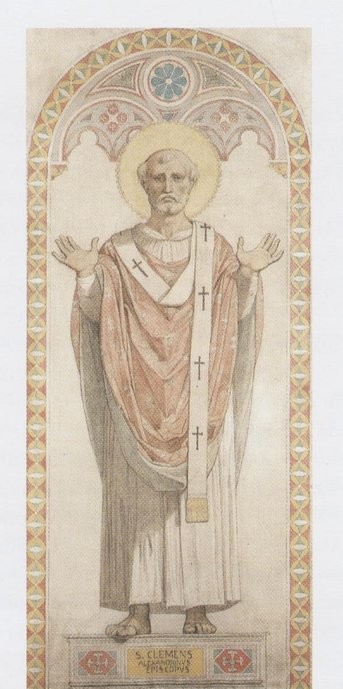
- No likeness from his lifetime survives, and he has no fixed sign. A 1584 engraving shows an old bearded scholar in a chair. Ingres drew him in 1842 with a halo, and labelled him a bishop.
- Wrote
- The Exhortation to the Greeks, the Instructor in three books, the Miscellanies (Stromata) in seven, and Who Is the Rich Man That Shall Be Saved? The Miscellanies has an eighth book too, but it is only a set of extracts. The historian Eusebius lists ten works. The rest are lost, or survive in pieces.
- Pronounced
- KLEM-ent of al-ig-ZAN-dree-uh.
feast days
West
- Dec4
The Anglican Church of Canada, in its Book of Common Prayer (1962). It was also his day in the old Western martyrologies (lists of saints' days), such as Usuard's, until the Roman Martyrology left him out.
- Dec5
The Episcopal Church, the Anglican Church in North America and the Anglican Church of Canada, in its Book of Alternative Services. Not the Church of England.
No Catholic, Orthodox or Lutheran calendar keeps a day for him. The Coptic book of saints' days, the Synaxarium, has two other Clements, but not him.
what was he like?
+took truth where he found it
He would not tie himself to one school of philosophy. He took whatever each had said well, and called that mix philosophy. He had little patience with Christians who feared Greek learning: “the multitude are frightened at the Hellenic philosophy, as children are at masks”.
Miscellanies, Book 1, chapter 7; Book 6, chapter 10+grave and cheerful
His guide to Christian life, the Instructor, even covers laughter. He does not want it rooted out, only kept in bounds. “For man is not to laugh on all occasions because he is a laughing animal, any more than the horse neighs on all occasions because he is a neighing animal.”
The Instructor, Book 2, chapter 5+gentle with the rich
His sermon on the rich opens by calling those who flatter the rich “godless and treacherous”. Then it tells rich believers that they can be saved. What they must give up, he said, is the love of money, not the money: “So let no man destroy wealth, rather than the passions of the soul, which are incompatible with the better use of wealth.”
Who Is the Rich Man That Shall Be Saved?, sections 1 and 14+open-handed
He told givers not to sort the worthy from the unworthy. “Do not you judge who is worthy or who is unworthy. For it is possible you may be mistaken in your opinion.” Better to help the undeserving too than to miss someone God loves.
Who Is the Rich Man That Shall Be Saved?, section 33what others said of him
His life is known from his own books and a few pages of Eusebius and Jerome. The warmest words come from Alexander, a bishop who was probably his pupil.
I have sent this letter to you by Clement, the blessed presbyter, a man virtuous and approved, whom ye yourselves also know and will recognize. Being here, in the providence and oversight of the Master, he has strengthened and built up the Church of the Lord.
Clement, a presbyter of Alexandria, in my judgment the most learned of men, wrote eight books of Miscellanies and as many of Outline Sketches, a treatise against the Gentiles, and three volumes called the Pedagogue. Is there any want of learning in these, or are they not rather drawn from the very heart of philosophy?
In more recent times Clement has grown in favour for his charming literary temper, his attractive candour, the brave spirit which made him a pioneer in theology, and his leaning to the claims of philosophy. He is modern in spirit.
his life in six moments
Greece to Egypt
Before about 190Six teachers, then rest
He went looking for teachers, and he names none of them. His first was an Ionian, in Greece. Others he heard in southern Italy, and others in the East: one from Assyria, and a Hebrew in Palestine. Then he tracked down the last, hidden in Egypt, and went no further. “When I came upon the last (he was the first in power), having tracked him out concealed in Egypt, I found rest.” He calls him “the true, the Sicilian bee, gathering the spoil of the flowers of the prophetic and apostolic meadow”. The historian Eusebius takes this teacher to be Pantaenus, who probably came from Sicily.
Miscellanies, Book 1, chapter 1; Eusebius, Church History, Book 5, chapter 11, with McGiffert's notes; Wace, Dictionary of Christian BiographyAlexandria
About 190Head of the school
Alexandria was the great city of learning in the ancient world. Its church had a school, where new Christians and curious pagans could hear the faith explained. Clement first helped his teacher Pantaenus there, then took his place.
Eusebius, Church History, Book 6, chapter 6; Catholic EncyclopediaAlexandria
Before 202A boy called Origen
One of his pupils was a boy named Origen. The Episcopal Church calls Origen “the most eminent theologian of early Greek Christianity”. Another pupil was probably Alexander, later bishop of Jerusalem.
Eusebius, Church History, Book 6, chapters 6 and 14; Jerome, Lives, chapter 38Alexandria
The 190s and 200sThree books, three stages
Some scholars see his three great books as three stages, from pagan to mature Christian. The Exhortation is an appeal to pagans. The Instructor is a guide to daily Christian life. The Miscellanies are a rambling notebook of deeper teaching. Their Greek name means something like patchwork quilts. He says he planted them like a wild, wooded hill, with “a mixture of fruit-bearing and fruitless trees”, to hide the fruit from thieves.
Miscellanies, Book 7, chapter 18; Catholic Encyclopedia; Freese, notes to PhotiusAlexandria
202Persecution empties the school
In 202 the emperor Severus began a persecution. Origen's father was beheaded. Soon no one was left in Alexandria to teach the faith, “as all were driven away by the threat of persecution”, says the historian Eusebius. Clement left the city then, it seems. As far as we know, he never came back.
Eusebius, Church History, Book 6, chapters 1 to 3, with McGiffert's notesCappadocia
About 211With a bishop in prison
Alexander, probably his old pupil, was now a bishop in Cappadocia, and in prison for the faith. Clement was with him, and looked after his church. When Antioch chose a new bishop, Alexander wrote a letter of joy, and Clement carried it there.
Eusebius, Church History, Book 6, chapter 11; Catholic Encyclopedia
his words
Clement's own books survive. These lines are from William Wilson's translation in the Ante-Nicene Fathers, 1885.
From his appeal to the Greeks
The Word of God became man, that thou mayest learn from man how man may become God.
It is an early form of what the Eastern churches call theosis: God became human so that humans might share in God's life. In Greek, ὁ λόγος ὁ τοῦ θεοῦ ἄνθρωπος γενόμενος, ἵνα δὴ καὶ σὺ παρὰ ἀνθρώπου μάθῃς, πῇ ποτε ἄρα ἄνθρωπος γένηται θεός.
Exhortation to the Greeks, chapter 1Holding festival, then, in our whole life, persuaded that God is altogether on every side present, we cultivate our fields, praising; we sail the sea, hymning; in all the rest of our conversation we conduct ourselves according to rule.
It is then, as appears, the greatest of all lessons to know one's self. For if one knows himself, he will know God; and knowing God, he will be made like God, not by wearing gold or long robes, but by well-doing, and by requiring as few things as possible.
Some men, in truth, live that they may eat, as the irrational creatures, “whose life is their belly, and nothing else.” But the Instructor enjoins us to eat that we may live.
The way of truth is therefore one. But into it, as into a perennial river, streams flow from all sides.
He hath changed sunset into sunrise, and through the cross brought death to life; and having wrenched man from destruction, He hath raised him to the skies, transplanting mortality into immortality, and translating earth to heaven.
Pleasantry is allowable, not waggery.
stories he passed on
Clement passed on stories about the apostles that had come down to him. Eusebius later copied both of these into his history.
John and the robber
Clement calls this story “a tale, which is not a tale but a narrative”. The apostle John left a strong, handsome and eager young man in a bishop's care. The bishop baptised him, then relaxed his watch. The young man fell in with idle friends. In time he became the captain of a band of robbers, “the fiercest, the bloodiest, the cruelest”. When John heard, he called for a horse and rode straight out. He did not run from the robbers' lookouts, and let them seize him. Their captain knew him, and ran in shame. The old apostle chased him, “forgetting his age”, and called out to him. The young man threw down his weapons and wept, and John brought him back to the Church.
“Why, my son, dost thou flee from me, thy father, unarmed, old? Son, pity me. Fear not; thou hast still hope of life. I will give account to Christ for thee.”Who Is the Rich Man That Shall Be Saved?, section 42; Eusebius, Church History, Book 3, chapter 23
How the Gospels were written
The historian Eusebius says Clement gave “the tradition of the earliest presbyters” on the Gospels. The Gospels with the family trees, Matthew and Luke, were written first. Mark wrote down what Peter had preached at Rome, because Peter's hearers asked him to. Peter neither stopped him nor urged him on. John wrote last of all.
“But, last of all, John, perceiving that the external facts had been made plain in the Gospel, being urged by his friends, and inspired by the Spirit, composed a spiritual Gospel.”Eusebius, Church History, Book 6, chapter 14, from Clement's lost Outlines
often misquoted
His feast days are 23 November in the West and 24 November in the East.
What the sources sayThose are the days of another man, Clement of Rome. Britannica prints them under Clement of Alexandria. The Church of England and the Roman Martyrology keep Clement of Rome on 23 November, and Greek churches on 24 November. The one old Western day for Clement of Alexandria was 4 December.
Britannica; Common Worship; the Roman Martyrology (1916)Pope Sixtus V removed him from the Roman Martyrology in 1586.
What the sources sayWikipedia says so, but gives no source. Pope Benedict XIV says Cardinal Baronius, who drew up the Roman Martyrology, simply did not carry his name over from the older lists. The Catholic Encyclopedia says he was dropped under Pope Clement VIII.
Benedict XIV, Postquam intelleximus (1748); Catholic EncyclopediaHe was bishop of Alexandria.
What the sources sayHe was a presbyter, or priest, and never a bishop. A window design by the artist Ingres calls him a bishop, but the ancient sources call him a presbyter.
Jerome, Lives of Illustrious Men, chapter 38; Eusebius, Church History, Book 6, chapter 11He died in Jerusalem.
What the sources sayNo ancient source says so. Where and when he died is unknown. The last we hear of him alive, about 211, he is carrying a letter to Antioch.
Wace, Dictionary of Christian Biography; Eusebius, Church History, Book 6, chapter 11His letter about a Secret Gospel of Mark shows what he really taught.
What the sources sayThe letter is known only from photographs of a copy that Morton Smith said he found at the Mar Saba monastery in 1958. The manuscript is now lost. Scholars still argue whether it is Clement's, a later forgery, or something else.
Smith and Landau, The Secret Gospel of Mark (Yale, 2023); WikipediaHe wrote the hymns “Sunset to sunrise changes now” and “Jesus our mighty Lord”.
What the sources sayBoth are English hymns of the 1900s, built on his words: the first by Howard Chandler Robbins in 1939, the second by F. Bland Tucker. The Episcopal Church lists them among his writings.
Hymnary.org; Lesser Feasts and Fasts 2022where he stood
Each line is Clement's own, from his books. TapClick “Show his line” to read it.
Your answers are next to his. From your result on . See your result
“Most of the time, it's better to say less.”
Clement agrees.
You
Show his line
For we ought not to speak long or much, nor ought we to speak frivolously.The Instructor, Book 2, chapter 7
“Wisdom is worth learning from anyone, even people who don't share your faith.”
Clement strongly agrees.
You
Show his line
Accordingly, before the advent of the Lord, philosophy was necessary to the Greeks for righteousness. And now it becomes conducive to piety; being a kind of preparatory training to those who attain to faith through demonstration.Miscellanies, Book 1, chapter 5
“Anger at real wrongdoing can be a good thing.”
Clement strongly disagrees.
You
Show his line
Nor is he angry; for there is nothing to move him to anger, seeing he ever loves God, and is entirely turned towards Him alone, and therefore hates none of God's creatures.Miscellanies, Book 6, chapter 9
“If you had to choose, you'd grow closer to God alone in quiet than among other people.”
Clement disagrees.
You
On record in the Stromata. Not quoted here.
“There's nothing wrong with being rich, as long as you use it well.”
Clement strongly agrees.
You
Show his line
Such an instrument is wealth. Are you able to make a right use of it? It is subservient to righteousness.Who Is the Rich Man That Shall Be Saved?, section 14
“If someone you know is doing wrong, it's your job to tell them.”
Clement agrees.
You
Show his line
Now censure is a mark of good-will, not of ill-will. For both he who is a friend and he who is not, reproach; but the enemy does so in scorn, the friend in kindness.The Instructor, Book 1, chapter 8
“Even if you believe you'll see them again, it's right to weep openly for someone you've lost.”
Clement disagrees.
You
Show his line
They say, accordingly, that the blessed Peter, on seeing his wife led to death, rejoiced on account of her call and conveyance home, and called very encouragingly and comfortingly, addressing her by name, Remember the Lord.Miscellanies, Book 7, chapter 11
“Giving to the poor isn't generosity. It's paying back what's already theirs.”
Clement agrees.
You
Show his line
All things therefore are common, and not for the rich to appropriate an undue share.The Instructor, Book 2, chapter 13
“The best way to live is free of strong emotions, with only a steady peace inside.”
Clement strongly agrees.
You
Show his line
We must therefore rescue the gnostic and perfect man from all passion of the soul.Miscellanies, Book 6, chapter 9
“Your body is a friend to look after, not an enemy to fight.”
Clement strongly agrees.
You
Show his line
Those, then, who run down created existence and vilify the body are wrong; not considering that the frame of man was formed erect for the contemplation of heaven, and that the organization of the senses tends to knowledge; and that the members and parts are arranged for good, not for pleasure.Miscellanies, Book 4, chapter 26
“Some questions about God are better left alone.”
Clement strongly disagrees.
You
Show his line
Faith, then, we say, we are to show must not be inert and alone, but accompanied with investigation. For I do not say that we are not to inquire at all.Miscellanies, Book 5, chapter 1
“In many Bible stories, the deeper meaning matters more than the history.”
Clement strongly agrees.
You
Show his line
For many reasons, then, the Scriptures hide the sense. First, that we may become inquisitive, and be ever on the watch for the discovery of the words of salvation.Miscellanies, Book 6, chapter 15
“If you believe God is calling you, follow, even if your family begs you not to.”
Clement agrees.
You
Show his line
Should a brother say the like, should a child, should a wife, should any one whosoever, in preference to all let Christ in you be conqueror. For He contends in your behalf.Who Is the Rich Man That Shall Be Saved?, section 23
“In the end, God will save everyone.”
Clement agrees.
You
On record in the Comments on the First Epistle of John. Not quoted here.
See where you stand beside him. Take the quiz
what his critics say
Some of what Clement wrote has troubled readers ever since. Here are the main charges, each with his own words, and his defenders' answers where they give one.
Photius's list
In the 800s, Patriarch Photius of Constantinople read Clement's Outlines, a book now lost. He listed what he called “impious and legendary fables”. Among them: that matter has no beginning, that the Son is a creature, and that the Word only seemed to take flesh. He also found souls passing from body to body, and worlds before Adam. Yet he wondered if the worst was really Clement's. The Catholic Encyclopedia thinks Photius threw Clement's mistakes “into undue relief”.
“He talks much other blasphemous nonsense, either he or some one else under his name.”Photius, Bibliotheca, codex 109; Catholic Encyclopedia
Did Christ need to eat?
Clement wrote that Jesus ate only so that those with Him would not get the wrong idea of Him, and that He felt neither pleasure nor pain. The patriarch Photius accused him of Docetism, the belief that Christ only seemed human. The Catholic Encyclopedia says Clement “clearly admits in Christ a real body”, which he thought free of the common needs of life.
“For He ate, not for the sake of the body, which was kept together by a holy energy, but in order that it might not enter into the minds of those who were with Him to entertain a different opinion of Him.”Miscellanies, Book 6, chapter 9; Catholic Encyclopedia
Free of all feeling
His perfect Christian is never angry or afraid, and does not even need cheerfulness. The Catholic Encyclopedia calls this “undoubtedly colored by Stoicism”. This picture is less a Christian with his feelings under control, it says, than “the ideal Stoic who has deadened his feelings altogether”.
“Nor does he need cheerfulness of mind; for he does not fall into pain, being persuaded that all things happen well.”Miscellanies, Book 6, chapter 9; Catholic Encyclopedia
Run from persecution
He taught that Christians should not hand themselves over when persecution comes. Anyone who does, he says, shares the guilt of his own death. He seems to have left Alexandria himself when persecution came. Eusebius's editor, McGiffert, answers the charge of cowardice: “it was not unworthy cowardice which led Clement to take his departure”. He points to the warm words Bishop Alexander wrote about Clement.
“If he who kills a man of God sins against God, he also who presents himself before the judgment-seat becomes guilty of his death.”Miscellanies, Book 4, chapter 10; McGiffert, notes to Eusebius, Book 6, chapter 6
Rules for women
His Instructor has strict rules on dress for everyone, and stricter ones for women. Yet in the Miscellanies he says women and men, slave or free, are to practise every virtue alike, “since it is a fit consequence that the same nature possesses one and the same virtue”.
“Let her be entirely covered, unless she happen to be at home.”The Instructor, Book 3, chapter 11; Miscellanies, Book 4, chapter 8
A hope for the dead
He held that Christ went down to Hades to preach the gospel, so that those who believed there could be saved. He saw God's punishments as meant to heal. Some modern writers count him among the first Christian universalists, who hold that in the end all will be saved.
“…God's punishments are saving and disciplinary, leading to conversion…”Miscellanies, Book 6, chapter 6; Wikipedia
friends, family and rivals
 Origen
 His pupil as a boy. Origen took charge of the teaching at Alexandria after Clement left. The Catholic Encyclopedia says Clement has been “dwarfed in history by the towering grandeur of the great Origen”.
Eusebius, Church History, Book 6, chapters 3 and 6; Catholic Encyclopedia Jerome
 Writing two centuries later, he admired Clement's learning and listed his books in his Lives of Illustrious Men.
Jerome, Lives of Illustrious Men, chapter 38; Letter 70His last teacher, and the one he stayed with. Clement first helped him at the school in Alexandria, then took his place.
Eusebius, Church History, Book 5, chapter 11, and Book 6, chapter 6Probably his pupil, and a lasting friend. Clement helped his church while he was in prison. Clement dedicated a book to him, the Ecclesiastical Canon, or Against the Judaizers. After Clement died, Alexander wrote of him with deep affection.
Eusebius, Church History, Book 6, chapters 11, 13 and 14Rivals at two extremes. Tatian and Julius Cassianus taught that marriage was corrupt. The sect of Carpocrates and his son Epiphanes taught that wives should be shared. Clement answered both in a whole book defending marriage. The 1885 English edition left it in Latin.
Miscellanies, Book 3, chapters 2, 12 and 13Gnostic teachers who had taught at Alexandria. He answered their ideas on martyrdom and on death. But he kept their favourite word, gnosis, meaning spiritual knowledge. His name for a mature Christian is the true Gnostic, whose knowledge rests on faith.
Miscellanies, Book 4, chapters 12 and 13; Catholic EncyclopediaThe patriarch of Constantinople in the 800s. He praised the Instructor and attacked the lost Outlines.
Photius, Bibliotheca, codices 109 to 111how he died
No one recorded how, when or where he died. He was alive about 211, and gone by about 215.
The last we see of him, he is carrying Bishop Alexander's letter to Antioch, about 211.
A few years after 211, Bishop Alexander wrote to Origen about “those blessed fathers who have trodden the way before us”. Among them was “the holy Clement, my master and benefactor”.
No last words and no grave are recorded.
is he a saint?
It depends on the church. Anglicans in North America keep his day, and Coptic writers call him St Clement. He is not on the Catholic or Orthodox calendars.
- CatholicNot on the calendarLeft out of the Roman Martyrology
- OrthodoxNot on the calendarNo day in the synaxarion
- CopticCalled St ClementBut no day in its Synaxarium
- AnglicanKept4 or 5 December, in the US and Canada
- LutheranNot keptNot in the LCMS or ELCA calendars
Doubts about his books are old. A list of books credited to Pope Gelasius put his works among those “in no case to be received amongst us”. In the 800s, the patriarch Photius found errors in his lost Outlines.
The old Western martyrologies, the lists of saints' days, kept him as St Clement on 4 December. When the Roman Martyrology was drawn up in the late 1500s, Cardinal Baronius did not carry the name over.
In 1748 Pope Benedict XIV looked at the case again, and did not add him. He gave three reasons. The old writers say almost nothing of his life. There is no trace that he was ever honoured in public. And some of his teaching was, at the least, open to doubt. Benedict said he meant no slight to Clement's learning.
Even so, the Catholic Encyclopedia of 1908 calls him St Clement, and Pope Benedict XVI gave a whole talk on him in 2007. The encyclopedia tells the older story like this:
Down to the seventeenth century he was venerated as a saint. His name was to be found in the martyrologies, and his feast fell on the fourth of December.
a prayer he wrote
The Instructor closes with his own prayer to Christ, Whom it calls “Instructor”, and then a hymn. These are the prayer's opening lines.
Be gracious, O Instructor, to us Thy children, Father, Charioteer of Israel, Son and Father, both in One, O Lord. Grant to us who obey Thy precepts, that we may perfect the likeness of the image, and with all our power know Him Who is the good God and not a harsh judge.
what to read first
Who Is the Rich Man That Shall Be Saved?
Clement of Alexandria
A short sermon on the rich young man. It ends with the story of John and the robber.
Read it freeExhortation to the Greeks
Clement of Alexandria
His appeal to pagans to leave the old gods for Christ. Chapter 1 has “how man may become God”.
Read it freeThe Instructor, Book 2
Clement of Alexandria
Everyday life: eating, drinking, laughter and sleep. The most human of his books.
Read it freeThe Miscellanies, Book 7
Clement of Alexandria
His portrait of the mature Christian, whose whole life is a festival and a prayer.
Read it freetake the quizzes
 Quiz Which early Christian thinks like you? And which would argue with you? See where you stand beside Clement. Start
  Quiz Christian Personality Test Which of eight types are you? Find your own. Start
 sources
His life, and his words
- Clement of Alexandria, Works. Tr. William Wilson, Ante-Nicene Fathers, vol. 2, 1885.
- New Advent, Miscellanies, Book 7. The same translation, revised by Kevin Knight.
- New Advent, Who Is the Rich Man That Shall Be Saved?. Same revision.
- The Greek of the Exhortation. Butterworth's edition, 1919, at Perseus.
- Eusebius, Church History, Book 6, chapters 1 to 14, and Book 5, chapter 11. Tr. Arthur Cushman McGiffert, 1890, with his notes.
- Jerome, Lives of Illustrious Men, chapter 38. Tr. Ernest Cushing Richardson.
- Jerome, Letter 70, to Magnus. Tr. W. H. Fremantle, 1893.
- Photius, Bibliotheca, codices 109 to 111. Tr. J. H. Freese, 1920.
- Benedict XIV, Postquam intelleximus, 1748, printed at the front of later editions of the Roman Martyrology (this copy, 1859). Latin.
Reference
- Catholic Encyclopedia, 1908, “Clement of Alexandria”
- Wace, Dictionary of Christian Biography, “Clement of Alexandria”, by B. F. Westcott
- Britannica, “Saint Clement of Alexandria”
- Pope Benedict XVI, General Audience, 18 April 2007
- OrthodoxWiki, “Clement of Alexandria”
- CopticChurch.net, “The Life of St. Clement”
- Yale University Press, Smith and Landau, The Secret Gospel of Mark, 2023
- Hymnary.org, “Sunset to sunrise changes now”
- Hymnary.org, “Jesus, our mighty Lord”
- Wikipedia, “Clement of Alexandria”, for the claims corrected above
- Louvre, Ingres's painted cartoon for the same window, INV 20314, 1842
- Merriam-Webster, “Alexandria” and “Clement”, for how to say it
Calendars
- The Episcopal Church, Lesser Feasts and Fasts 2022
- The Anglican Church in North America, The Book of Common Prayer (2019), calendar
- The Anglican Church of Canada, Advent (Book of Alternative Services)
- The Anglican Church of Canada, The Book of Common Prayer (1962), calendar
- Church of England, Common Worship calendar
- The Roman Martyrology, 1916 edition
- The Coptic Synaxarium, CopticChurch.net
- LCMS, Commemorations
- Evangelical Lutheran Worship, ELCA, the church year
Pictures
- Clement alexandrin, from André Thevet, Les vrais pourtraits et vies des hommes illustres, 1584. Boston Public Library, via the Internet Archive. Public domain.
- Saint Clément d'Alexandrie, Jean-Auguste-Dominique Ingres, 1842. Musée du Louvre. Public domain.
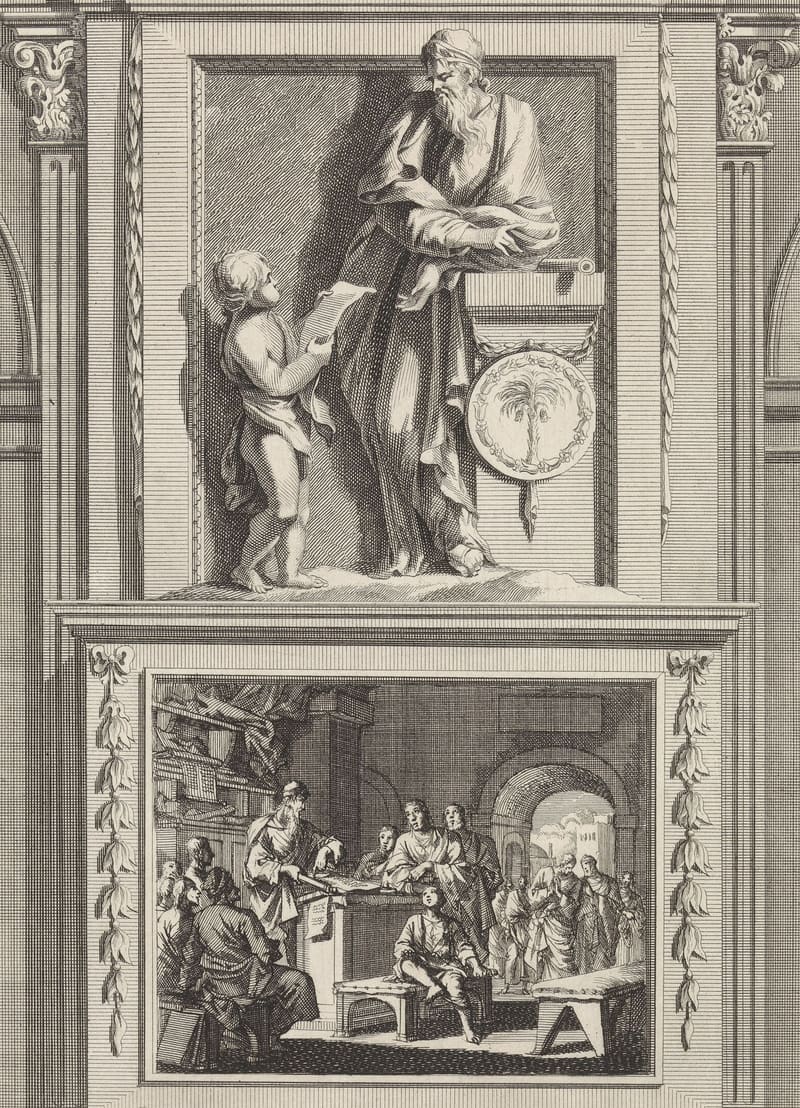
- H. Clemens van Alexandrië, kerkvader, Jan Luyken after Jan Goeree, 1698, for William Cave's lives of the Fathers in Dutch. Rijksmuseum, Amsterdam. CC0.