Anglican (broad)
- 6Axes
- 5Poles named
- 17Others
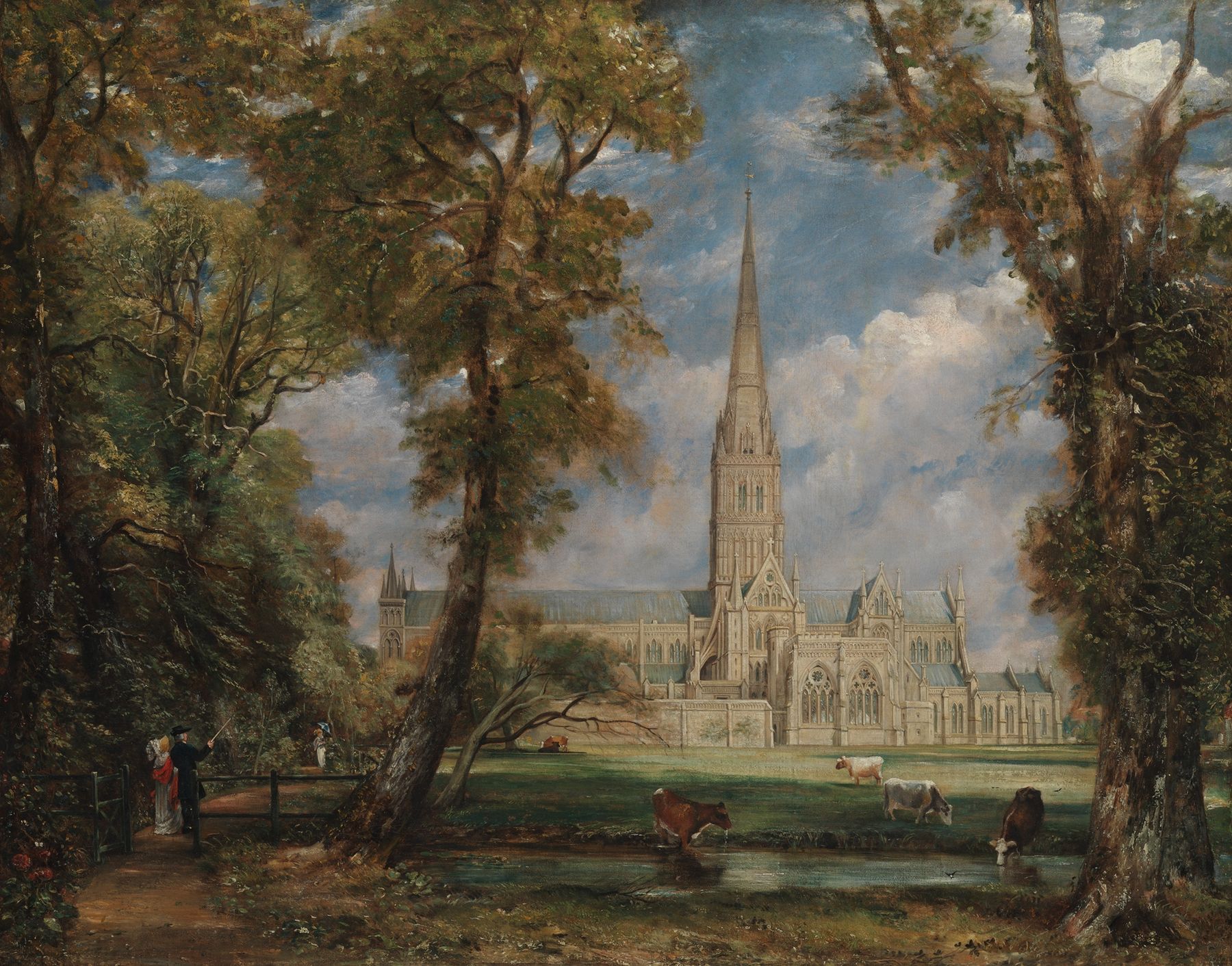
Picture: Salisbury Cathedral from the Bishop’s Grounds, John Constable, about 1825. The Metropolitan Museum of Art, New York.
Anglican in a sentence
The Church of England and the churches grown from it, which kept bishops, a prayer book and the church year at the Reformation. Its settlement was built to hold people who disagree.
Sacramental, liturgical, one-people-leaning
What marks it out
Anglicans are marked out more by how they pray than by what they argue. The Book of Common Prayer, largely Thomas Cranmer’s work, sets the words for morning and evening prayer, communion, baptism, marriage and burial, and the 1662 edition is still the Church of England’s legal standard of doctrine. A visitor knows roughly what will happen before it happens, and so does the vicar.
On communion the sketch places Anglicans firmly at the sacramental end. Article XXVIII of the Thirty-Nine Articles rejects transubstantiation, the teaching that the bread and wine stop being bread and wine, as “repugnant to the plain words of Scripture”, and in the very next breath says the body of Christ is “given, taken, and eaten, in the Supper, only after an heavenly and spiritual manner”. Both halves are meant.
On grace the map names no position, and that is an honest reading rather than a gap. Article XVII teaches predestination to life, which is the idea that God chose His people before the world began, and then says nothing whatever about the other half of the question. The silence was deliberate. Calvinists and Arminians have both signed the Articles in good conscience for four centuries.
Scripture comes first: Article VI says Holy Scripture “containeth all things necessary to salvation”, so nothing that cannot be read there or proved from it may be required of anyone as an article of belief. But the creeds, the early councils and the prayer book stay in daily use, which puts Anglicans on the Scripture-first side without pushing them to the pole. The word broad in the name is doing real work: Anglo-Catholics, evangelicals and a liberal middle all live inside one structure, and broad church has been an English term for exactly that willingness since the nineteenth century.
Did you know?
-
When Elizabeth I’s prayer book appeared in 1559, the words said as the bread is given joined the Catholic-sounding line of 1549, “The body of our Lord Jesus Christ”, to the Protestant-sounding line of 1552, “Take and eat this in remembrance”. Nobody chose. Both were printed, and both are still said today.
Book of Common Prayer 1559, words of administration, combining the 1549 and 1552 forms; retained in 1662.
-
There were forty-two Articles before there were thirty-nine. Cranmer’s set of 1553 was cut down under Elizabeth I and given its final form in 1571, which is the text clergy still assent to.
Forty-Two Articles (1553); Thirty-Nine Articles, final form 1571.
Where it came from
A Reformation church inside a pre-Reformation body. The English church broke with Rome under Henry VIII in the 1530s and was made Protestant in doctrine under Edward VI and Elizabeth I, but kept its bishops, its cathedrals and its parishes whole. The Anglican Communion today runs from the Church of England to the Episcopal Church in the United States, the Church of Nigeria and dozens more. Methodists are the closest relatives of all: John Wesley was an Anglican priest and died one.
Where it sits on all six questions
Your answers are marked. From your result on . See your result
In the hatched middle the quiz names neither pole.
Which traditions are closest?
Nearness is not agreement: two families can land in the same band for different reasons.
- Mainline Protestant (PCUSA / ELCA / UMC) Closest 87%match
- Wesleyan / Methodist 74%match
- Lutheran (confessional) 72%match
- Catholic (Roman and Eastern) 64%match
- Eastern Orthodox 60%match
- Presbyterian / Reformed (confessional) 52%match
Side by side
One page puts this tradition next to another: what they share, where they part, and how it came to be.
What we read
Read to place this tradition
Thirty-Nine Articles VI, VIII, XVII, XX, XXI, XXV, XXVII, XXVIII; Book of Common Prayer 1662, the calendar and the collects.
-
The Thirty-Nine Articles of Religion (1571)
A few pages, free online, and each article a paragraph. VI is Scripture, XVII predestination, XXVIII the Lord’s Supper.
-
The Book of Common Prayer (1662)
Readable straight through, and still the doctrinal standard. The collects are the short set prayers, one for each Sunday of the year.