Presbyterian / Reformed (confessional)
- 6Axes
- 6Poles named
- 17Others
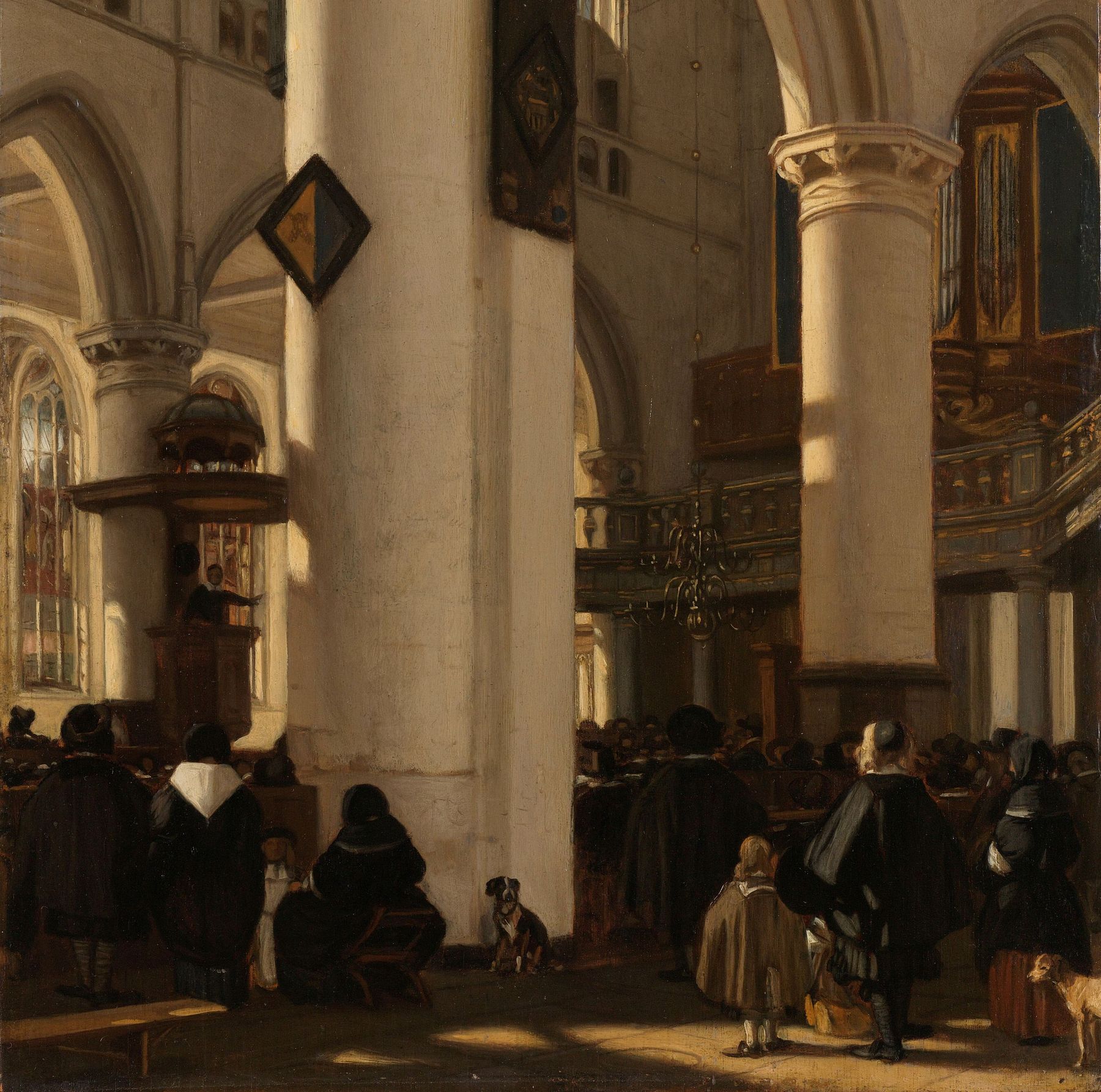
Picture: Interior of a Protestant Gothic Church during a Service, Emanuel de Witte, 1669. Rijksmuseum, Amsterdam.
Presbyterian / Reformed in a sentence
Churches governed by elders and bound to the Westminster Confession or the Three Forms of Unity. God’s choosing comes first, one covenant runs from Abraham to the font, and worship does only what Scripture commands.
Firmly monergist, one-people-of-God, sacramental
What marks it out
Grace sits at the far monergist edge, monergism being the view that God alone brings a person to believe. Westminster says God chose a people before the world was made, and that the grace which raises the spiritually dead makes the unwilling willing. Because the work is His, so is finishing it.
Covenant theology holds the rest together. One people of God runs across both testaments under one covenant of grace, so there is no separate track for Israel and no rapture in the system, and the children of believers are baptized as Abraham’s children were marked. At the Table Christ is really given, but spiritually rather than physically.
The cessationist reading comes from the Confession’s first paragraph, which says the older ways God used to reveal His will are “now ceased”. The claim is not that He has stopped healing, but that He has stopped adding to Scripture.
The worship reading surprises people. Presbyterians look formal, yet the map puts them on the free side of center, correctly: the Westminster Assembly replaced the Book of Common Prayer with a Directory, which is advice rather than words to read aloud, and nothing enters a service unless Scripture calls for it.
The name is the government. Presbyteros is the Greek for elder, and these churches are run by elders: a session of them in each congregation, a presbytery of ministers and elders over a region, and a general assembly above that. There is no bishop, and no congregation stands entirely on its own, so a minister answers to a court of his peers rather than to the people who pay him.
Did you know?
-
The Confession took three years, and the committee that wrote it never really stopped. Parliament summoned 121 ministers to Westminster Abbey in July 1643; they moved into the Jerusalem Chamber that October, finished the Confession in 1646, and had held 1,163 numbered sessions by the time they stopped counting in 1649. The minutes run on to 1652.
Westminster Assembly (1643–1652) records; Britannica, “Westminster Assembly”.
-
The Heidelberg Catechism of 1563 is a calendar as well as a book: its 129 questions are cut into fifty-two Lord’s Days so a congregation hears all of it preached once a year. It opens by asking “What is your only comfort in life and in death?”
Heidelberg Catechism (1563), Lord’s Day 1; Christian Reformed Church, “Heidelberg Catechism”.
Where it came from
Geneva is the taproot, through Calvin and then John Knox’s Scotland. The English-speaking branch confesses Westminster, finished in 1646; the Dutch and German branch confesses the Belgic Confession, the Heidelberg Catechism and the Canons of Dort. Nearest relatives: Reformed Baptists, who copied Westminster and then rewrote its chapters on baptism, and confessional Lutherans, who share the monergism and part company at the Table.
Where it sits on all six questions
Your answers are marked. From your result on . See your result
In the hatched middle the quiz names neither pole.
Which traditions are closest?
Nearness is not agreement: two families can land in the same band for different reasons.
- Reformed Baptist (1689) Closest 77%match
- Lutheran (confessional) 68%match
- Mainline Protestant (PCUSA / ELCA / UMC) 55%match
- Anglican (broad) 52%match
- Reformed charismatic (Sovereign Grace, Newfrontiers) 49%match
- Southern Baptist (Calvinist) 47%match
Side by side
Four pages put this tradition next to another: what they share, where they part, and how it came to be.
What we read
Read to place this tradition
Westminster Confession 1.1, 3, 10, 21.5, 28-29, 31.3-4; Westminster Directory for Publick Worship; Heidelberg Catechism 65-82.
-
The Westminster Confession of Faith (1646)
Thirty-three short chapters. Chapter 1 carries authority and cessation, chapter 3 grace, and 21.5 worship.
-
The Heidelberg Catechism (1563)
Warmer than the Confession and far shorter. Questions 65 to 82, on the sacraments, hold up the Table reading.