Lutheran (confessional)
- 6Axes
- 6Poles named
- 17Others
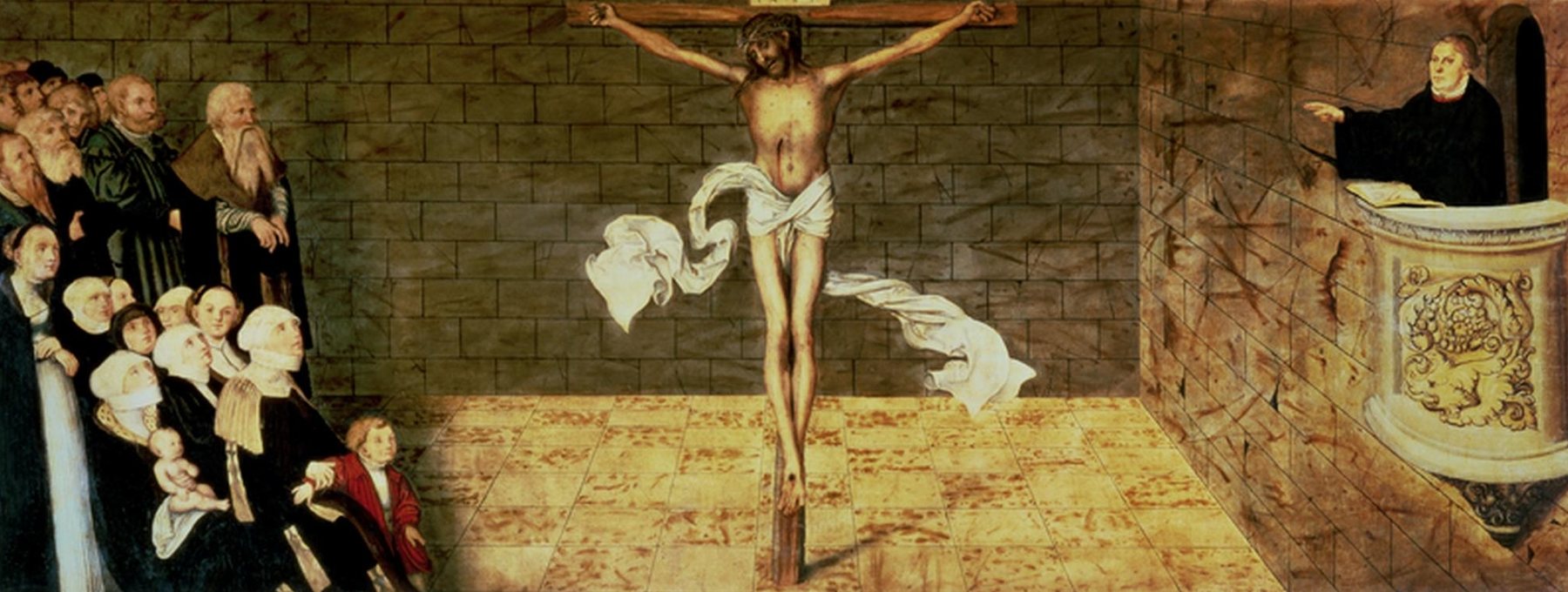
Picture: Luther Preaching, predella of the Reformation Altarpiece, Lucas Cranach the Elder and the Younger, 1547. St Mary’s Church, Wittenberg.
Lutheran in a sentence
Lutheran churches that still bind themselves word for word to the Book of Concord of 1580, keeping a liturgy that looks Catholic from the outside. Salvation here is entirely God’s work.
Sacramental, one-people-of-God, liturgical
What marks it out
Lutherans teach that a person contributes nothing whatever to his own conversion. The Holy Spirit works faith through the preached Word and the sacraments, and the will before that is not neutral but dead. That is monergism, the view that God alone brings a person to believe, and on this axis it ought to put Lutherans at the very end of the rail.
It does not, because they refuse the second half of the Reformed package: they will not say grace cannot finally be resisted, and they will not say God chose anyone for damnation. If a person is saved it is all God; if a person is lost it is all his own doing. The Formula of Concord leaves that asymmetry standing instead of tidying it away, so an honest confessional Lutheran lands just short of the post.
On communion Lutherans are as sacramental as anyone on this map. The body and blood of Christ are truly present in, with and under the bread and wine. They reject the word consubstantiation, which their opponents coined for them, because it sounds like two substances mixed and because it sounds like an explanation. They do not think the how can be explained. “This is My body” is taken to be enough.
And yet Scripture alone. The Formula of Concord calls Scripture the only rule and norm by which every teaching and every teacher must be judged. The creeds and the confessions are kept and subscribed because they are held to say exactly what Scripture says, not because they stand beside it as a second authority.
Worship keeps the historic shape of the Mass, with confession, Kyrie, Gloria, creed and the words of institution in their old places, under a church year beginning in Advent. On the last things, Augsburg Confession XVII condemns the idea that before the resurrection the godly will take possession of an earthly kingdom, which rules out the entire dispensational scheme in a sentence written in 1530. On the gifts, confessional Lutherans do not practice tongues or prophecy: Augsburg Confession V insists the Holy Spirit comes through the Word and the sacraments and not apart from them.
Did you know?
-
Luther wrote the Small Catechism because of what he saw on an inspection tour. Sent around the Saxon parishes in 1528, he found that ordinary people could not say the Lord’s Prayer, the Creed or the Ten Commandments, and that many of their pastors could not teach them. His preface calls it a deplorable, wretched deprivation. The little book he wrote the next year is still learned by heart.
Luther, Preface to the Small Catechism (1529), on the Saxon visitation of 1528.
-
The Augsburg Confession was read aloud to an emperor. On 25 June 1530 the Lutheran princes had it read out in German before Charles V at the imperial diet in Augsburg, as their answer to the charge of heresy. It is still the document a confessional Lutheran pastor subscribes.
Augsburg Confession presented to Charles V at the Diet of Augsburg, 25 June 1530.
Where it came from
The first Protestants, and for a while the only ones. Lutheranism starts with Martin Luther’s protest of 1517 and takes fixed form in the Book of Concord of 1580, which gathers the three ancient creeds, the Augsburg Confession, Luther’s two catechisms and the Formula of Concord into one volume. Confessional in the name means a church body that still subscribes to all of it, chiefly the Lutheran Church Missouri Synod and the Wisconsin Evangelical Lutheran Synod in North America. The larger, looser Lutheran bodies appear on this map under mainline Protestant.
Where it sits on all six questions
Your answers are marked. From your result on . See your result
In the hatched middle the quiz names neither pole.
Which traditions are closest?
Nearness is not agreement: two families can land in the same band for different reasons.
- Anglican (broad) Closest 72%match
- Mainline Protestant (PCUSA / ELCA / UMC) 69%match
- Presbyterian / Reformed (confessional) 68%match
- Wesleyan / Methodist 59%match
- Reformed Baptist (1689) 52%match
- Catholic (Roman and Eastern) 43%match
Side by side
Two pages put this tradition next to another: what they share, where they part, and how it came to be.
What we read
Read to place this tradition
Formula of Concord, Preface ("the only rule and norm") and Epitome II and XI; Augsburg Confession IX, X, XVII; Small Catechism IV; the Divine Service.
-
The Augsburg Confession (1530)
Twenty-eight short articles and the clearest statement of what Lutherans think they are. IX is baptism, X the Supper, XVII the last day.
-
Luther’s Small Catechism (1529)
Six parts and a few pages, written for a father to teach his household at the table. Every commandment answered with: what does this mean?