Wesleyan / Methodist
- 6Axes
- 6Poles named
- 17Others
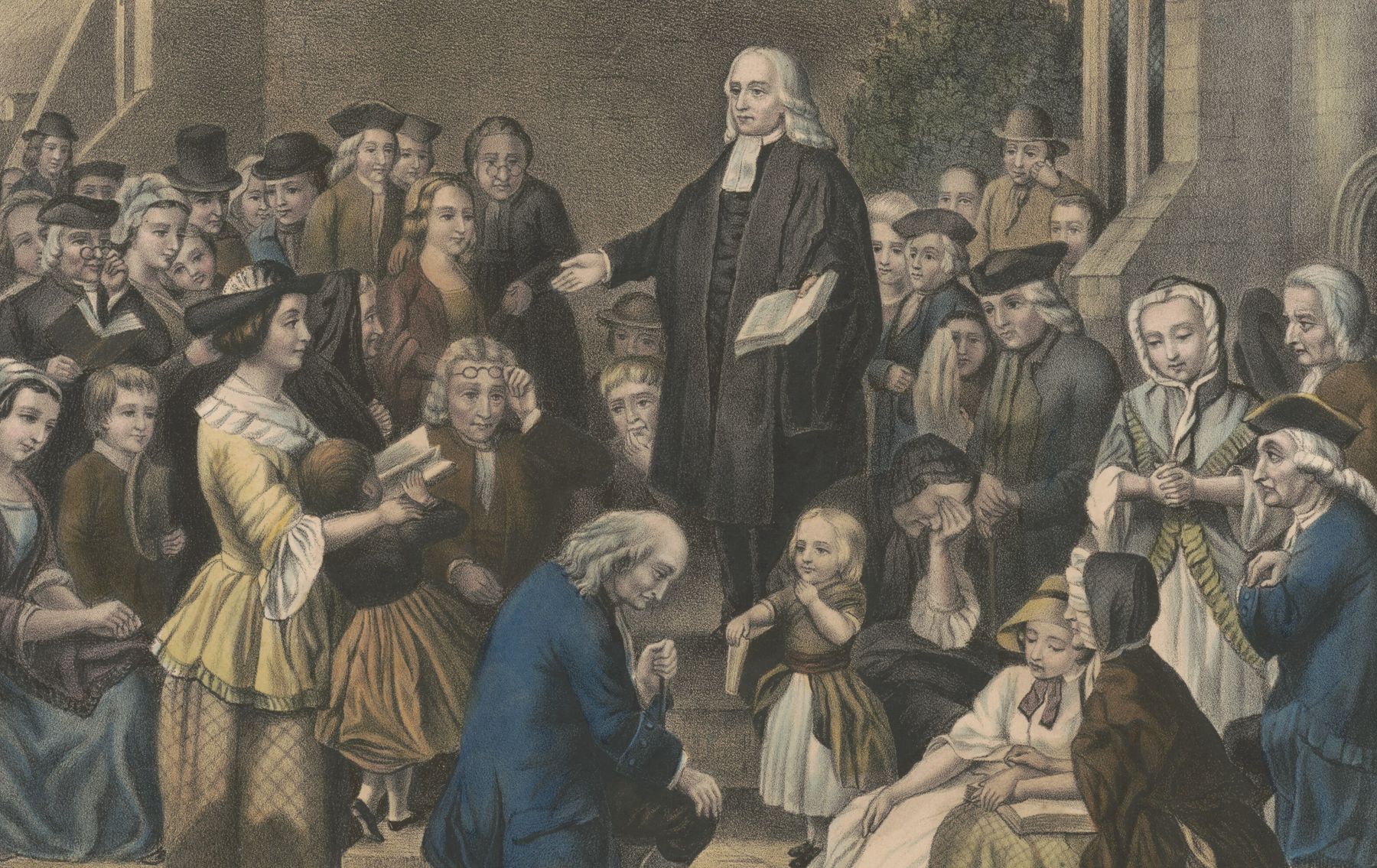
Picture: John Wesley Preaching on His Father’s Grave, Currier and Ives. Library of Congress, Washington.
Wesleyan / Methodist in a sentence
The churches that came from John Wesley, where grace is offered to every person and can be refused by every person. They keep a high view of communion, and a confidence that God really can make someone holy in this life.
Sacramental, firmly synergist, one-people-of-God
What marks it out
Grace sits at the synergist pole, synergism being the view that a person freely cooperates with the grace God gives. Wesley’s word for the first move is prevenient grace, which runs ahead of any decision and reaches everyone, so nobody can say they were never offered the chance. Then the person answers, and may say no, which is what Wesleyans mean when they insist on free will.
The Table reading will surprise anyone who has only met Methodism at its most informal. Wesley preached a sermon arguing that a Christian should receive communion as often as he possibly can, and over his life he communicated on average about once every four or five days. Methodists baptize infants and teach the Supper as a means of grace.
Authority reads as Scripture over tradition rather than Scripture alone: Scripture is the rule, and the creeds, the Articles of Religion and the church’s experience are consulted without being made equal to it. Methodists shorten this to Scripture, tradition, reason and experience, a phrase whose inventor later said he regretted coining, because people read it as four equal legs.
This is one of the few older Protestant traditions that never turned cessationist: Wesley argued the miraculous gifts faded not because the church had outgrown them but because Christians’ love had grown cold. Worship leans liturgical, with service books and a church year from the Church of England alongside extempore prayer and loud hymn singing.
The confidence about holiness has a name: entire sanctification, or Christian perfection. Wesley did not mean that a Christian stops making mistakes. He meant that love for God and neighbor can come to fill a person so completely that nothing is left competing for the heart, and that it is worth expecting in this life rather than at death. He gathered the case in A Plain Account of Christian Perfection, which traces his thinking back to 1725.
Did you know?
-
Wesley decided to go public against predestination by casting lots. In 1739 he drew twice over whether to preach his sermon Free Grace, and the lot came up “preach and print”. Whitefield begged him not to, asking “what will be the consequences but controversy?”, and the revival split in two.
Wesley’s Journal, April 1739; Whitefield to Wesley, 25 June and 2 July 1739.
-
American Methodism’s doctrinal standard is an edited Church of England. In 1784 Wesley cut the Thirty-Nine Articles down to twenty-four for the Americans, dropping predestination and anything peculiarly English; the Americans then added a twenty-fifth recognizing the government of the new United States.
Wesley’s Sunday Service (1784); the Twenty-Five Articles adopted at the Christmas Conference, Baltimore, 1784.
Where it came from
The Church of England is the parent: Wesley was an Anglican priest who never left, and who handed his American societies a prayer book and his own edit of the Articles. The children are many: the United Methodist Church and the bodies leaving it, the African Methodist Episcopal churches, the Church of the Nazarene, the Salvation Army. Pentecostalism is a grandchild.
Where it sits on all six questions
Your answers are marked. From your result on . See your result
In the hatched middle the quiz names neither pole.
Which traditions are closest?
Nearness is not agreement: two families can land in the same band for different reasons.
- Mainline Protestant (PCUSA / ELCA / UMC) Closest 79%match
- Anglican (broad) 74%match
- Eastern Orthodox 66%match
- Catholic (Roman and Eastern) 64%match
- Lutheran (confessional) 59%match
- Anabaptist / Mennonite (peace church) 49%match
Side by side
Three pages put this tradition next to another: what they share, where they part, and how it came to be.
What we read
Read to place this tradition
Wesley, "Free Grace" and "The Duty of Constant Communion"; Articles of Religion V, VIII, XVI-XVIII; UMC Book of Discipline (Scripture, tradition, reason, experience).
-
John Wesley, “The Duty of Constant Communion”
A few pages, drafted in his Oxford days, and the reason this tradition sits so far towards the sacramental end.
-
John Wesley, “Free Grace”
The 1739 sermon against predestination that split the revival, and the clearest statement of why grace reads as it does here.