Eastern Orthodox
- 6Axes
- 6Poles named
- 17Others
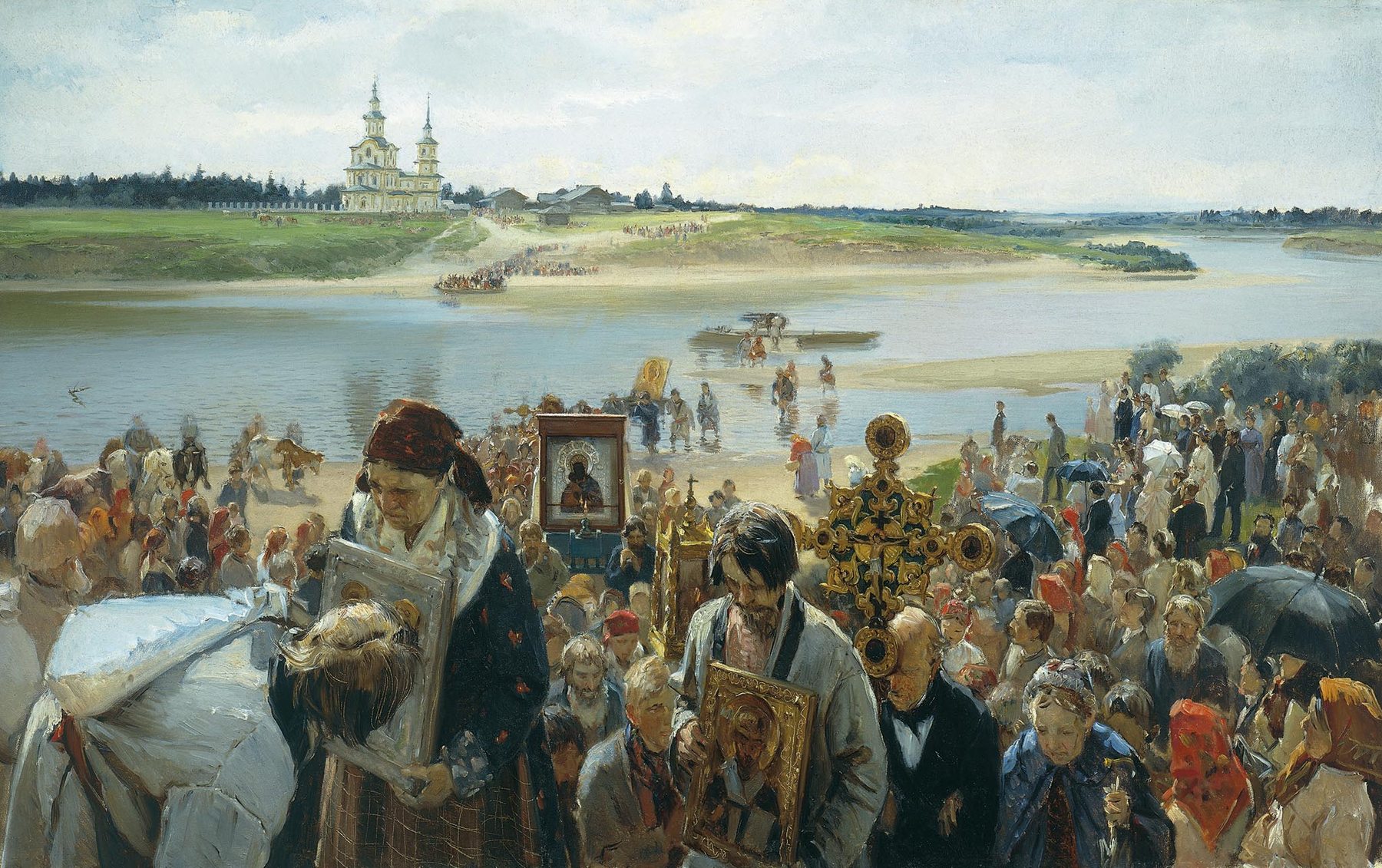
Picture: Religious Procession, Illarion Pryanishnikov, 1893. State Russian Museum, St Petersburg.
Eastern Orthodox in a sentence
The churches of the Christian East: one faith, in communion with one another but not with Rome, and led by bishops in council. Their worship has changed remarkably little since the first millennium.
Sacramental, rooted in Scripture and tradition, liturgical
What marks it out
Orthodoxy is a liturgy before it is a theology, and Orthodox writers say so first. The Divine Liturgy of St John Chrysostom is sung on most Sundays of the year from a fixed text, almost always unaccompanied, in a church covered with icons. Very little is chosen by the priest and nothing is projected on a screen. If you want to know what Orthodox Christians believe, the usual advice from inside is to come and stand through it.
The East’s word for how salvation works is synergy, from the Greek for working together, and it is not a compromise between two Western options: it predates the argument entirely. God’s grace does everything, and the person must genuinely cooperate with it. Behind that stands a larger claim called theosis, that salvation is not only forgiveness but real participation in the life of God. Athanasius put it in the fourth century: God became man so that man might become god, which means becoming by grace what God is by nature, not sharing His essence.
Scripture belongs to the church that produced it, and is read alongside the councils, the liturgy and the Fathers rather than against them. There are seven ecumenical councils; the seventh, at Nicaea in 787, settled that icons may be venerated, on the argument that God Himself took a body that could be painted. The Eucharist is the body and blood of Christ, and the Synod of Jerusalem in 1672 was willing to use a Greek word equivalent to transubstantiation while insisting that the how of it stays a mystery.
On the gifts of the Holy Spirit the sketch leans continuationist, because nothing in this tradition ever announced that God had stopped. Healings, miracles and holy people who see what others cannot are part of its ordinary expectation rather than a special movement within it.
Did you know?
-
The Great Schism has an end date almost nobody knows. The mutual excommunications of 1054 were lifted on 7 December 1965, when a joint declaration by Pope Paul VI and Patriarch Athenagoras I was read out at the same hour in Rome and in Istanbul, committing the sentences to oblivion. The two churches are still not in communion. The anathemas are gone.
Catholic-Orthodox Joint Declaration of Pope Paul VI and Patriarch Athenagoras I, 7 December 1965.
-
Orthodox babies receive communion. Baptism, chrismation (the anointing that became confirmation in the West) and first communion all happen at the same service whatever the age of the person baptized, and an infant is carried to the chalice every Sunday after that. The West did the same until about the twelfth century.
Eastern Orthodox practice; the Latin Church discontinued infant communion around the twelfth century.
-
The longer Liturgy of St Basil the Great is used exactly ten times a year: the five Sundays of Great Lent, Holy Thursday, Holy Saturday, the eves of Christmas and Theophany, and 1 January, which is St Basil’s own feast.
Byzantine rite: the Liturgy of St Basil is appointed ten times a year.
Where it came from
One half of the undivided church of the first thousand years. East and West drifted apart over centuries and broke communion in 1054, over the pope’s authority and over the filioque, a clause the West added to the Nicene Creed saying the Holy Spirit proceeds from the Son as well as from the Father. Orthodoxy today is a communion of self-governing churches, Greek, Russian, Serbian, Romanian, Antiochian and more, with the Ecumenical Patriarch of Constantinople first in honor rather than in command. The Oriental Orthodox churches, which parted earlier still, are a separate communion.
Where it sits on all six questions
Your answers are marked. From your result on . See your result
In the hatched middle the quiz names neither pole.
Which traditions are closest?
Nearness is not agreement: two families can land in the same band for different reasons.
- Catholic (Roman and Eastern) Closest 91%match
- Wesleyan / Methodist 66%match
- Mainline Protestant (PCUSA / ELCA / UMC) 65%match
- Anglican (broad) 60%match
- Lutheran (confessional) 40%match
- Anabaptist / Mennonite (peace church) 27%match
Side by side
One page puts this tradition next to another: what they share, where they part, and how it came to be.
What we read
Read to place this tradition
Synod of Jerusalem (1672), Decrees 3 and 15-17; John of Damascus, On the Orthodox Faith IV.9 and IV.13; the Divine Liturgy of St John Chrysostom; Seventh Ecumenical Council.
-
The Divine Liturgy of St John Chrysostom
The text itself, online in full. Reading it straight through is the fastest way to meet Orthodoxy from the inside.
-
John of Damascus, An Exact Exposition of the Orthodox Faith
Eighth century, and still the standard summary. Book IV, chapters 9 and 13, are baptism and the Eucharist.